The work’s title came before the work. I had been thinking about what gets lost in transmission: the aulos's perished reeds, the signal reduced to features, the sound that arrives changed. The word »elision« kept returning. Spoken aloud, it hovers near »ear illusions,« a phonetic slippage that points toward the perceptual instabilities the work would come to explore: Synthetic sound, phantom spectra, an ancient instrument's capacity to deceive and possess.
I looked up the etymology. »Elision« derives from the Latin elidere: to strike out, to crush, from e- (out) + laedere (to strike, to damage). In everyday speech it names the omission of a sound or syllable when speaking, as for example with the contractions »I'm,« or »let's« that smooth language at the cost of completeness. But there is a second meaning: the process of joining together or merging things, especially abstract ideas. The word holds both operations at once. Something is struck out so that something else can merge and flow.
The title unfolds this gesture into three operations:
Subtraction: what gets removed. The aulos's unique »crushed« double reed, the vibrating element that produced its sound, perished centuries ago. No complete instrument survives intact. Machine listening performs its own subtractions, extracting features while discarding what its parameters cannot capture.
Slippage: what drifts in transmission. The signal arrives transformed, still carrying information but no longer identical to its source. The aulos occupied an unstable position in the cultures of ancient Greece and beyond. Music that threatened to become noise. Human sound that approached the non-human.
Refraction: what bends through passage. The aulos's spectral signature, folded into numerical data, gives rise to synthetic forms through nUPIC, a rebuilt version of Xenakis's graphical sound system. And when dense timbral combinations enter the cochlea, phantom frequencies emerge at angles to the source. The ear refracts what it receives into what was never played.
At the core of the work is a loop: analysis and resynthesis. Sound enters the machine, is broken into features, reduced to numerical representation; from that representation, new sound is generated. But what emerges is not what entered. Each passage through the system transforms. Media archaeology teaches that no transmission is neutral: every medium leaves its signature on what passes through.1 I wanted to make this signature audible.
Three ears operate across these registers. The machine ear subtracts. The human ear is where sound slips. The cochlear ear refracts. Each is designed: built or evolved to attend to certain features and discard others. The work lives in the gaps between them, in what each strikes out, in what each opens up.
What follows is an account of »Oto Aulos,« a composition for aulos and computer that I am developing with performer Lukas de Clerck. The work combines de Clerck's Telescopic Aulos (an instrument of his own invention, derived from ancient Greek sources but transformed into something speculative and contemporary) with machine listening, pluriphonic synthetic sound, graphical synthesis, and techniques that extend the composition into the listener's ear. This text traces the research, the technical systems, and the conceptual questions that have shaped the collaboration.
The Ancient Instrument
I came to the aulos through Lukas de Clerck’s release, The Telescopic Aulos of Atlas. I heard him play before I knew what to make of it. The dense beating of two pipes. The hissing and roaring that seemed to exceed the instrument itself. The sense that something was sounding beyond what his breath and hands produced. Only later, searching for a framework, did I find Sean Alexander Gurd's Dissonance: Auditory Aesthetics in Ancient Greece and a story from the book I kept returning to.2
Delphi, 586 BCE. The Pythian Games include, for the first time, a musical competition. The aulete Sacadas of Argos performs a solo composition, the Pythian nome, depicting Apollo's battle with the serpent Python. At its climax, the moment of the serpent's death, Sacadas did not play a melody. He produced a hissing sound. The technique was called syrigmos, and it exploited the aulos's capacity for sounds beyond stable pitch. Squeaks, roars, breath noise, the acoustic turbulence of an overblown reed or a partially stopped finger hole.3
The dying monster's voice, rendered in timbre rather than tone.
The Telescopic Aulos of Atlas, by Lukas De Clerck
The Telescopic Aulos of Atlas, by Lukas De Clerck
What struck me was the audacity of the gesture. Technical innovation and aesthetic provocation at once. Sacadas moved the aulos to the centre of 6th-century art music by demonstrating its capacity to represent what pitched melody could not. The syrigmos was not music in the conventional sense. It was sound design, mimetic noise, the incorporation of the extra-musical into compositional structure.
The aulos was a double-pipe, double-reed wind instrument central to ancient Greek sonic culture.4 Two pipes held simultaneously, each fitted with a reed, both sounding at once. The player's breath, sustained through circular breathing techniques, produced drones and melodies that intertwined, separated, converged. The acoustic result was dense, beating, rich in combination tones.
The instrument held a peculiar cultural position. Ubiquitous yet suspect. Associated with states of possession, with Dionysian ritual, with the dissolution of rational self-control.5 The Greeks required and mistrusted the aulos in equal measure. The myths they constructed around it (Athena discarding the pipes that distorted her face, Marsyas flayed for challenging Apollo) functioned as regulatory mechanisms. Stories told to contain what the instrument unleashed.6
Reading Gurd, I started to see the syrigmos differently. Not as an isolated technique but as a site where Greek anxieties about sound concentrated. His distinction between »euphonia« (ordered, harmonious sound) and »cacophonia« (disruptive noise) gave me a framework.7 The aulos occupied the boundary between these categories. What Sacadas discovered was a technique for making that boundary compositionally productive.
But what did the aulos actually sound like? The wooden Louvre aulos dominates the scholarship: bore profiles, finger hole positions, probable pitches can be calculated.8 Bone instruments and bronze mechanisms survive but remain largely unstudied. Yet every surviving instrument lacks the element that produced its sound. The reeds were made from cane or oat straw — ancient Egyptian pipes were found with spare oat straws in their cases — and did not survive the centuries. The timbre, the attack, the capacity for the syrigmos: these were functions of reed construction and embouchure. Knowledge that lived in bodies and plants. Not recoverable from physical remains.
The incompleteness is not merely negative. It opens a space for speculation, for new forms of engagement with the past. The gap becomes productive terrain.
The Telescopic Aulos
Today, Lukas de Clerck does not play a reconstruction. He plays the Telescopic Aulos of Atlas, an instrument of his own invention, derived from ancient vase paintings and archaeological inference, but transformed into something speculative and contemporary.9
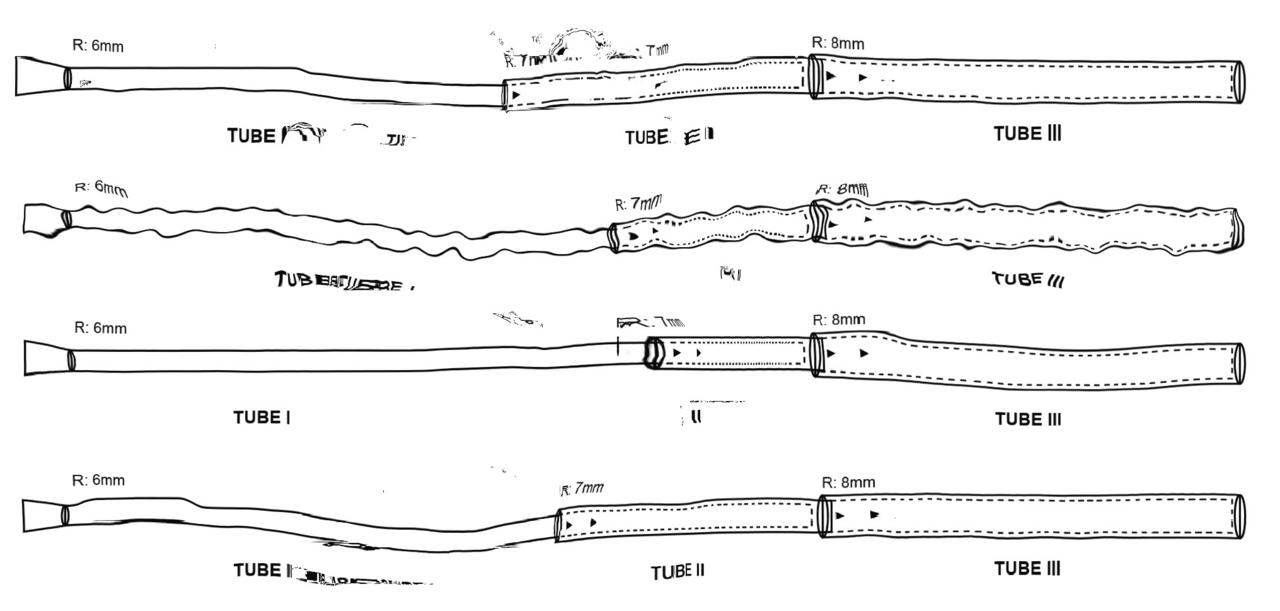
De Clerck uses metal tubes instead of bone or wood. There are no finger holes: each pipe consists of three sections that slide into one another, changing pitch through telescopic extension (Fig. 1). A phorbeia helps stabilise the embouchure while both hands manage the sliding pipes. The instrument was constructed by the collective Noir Métal at Brasserie Atlas in Brussels, a former brewery where de Clerck lived and worked. It is, as he notes, »a poetic coincidence that the birthplace of the instrument is named after the Greek titan condemned to carry the sky.«10

The formulation of de Clerck's is precise: »Instead of conserving what is found, he invents what is not.«11 His practice operates at the threshold between archaeomusicology and instrument design. Like Harry Partch building instruments for an imagined music — a 43-tone just intonation that did not yet exist — de Clerck constructs toward a sound world rather than reconstructing one. The Telescopic Aulos is not a replica but a response, taking the aulos's double-pipe morphology, its reed-driven sound production, its capacity for microtonality, and asking: what else might it become?
The reeds remain central. De Clerck makes them himself from a cane (Fig. 2). »The reeds are the core, the sound source. They behave like two oscillators, bending high-pitched notes into beatings. The pipes are a context, a channel for the sound. They create a narrative.«12 An analogue synthesizer avant la lettre. The analysis-resynthesis loop doesn't translate the aulos into synthesis. It finds the synthesis already there.

What emerges is not recovery but invention grounded in research. Sound that might bear some relation to what was heard in ancient Delphi or Athens. Or might not. The uncertainty is not a problem to be solved. It is the condition of the work, and the starting point for collaboration. Here the analysis-resynthesis loop begins.
Analysis and Synthesis
Applied to the aulos signal, conventional machine listening simply failed. The pitch-tracking algorithms returned noise. The onset detectors fired continuously or not at all. The spectral analysis fragmented into chaos. It took time to see what was happening: the system was working correctly. It was the assumptions about what the aulos was doing that were wrong.
Standard audio feature extraction is designed around assumptions of pitched, harmonic, tonal material. In other words, for euphonia, ordered sound.13 But the aulos operates precisely where these tools fail. Overblown reeds produce chaotic spectra without stable partials. Breath noise distributes energy across frequency bands without harmonic structure. The beating between two pipes generates interference patterns that confuse monophonic assumptions. Standard machine listening subtracts exactly what made the aulos distinctive. The noise is not residue to be filtered out. It was compositional material.
What does it mean to design an ear? Every machine listening system embeds assumptions about what matters in sound. The choice of which features to extract is already a decision about what counts as signal and what gets discarded as noise.14 Designing an ear for the aulos meant inverting these assumptions; treating spectral instability as information rather than interference.
I rebuilt the system with different priorities. Spectral flux: variation of spectrum over time. Inharmonicity: departure from harmonic frequencies. Noisiness: proportion of non-harmonic energy.15 These descriptors attend to what pitch-centric analysis discards. Timbral volatility, spectral turbulence, the micro-fluctuations of a reed in unstable vibration. These features become data; the data drives synthesis, not one stream but many, branching into simultaneous domains. Analysis flows into resynthesis, but what emerges is not reproduction. It is transformation: the aulos signal, passed through the computational ear, rendered into new sonic forms that proliferate from a single source.
In 2018, at the ZKM | Center for Art and Media Karlsruhe symposium, »From Xenakis's UPIC to Graphic Notation Today,« I met the engineers Guy Médigue and Alain Després, two of the original builders of the UPIC system at Paris’ CEMAMu (Centre d'Etudes de Mathématique et Automatique Musicales) in the 1970s.16 The encounter was a form of transmission. Not documentation, but direct contact with knowledge that had lived in practice. The UPIC is a digitised tablet tool that allows composers to draw sound directly. A stylus on a digitising tablet traces shapes that become frequency trajectories over time. But beneath the apparent immediacy lies a layer of compositional abstraction. Arcs (frequency trajectories), envelopes (amplitude shapes), wavetables (oscillator waveforms). The drawn gesture becomes a data structure; the synthesis engine interpreted it to produce audio.17
nUPIC, my rebuilt version implemented in SuperCollider, maintains this tripartite architecture but extends it.18 Where the original UPIC received input from a drawing tablet, nUPIC receives input from analysis and from code. The system uses SuperCollider's Just-In-Time library, integrating text into the compositional and performance process (Fig. 3). The machine listening system generates numerical streams that populate these abstractions. Spectral profiles become wavetables carrying the instrument's harmonic signature. Timbral trajectories become arcs. Dynamic contours become envelopes. Spatial parameters become panning curves across a multichannel array. Hand, algorithm, text: three entry points into a shared synthesis architecture.
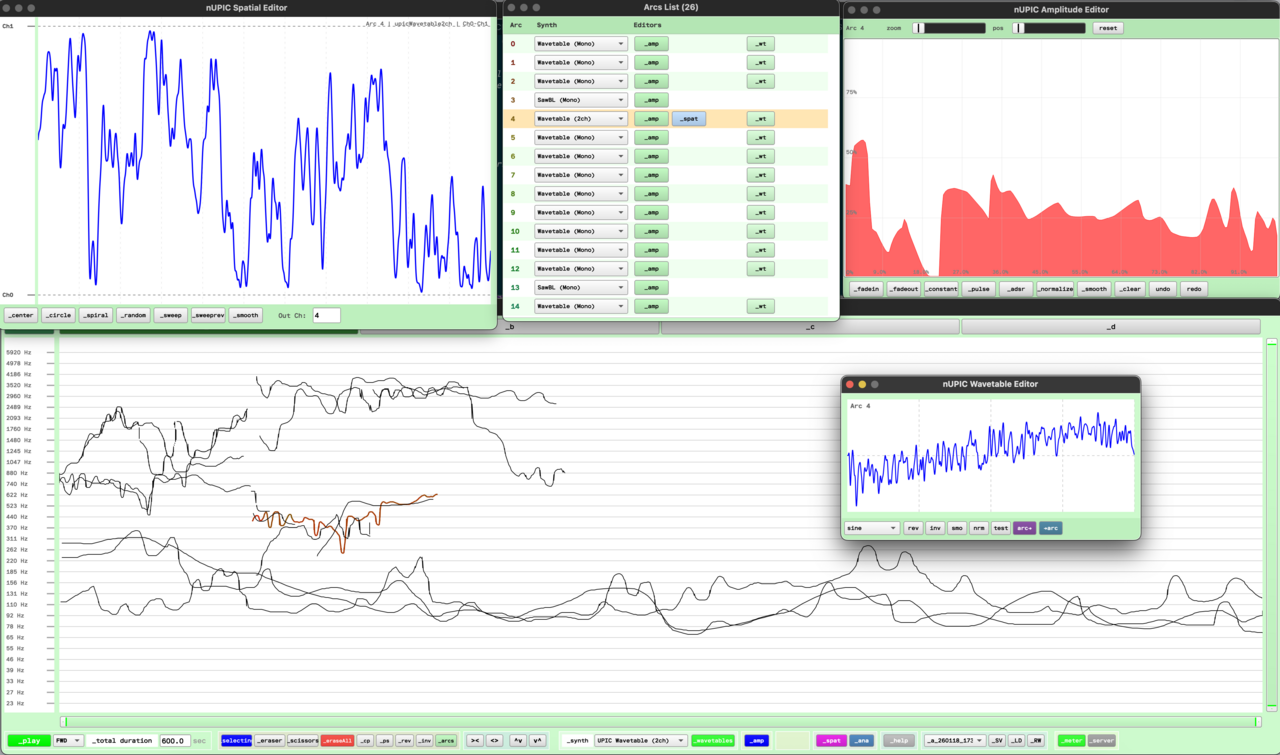
Xenakis called this principle of branching »arborescence;« a generative process in which a single line proliferates into multiple offshoots, like a tree growing from its trunk.19 In nUPIC, I extend this to the analysis-resynthesis loop. One source, the aulos signal analysed and rendered numerical, gives rise to several simultaneous synthesis domains. The spectral centroid drives arc frequency while spectral flux modulates wavetable position and noisiness shapes spatial spread. The branches transform the source differentially, each parameter following its own trajectory. The aulos as trunk, the synthesis parameters as branches.
What emerges is neither the aulos nor a representation of the aulos. It is a synthetic derivative. Sound that would not exist without the aulos as source, but that the aulos itself could never produce. The loop does not close; it spirals.
The Phantom Ear
The machine listens. I listen. But there is a third ear, one that produces what it does not receive.
I came to the literature on combination tones through Maryanne Amacher's liner notes. Her phrase »third ear music« stuck with me before I understood what it meant.20 Later, Christopher Haworth's work deepened my thinking. His 2023 release Auditory Distortion Synthesis demonstrated what it might mean to compose with sounds generated within the listener's ear.21 Haworth's writing on distortion product otoacoustic emissions (sounds the ear not only generates but actually emits back into the world) reframed my understanding of what listening is and does.
In the mid-18th century, the violinist Giuseppe Tartini noticed that when he played two high notes loudly, a third tone appeared. Lower than either of the originals, clearly audible, yet not produced by the instrument.22 A century later, Helmholtz identified these as products of auditory distortion, sounds generated in the ear itself.23 We now understand the mechanism more precisely. When pairs of frequencies stimulate the cochlea, the nonlinear response of outer hair cells generates distortion products. The most prominent is the quadratic difference tone: if frequencies f₁ and f₂ stimulate the ear, the cochlea generates a tone at f₂ minus f₁. The tone is real. It activates auditory nerve fibres. But it is not in the room. It is in the ear.
Extending earlier research on auditory distortion, Cádiz, Gutiérrez, and Haworth developed quadratic difference tone spectrum synthesis (QDTS): a method for calculating carrier signals that evoke entire harmonic series of distortion products.24 The acoustic signal is designed to trigger a target spectrum generated within the listener's auditory system. I have implemented their algorithm in SuperCollider.25
For the Oto Aulos project, this opens a third register of listening. The aulos was always, in a sense, an instrument for triggering cochlear distortion. Its dense spectra, its capacity for sustained beating, its timbral volatility: all tend toward phantom frequencies. The syrigmos itself may have activated distortion products that contributed to the instrument's overwhelming, possession-inducing effect.
The synthesis system extends beyond nUPIC into this second domain. Where the machine listening attends to noise and spectral flux, the QDTS pathway employs conventional spectral analysis, waiting for sustained portions when both pipes sound together, extracting fundamentals and partials. This information drives synthesis that evokes phantom spectra in each listener's ear.
Spatialisation operates distinctly here. The multichannel array distributes sound across the performance space. Sound that can be localised, that moves through architectural acoustics. But phantom frequencies appear without a clear spatial position. Some seem to originate inside the head; others hover at the threshold of the body, oscillating close to the ear as if the sound were breathing at the boundary between self and environment.26 The interplay creates perceptual instability. The work oscillates between external and internal. Between sound that surrounds, sound that inhabits, and sound that approaches without arriving.
Coda: The Flayed Instrument
The myths tell us what the culture feared. Athena invents the aulos, then discards it when she sees her reflection. Cheeks distorted, face transformed. Marsyas retrieves the pipes, masters them, and challenges Apollo to a contest. He loses. Apollo flays him alive.27
These are not celebratory narratives. They are warnings. The aulos appears as a technology that exceeds its user, that blurs the boundary between human and non-human sound. The syrigmos was dangerous precisely because it worked. It dissolved the distance between sign and referent, between controlled expression and ecstatic possession.28
I think about these myths differently now, after years working with machine listening systems. The anxieties they encode (technologies that hear and produce sound in ways exceeding human intention, mimetic capacities that blur the line between authentic and synthetic) are not unfamiliar. We tell similar stories about different instruments.
The reeds vibrated according to their own physics; the beating between pipes generated interference patterns no single intention could determine; cochlear distortion products emerge in each listener's ear without the performer's knowledge. Marsyas played, but something else sounded. The instrument exceeded its operator.
What de Clerck and I are building is not reconstruction. It is not an attempt to recover what was lost. The Telescopic Aulos is an invention, not a replica. The composition we have created with the Telescopic Aulos and machine synthesis is titled Oto Aulos: ear-pipes, from the Greek ὠτός (otos), ear. The name folds the listening organ into the instrument. It acknowledges that the work does not end at the loudspeaker cone. The ear is not a passive receiver; it is part of the sounding apparatus. What the cochlea contributes (its phantom frequencies, its physiological refractions) belongs to the composition as much as what de Clerck plays or what the synthesis system generates.
The listener in the performance space hears the Telescopic Aulos. Its acoustic presence, breath and reed and metal. They hear what emerges from the synthesis system, spatialised, transformed, distributed across the array. And they hear what their own ears produce, the phantom frequencies generated physiologically within the ear itself. These do not arrive as separate streams. They fuse – ancient instrument, computational transformation, and cochlear production converging in an experience that cannot be cleanly parsed into its sources.
The aulos was an instrument of possession. The ancient sources agree on this even when they agree on little else. It overwhelmed; it dissolved boundaries; it produced states that exceeded rational control.
The work is not to recover the sound but to reactivate the problem it posed. What happens when an instrument exceeds its player? When a listening system hears what its designer cannot predict? When the ear produces what it does not receive?
The questions remain open. The sound begins.
Marcin Pietruszewski is a composer and researcher working at the intersection of computational listening, sound synthesis, and media archaeology. He teaches at Bauhaus-Universität Weimar and has contributed writing to The SuperCollider Book 2 and a chapter on Xenakis's UPIC system published by ZKM and Hatje Cantz. His work has been presented at La Biennale di Venezia, ZKM Karlsruhe, CTM Festival, and Sonic Acts.
The author wishes to thank Lukas De Clerck and Taïca Replansky for their invaluable comments on the early draft of the text.
This text was commissioned as part of CTM 2026 »dissonate resonate.«
- 1
On media archaeology and the non-neutrality of transmission, see Wolfgang Ernst, Digital Memory and the Archive, ed. Jussi Parikka (Minneapolis: University of Minnesota Press, 2013); and Jussi Parikka, What Is Media Archaeology? (Cambridge: Polity Press, 2012).
- 2
Sean Alexander Gurd, Dissonance: Auditory Aesthetics in Ancient Greece (New York: Fordham University Press, 2016), 97–99. The Pythian nome is described in pseudo-Plutarch, De Musica 1133c–1134a.
- 3
On the syrigmos, see Gurd, Dissonance, 98–99; Martin L. West, Ancient Greek Music (Oxford: Clarendon Press, 1992), 105–6.
- 4
For comprehensive accounts of the aulos, see West, Ancient Greek Music, 81–109; Stefan Hagel, Ancient Greek Music: A New Technical History (Cambridge: Cambridge University Press, 2009), 327–84.
- 5
Peter Wilson, »The Aulos in Athens,« in Performance Culture and Athenian Democracy, ed. Simon Goldhill and Robin Osborne (Cambridge: Cambridge University Press, 1999), 58–95.
- 6
On the Athena-Marsyas myth and its regulatory function, see Gurd, Dissonance, 77–96.
- 7
Gurd, Dissonance, 96–114.
- 8
West, Ancient Greek Music, 83–84, 97–98. On specific instruments, see Stefan Hagel, »Understanding the Aulos Berlin Egyptian Museum 12461/12462,« in Studien zur Musikarchäologie VI, ed. Ellen Hickmann, Arnd Adje Both, and Ricardo Eichmann (Rahden: Marie Leidorf, 2008), 67–106; Stelios Psaroudakes, »The Aulos of Poseidonia,« Greek and Roman Musical Studies 2 (2014): 117–49.
- 9
On the Telescopic Aulos of Atlas, see the liner notes to Lukas De Clerck, The Telescopic Aulos of Atlas (Ideologic Organ, 2024). Available at lukasdeclerck.bandcamp.com/album/the-telescopic-aulos-of-atlas.
- 10
De Clerck, liner notes to The Telescopic Aulos of Atlas.
- 11
Lukas De Clerck, artist statement, lukasdeclerck.com/Info.
- 12
De Clerck, liner notes to The Telescopic Aulos of Atlas.
- 13
On the assumptions embedded in standard audio feature extraction, see Alexander Lerch, An Introduction to Audio Content Analysis, 2nd ed. (Hoboken, NJ: Wiley, 2022); Michael A. Casey et al., »Content-Based Music Information Retrieval,« Proceedings of the IEEE 96, no. 4 (2008): 668–96.
- 14
On the epistemological implications of feature selection, see Jonathan Sterne, MP3: The Meaning of a Format (Durham, NC: Duke University Press, 2012).
- 15
Geoffroy Peeters et al., »The Timbre Toolbox: Extracting Audio Descriptors from Musical Signals,« Journal of the Acoustical Society of America 130, no. 5 (2011): 2902–16.
- 16
The symposium proceedings were published as Peter Weibel, Ludger Brümmer, and Sharon Kanach, eds., From Xenakis's UPIC to Graphic Notation Today (Karlsruhe: ZKM; Ostfildern: Hatje Cantz, 2020).
- 17
On the UPIC's architecture, see Peter Hoffmann, »Music Out of Nothing?« (PhD diss., Technische Universität Berlin, 2009); Makis Solomos, »Xenakis and the UPIC,« in Weibel, Brümmer, and Kanach, 89–102.
- 18
nUPIC source code: https://www.marcinpietruszewski.com/research-nupic.
- 19
Bálint András Varga, Conversations with Iannis Xenakis (London: Faber and Faber, 1996), 88.
- 20
Maryanne Amacher, liner notes to Sound Characters (Making the Third Ear) (New York: Tzadik, 1999).
- 21
Christopher Haworth, Auditory Distortion Synthesis (Superpang, 2023), with accompanying essay.
- 22
Giuseppe Tartini, Trattato di musica secondo la vera scienza dell'armonia (Padua: Stamperia del Seminario, 1754).
- 23
Hermann von Helmholtz, On the Sensations of Tone, trans. Alexander J. Ellis (London: Longmans, Green, 1885; repr., New York: Dover, 1954).
- 24
Gary S. Kendall, Christopher Haworth, and Rodrigo F. Cádiz, »Sound Synthesis with Auditory Distortion Products,« Computer Music Journal 38, no. 4 (2014): 5–23. Esteban Gutiérrez, Christopher Haworth, and Rodrigo F. Cádiz, »Generating Sonic Phantoms with Quadratic Difference Tone Spectrum Synthesis,« Computer Music Journal 47, no. 3 (2023): 19–34. Original implementation: github.com/cordutie/QDTS.
- 25
My SuperCollider implementation: github.com/mpietrus00/QDTS_SC.
- 26
On the spatial properties of auditory distortion products, see Kendall, Haworth, and Cádiz, »Sound Synthesis with Auditory Distortion Products,« 18–20.
- 27
For the discarding of the aulos, see Pindar, Pythian 12; for the flaying, Ovid, Metamorphoses 6.382–400. On the myth's cultural function, see Gurd, Dissonance, 77–96.
- 28
Gurd, Dissonance, 96–114.
Bibliography
Amacher, Maryanne. Liner notes to Sound Characters (Making the Third Ear). New York: Tzadik, 1999.
Casey, Michael A., Remco Veltkamp, Masataka Goto, Marc Leman, Christophe Rhodes, and Malcolm Slaney. »Content-Based Music Information Retrieval: Current Directions and Future Challenges.« Proceedings of the IEEE 96, no. 4 (2008): 668–96.
De Clerck, Lukas. The Telescopic Aulos of Atlas. Ideologic Organ, 2024. https://lukasdeclerck.bandcamp.com/album/the-telescopic-aulos-of-atlas.
Ernst, Wolfgang. Digital Memory and the Archive. Edited by Jussi Parikka. Minneapolis: University of Minnesota Press, 2013.
Goldstein, Julius L. »Auditory Nonlinearity.« Journal of the Acoustical Society of America 41, no. 3 (1967): 676–99.
Gurd, Sean Alexander. Dissonance: Auditory Aesthetics in Ancient Greece. New York: Fordham University Press, 2016.
Gutiérrez, Esteban, Christopher Haworth, and Rodrigo F. Cádiz. »Generating Sonic Phantoms with Quadratic Difference Tone Spectrum Synthesis.« Computer Music Journal 47, no. 3 (2023): 19–34.
Hagel, Stefan. Ancient Greek Music: A New Technical History. Cambridge: Cambridge University Press, 2009.
Hagel, Stefan. »Understanding the Aulos Berlin Egyptian Museum 12461/12462.« In Studien zur Musikarchäologie VI, edited by Ellen Hickmann, Arnd Adje Both, and Ricardo Eichmann, 67–106. Rahden: Marie Leidorf, 2008.
Haworth, Christopher. Auditory Distortion Synthesis. Superpang, 2023.
Helmholtz, Hermann von. On the Sensations of Tone as a Physiological Basis for the Theory of Music. Translated by Alexander J. Ellis. London: Longmans, Green, 1885. Reprint, New York: Dover, 1954.
Hoffmann, Peter. »Music Out of Nothing? A Rigorous Approach to Algorithmic Composition by Iannis Xenakis.« PhD diss., Technische Universität Berlin, 2009.
Kendall, Gary S., Christopher Haworth, and Rodrigo F. Cádiz. »Sound Synthesis with Auditory Distortion Products.« Computer Music Journal 38, no. 4 (2014): 5–23.
Lerch, Alexander. An Introduction to Audio Content Analysis. 2nd ed. Hoboken, NJ: Wiley, 2022.
Ovid. Metamorphoses. Translated by Frank Justus Miller. Revised by G. P. Goold. Loeb Classical Library. Cambridge, MA: Harvard University Press, 1916.
Partch, Harry. Genesis of a Music: An Account of a Creative Work, Its Roots, and Its Fulfillments. 2nd ed. New York: Da Capo Press, 1974.
Parikka, Jussi. What Is Media Archaeology? Cambridge: Polity Press, 2012.
Peeters, Geoffroy, Bruno L. Giordano, Patrick Susini, Nicolas Misdariis, and Stephen McAdams. »The Timbre Toolbox: Extracting Audio Descriptors from Musical Signals.« Journal of the Acoustical Society of America 130, no. 5 (2011): 2902–16.
Pindar. Olympian Odes. Pythian Odes. Edited and translated by William H. Race. Loeb Classical Library. Cambridge, MA: Harvard University Press, 1997.
Psaroudakes, Stelios. »The Aulos of Poseidonia.« Greek and Roman Musical Studies 2 (2014): 117–49.
Pseudo-Plutarch. De Musica. In Plutarch's Moralia, vol. 14, translated by Benedict Einarson and Phillip H. De Lacy. Loeb Classical Library. Cambridge, MA: Harvard University Press, 1967.
Solomos, Makis. »Xenakis and the UPIC.« In From Xenakis's UPIC to Graphic Notation Today, edited by Peter Weibel, Ludger Brümmer, and Sharon Kanach, 89–102. Karlsruhe: ZKM; Ostfildern: Hatje Cantz, 2020.
Sterne, Jonathan. MP3: The Meaning of a Format. Durham, NC: Duke University Press, 2012.
Tartini, Giuseppe. Trattato di musica secondo la vera scienza dell'armonia. Padua: Stamperia del Seminario, 1754.
Varga, Bálint András. Conversations with Iannis Xenakis. London: Faber and Faber, 1996.
Weibel, Peter, Ludger Brümmer, and Sharon Kanach, eds. From Xenakis's UPIC to Graphic Notation Today. Karlsruhe: ZKM; Ostfildern: Hatje Cantz, 2020.
West, Martin L. Ancient Greek Music. Oxford: Clarendon Press, 1992.
Wilson, Peter. »The Aulos in Athens.« In Performance Culture and Athenian Democracy, edited by Simon Goldhill and Robin Osborne, 58–95. Cambridge: Cambridge University Press, 1999.