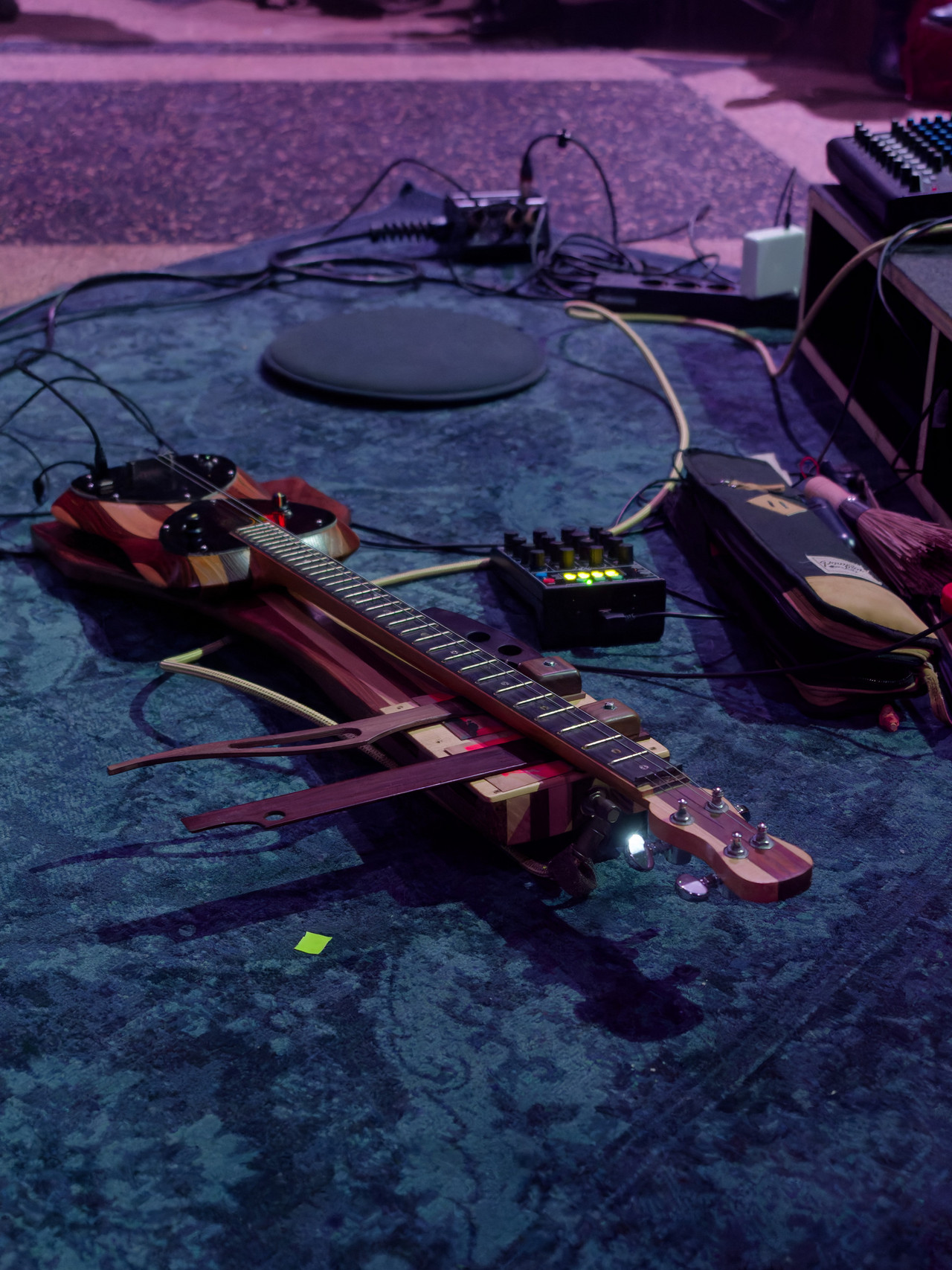
The artistic fellows will be working during the festival week at radialsystem studios. They will present their current solo work in short, public presentations on Tuesday 27 January 2026, and share insights into some of the ideas, processes and conversations explored during the week at a roundtable discussion on the festival’s closing Sunday 1 February. During CTM Festival week, numerous other concerts and inputs will also complement the lab’s theme, including new premiere works by Sote, CORIN, and Marcin Pietruszewski with Lucas de Clerck.
Fellows 2026
Bint Mbareh is a Palestinian artist working in folkloric research and resurgence. For them, research into the less tangible (magical, metaphysical) potentials of culture must be done as embodied practice in community between people subjected to extreme structural violence in order to imagine what clues such practices can give us for the future. Amro’s motivation in researching and practicing traditions and rituals, such as the rain-summoning music that has been a focus of her work seeks the liberatory potentials of traditions. Since the last two years, she has also been more intensively navigating questions of Palestinian agency, ossification and instrumentalisation of narratives around identity and the traditional.
Dorothy Carlos employs electronics and a wide spectrum of extended techniques to push the cello beyond the confines of the classical tradition. Her earliest musical education came through communal fiddle and folk traditions of the American South, which have deeply shaped her sense of musical possibility. What happens when the outline of an Appalachian fiddle tune meets digital delay or glitch? How can the idioms of folk improvisation dialogue with experimental compositional and performance practices?
Maarja Nuut has been exploring archival Estonian sounds, dances, and texts, with a special interest in how landscape and environment shape these. Nuut’s practice is at once personal, sourcing stories and impressions from family history and current experience, as much as rooted in field recordings from the environment and culture in which her family has been based over generations. As she dives more deeply into sound synthesis, improvisation, and experimentation with participatory practice as a way to bring archetypal stories and abstract thought into tangible experience, her relationship with the traditional has become more dynamic, questioning what is chosen to be preserved, and what preservation means.
Marina Tantanozi combines the bassflute, voice, inside-flute amplifications, and effects in her search for a language of her own. Through decomposing-recomposing rhythms, structures, and melodic elements, she explores how to integrate with the traditional in a radical and authentic way. Her work, grounded in a tactile approach to sound, investigates universality and fragility, and seeks deeper ways to explore already established structures and forms.
The artistic practice of Miłosz Kędra is deeply rooted in ritual, structure, and sensibility that stems from a conservative Catholic upbringing. Often finding it difficult to express aspects of their experience through art, they are interested in expanding the imagination around practices of queering. Their current work focuses on the pipe organ, transporting the instrument’s sound beyond the church by synthetically processing its tones and bringing in other sounds and techniques.
Also seeking to widen the possibilities of his instrument is Saba Alizadeh*, a kamancheh player who bridges Persian musical traditions with experimental sound practices, often incorporating archival, historical, and political recordings in a neo musique concrète approach. He is currently interested in augmenting his instrument while also continuing to deepen his knowledge of the texts and philosophies behind his work.
Varoujan Chetirian has been navigating the shifting planes of identity and belonging, as part of the Armenian diaspora in Europe. For him, the feeling of connection to an ancestral homeland is strengthened by music, literature, poetry, rather than a house with trees and a garden. Immersed in studies of electroacoustic music and sound art in Europe and Berlin, he has at the same time become more active in Armenia, building bridges towards the country of his childhood. Within the lab, he is interested in weaving together his schooling in the European avant-garde and the traditional Armenian sounds he had grown up with, while also exploring how this is shifted through a diasporic lens.
*Update 21.1.2026: Please note that Saba Alizadeh is unable to attend the lab and wishes to share the following statement: »In light of the recent devastating events in Iran and the personal loss of a family member, I regret that I do not presently have the emotional or physical capacity to join CTM’s wonderful community. I apologize for any inconvenience this may cause.«
About the lab
Resynthesising the Traditional is a multi-year thematic thread that dives into questions on the traditional. When does something become a tradition? Who defines it, who belongs within it, and why? How do traditions remain recognisable? When do they change into something completely new? How are traditions governed? What are their restrictions, why do these exist, who breaks them, and why? How can we work with the repeated flattening of histories to suit dominant voices, instead finding echoes of buried pluralities within the traditional? These are only some of the questions that motivate this thematic line of inquiry.
At the heart of this thematic thread is the namesake artistic lab, which is designed as an open toolbox for artists exploring how to (re)connect to »the traditional,«, and is intended to help them navigate their practice outside of (self-)exoticisation and the uneven power dynamics created by mass-cultural and other stereotypes. Evoking resynthesis – a processing method in computer music that analyzes sounds to extract their fundamental components – as a guiding metaphor, the lab also invites participants to confront conservative views of culture as something frozen, thus resistant to any transformative practices.