CTM 2026 Lab

26 January – 1 February 2026

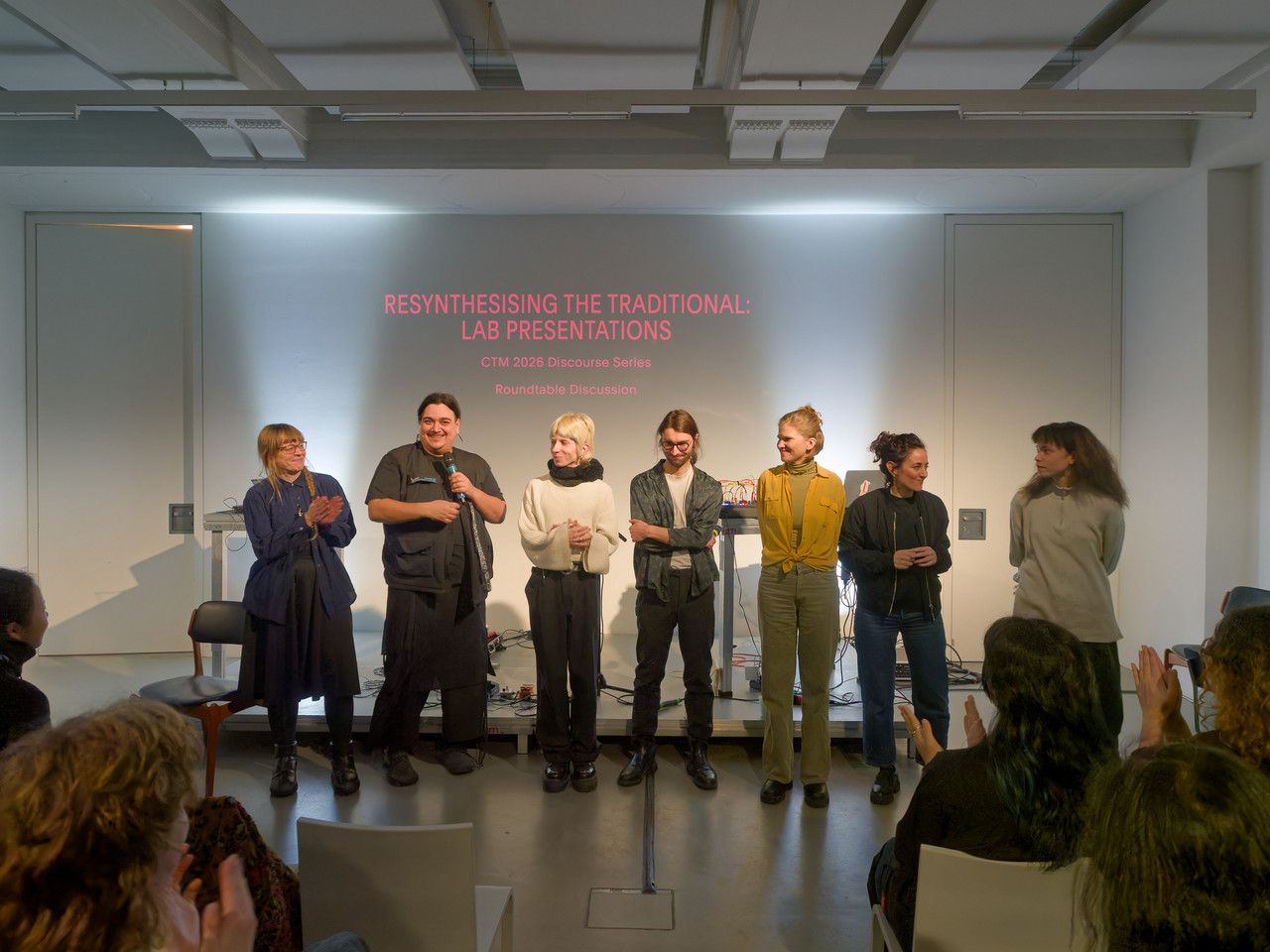
Returning to CTM for a second year, the Resynthesising the Traditional artistic lab 2026 was hosted by Yara Mekawei and Stas Shärifullá. It regrouped five fellows selected via open call. Public formats took place at the start and end of the festival – kicking off with a day of performances and discussions, and ending in a roundtable conversation exploring the lab's themes on the closing festival day.

The lab took place in the Radialsystem Studios over the course of six days, and included inputs from external artists/researchers. The public events were hosted at daadgalerie, respectively on 27 January and 1 February respectively, bookending CTM's 2026 edition. Expert inputs included presentations from Bulat Khalilov (Ored Recordings) and Budhaditya Chattopadhyay, as well as a visit to the Humboldt Lautarchiv.

About the fellows:

Dorothy Carlos employs electronics and a wide spectrum of extended techniques to push the cello beyond the confines of the classical tradition. Her earliest musical education came through communal fiddle and folk traditions of the American South, which have deeply shaped her sense of musical possibility. What happens when the outline of an Appalachian fiddle tune meets digital delay or glitch? How can the idioms of folk improvisation dialogue with experimental compositional and performance practices? 

Maarja Nuut has been exploring archival Estonian sounds, dances, and texts, with a special interest in how landscape and environment shape these. Nuut’s practice is at once personal, sourcing stories and impressions from family history and current experience, as much as rooted in field recordings from the environment and culture in which her family has been based over generations. As she dives more deeply into sound synthesis, improvisation, and experimentation with participatory practice as a way to bring archetypal stories and abstract thought into tangible experience, her relationship with the traditional has become more dynamic, questioning what is chosen to be preserved, and what preservation means. 

Marina Tantanozi combines the bassflute, voice, inside-flute amplifications, and effects in her search for a language of her own. Through decomposing-recomposing rhythms, structures, and melodic elements, she explores how to integrate with the traditional in a radical and authentic way. Her work, grounded in a tactile approach to sound, investigates universality and fragility, and seeks deeper ways to explore already established structures and forms.

The artistic practice of Miłosz Kędra is deeply rooted in ritual, structure, and sensibility that stems from a conservative Catholic upbringing. Often finding it difficult to express aspects of their experience through art, they are interested in expanding the imagination around practices of queering. Their current work focuses on the pipe organ, transporting the instrument’s sound beyond the church by synthetically processing its tones and bringing in other sounds and techniques.

Varoujan Chetirian has been navigating the shifting planes of identity and belonging, as part of the Armenian diaspora in Europe. For him, the feeling of connection to an ancestral homeland is strengthened by music, literature, poetry, rather than a house with trees and a garden. Immersed in studies of electroacoustic music and sound art in Europe and Berlin, he has at the same time become more active in Armenia, building bridges towards the country of his childhood. Within the lab, he is interested in weaving together his schooling in the European avant-garde and the traditional Armenian sounds he had grown up with, while also exploring how this is shifted through a diasporic lens. 

Two fellows – Bint Mbareh and Saba Alizadeh were not able to join on short notice due to travel issues and the protests in Iran respectively.