The Time for Denial Is Over 1
Lars-Christian Koch, Mwazulu Diyabanza, Sarah Imani, Eva-Maria Bertschy, Christian Nyampeta, Patrick Mudekereza
00:00
HAU Hebbel am Ufer (HAU2)Watch on YouTubeTickets coming soon
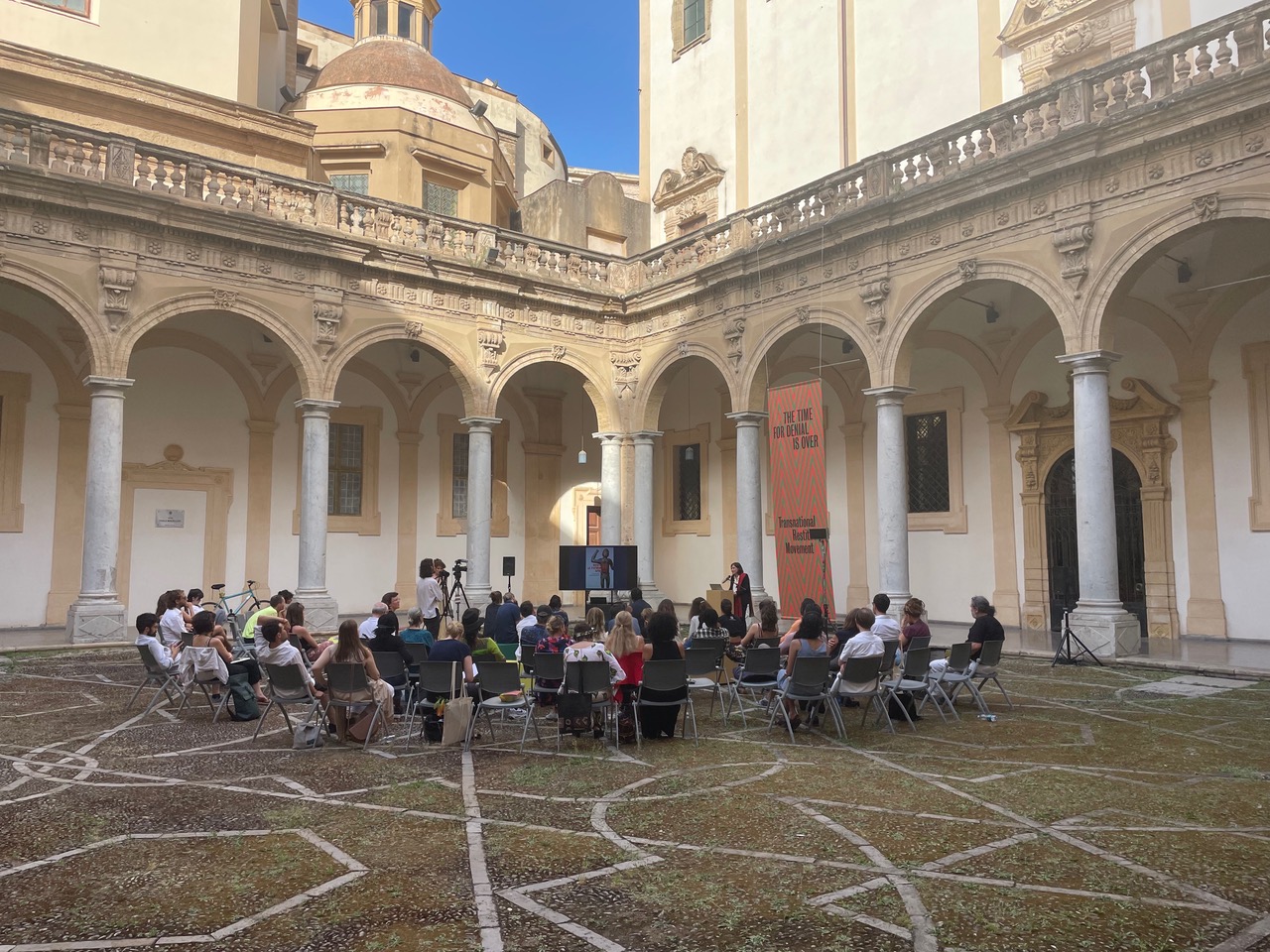
Following encounters in Palermo and Leipzig, they will discuss the significance of intangible cultural heritage and music for the restitution process in a series of lectures, performances, and screenings in Berlin. What happens to all the knowledge and music extracted by missionaries, ethnographers, salesmen, and officials of the colonial powers, that have been locked away in European archives? How can they be made accessible again for people in the African countries and regions whose heritage they represent? How can the musicians and artists working between continents deal with this heritage? And how can we prevent the same mechanisms of violent extraction and appropriation of knowledge and cultural practices from being reproduced in a different form today?
»The Time For Denial is Over« is two-day discourse programme that accompanies the presentation of »The Ghosts are Returning,« a post-documentary music performance about seven pygmy skeletons brought to Geneva from Congo by a Swiss doctor in the 1950s. Together with the Congo’s Mbuti people, GROUP50:50 have developed a funeral ritual for the seven spirits – taking inspiration from traditional Congolese music, the funeral ceremonies and polyphonic chants of the Mbuti, and laments in the classical music tradition – in the hope that they will find peace.
Day 1 Programme
Who is the Thief, Who is the Owner?
Talks by Mwazulu Diyabanza and Sarah Imani, moderated by Eva-Maria Bertschy.
Regarding cultural objects and Ancestral Remains in European museums, private collections, and university archives, a whole series of complex legal questions arise. Who is the owner of the objects? Are they objects at all or are they humans? Were they expropriated, taken by force, or legally acquired? To whom should they be returned? Because essential information is often missing to clarify these questions, many argue for the status quo. How do questions of ownership relate to the cultural rights and human rights of dispossessed peoples? In the course of restitution, the legal premises of our current world order are also subjected to a decolonial critique. Congolese activist Mwazulu Diyabanza (Multicultural Front Against Looting) and researcher Sarah Imani (ECCHR) will give short talks and engage in a discussion moderated by Eva-Maria Bertschy.
The Restitution of Intangible Cultural Heritage
Introduction by Lars-Christian Koch
Screening: »Sometimes it was Beautiful« by Christian Nyampeta
Christian Nyampeta in conversation with Patrick Mudekereza
In addition to cultural artefacts and Ancestral Remains, ethnographers, art collectors, and missionaries in the former colonies have also recorded and collected music and other intangible cultural heritage in order to make it available to European museums and universities for research purposes. So far, these have received little attention in the current restitution debate. How can these recordings be made accessible to artists, musicians, and researchers, but also to the local communities whose cultural heritage they represent? How can they be reappropriated? And how do we deal with the knowledge and representations that reproduce colonial violence? A short introduction by Prof. Lars-Christian Koch will be followed by a screening of Christian Nyampeta’s film »Sometimes it was beautiful,« and a conversation with between the film director and the writer and curator Patrick Mudekereza.
»Sometimes it was Beautiful«
Film by Christian Nyampeta (2018, 40 min)
Christian Nyampeta’s film is about a meeting between an improbable group of friends, who gather to watch »I fetischmannens spår« (In the Footsteps of the Witch Doctor), one of the six films that the Swedish cinematographer Sven Nykvist made about the Congo between 1948 and 1952. Postcolonial luminaries, a filmmaker, and a high ranking royal of a former colonial empire talk about the »traces of a history that is filled with pain« and the »balance of composition.«
Event Access
Please consult our Accessibility section for information on volume / lighting, mobility, age restrictions and other access information.
Curated by GROUP50:50 in cooperation with CTM Festival, PODIUM Esslingen, Centre d’Art Waza Lubumbashi, and Fondazione Studio Rizoma Palermo. Funded by the German Federal Agency of Civic Education.