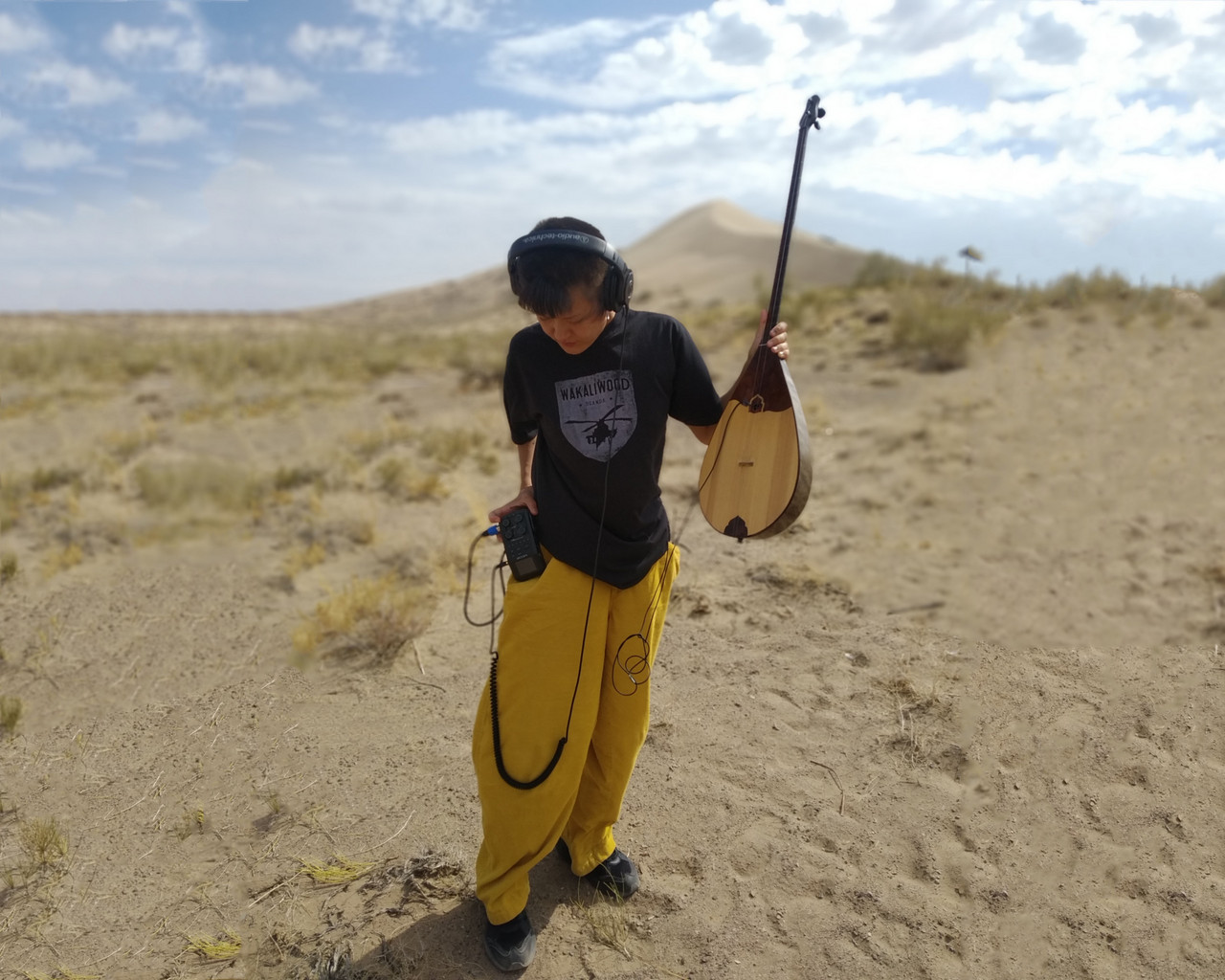
At the lab's core was the guiding metaphor of resynthesis – a processing method in computer music that analyzes sounds to extract their fundamental components. Through this lens, the lab aimed to confront conservative views of culture as something frozen, solidified, and generally untouchable, thus resistant to any transformative practices.
The lab was hosted by Medina Bazarğali and Bilawa Respati. The fellows were selected from over 135 artists and practitioners who applied to the call for participants. Selected by the co-hosts Bilawa Respati and Medina Bazargali, with input from Stas Shärifullá, and the teams of CTM Festival, Korkut Triennale, and Goethe-Institut Kazakhstan, the six selected fellows broought together a range of experiences, knowledge, and musical aesthetics that relate to »the traditional.«
The fellows presented their practices to the public on 17 October 2025 at Tselliny Center for Contemporary Culture and further insight into lab ideas and processes were shared at a roundtable on 23 October 2025 at Goethe-Institut. The Lab concluded with an evening of performances by HMOT, Bilawa Respati, and Kokonja featuriing Alen Lee.
The collaboration between CTM and Korkut within the Resynthesing the Traditional strand continued in May and June 2026 with a series of performances, talks and commissioned works at the II Korkut Triennale.
Theme: The Wind Howls
The lab’s thematic focus on aural traditions and the wind evoked the wide range of cultures in Central and North Asia, and beyond, where for generations sonic practices—whether instrumental music, spoken literature, or various forms of improvisation—have been central to shaping societies and worldviews. Most of these practices are easy to learn but difficult to master. They are accessible to nearly everyone, regardless of special training or social status, yet, in some cases, they require a lifelong commitment.
Aural traditions and sound are also intimately linked to the wind, a phenomenon that can be examined as both a powerful cultural symbol and a physical element. Understanding wind is fundamental to our understanding of acoustics. As the movement of air, it interacts with objects in the environment, causing vibrations that produce sound. In turn, sound travels through the air, setting off a chain reaction that carries its energy. This principle lies at the core of the design of many musical instruments, starting with the voice—the most primal and fundamental instrument of all—which can be amplified when spoken or sung into the wind, allowing it to carry the song. Woodwind and brass instruments rely on the performer’s breath to create wind, which makes them resonate, while all manner of organs, bagpipes, and hurdy-gurdys generate wind artificially, forcing it through pipes of varying lengths to produce sound, following the very same principle. Some instruments, when played by a skilled performer, can mimic the sound of wind, causing pieces of wood and skin to rumble like a hurricane or strings to howl like the buran on the winter steppe.
II Korkut Triennale
In summer 2026, the Tselinny Center for Contemporary Culture in Almaty hosted the second edition of the Korkut Sonic Arts Triennale, which has evolved from its original shape of the Sound Art and New Music Biennale into the Sonic Arts Triennale. This second Korkut edition – titled Rites of Eternal Wind – keeped its initial focus on sound and music, but extended this vision even further by showcasing adventurous sonic events and situations including soundwalks, experimental choir performances, hybrid poetry readings, research-driven audio essays, guided listening sessions, and more.
The Korkut Triennale's conceptual framework is rooted in the understanding that Central Asian, Turkic, North Asian, and many other cultures in the broader region are fundamentally auditory, with oral and listening traditions historically taking precedence over written ones. For generations, sonic practices of these lands — whether instrumental music, spoken literature, or various forms of improvisation — have been central to shaping societies and their worldviews. Honouring these practices and making room for others, the Triennale, with a home base in the newly opened Tselinny Center for Contemporary Culture, was transforming into a vast resonating space for sonic ceremonies, sonic rituals, sonic dialogues, sonic celebrations, sonic mournings, and sonic remedies.
This lab edition was kindly supported by Goethe-Institut Kazakhstan.