
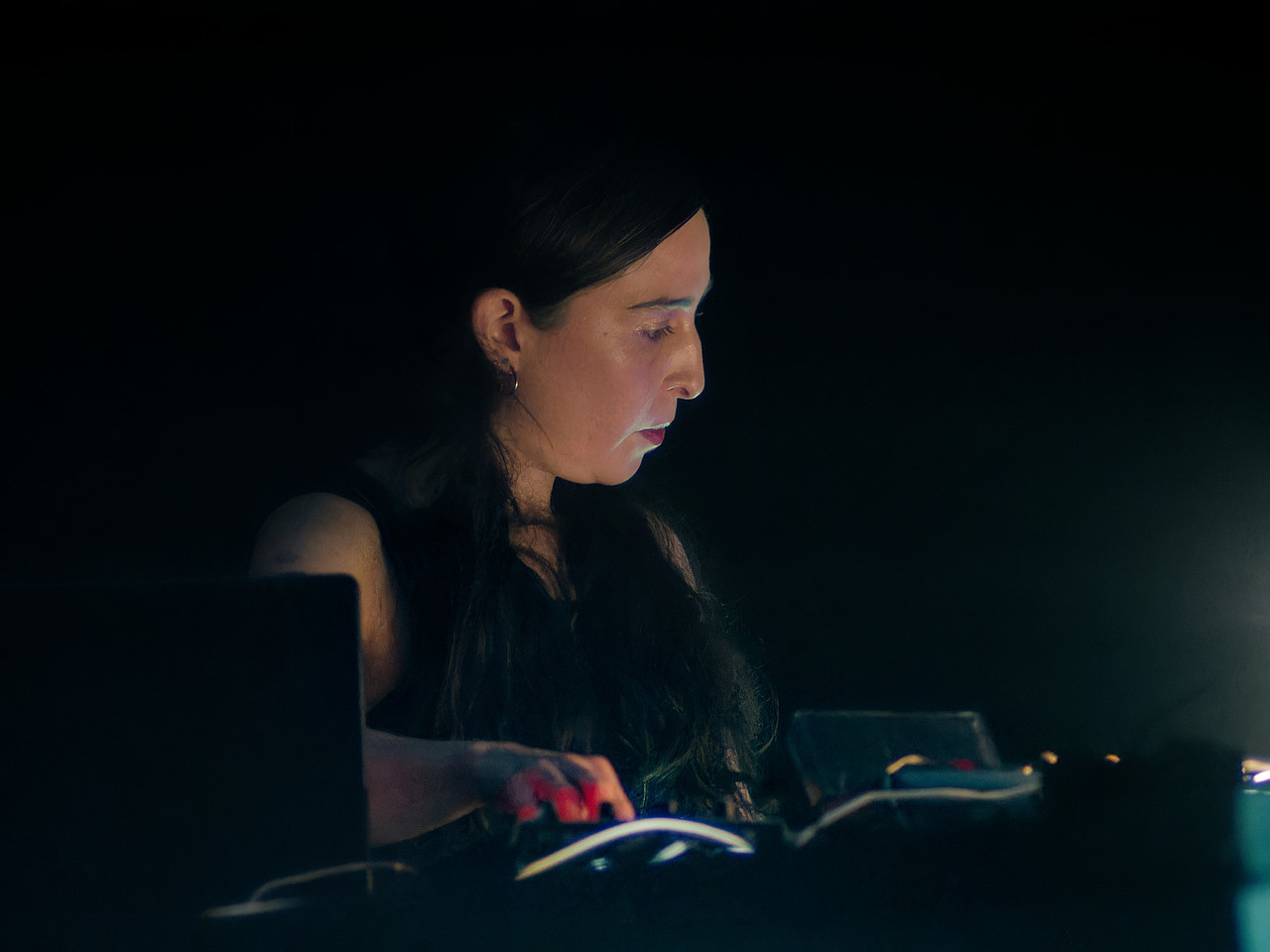
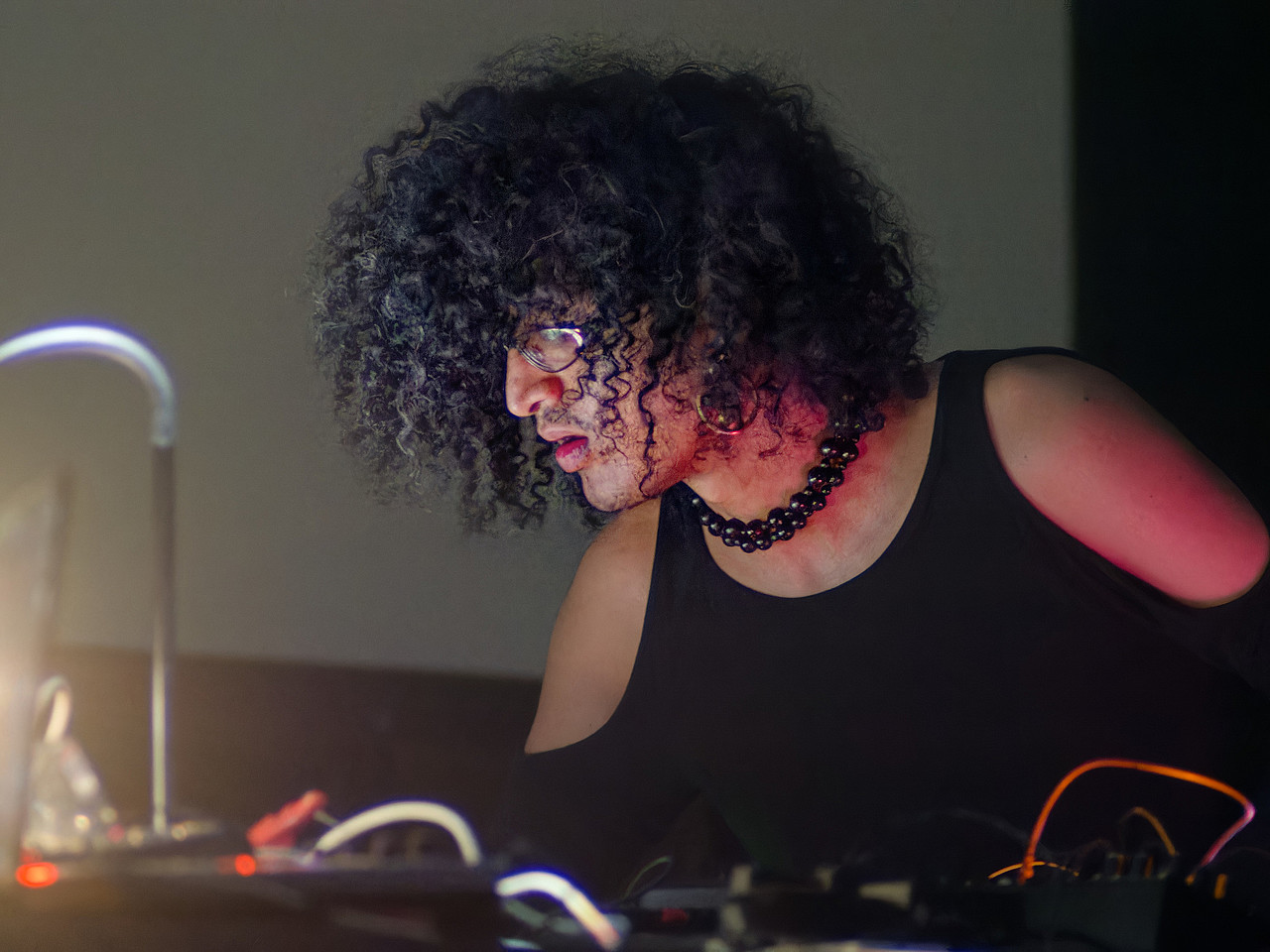
»MAPS: Electronic and Electroacoustic Resonances between Ecuador and Mexico« was a listening process stemming from an exploration by the artists Concepción Huerta and FE Sexta, where the titular territories become present through a tapestry of sounds, images, connections, feelings, affect, and texts.
FE Sexta (Ecuador) is a cross-disciplinary artist who experiments with the body, moving images, and sound. Their approach originates from imaginative narratives and viscous formats that arise from the immediate future. Concepción Huerta (Mexico) is a sound artist, photographer, and editor who focuses on creating musical stories by interweaving sound and image. Concepción focuses on absence and abstract resonance through tapes and other instruments. Through »MAPS,« the artists sought to unlearn their »Latin American« identity, starting from the context of its electroacoustic and electronic music as well as the history that this region carries. This process was based on the experiences and trajectories of sound artists such as Mesías Maiguashca and Antonio Russek, specifically in their attempts and approaches to sound and its modulation within a diffuse regional/umbrella identity that embraces a mixture of more localised identities and traumas still present since colonisation.
»MAPS« is a process of examining collective memory and a dialogue between bodies and voices that have been forming and finding each other over time. The following essay is a blend of research, interview, contemplation, and reflections in the form of a ghostly voice, whose identity is meant to be individually defined by each reader.
Looking Back and Beyond
Latin American composers have been interested in electro-acoustic experimentation since the advent of this field of sound. The first experiments with electroacoustics in Latin America took place simultaneously in various territories in the mid-1950s.
In most Latin American countries, the first electroacoustic music laboratories were created with many difficulties, with no support from governments and/or institutions – a situation that hasn’t changed much. In Mexico, the first Electronic Music Laboratory came to light in 1970. In Ecuador, the Department of Research and Composition (DIC) was not established until 1987. In Mexico, Antonio Russek, Vicente Rojo, and Roberto Morales were among those who began experimenting with this genre. In 1978, Russek founded the Independent Center for Musical and Multimedia Research (Centro Independiente de Investigación Musical y Multimedia CIIMM).1
»Connecting with Russek's work reminds me to follow a path, but to be disobedient at the same time and venture into the unfathomable, into the limits. To explore and experiment,« says Concepción. »I connected with Russek's work without a need to understand it rationally. I knew it was important to me when I listened to it. Particularly his album Música del Desierto, which he developed in the desert of Coahuila, and which mixes different techniques such as field recordings and electronics. I listened to that CD and I knew I had to write to him.«
The Ecuadorian composer Mesías Maiguashca arrived in Germany in 1966, where he worked at the Electronic Music Studio in Cologne and co-founded the music group Oeldorf. Maiguashca was one of the first to base his sonic practice on an expanded vision, using different media to create and stage music. In a way, he managed to combine the features, worldview, and sound of the peoples of Ecuador with experimental European music.
»As a child, I played in a symphony orchestra. But I was always thinking about the vomit tapes I made – that's what I call the mixes that came from recording over what was recorded – and the sounds of the little toys I built. Listening to Mesías confirmed to me the sonic possibilities that were always there. Hearing his works made sense of my experience and conveyed a certain sense of security,« FE shared.
Latin America is something like this vomit. A vomit that creates something else. »... in Latin America, we have the presence of a natural sensitivity towards ternariness opposed to rhythmic binary – against a torrential flow, sensuality without guilt, and a stubborn modalism,« wrote Coriún Aharonián in his essay »Factors of Latin American Musical Identity after Five Centuries of Conquest, Domination, and Miscegenation« (Uruguay, 1994).
As colonised territories, the borders of Mexico and Ecuador respond more to Western-white political and strategic interests than to their mestizo (mixed race) cultural reality. This, to a large extent, also influences the search for an identity within electroacoustic and electronic music, a need to position oneself in the world through sound. Many composers used indigenous materials in their works. Many processed these materials into something that became appropriation, reappropriation and/or reformulation.
Mesías's music is a blend of Western and non-Western concepts, timbres, and techniques. It is simultaneously an expansion of these, something that is born and reinvents itself all the time. It raises questions about the experience of listening. »Ayayayayay« was a confrontation for Maiguashca with himself and the Ecuador of that time; the recording of all these sounds reminded him of his childhood and the divisions marked by inequality between indigenous and non-indigenous, poor and rich.
»Mesías Maiguashca is one of those beings whose identity is not exhausted in the roots but – accepting the botanical analogy – continues in the trunk, branches, leaves, flowers, fruits, pistils... His roots are his Ecuadorian stage. His trunk is that initial European phase. His branches are his explorations into fractals, science fiction, or Carlos Castañeda. His bark, which strengthens and protects him, is his acoustic inquiry into the very nature of sound. His flowers are his activity in constructing those curious Sound Objects. And his fruits are the students of the Hochschule de Friburgo. And his sap? That honesty with oneself.« – excerpt from the presentation of Mesías Maiguashca's works at the Centro de Arte Contemporáneo de Quito (Ecuador) by Juan María Solare, Worpswede (Germany, 2012).
It is crucial to emphasise that there are few credits and mentions of women composers in the history of electroacoustics in LATAM, and there are not many records of their work. Today, it is still practically impossible to access the pieces of the Mexican pianist and composer Alicia Urreta, for example. However, Contingent Sounds has recently published the book Switched On: The Dawn of Electronic Sound by Latin American Women.
Mapping the Invisible and Polymorphic. Sound as Matter.
One of the factors of unity within the experience, sound, and diversity of Latin America is repetition. Many of us from the region like to repeat ourselves, to listen to ourselves, to constantly confirm that we exist. Another is a »sense of anticipation or delay.« But what happens when we inhabit this feeling as an end, as the place to go? It becomes like prolonged listening, communicating beyond linear habits and borders.
So, what happens to the map when it touches land? (axis, axis, axis) It inhabits borders of relation. It does not trace or divide but experiences (listens), engages in dialogue (affects), and speculates (creates). It opens possibilities from what it meets and exists on different planes and layers, among them including the absent and the taken for granted, such as care and support – or also the absence thereof. It invokes gestures, feelings, friendships, and connections that sometimes blend with coincidences, but are cosmic clues pointing us toward a common struggle and to where we are heading.
Investigating what inhabits, connects, and shapes our territories, in this case, Mexico and Ecuador, is not a search for identity but an event that confuses identities. Latin America is the result and mixture of multiple possibilities that arise from the same violation. She is a bastard and denied daughter, but one that is expected to be most similar to her violator, without »surpassing« him. However, it cannot be the same, because its rivers and volcanoes weep and remind us, and do not forget.
And how do we listen to our lands? How do we trace their complicities? How do we resist from our different resonances and tensions?
Concepción Huerta and FE Sexta proposed embodying a map that connects their territories through electronic resonances. They proposed acting as bridges to delve into their searches and memories. If something unites Latin America, it is the history of the body, its material memory, its voices, and whispers in the wind. If anything, LATAM is a multidimensional possibility that continues to weave itself from something that still does not heal. It is the melancholy for the land and mountains. This formed the basis of their work, »MAPS.«
What is the story of this map? Where does it come from, and what are its emotional imprints? With whom did you trace it?
Concepción Huerta: I think of Mexico, and I feel how the noise is about to burst my ears. Everything is strident, mixed, chaotic, collapsing, full of screams... And at the same time, that contrasting silence. The silence of impunity, femicides, violence. At the same time, I remember, for example, when I went to Chiapas. I remember being in the jungle and hearing a concert, an orchestra of insects. One of the most beautiful things I've heard in my life.
and at the same time
a same time
the same time
where the self is lost to be found
FE Sexta: My last experience with Ecuador was like a refuge. I lived for a long time in the mountains, in Ilaló. A place free from city sounds. There, I felt connected, the waves were very even, and there was only a lot of calm. But I also started feeling an internal accumulation of a fear of that calm and that triggered a feeling of wanting to let everything go. Then I arrived in the middle of Quito, the centre of chaos. Where the sky falls. Strident rain that covers all other sounds when it arrives. That's where I started learning to listen to myself, while everything was falling on me. The future turned black for me. And now, that sound is what I miss the most.
listening to ourselves in chaos
in noise
in the fog
in the lines of the abyss, we listen better
sound is channeling what precedes us and unites us here
It is important to remember that the culture and music of the American continent result from three sources: the indigenous, composed of multiple and diverse ethnicities; the conquest, meaning Western European colonisation; and the African, peoples brought by colonisers as slaves. These latter two also originate from multiple and diverse territories within these continents. In »Factors of Latin American musical identity after five centuries of conquest, domination, and mestizaje,« Coriún Aharonián mentions that the distribution and proportion of each of these sources in LATAM determined a very varied mestizaje over the centuries, with significant differences between one region and another: »There were many cultural systems, and often those systems were not confined to precise geographical limits. Furthermore, cultures, languages, and music coexisted in a diffuse territory.«
FE told me that creating »MAPS« was an opportunity to continue digging into this feeling of not coming from any specific place: »From here, more questions arise about identity, about understanding more about where I am supposed to come from. About the indescribable... And seeing how this has been reflected in so many people who come from the same latitudes as me, how it has manifested in these people.«
Concepción started with the desire to try to map a multidimensional possibility that continues to form and communicate in and with a diffuse past. To create confusion. It is common for Latin Americans to feel like we are floating between a contrast of chaos and the illusion of order, easily corruptible, a European calmness, violent with its order sustained by silence. A need to survive from our relations and our nostalgia emerges from this.
Irene Trejo: How has your relationship with Mexico/Ecuador changed, being far away? And how do you listen to these places now, from a distance? What do you hear?
Concepción Huerta: Now that I am far from Mexico, I hear the same contrast but from an imbalance, like listening from only one ear. The past in the present. I hear whispers, touch... I don't know how touch sounds, but that's what I hear. Like touching a lot. Like many relationships collapsing into each other. A union of encounters.
FE Sexta: The truth is, I feel very little attachment to Ecuador. Although it is always present, pulsating. I hear my mom and my sister. And that strident rain.
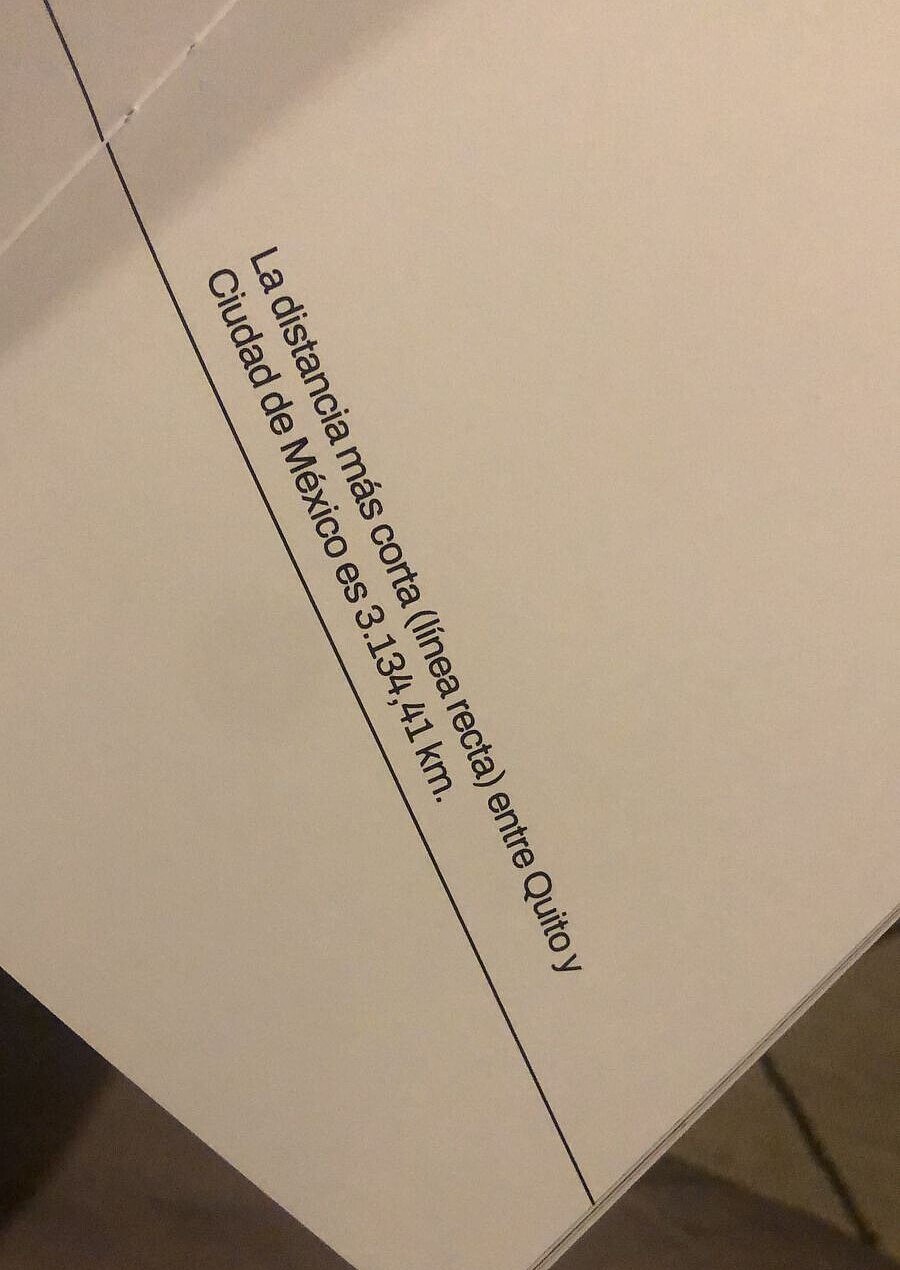
When they met, Concepción and FE connected very quickly due to the similarities in how they sound. Also, their love for the musician and composer Polibio Mayorga, and ceviche.
Concepción Huerta has been experimenting with electronic/electroacoustic music since 2013 when she moved to Mexico City. There, she began listening to and documenting the scene. She then started playing with foley, field recordings, and processing with cassettes... Now her process has more to do with synthesis; shaping sounds with digital processes that blend with analogue ones. With dimness and the spectral. With ghosts.
Since childhood, FE enjoyed disassembling things to create something new. As mentioned before, they recorded on top of tape, on cassettes; overlaying radio, people, and themselves talking. They also experimented with VHS distortions, played with circuit bending, and created music using Game Boys and GPS trackers. Rather than focusing on electronic music, FE states that they seek sounds that their brain doesn't comprehend. They connect audio and image, creating one from the other and/or manipulating them. This approach continues to manifest in their practice in various forms.
Concepción has also spent some time visiting Quito, exploring places where FE used to go. And FE lived for a while in the same neighbourhood as Concepción in CDMX (Mexico City). Now, they are further united in coming to live on this side of the ocean, in Europe, perhaps to listen more clearly to where they come from and where they are going.
A method of changing methods, travelling, resulting in sonority materialising.
Resonances Between Mexico and Ecuador
We are
A past that doesn't close
We are a record in time
Sounding and resonating along with all the possibilities of some origin
We are electromagnetic signals in space
We are the memory of an open and transmitted file
Our experiences and feelings create maps and cartographies on the earth
We listen to each other
We are here to relate
Affect each other
To be part of a story among many
We are a contingency
– Poem by Concepción Huerta and Irene Trejo
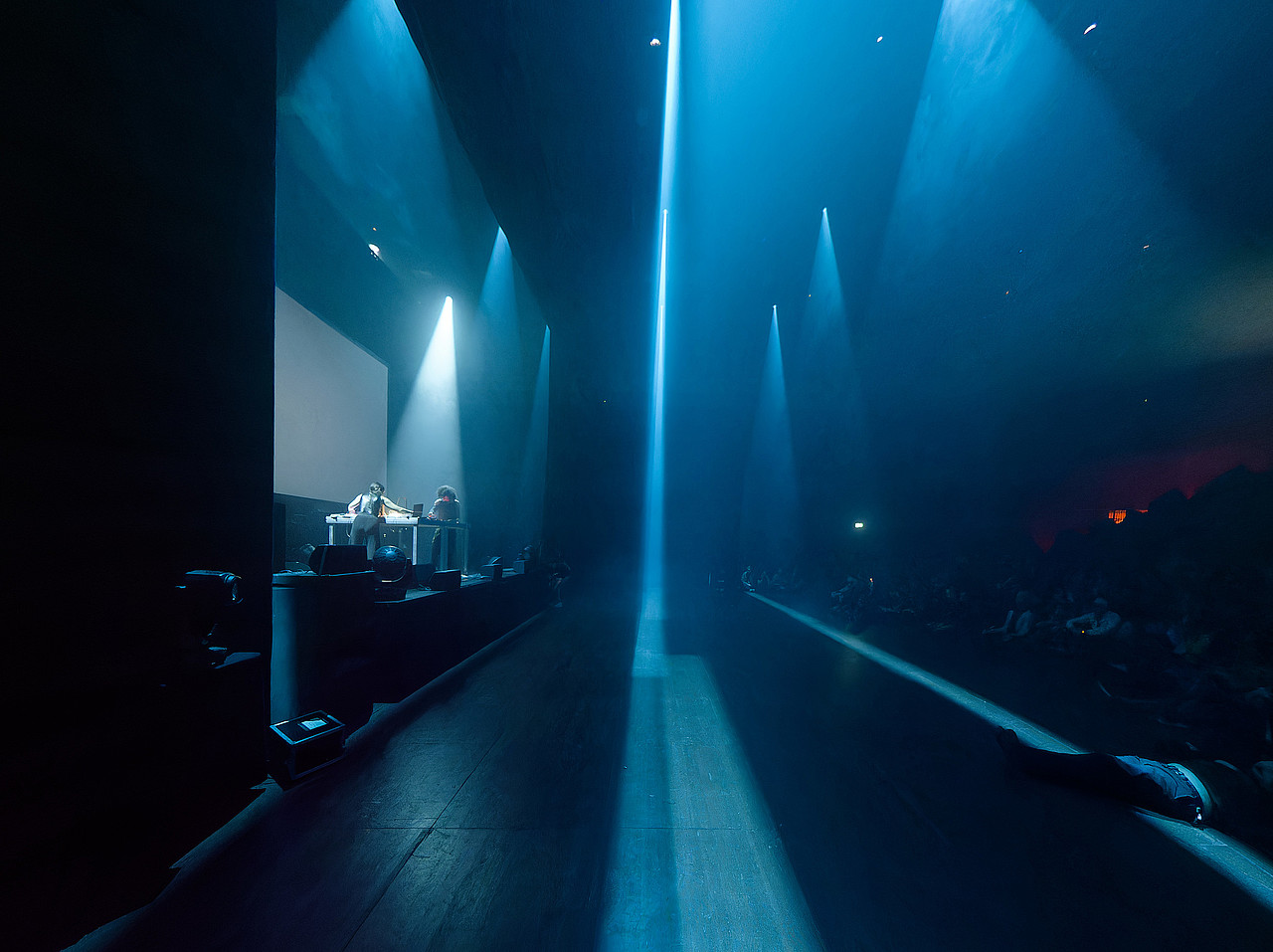
The performance of »MAPS« at CTM 2024 started in darkness. A void. The first sound that emerged was the piece »Storm« by Antonio Russek. Concepción had been in conversation with Russek during the development of the project. Russek's work spans various formats but is grounded in an acoustic exploration and experimentation that simultaneously stimulates the listener's imagination, opening up something else...
During their creative process, Concepción and FE had access to some of the archives from Radio UNAM – a radio station from Mexico’s public university – thanks to Mexico’s Fonoteca Nacional. The Fonoteca Nacional was the first archive of its kind in Latin America, aiming to protect one of the most neglected heritages of the 20th century. Within this archive, an item that had a special influence on »MAPS,« especially for Concepción, was an interview with Antonio Russek titled »Towards a New Music.« This interview influenced her because it talks about everyday processes and how in practice, many details lead to why things turn out a certain way. Listening to it helped Concepción to connect with the human process we have when creating and the similarities and differences between each musician/artist.
(2004) Storm by Antonio Russek
(2004) Storm by Antonio Russek
Beyond the reference to the piece »Storm,« Concepción and FE decided not to use sounds from the archive but to create sounds that were more closely tied to their experience and practice; especially abstract synthesised sounds. Their intention was to give space to what emerged from the blend of their histories, their processes, and their current context in Berlin.
Lighting design by Shaly Lopez enhanced the density and intensity of the performance. beginning with flashes and glitches that started to open the fabric – of sounds, silences, images, connections, pains, loves, farewells, encounters, and texts. To create the lights, Shaly imagined millions of points being drawn and fading. His process involved envisioning textures that translated into flickers, marking a dramaturgy based on dots and lines that, in turn, transformed into passages.
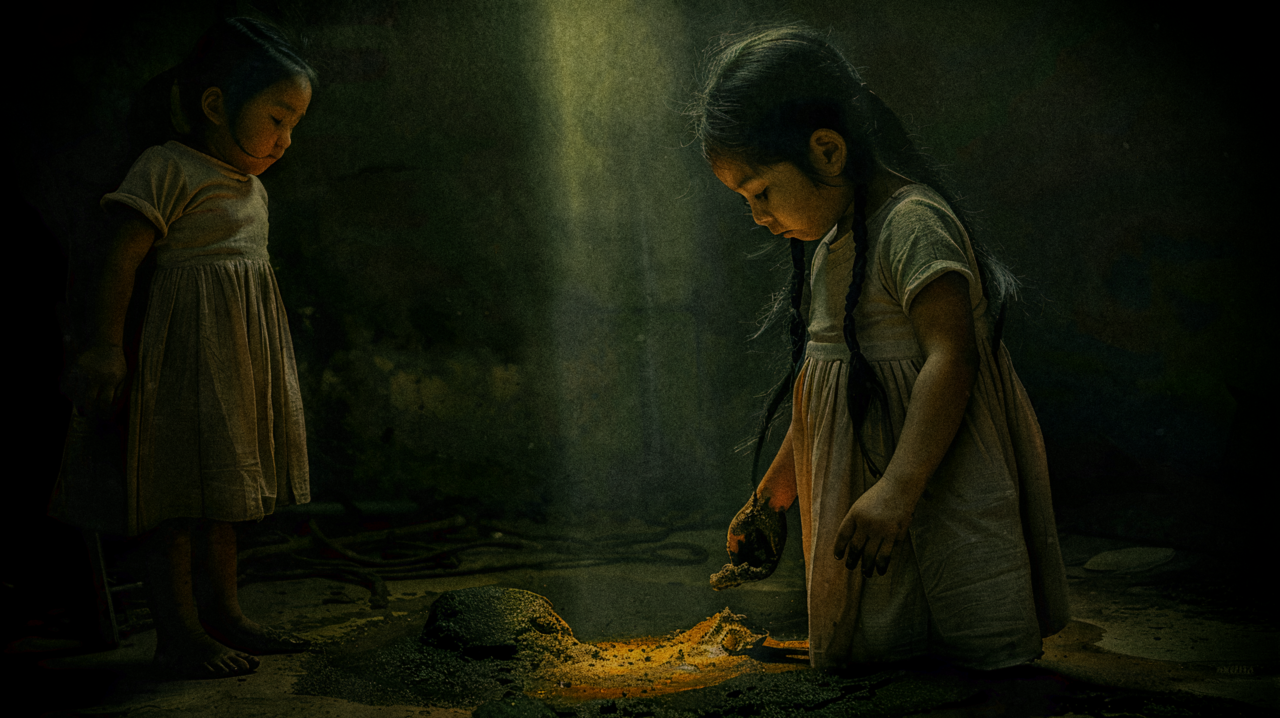
A cartography in disintegration began to form, opening within a perpetual flicker. Images of bulbs about to burn out, childhood farewells, animality, fire, ash, and a handful of black mud slipping through between fingers appeared. »Identity for me is like the earth slipping through our hands,« said FE, who created the visuals for »MAPS.«
In the end, the light strokes and images culminated in chaos and noise. The strobe that Shaly controlled took on a life of its own.
Memory Does Not Die (Repeat)
Irene Trejo: How is your map today?
Concepción Huerta: My map today has been shaping up beautifully. I returned to school here in the Netherlands after a while. The same path but different. Then I went to a friend's house... Connections reconfiguring. Later, I returned home to other encounters. If I could draw it, it would be a kind of geometry with various exits between what I think, feel, and where I am present.
FE Sexta: Like a vine, sweeping through everything everywhere.
Today we see more clearly than ever that colonisation is not a thing of the past but an ongoing reality. Extermination and broken hearts seem to encompass everything. However, nothing exists without its connections and traces. We are both a consequence and creators at every step. Mapping together is consciously walking hand in hand through uncertainty. Remembering, so as not to replicate forgetfulness. And sound, light, image, and words become touch, a multidimensional body, like magic and dreams. That magic that still runs through Latin America, a spectrum that forges new forms from what was and is learned, or not.
»The existence of a Latin American sense of time, the use of repetitive elements, austerity in the use of expressive resources and technological means, a certain primitivism, and a particular interest in exploring the inherent magic of the musical event. Magic,« wrote the Chilean Federico Schumacher in »La Música Electroacústica en América Latina (PDF).« »It is mestizaje that distinguishes us, and Latin American creators have understood that, though somewhat schizophrenic, we find ourselves between two worlds.«
I feel it's more than just two. And that each person, according to their strokes, territories, tensions, feelings, and desires, is trying to listen to the other.
»It's a circle,« Concepción says. That's why she and FE also sought this shape when creating the sound spatialisation for the day of the performance. She told me that the first time she travelled to Ecuador from Mexico, she cried when she landed, due to something she was reading:
»Love always shows us the world’s circularity« – from the book Conjunto Vacío by Verónica Gerber Bicecci.
Becoming the Search.
Remembering in it, to not disappear.
What Happens to the Map When it Touches Land?
Concepción Huerta: It overlays.
FE Sexta: It traverses it.
Irene Trejo is a transdisciplinary artist, poet, and journalist from Mexico based in Berlin. She focuses on the exploration of different relational forms and translanguage through sound, words, and embodied listening. She organises and waters the series Fluid Ecotonalism, and creates sonorous poetry as »merma suelo.« Irene studied digital media and investigative journalism, though has learned much of her craft as an autodidact in collaborative processes.
This text was commissioned as part of CTM 2024 – Sustain.
- 1
Rocha Iturbide, Manuel. »Cronología comparada de la Historia de la Música Electroacústica en México (PDF),« artesonoro.net. Link to PDF: https://www.artesonoro.net/articulos/Cronologia.pdf