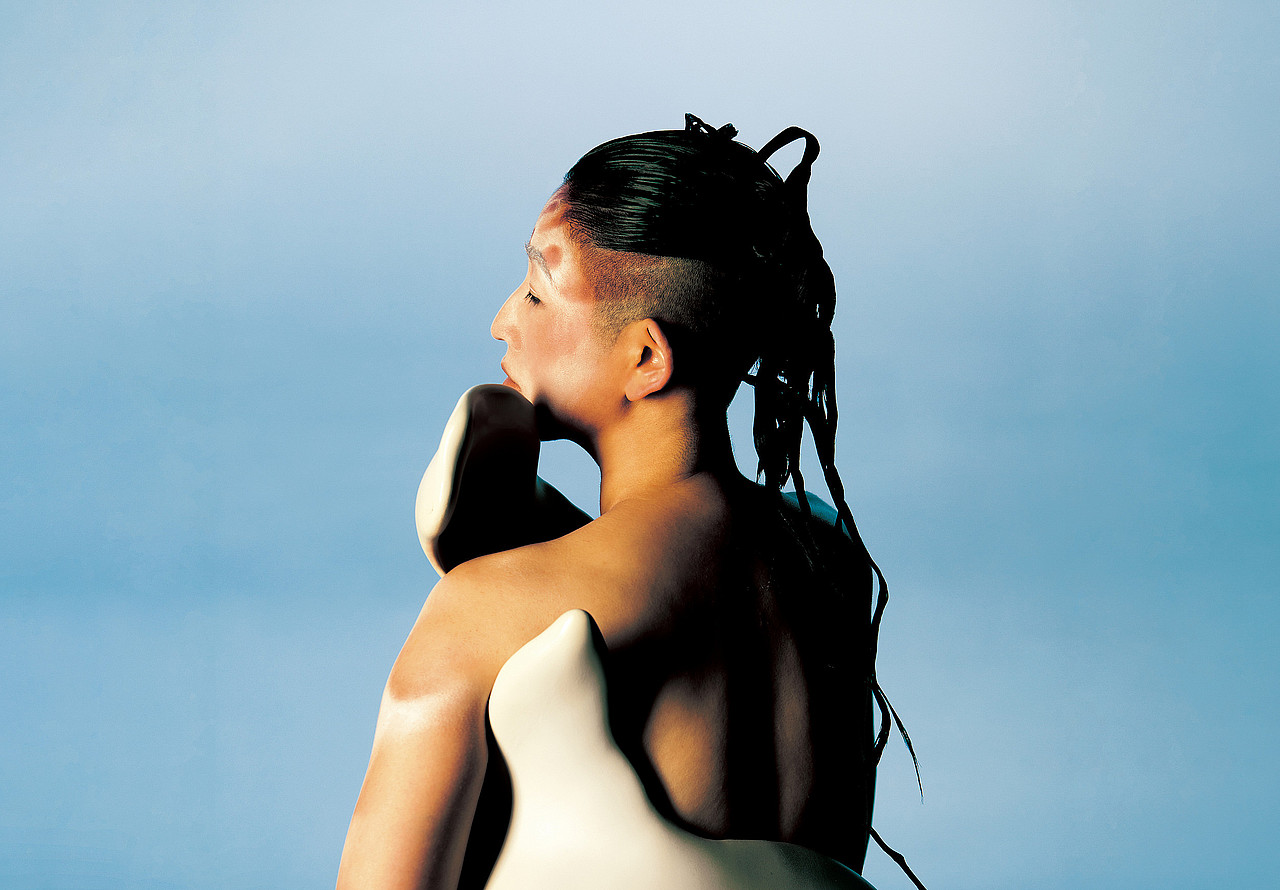
The genesis lay in her debut 2018 album Golem; evolving into Arthropods in 2019, and in 2023, Holes of Sinian which heralds an iconoclastic resurgence – a return to the interstices of the orifices and cracks, to the delicate and the minute, to the breathing vitality within death, and to the pneumatic »Ling Qi 靈氣,« the ethereal energy, radiating from the »East.« In this light, »East« transcends mere geographic notion and is not necessarily confined by ideology. It embodies an innate essence, a pulsating life rhythm, a trembling vibration whose sounds, nurtured by the multiple life-death entanglements amidst three years of a global pandemic, spread from the booming eardrums of 33EMYBW to her porous, arthropodic body. Echoes of dreams and memories call to her subconscious, beckoning a return in the most unadulterated, minuscule form to the earth and oceans, to the matrix and the stars.
While many musicians nowadays hastily embrace new media, basking in the spotlight and attention brought by live streaming and variety shows, 33EMYBW chooses to ascend mountains and plunge into seas within the soil and air of the »Orient.« Let us not delve into how she spent three years planning and showcasing the cultural project DONG, which investigates the ethnomusicology of the Dong people; in Long May the Water Flow: An Enduring Discussion on the Convergence and Co-evolution of Eastern and Western Music, Sparked by Chou Wen-chung’s Musical Philosophies, based on her research into the music of various Chinese ethnicities, 33EMYBW reinterprets and reconstructs the soundscape of the »Southern Mountains« from the book Classic of Mountains and Seas. Beyond her work and creation, 33 devotes her energy to reading, drawing, dream-catching, attuning to flora and vegetal beings, learning about religious philosophy, experimenting with field recording...
Holes of Time 时间之孔 feat. oxi peng, by 33EMYBW
Holes of Time 时间之孔 feat. oxi peng, by 33EMYBW
As such, in Holes of Sinian, 33 seamlessly weaves a web of sounds and instruments seldom heard in the mainstream, often cast as »the other« by the Western world – traditional and ethnic music from the heartlands of Sichuan's Garzê, Tibet, Yunnan, the distant echoes of Tanzania, Bulgaria, Thailand, and beyond. These sounds cradle a world brimming with the essence of life, threading through the temporal and spatial orifices of various dimensions. Each passage is a return, guiding 33 to shy and sacred spaces where her spirits lie closer. At times she emerges, perched at the pinnacle of perspective, witnessing the birth, bloom, and withering of all creation. These returns resonate anew, merging with the earth, sinking deep into the roots of plants, joining the natural cadence of cycles, mingling with the profound stirrings of her tentacles, meticulously distilled and carved into a flowing »Tai hu stone« of silicate hues: fierce, burgeoning, clamorous, clanging – an unceasing thunder of world-rending sounds. Yet also fluttering, swaying, dreaming, chirping, attuning with water, wind, mountains, soil, and beings, a heart's echo. These spirited rhythms leap and collide, surely heard by the molting larvae and the nascent chrysalis…– this is the sanctuary of the spirit, seeding and awakening in the »East.«
From the realm of dreams, I converse with 33EMYBW about the »orifices of the orient,« permeated by the flow of the artist’s sonic creations, which she refers to as »Arthropods Dance.«
The soul is a fragment of a dream,
the seed of future and past,
evolving infinitely on the Arthropods Continent.
We seek out dreams and catch them,
to scrape together the new Adam.
—33EMYBW
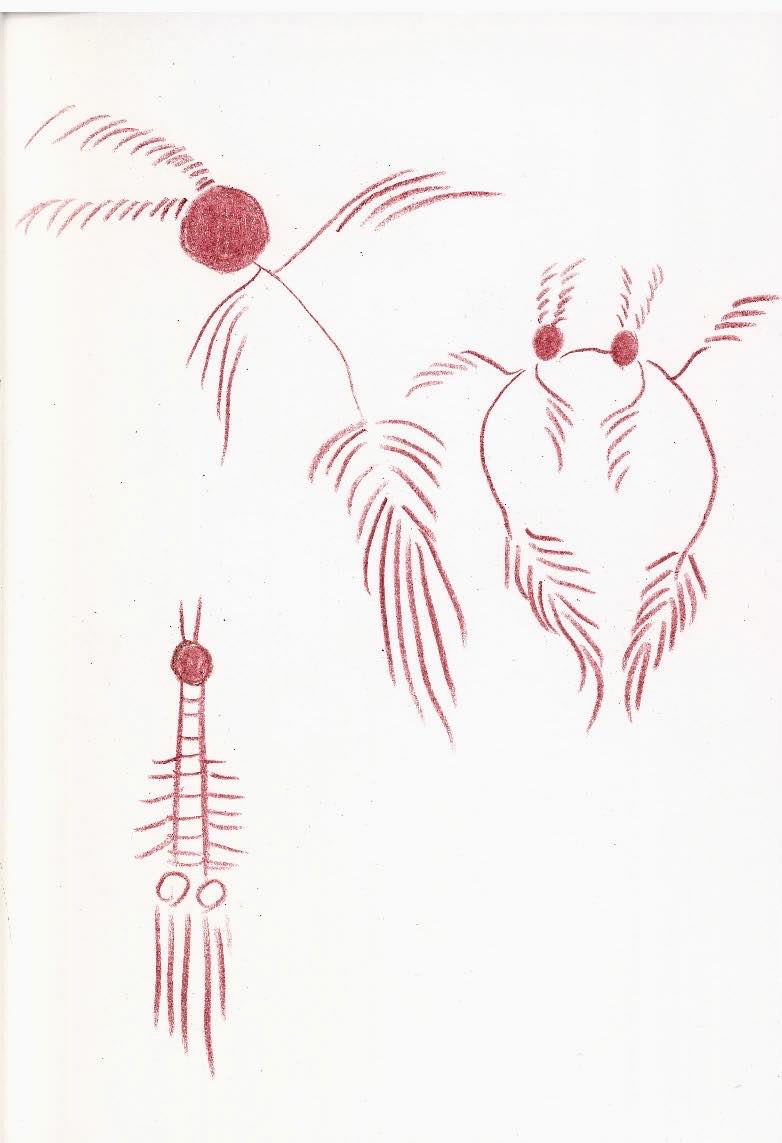
oxi peng: We have been exchanging dreams for about three years now, starting around the pandemic. Looking back on these three years, do you feel that your dreams have changed? What changes have you noticed in yourself?
33EMYBW: Do you remember the original name of »Holes of Time«, the song we collaborated on, was »Tai Xu 太虛,« which refers to the Grand Void of illusions from Dream of the Red Chamber1. In the fifth chapter of the novel, Jia Baoyu, intoxicated, wanders into the Grand Void of illusions in his dream and meets the Fairy Disenchantment, foreshadowing the fates and endings of the characters in the book. Reflecting on the past three years, I no longer try to find inspiration in dreams, but I still document them, receive feedback from them, and collect their symbols – to observe myself rather than to look for foreshadowing.
op: Perhaps it can be said that dreams have become more »materialised.« Here, »materialised« refers to the perception and embodiment of the material properties of dreams. As you've mentioned, the reality of dreamscapes intertwines with the reality of life, affecting and influencing each other. Such entanglements could be felt through your creations, whether it's artistic, musical, sonic, or in your everyday work and life. Dreams seem to have become a kind of spiritual channeling or practice for you. For instance, you wrote of the primordial dreamscapes of the album Arthropods: »The soul is a fragment of a dream, the seed of future and past, evolving infinitely on the Arthropods Continent. We seek out dreams and catch them, to scrape together the new Adam.« Is your creation a way of collecting fragments of souls?
33: The first song on my debut solo album Golem is called »Masudi,« named after the dream catcher in Milorad Pavić's Dictionary of the Khazars. The primordial dreamscapes on the Arthropods Continent [both a track off the album, and also a fictional space emerged from 33EMYBW’s music creations] are indeed the soul of the Golem from Golem. A golem is a creature from legend, an animated being crafted from clay and brought to life through magical means. Initially soulless, but as they evolve and through the experiments of their creators, they can acquire souls, interconnect, and replicate in various forms. In the conceptual setting of Arthropods, »Arthropod« is a form metamorphosed from the golem. Thus, one story gives birth to another story, one album transforms into another album... Every segment of a golem contains a soul. Whether the soul is duplicated, rewritten, or comes from another source, they can upload and download to each other, interconnect and coexist. In 2017, the computer program AlphaGo successfully defeated human Go players, the humanoid Sophia, designed as a companion »social robot« for the elderly was granted Saudi citizenship, and humans continue to ambitiously imagine transcending their physical bodies. The title of the album Golem is inspired by these phenomena.
Do you think the »Arthropoda Dance« is a form of cyborg?
op: I feel »Arthropoda Dance« is a kind of multifaceted hybrid. It possesses the mechanical and digital aesthetics of a cyborg, while also embodying the fluidity and uncontrollability inherent in a living organism. This uncontrollability brings with it the shimmers of the unknown. I find this unknown quite fascinating, as it may give rise to forms and occurrences/sounds that even you as the creator may not yet be aware of. Furthermore, if the cyborg here refers to Donna Haraway's cyborg, then it is a rebellion against a world view dominated by white heterosexual male anthropocentrism. In that sense, the »Arthropoda Dance« indeed carries this kind of heresy. To me, its rebellion seems to be about breaking certain established boundaries. There is a spontaneous deconstruction, reshaping, replication, mutation, and symbiosis in the ecosystem of Arthropoda Dance, whether it's in the realm of music and aesthetics or in exploring its sociality. And this ecosystem is actually closely intertwined with the cycles of growth and decay of all living entities in the world.
The notion of »Arthropoda Dance« is also your creation. Why do you use it to describe the music you make?
33: Electronic music is very much like an organism – dividing, growing, and evolving within a framework of high repetition. Arthropods, with their repeated body segments and exoskeletons, thrive in an incredibly diverse range of environments, which is both dazzling and fascinating to observe. The Arthropoda Dance is about listening through sensuous formation, which entails not only transformations between modes of sensory perception but also the opening of channels for shifting perspectives – allowing me to transcend my human viewpoint and adopt the perspectives of insects. Describing the music I create as Arthropoda Dance resonates with this synchronicity. It represents the transmutation of ancient earthly species into abstract music, or perhaps the other way around.
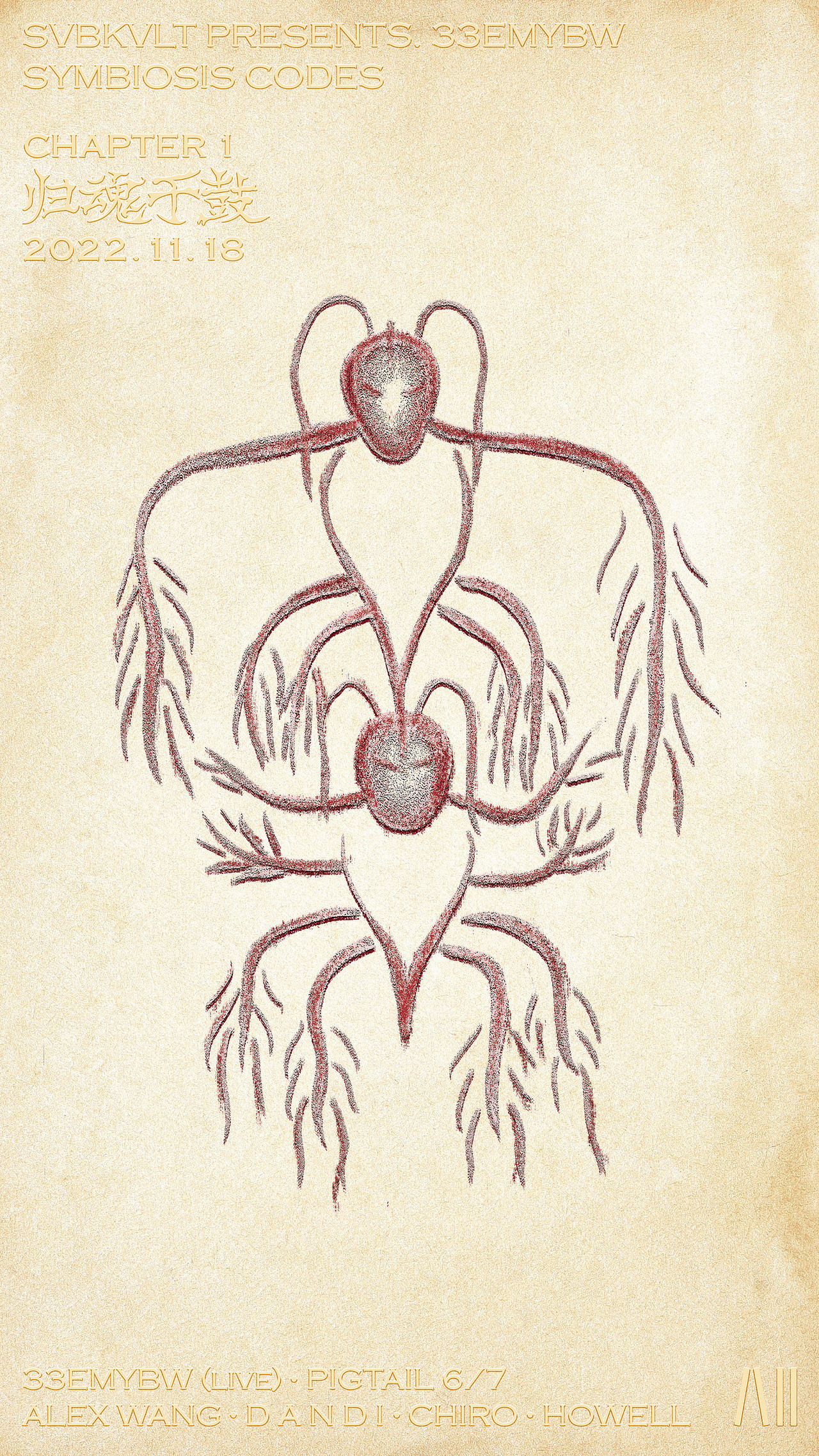
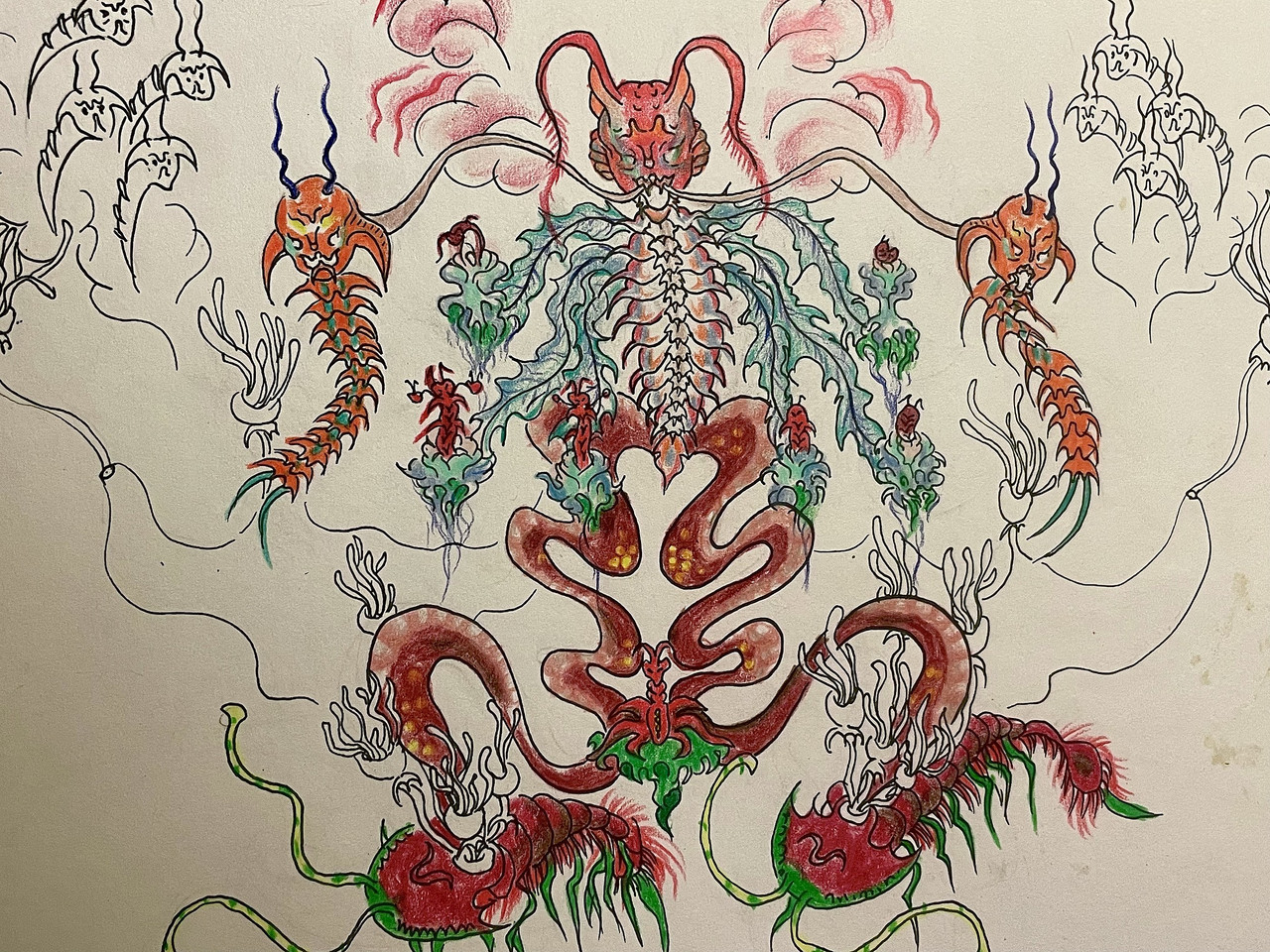
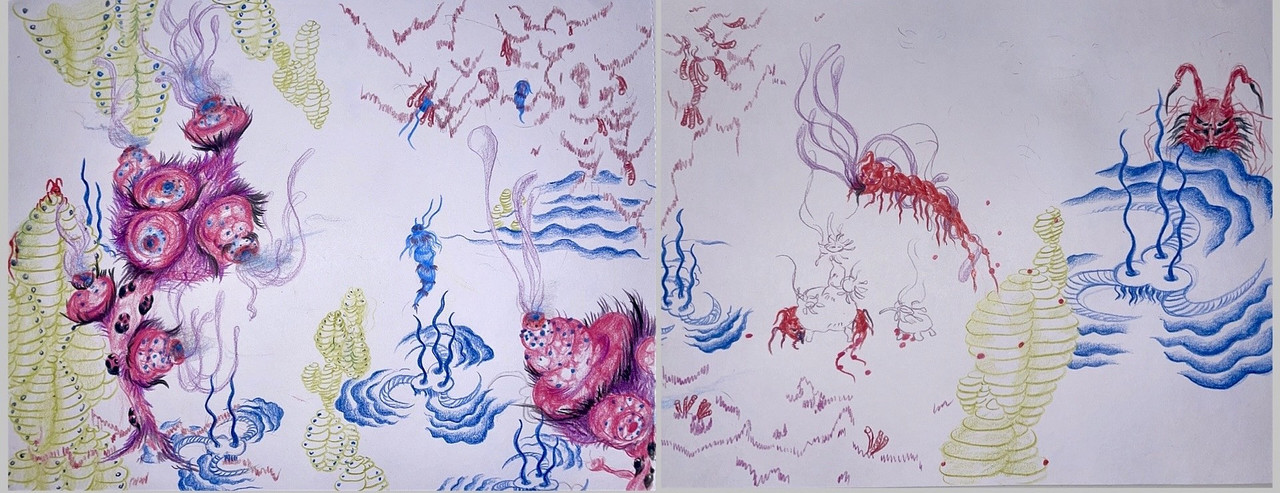
op: I think this is also a profound entanglement of ancient life forms with the pulsating rhythms and sound you created. I am reminded of your 2022 album Symbiosis Codes. In Chapter 1, Souls’ Return to the Drum, you conjured an archeological artefact from the fabled Arthropod Continent. Your words paint a vivid scene: »In the cave, I saw a multitude of paintings on the rocks – not mere animal forms, but visages adorned with insect tentacles. These tendrils intertwined, sprouting into new faces with antennae…Anyone who donned a mask with this pattern was seized by an unstoppable urge to dance.« This is a collective dream recorded in the scroll »Arthropod Continent Collective Dream Illustration,« dates unknown. Rock paintings, as an ancient art phenomenon, depict people's daily lives, rituals, and imaginations. During rituals, people communicate with spirits through the sound of drums and receive responses from ancestors. And the »insectoid tribe« and repetitive drumming are not just relics of the past.«
Symbiosis Codes / Mandala, by 33EMYBW
Symbiosis Codes / Mandala, by 33EMYBW
Your narrative, or rather this slice of archaeological reality from the Arthropod Continent, resonates with one of Donna Haraway's reinterpretations of »SF.« She interprets »SF« as »Speculative Fabulation« – a process of contemplative myth-making. With each of your album creations, from Golem and Arthropods, to Symbiosis Codes and the recently released Holes of Sinian, you weave speculative universes into existence. These realms proliferate, mutate, and intertwine in symbiosis, crafting a fragmented yet interconnected Arthropod Continent where sonance and cadence are the quintessence and soul. Through oscillation and frequency, you reconstruct a non-anthropocentric saga – a poetic, modest, and cyclical tableau of biological civilization, coursing through the veins of humanity, insects, and the fabric of multidimensional timespace.
Could you briefly talk about the creation of the »Arthropod Continent Collective Dream Illustration«; or perhaps more aptly, the unearthing and substantiation of this dream?
33: The Chilean writer Adriana Valdés once remarked that »an artist does not belong to any one specific culture but rather inhabits the orifices and fissures between cultures. They reside along the transit routes that connect one culture to another.« It is within these interstices – these unpredictable spaces brimming with tension and uncertainty – that free creation occurs and life itself is birthed. The »Arthropod Continent Collective Dream Illustration« emerged from such a liminal space. It is not just my creations that find their refuge in these gaps; the record label SVBKVLT, home to many of my works, also exists like a seed nestled in the crevices, weaving through the voids and thriving in the interstitial flow.
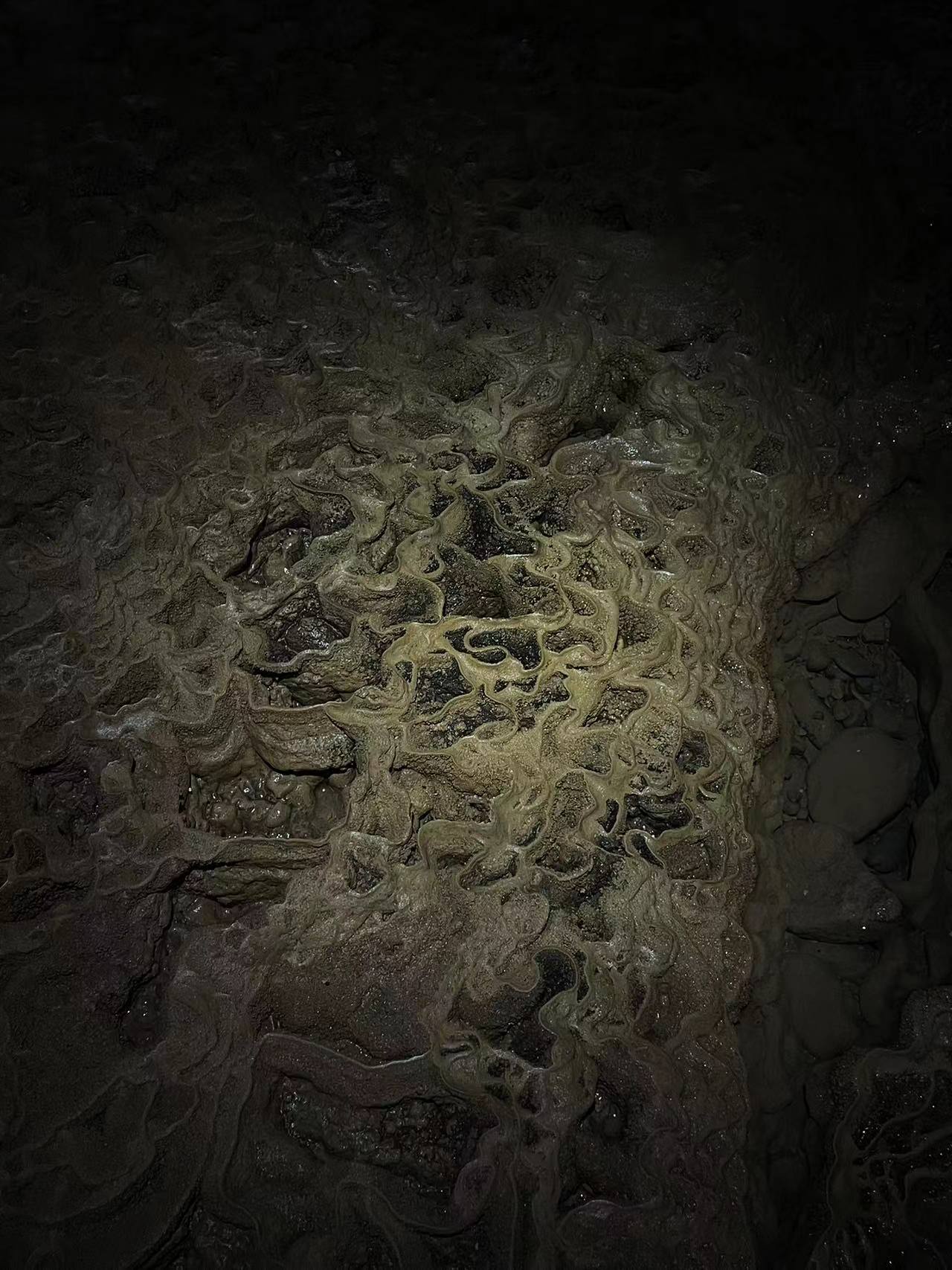
op: I am captivated by the concept of orifices, cracks, and holes as spaces that cultivate the act of free creations. These elements might be too subtle or microscopic to be noticed in our everyday existence, yet they are omnipresent. Orifices, or holes, possess an inherent duality; they are enclosed, yet simultaneously they are gateways to infinite openness. They seem to act as channels, linking multidimensional realms, senses, and a mosaic of seemingly disparate fragments – thoughts, aesthetics, dreams, and beyond. They offer a breadth of inclusivity while also bearing the constraints of their material form. As you've mentioned, the creations birthed within these spaces may be fated to remain niche, a reflection of the complexity, intricacy, and rich diversity that these unique spaces embody.
33: In Daoism, the place where the immortal sages practice their asceticism is called »Dong 洞 Tian天.«.Dong can be translated as a cave or a hole; and Tian refers to heaven, a non-earthly place. In this light, »Dong Tian« may suggest the celestial orifice...as »Dong« in Chinese embodies the concepts of a cave, a hole, and an orifice, alluding to secluded and sacred spaces. These realms are interlinked by a labyrinth of passages through which the immortals traverse. Legend holds that if a mortal stumbles into a »Dong Tian« and spends but a single day there, they may emerge to find that centuries have elapsed in the mortal world.
In my album Holes of Sinian, the Ediacaran biota are envisioned as phantoms of evolutionary dead ends, yet extinction is merely one possibility within the vast tapestry of holes, caves, and celestial orifices. Their essence persists in alternate holes, operating within non-linear temporalities. I gather these discontinuities – the leaps across history, the fissures in biological evolution, the cultural fragments—and import them into these interstices. There, I string weave them together through sound and rhythm.
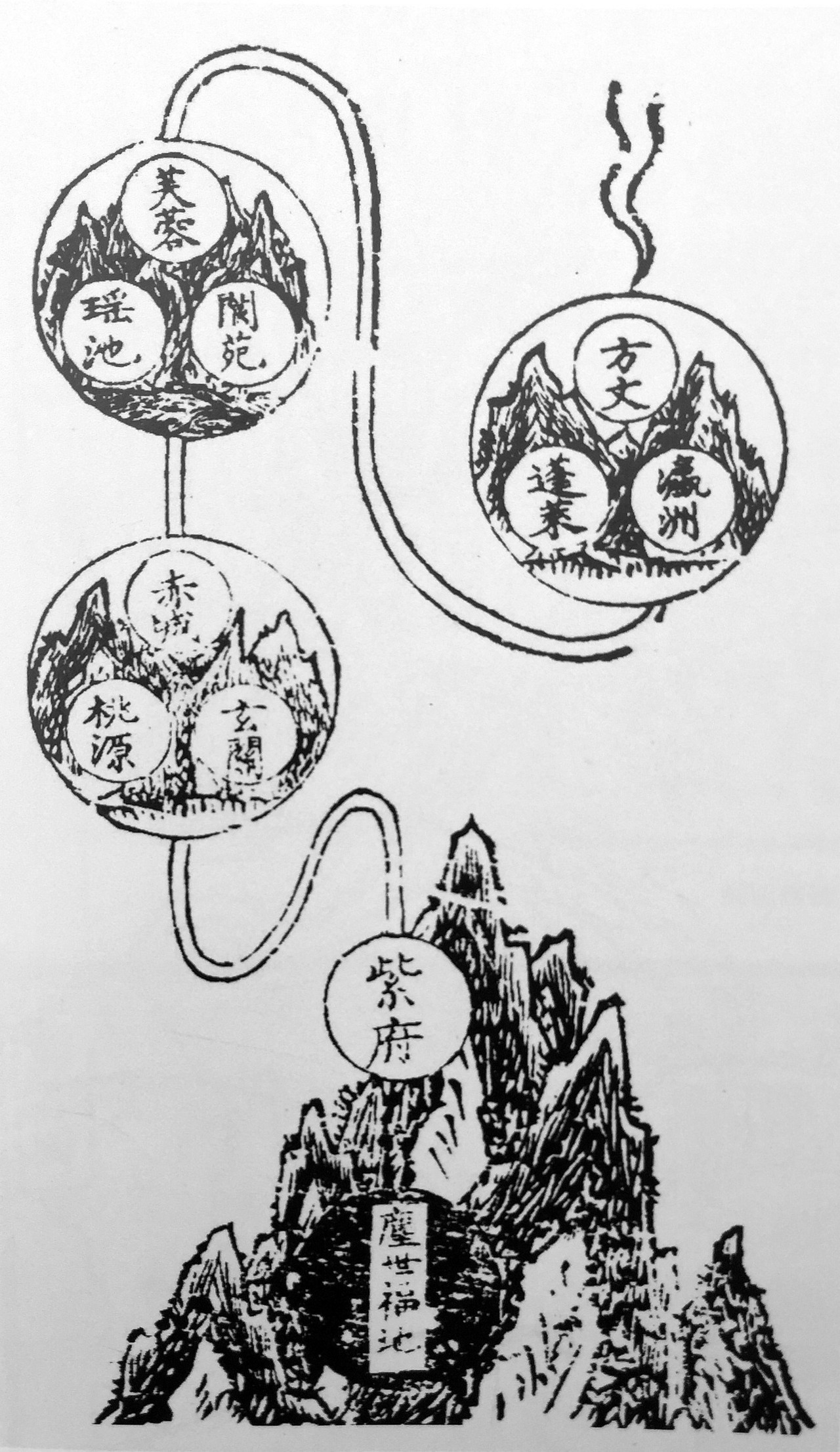
op: Such connections make me feel that your creative process is a kind of spiritual medium process. Like a shaman, a priestess – where sound and rhythm become your incantations, dreams, your sacred ceremonies, and the orifices of the very sites where such mystical convergences take place. It is through these apertures that you beckon the spirits of antiquity to cascade into what we perceive as the present reality, traversing the thresholds of cracks and holes.
33: You can also see the music festival as an arena of spiritual mediums, where all kinds of magicians and spiritual beings wield their arcane arts, exchange magical powers…each performance is a spell where the audience witnesses the conjuring of sonic enchantments.
op: Hahaha. Indeed! But speaking of Holes of Sinian, I strongly feel that it is a kind of
rebellious return as I wrote in the beginning of our conversation: a return to the interstices of the orifices and cracks, to the delicate and the minute, to the breathing vitality within death, and to the ethereal energy of the »East.« I'm curious how you, as an artist, view the East and the West?
33: Last year, I participated in a compilation organised by Bie Records to commemorate the 100th anniversary of Chou Wen-chung’s2 birth, which led me to study and think about his ideas on
East-West convergence. Currently, East and West is actually a more complex proposition. As we grow to understand that these terms represent more than geographical demarcations, we are faced with the challenge of redefining them, particularly from the standpoint of »the other« and especially those who have historically been situated lower on the power hierarchy. How, then, should we approach the conversation about East and West from this vantage point?
op: Yes. It's very difficult. I feel that the East itself is a multifaceted existence. On one hand, it is situated within the weight of identity politics, serving as a banner for cultural and historical distinction. On the other, many artists originating from the so-called East in fact resist such forceful categorisation that seeks to confine them within the Eastern box. This topic is rife with intrigue, brimming with contradictions and layers of complexity. Also because East and Asia are not interchangeable terms; the very existence of the East presupposes a point of reference. It exists in a relational, antagonistic, yet symbiotic dynamic with the West, suggesting that our understanding of these concepts is perpetually shaped by their interaction and mutual dependence.
33: The issue at hand is not the East nor the West, but rather the box into which things are placed. Such a box is emblematic of a binary system, which may be overly simplistic or even reductive. I personally consider East and West not as rigid opposites but akin to the fluidity of yinyang, the interplay of life-death, the harmony of movement and stillness, the rhythm of breath, the energy of mountains and rivers… There is an inherent continuity between these seeming dichotomies – a dynamic balance rather than a stark division. It is not about forcibly confining another form of energy within a box and sealing it shut. Instead, it's about recognising and embracing the nuanced spectrum that lies between and beyond the binaries.
op: I completely agree. I'm curious about how you transformed the »box« into holes and orifices in the project commemorating the 100th anniversary of Chou Wen-chung's birth. I recall you drew inspiration from the Classics of Mountains and Seas for your creation of »The Unheard Southern Mountains 南山其音.« Could you briefly talk about the creative process behind this piece?
33EMYBW - The Unheard Southern Mountains 南山其音, by bié Records
33EMYBW - The Unheard Southern Mountains 南山其音, by bié Records
33: Yes. My inspiration came from the first volume of Classics of Mountains and Seas, »Nanshan Jing« – the Southern Mountain scroll. I tried to create a »Shan Hai Jing scroll« in the form of sound. The piece features a menagerie of mythical creatures, each with unique vocal attributes, such as the Xuan Turtle, whose sound resembles the clapping of wood and is said to prevent deafness, and the Nine-Tailed Fox, whose cry echoes a baby's coo. The culmination of the track introduces the mountain god, the »big boss« of this sonic realm.
However, this track transcends mere depictions of deities; it was not my intention to craft a new electronic folk music, so to speak. Instead, I aspired to reveal an unexpectedly natural and harmonious domain, where the hum of insects and the bellows of beasts are enveloped in the deep breath of the mountains. This soundscape invites the listener to become one with nature, embodying the Daoist concept of »unity of heaven and human.«
I employed traditional instrument samples with restraint, allowing the melody to recede into the backdrop – flowing like rivers or coursing like blood. The drum patterns were crafted with a focus on the spaces in between, giving room for the music to breathe. In structuring the piece, I envisioned myself journeying across the forty mountains described in Nanshan Jing, each passage marking a transition between these mystical landscapes…
op: Indeed, while listening, one experiences a profound sense of spiritual wandering. I hope you will continue to explore the Classics of Mountains and Seas in your creations. Now, returning to the topic of the East, what does the East represent to you? In your heart, what form does the East take? And how is it reflected in your artistic works?
33: I wish to define Holes of Sinian as the »East.« The album blends vocal and instrumental samples from various regions, creating a soundscape marked by leaps and pauses within its song structures. It features poetry that navigates the realms of life and death, invokes flashes of ancient existence, and incorporates articulated dance steps alongside the imagery of mountains, stones, and oceans. These elements intertwine and connect, giving rise to new auditory experiences. Holes of Sinian, or the »Orifices of the East,« represent more than mere aesthetic choices. They are the spaces where I as the artist reside and create. These apertures, these fissures in the fabric of being, are the channels through which people listen and behold, the pathways by which we, as one with the world, partake in the webs of existence.
oxi peng is a memory born on the other side of sunset, first captured on 16mm film – a fictional presence among words, symbols, energies, and touches created by peng. oxi practices (embodied writing), creates (psychedelic poetry), and dreams (of pink tardigrade) softly.
This text was commissioned as part of CTM 2024 – Sustain.
- 1
Dream of the Red Chamber (Hong Lou Meng 紅樓夢), written by Cao Xueqing in the mid-18th century, is considered as one of the four great classical novels of Chinese literature.
- 2
One of the most important Chinese American composers of contemporary classical music, Chou (1923-2019) is credited by Nicolas Slonimsky as one of the first Chinese composers who attempted to translate authentic East Asian melo-rhythms into the terms of modern Western music.