Runs:
28.1. – 4.2.2023
silent green Betonhalle
Exhibition times:
Opening: 27.1. | 17:00 – 24:00
Daily 14:00 – 22:00
Except Sun 29.1. & Sat 4.2. | 12:00 – 17:00
Performance interventions:
Sun 29.1. & Sat 4.2. | 19:00 – 20:00
The central constituent of the exhibition is a new soundwork, developed from a collection of unheard recordings by five previously unknown Indian electronic composers. These include Gita Sarabhai who had studied with John Cage in New York in 1946 and was one of the initiators of the NID studio, I.S Mathur and S.C Sharma who were both faculty members and technicians at the school, Atul Desai a musician and poet who was also working at the NID and the broadcaster All India Radio, and Jinraj Joshipura, who was just 19 years old at the time, and was introduced to electronic music production and sound synthesis whilst studying architecture in Ahmedabad.
Paul Purgas unearthed recordings of the tape experiments and compositions created by the above composers at the NID archive after a period of detailed research that subsequently involved the careful restoration and digitisation of the material. He transposed excerpts from the 30 hours worth of tape recordings, to form the basis of a multi-channel composition that interweaves broader aspects of the archive, including spoken word, tape collages, field recordings, sound effects and film soundtracks. Collectively this composition reflects on the role of electronic sound as a tool for world building and the dream-like spirit of India’s post-colonial sonic imaginary.
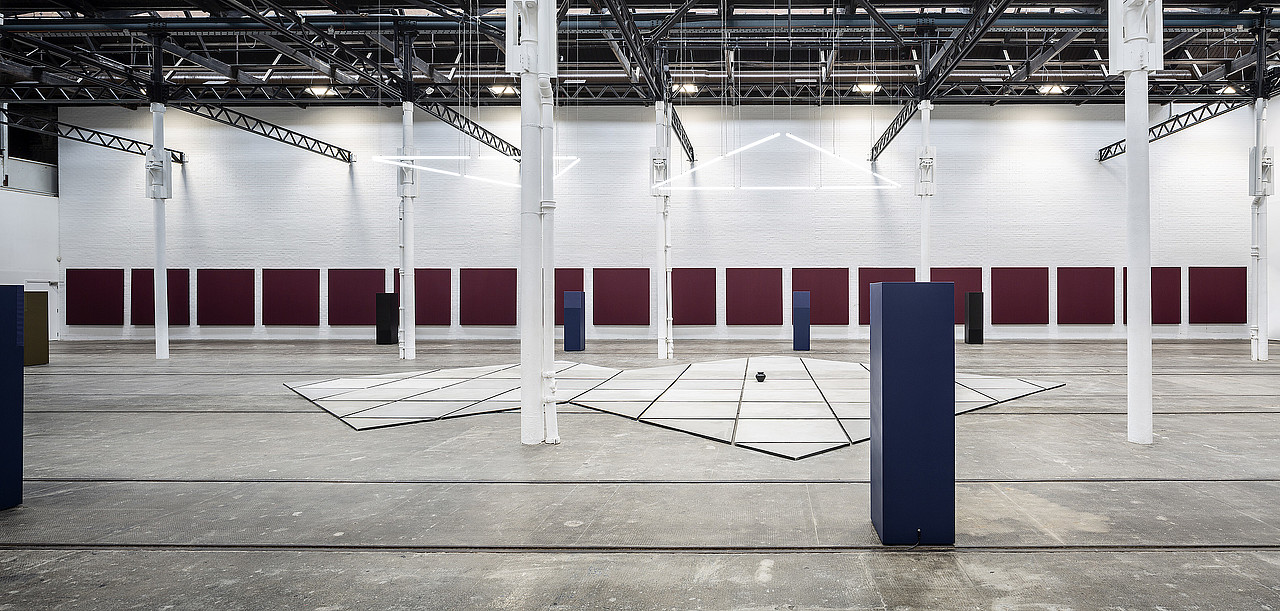
This soundwork is located within a configuration of architectural and design components that directly echo or cultivate physical elements found at the NID and operate as a topographic framework referencing Modernist architecture as well as India’s powerful textile industry, and South Asian ancient religious and mathematical traditions. The installation also functions as a performance space, with the geometric floor and sound system operating as a stage and PA system for a series of live musical events during the exhibition period, with performances by Imran Perretta, Nabihah Iqbal, Paul Purgas, Poulomi Desai, and Suren Seneviratne.
Adjacent to the central installation will be a resource area which expands upon the project’s themes and ideas, incorporating textiles and design objects, archival print material, books, moving image and sound. Examples of this will be a reproduction of the »India Lounge« furniture suite including the 24/42 chair co-designed by Hans Gugelot and Gajanan Upadhyaya as a partnership between the Ulm School of Design (HfG) and NID in 1965. The seating system created a material manifestation of a harmonised post-war and post-colonial modernity. Alongside this will be a presentation of materials relating to the Bauhaus’s first international exhibition presented in Calcutta in 1922 where works by Paul Klee, Lyonel Feininger, Johannes Itten, and other Bauhaus artists were presented alongside those of modern Indian artists such as Nandalal Bose, Sunayani Devi, and Abanindranath and Gaganendranath Tagore.These elements will be curtained with textiles, and presented alongside sound and moving image work to create an immersive pedagogical space that will also contain books and accompanying reading materials relating to the research.
Supported by Bauhaus Dessau, British Council, Complete Audio, HEDD Audio, Moog Europe.
The »We Found Our Own Reality« installation was originally commissioned & produced by Camden Arts Centre, London & Tramway, Glasgow.
Curation: Paul Purgas
Project Lead: Jan Rohlf
Production Lead: Sara Smet
Technical Lead: Jonas Hinz, Cagla Atar
Sound & Video Scenography: Astvaldur Thorisson, Tim Wildemann
Production & Set-Up Team: Benjamin Maus, Federica Partinico, Isabella Bassi, Jordane Coquard, Lilian Syrigou, Luka Murovec, Ninon Esclangon, Pelin Gebhard, Tom Richards, Ulli Altzschner, Victor Navarro
Thanks to: Alex Arslan, Jan Werner & Andi Toma, Klaus Bernzen and Tresor Berlin, Matt Williams, Martin Mäntele, Regina Bittner, Sebastian Reuter, Wolfgang Seidel.