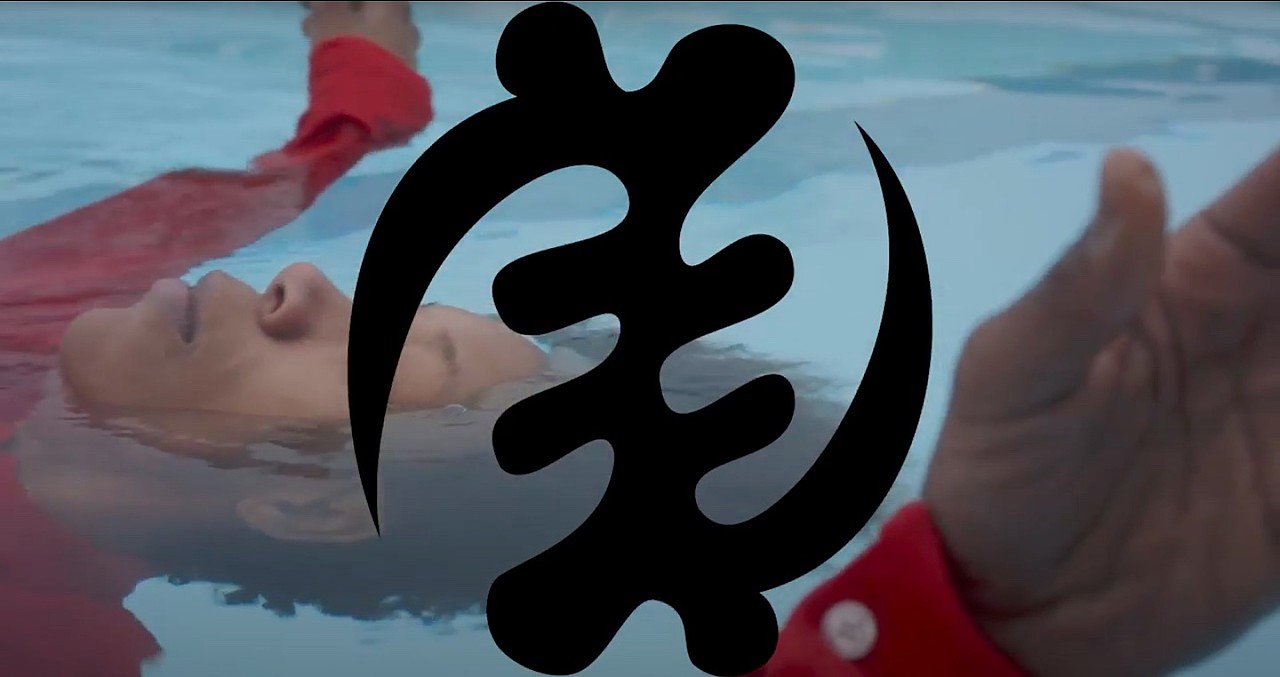
Commissioned by Nusasonic and Musicboard Berlin, artists Collo Awata and Madam Data will premiere an installation resulting from a months-long residency spanning Berlin and Singapore.
This audio-visual composition emerged from the artists’ dealings with nonlinear paradigms of time, such as cyclical time, curved time, fractal time, and quantum time. In these reckonings there are resonances with time-marking strategies in their non-Western pasts and presents; specifically those space-times outside of coloniality.
To create their work, the artists studied the Bakongo cosmogram (a recurring depiction of cosmology in artifacts and documents from the Kongo people), the range of time practices available to people in their own space-times (especially music, dance, and other bodily sounding traditions), and the artists’ own personal histories and ancestries.
So much has been lost: to time, willful destruction, and the degradation of storage media. The »loss« of information is a function of time – it means that in going in one direction (past to future), knowledge becomes less accessible. Yet the principle of conservation of information says that nothing is truly »lost« – just dispersed and divided – and as practitioners of time-manipulation technologies such as music, dance, and history, we are able to restore certain data continuities with our present. The resulting information is fragmentary, ghostly, sometimes contradictory, but it *is* us; it has its own life, it moves through the world as spirits do.
Collo Awata and Madam Data found that it is both difficult and undesirable to situate ancestral knowledge in the past; doing this recreates colonial narratives by ejecting histories/realities out of time and into a mythical »before« and a futuristic »after.« Instead, the artists chose to situate their experiences according to the cosmogram; as always having happened and always in the process of happening, as the motion of spirits through the world. They demand that the moment of our exit from the colony is not »now« or »then,« but at every single point along our continuum.
The Cosmogram
The Bakongo Cosmogram is most commonly depicted using a circle cut across by two lines, one vertical and horizontal. The four points at the ends of the crossing lines designate points of
significance: the bottom point, beginnings (Musoni); then moving counter clockwise, birth on the right, crossing over into the living (Kala); then, on the top, maturity and fullness in the world (Tukula); then, on the left, death, crossing over into the dead (Luvemba).
From the cosmogram we draw not only a cosmology but a system of temporal definitions. The counter-clockwise motion around the circle, described as the journey from life into death and back, allows for the overlap of points; a broad, resonant simultaneity. It also calls to mind the complex sinusoid of acoustic science, defined via amplitude (A), frequency (Omega), and
phase (Phi), also circling endlessly around its origin.
Motion then becomes more than displacement; the cosmogram is more than a map; it traces the geodesics of its space-time with the motion of spirits. »Kalunga,« the central horizontal line, represents the barrier between the world of the dead, the division between positive and
negative real numbers. Moving across it, we change from one thing into another; the change is the substance of motion itself, no longer an »accident« – one does not move without changing.
It is no surprise that Kalunga is often depicted as a body of water – something both artists are endlessly fascinated with, and have both experienced viscerally as the site of transformation.
The Yowa Continuum
This piece is a document of exploration and joy.
The installation goes through four stages: Kala (birth), then Tukula (peak physical experience), Luvemba (death), and finally Musoni (spiritual world) before re-birth. The four speakers and screens are a map of the cosmogram. The sounds and images depict a cross-association of spaces, physical onto spiritual, virtual onto real. They have been collected from the artists’ personal movements through their (currently disjointed) worlds. Honouring their agreement to situate the work in the broad, resonant present, and to reject any myth-making that robs people of access to time, they recorded elements of their daily lives – walking, speaking with friends, dancing together, singing, motion with and without the weight of ritual.
The artists invite any witnesses to move around the sounds and images in a way that is safe for them, and hope that people’s experience of this work reflects the continuity evident in the cosmogram – that the continuum it describes includes them, and imbues all of our actions with the grace of water itself.
Commissioned by Nusasonic and Musicboard Berlin. Nusasonic is an initiative by Playfreely/BlackKaji, Yes No Wave, WSK Festival for the Recently Possible, CTM Festival, and Goethe-Institut Southeast Asia. The presentation of the work at CTM is supported through the »dive in. Programme for Digital Interactions« of the German Federal Cultural Foundation with funding of the Federal Government Commissioner for Culture and the Media (BKM) through the »Neustark Kultur« programme.