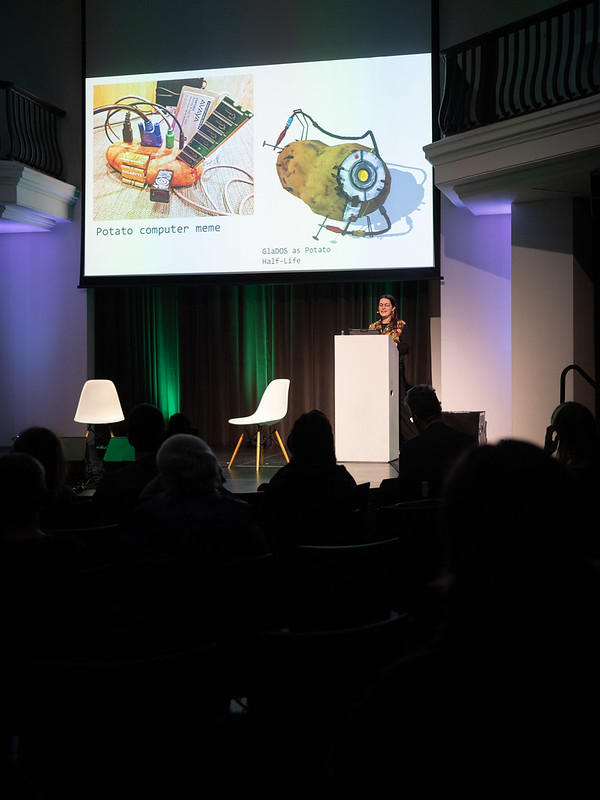
A big thank you goes out to the over 200 applicants that submitted proposals to take part in this edition. RND 2024 will assemble nine students, scholars, and artists/researchers from a variety of fields of study and approaches who will present research touching on CTM's Sustain festival theme. The selected candidates will give short presentations (10 min.) within different thematic modules, with discussions after each presentation and at the end of each session. Presentations will be in English.
This RND edition will take place in collaboration with the Berlin University of the Arts (UdK), the Institute Art Gender Nature at the Basel Academy of Art and Design FHNW, the C:POP. Transdisciplinary Research Center for Popular Music Cultures and Creative Economies of the Paderborn University, and the Berlin-based network and project space Trust. Entrance to the event is free.
RND 2024 Programme
Introduction
Hosted by Anita Jóri (CTM Festival, UdK University of the Arts Berlin)
Module 1: Sounding AI
Hosted by Trust
Symbiosis as a Sustainable Paradigm for Computational Creativity
Matthias Jung (PhD candidate, University of Agder, Kristiansand, NO)
Many search-based AI methods for music generation are based on evolutionary coding and genetic algorithms today. These computational approaches are inspired by evolutionary biology and often tend towards the Darwinian idea of the survival of the fittest: sustaining the most adaptable individuals of a population to create the next generation. This evolutionary principle, however, is not the only that has been suggested to explain evolutionary life. Lynn Margulis, for example, has suggested in the 1960s that symbioses play a much bigger role during evolution than previously assumed. Individuals and groups of the same and of different species have been forming collaborative entities and in fact even the cells in the human body have evolved as a merger of before separate organisms.
This brings up the question of what we might learn from these symbiotic associations for the field of music coding and how we can apply this principle for creating sustainable creative scenarios. Can biological theory even inspire the way we interact with creative technology in the first place, i.e. can we see human-computer interaction as a form of symbiosis and how can we use that perspective for understanding computational creativity? Finally, on a more concrete level, what are ways to integrate symbiotically intelligent organisms into creative practice and how can those contribute to sustain planetary life after all?
Matthias Jung holds a Bachelor from Paderborn University in Popular Music and Media and a Master in Electronic Media from Stuttgart Media University. Before starting his Ph.D. in Norway, he worked at Berlin’s state academy as audio production specialist and headed the programme team of Most Wanted: Music conference. His recent research focuses on Intelligent Music Performance Systems, bio-inspired coding and creative symbioses, some of which he carried out at Georgia Tech University as a visiting scholar.
Title Tba
Ada Ada Ada (PhD candidate, IT-University of Copenhagen, DK)
What happens when voice design becomes a matter of statistical analysis and averaging? Artificial intelligence tools are rapidly invading the world of sound. The field of voice cloning has particularly gained a lot of attention for both its ethical and legal ramifications. AI tools depart significantly from previous synthetic voice tools, due to their inherent reliance on statistical analysis. From a research angle, we dissect what this departure means for the tools' paralinguistic capabilities. In short, we want to know more about the politics and aesthetics of AI voices, and how they are able to perform.
In this presentation, we discuss how various voice cloning tools create cultures of the paralinguistic in different ways. We look at e.g. laughter, stuttering, pacing in voice-to-voice and text-to-speech tools like Microsoft Azure, ElevenLabs, and FakeYou. We speculate on how the limitations and possibilities inherent in AI tools can shape the future of voice, music, and sound design.
Ada Ada Ada is an algorithmic artist and research assistant. She works with gender and bodies as perceived by computers through algorithms, software and »artificial intelligence.« Her own trans experience often comes into play in her works. As part of Voice as a Matter of Design at the IT-University of Copenhagen, she discovers novel ways of using »AI« voice cloning software. She investigates how the design space of synthetic voices can be broadened to include more vocal identities.
Sustaining Voice: AI-generated Voices and the Human
Aline Zara (PhD student, University of Toronto, CA)
We are increasingly surrounded by AI-generated voices: the voice of the telephone answering machine, the voice of the train announcer, or the voice of the TikTok narrator. Some we can identify as AI-generated by ear, but as technology progresses these synthetic voices lose their robotic drawl to become nearly human, with realistic paces, pitches, and intonations alongside localised and racialised accents. We are adeptly and recognisably cloning the human voice – deconstructing it into units and recombining it into mimetic tonalities, words, and phrases via neural networks – to exist in presumed perpetuity. Does this cloning succeed in its overarching project to sustain?
Following the work of Dominic Pettman (2017), these machinic and cybernetic voices forge new social relationships as disembodied and extrahuman. However convincing, AI-generated voices may signify less as clones of their original human voices and more as simulated, hyperreal aurality – an expanded potential of what the human voice and experience can sound like. Grounded in the study of voice, technology, and critical AI, I reposition and relisten to AI-generated voices within human and non-human sustainability.
Aline Zara is a PhD student at the University of Toronto’s Faculty of Information in Media, Technology, and Culture, and is part of the Book History and Print Culture collaborative programme. She works as a researcher in the Canadian book industry with BookNet Canada and is the founder and publisher of nAIrrative Press, a publishing house devoted to AI-written, AI-narrated audiobooks. Her doctoral research focuses on AI-generated voices, orality, and storytelling in audiobook narration.
Module 2: Embodied Listening
Hosted by Christoph Jacke (C:POP. Transdisciplinary Research Center for Popular Music Cultures and Creative Economies of the Paderborn University)
The Body as a Site for Composition
Ragnhild May (PhD Fellow, The Royal Danish Academy of Fine Arts/University of Copenhagen, DK)
Traditional Western instruments are designed for a specific body and a specific type of practice. Feminism and posthumanism give a different view on the body’s relation to technology than the one that has been prevalent in musical history. What traditionally has been viewed as separate entities are fused and entangled. An example of such an entangled relation is seen in the psychoacoustic phenomenon difference tones, an additional low-frequency third tone that occurs endogenously in the ear of the listener as a consequence of two high pitched tones. The tone does not exist in the original sound stimuli but is elicited endogenously in the ear (Roederer, 2008). The phenomenon blurs the boundaries between instrument and body as the sound is elicited from inside the body of the listener, that thereby can be seen as the instrument itself or the site for composition. This raises issues such as: Can one envision a type of instrument practice for other norms, bodies and forms of practices? When are the categories body and instrument entangled?
Theoretically, I will consider difference tones as an example of another way of understanding the instrument’s relation to the body. The theoretical survey of the issues will take its starting point in the concepts: entanglement and cyborg, sourced from Karen Barad and Donna Haraway.
Ragnhild May is educated in visual arts and has a Master of Fine Arts in Music/Sound from Milton Avery Graduate School of the Arts (US) as well as Post-Master of Fine Arts in Sound Art from Royal Institute of Arts Stockholm (SE). She is currently a PhD fellow at the Royal Danish Academy of Fine Arts (DK). May has been awarded the Carl Nielsens Talent Price, International Studio & Curatorial Program. In 2022, May was an Arts and Media Fellow at DAAD in Berlin.
Captioning Sustained Sound: Closed Captioning and Accessibility in Sound and Video Art
Mariana Dias (Masters studies in Visual & Media Anthropology, HMKW Berlin, DE)
My research surveys emerging practices in Closed Captioning and Accessibility in the fields of Sound Art and Video Art. Closed Captioning is a crucial accessibility feature that involves much more than dialogue transcription, essential sound cues and speaker identification. While established standards exist for film and TV, unconventional narratives present in sound and video art pose challenges that can make the captioning process subjective, risking artwork misrepresentation and a diminished experience to those who rely on this accessibility feature. Therefore, the goal of this research is to survey, measure and suggest closed captioning methods specific for sound and video art that sustain audience diversity while extending the expressive potential of these art forms. The presentation would include examples of captioned sound and video art pieces, the considerations behind their captioning process, and how certain techniques might be scaled into accessibility protocols for larger exhibitions, collections, or even festivals.
Mariana Dias is a Brazilian-American scholar from Miami, currently pursuing a Masters in Visual & Media Anthropology at the Hochschule für Medien, Kommunikation und Wirtschaft (HMKW) Berlin. For the past ten years she has been active in online radio and audiovisual translation, two fields now converging in her academic practice. Her current research interests include AI and conflict mediation, non-violent communication, online radio websites, and auto-ethnographic radio storytelling with memes, the latter taking the form of a monthly radio show called Deep Fried DJ on Cashmere Radio.
Collective IDentity: Collaborative Improvisation, Voice, Movement and Parkinson's
Jaka Škapin (Musical Director at Luminelle, London, UK)
Collective IDentity (CID), is the latest in a series of multidisciplinary explorations produced by Luminelle, a UK-based community interest company. Alongside long time collaborator Danielle Teale, this project explores the intersection between improvised, mindful expression, and professional, co-creative practice with dancers with Parkinson’s. It explores core themes of intimacy, care, and relationship, and was devised using a co-creative approach in which all dancers took part in a live, improvised dance process within their home in 2021.
Drawing on stories and experiences from their lives as inspiration, Jones and Škapin improvised a responsive and nurturing one-to-one exchange with the dancers in workshops which took place across the country in the homes of dancers with Parkinson’s. Movement direction by Danielle Jones draws from the raw and human approach of cinematographer Pavel Radu, using handheld camera to connect with the vulnerability of the human body in movement, amplified by the improvised vocal contributions of Jaka Škapin which utilise looping and sampling technologies. The resulting body of work is an honest, intimate, and jubilant look at life, the body, and the domestic space.
This presentation aims to pose questions about the role of voice, improvisation and technology in co-creative processes which centre the lived experience of vulnerable groups and individuals.
Jaka Škapin is a Slovenian transdisciplinary performance artist and award winning composer (Sound and Music awards, best sound/music at the Toronto Experimental Film Festival, best dance film at LA Shorts film festival) whose sound is marked by meditative and expansive vocal tapestries bearing the marks of his background in choral music, jazz training, and Slavic heritage. His work has recently been featured by the British Music Collection, the Netherlands Institute for Sound and Vision, and funded by PRS Foundation.
Module 3: Locating Sounds
Hosted by Stas Shärifullin (Institute Art Gender Nature at the Basel Academy of Art and Design FHNW)
Scottish Cityscapes, Cultural Lifeways, and Black Sonic Ecologies: The Case of Sound System Cultures in Edinburgh
Aadita Chaudhury (PhD candidate, York University, CA and research assistant, Goldsmiths, University of London, UK)
The meeting of Black technoscientific knowledge traditions with Scottish history and its presence throughout its cultural lifeways and cityscapes speaks to a unique heritage of colonialism and exchange that is specific to the Scottish experience. While Scotland has its own history of various degrees of subjugation under the British colonial project, Scottish people have also partaken in empire as is sometimes described as »junior partners« in the imperial project through their own involvement in extraction of lands, resources, lives and knowledge systems.
In late 20th century and contemporary United Kingdom, reggae sound systems remain a palpable part of the ways Black sonic ecologies and knowledge systems propagate. The commingling of Scottish and Caribbean experiences, and the resultant technoscientific cultures are yet to be fully considered. This paper situates the role and persistent presence of Black knowledge systems in the Scottish context, with a specific attention to the sound system scene in the city of Edinburgh and surroundings.
Aadita Chaudhury is a PhD candidate in science and technology studies (STS) at York University, Canada. With a background spanning environmental studies, STS, political ecology, cultural studies and interdisciplinary arts practice, Aadita explores how scientific inquiry and the arts can configure nature as a site for embodied experiential knowledges, and future world-making. She is also a research assistant to the Sonic Street Technologies project at Goldsmiths, University of London.
Listening as a Form of Activism, Field Recordings as an Act of Archival Practice
Julianne Chua (Humboldt-Universität zu Berlin, DE)
MOTHER TONGUES is a countermapping video project that explores the issues of language, (post)migration, and diaspora by disrupting static images of liminal and interstitial sites in the city of Berlin with a cacophony of field recordings from İstanbul, where generations of Gastarbeiter*innen (»guest workers«) and newer waves of immigrants trace their last port of call. Teasing out notions of hapticity, ephemerality and transience through the specificity of analogue photographs created with a Kodak FunSaver disposable camera as a chosen medium, the images elucidate the sense of loneliness, anonymity, and alienation that immigrants sometimes face, reinforced by scenes of supermarkets, train platforms, and traffic lights that are mostly devoid of people.
Berlin’s diasporic population is much more diverse than its English-speaking communities, and this landscape is ever-shifting. Despite this fact, languages such as Turkish, Arabic, and Vietnamese are overheard on the streets, but unheard on »official« channels. How can we invoke collective acts of listening and participatory art to transpose notions of the diaspora and sustain transversal affinities? By disrupting spaces with silences and sounds from elsewhere, the work reflects upon the absence of multilingualism in Berlin’s public spaces and activates sonic borderlessness as a tool to reimagine space as (post)migrant utopias.
Julianne Chua is a Singapore-born, Berlin-based artist, writer and researcher. Her works have been published or are forthcoming in Afterglobe, Kepulauan, The Posthumanist and SAVVY's Burning?, presented at Kunstraum Potsdamer Straße, Weißensee Kunsthochschule and Universität der Künste, and performed at NYU Abu Dhabi and Haus der Kulturen der Welt. As part of Refuge Worldwide’s Radio Mentorship Program, she is developing a show that interweaves poetry, field recordings and sound archives.
Sustaining Inequality: The Right to Territory & Rave Culture in Conflict Regions
Maria Giaever Lopez (independent researcher)
This presentation explores the relationship between the right to territory, rave, and festival culture and the power relations imbricated in between. What happens when we organise raves or festivals in foreign, post-colonial, or post-conflict regions? Who has the right to the territory and to occupy it? Is the practice of a »free party rave« or the »music festival« sustaining inequality in this territory? What practices can be developed to take care, foster interdependency, and counter extractivism? Is it ever possible in our everyday consumer society?
This paper presents two case studies through ethnography and document analysis: the free teknival in Albania (every end of August since 2019) and BPM festival (Mexico, finished in 2017) in order to interrogate the extractive and neo-colonial effects of types of events. The presentation argues for the need to develop a more ethical and decolonial culture of partying while building a critical notion of the »right to the territory« that questions the current state of both underground and mainstream practices.
Maria Giaever Lopez is a researcher of electronic music & colonialism. She holds a PhD in Sociology from the University of Westminster (London). Her thesis explored resistance practices through the Palestinian electronic music scene. She is part of Sota a Terra (Valencia) a feminist rave collective.