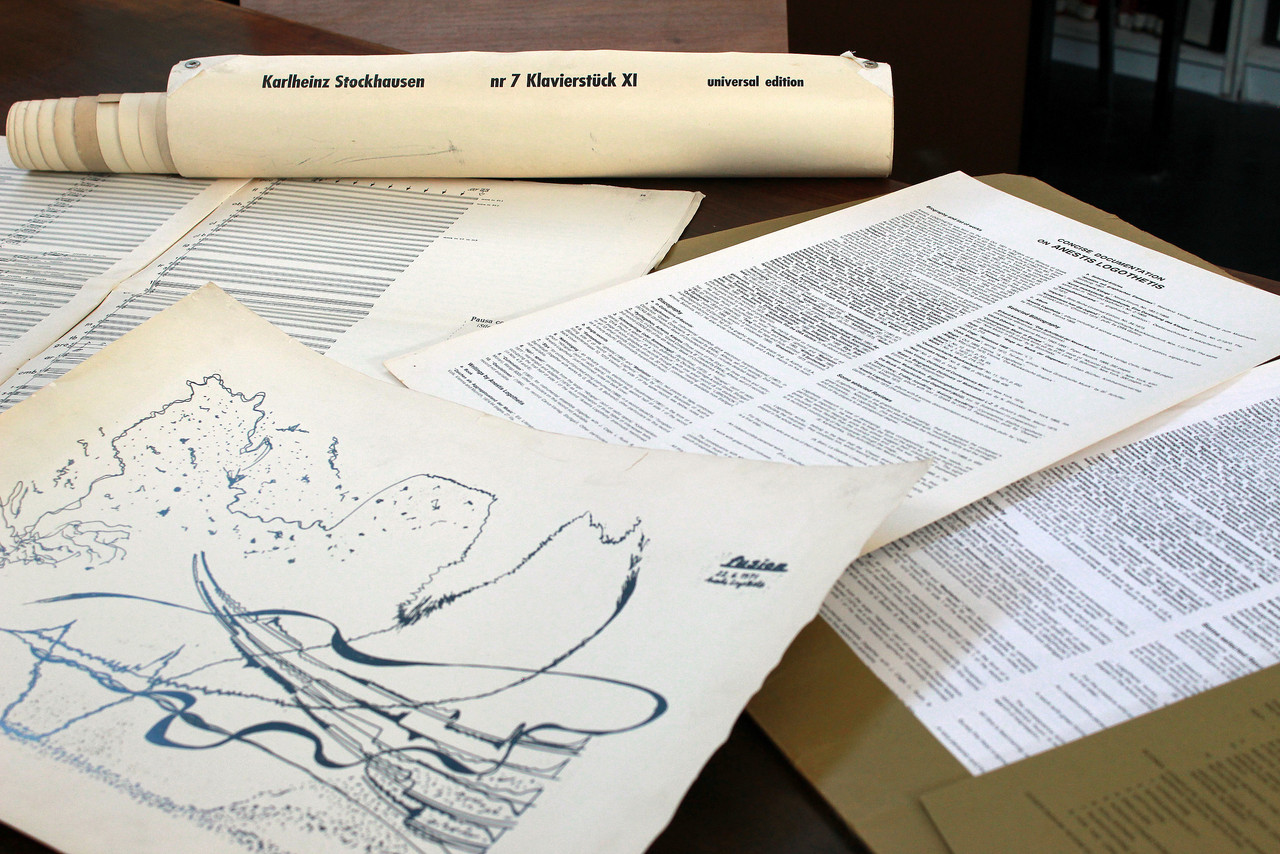
Programme
March 29, 2021 | 17:00-18:30 CET (Berlin time)
»RevArsAvr: Backwards to the Future« by Andrey Smirnov
March 30, 2021 | 17:00-18:30 CET (Berlin time)
»Future Chorus« by Eleni Ikoniadou
March 31, 2021 | 17:00-18:30 CET (Berlin time)
»Where ›time‹ takes ›place.‹ Media-Archaeological Thoughts on the (Musical) Topologization of Chrónos in the Archive, and as (Sonic) Technológos« by Wolfgang Ernst
How to Join
All sessions are now full and registration is closed. Please note that the talks will be recorded and made available shortly afterwards on the YouTube channels of CTM Festival and Athens and Epidaurus festival.
Detailed Talk Descriptions
RevArsAvr: Backwards to the Future
Talk by Andrey Smirnov
This lecture focuses on revolutionary Russian composer, theorist, and adventurer Arseny Avraamov, an early proponent of the mathematization of music and its’ restructuring according to principles derived from acoustical research. In 1916, one year before the Bolshevik coup, Avraamov published »Upcoming Science of Music and the New Era in the History of Music,« a manifesto-like article proposing the use of the language of mathematics to more easily and efficiently convey musical knowledge. His objective was to unite efforts of researchers and artists to produce a revolution in music theory and techniques based on the cross-connection of the arts and sciences. Among the subjects under consideration were new approaches to music theory, spectral-based musical composition, sound synthesis, polyrhythms, and future enrichment of a rhythm by means of combination of the Ancient Greek and modern principles. While in Soviet times the name of Arseny Araamov as well as his theoretical works were largely forgotten, in 1940 leading Russian composer Mikhail Gnesin asserted: »A. Avraamov should also be recognized as a founder of Soviet musical acoustics.« Indeed, most Russian musical inventions and developments (the Theremin, Graphical Sound, the Rhythmicon, ANS Synthesizer etc.) might be considered as direct or indirect consequences of Avraamov's manifesto.
Andrey Smirnov is an interdisciplinary artist, independent curator, collector, and writer. He is the founder of the Theremin Centre, a research fellow at the Centre for Electroacoustic Music at Moscow State Conservatory, the head of the Rodchenko Sound Lab, and a lecturer at the Rodchenko Art School in Moscow. He teaches History and the Aesthetics of electro-acoustic music, composition, and new musical interfaces. His main ongoing project is focused on restoring the censored history of artistically utopian early 20th century Russia. He is the author of the book Sound In Z: Experiments In Sound and Electronic Music in Early 20th Century Russia (Walther Koenig & Sound and Music, London, 2013).
Future Chorus
Talk by Eleni Ikoniadou
Imagine a chorus of voices – some human, some animal, some machine – arriving from an unknown space and time to perform a lament. Laments are extreme expressions of grief in the form of a song or poem. In ancient tragedy, a chorus typically (re)turns to the past to scan history for a precedent, in search for meaning of the present. On this occasion, the chorus travels to the past not to learn from it but to rewrite it, from the perspective of those voices silenced by the archive.
Dr Eleni Ikoniadou is Senior Tutor in Visual Communication and leader of the Experimental Communication pathway at London's Royal College of Art. She curates and runs Fugitive Voices, a series of conversations with guest artists and theorists that seeks to locate practices and concepts that disrupt dominant narratives and official archives. As part of her art group AUDINT (audint.net), with Steve Goodman (kode9) and Toby Heys, she has co-edited the volume Unsound: Undead (Urbanomic, 2019) and produced a series of exhibitions under the same title, funded by the Arts Council of England (2018-2020). She is founder and co-editor of the Media Philosophy Series (R&L) and author of the monograph The Rhythmic Event: Art, Media and the Sonic (The MIT Press, 2014).
Where »time« takes »place.« Media-Archaeological Thoughts on the (Musical) Topologization of Chrónos in the Archive, and as (Sonic) Technológos
Talk by Wolfgang Ernst
In a variation of Marcel Proust's seminal novel, A la recherche du temps perdu, and playing with the term chronotopia itself, this lecture will be ask: Where does »time« take place? This talk will first examine how current videoconferencing media determine our communicative co-presence, before exploring a (re-) definition of the term »chronotope,« with a reference to Michel Foucault's seminal text »Of Other Spaces.« The musical »archive« will be contrasted with the sonic »recording,« via a focus on symbolic musics versus actual sounds found in the KSYME archive. The more we focus on »time,« the more remote this parameter becomes, dissolving into a multitude of cultural techniques and technological operations. More radically, »time,« as a reasonable and plausible parameter of analysis, itself gets lost in the present media condition.
Wolfgang Ernst is trained as a Historian and in Classics (Latin Philology and Classical Archaeology), with an ongoing interest in cultural temporalities before growing into the emergent technology-oriented »German school« of media science. His academic focus had been on archival theory and museology, before moving to media materialities. Since 2003, Ernst is Professor for Media Theories at the Institute for Musicology and Media Science at Humboldt University in Berlin. His current research covers »radical« media archaeology as method, the epistemology of technológos, the theory of technical storage, the technologies of cultural transmission, micro-temporal media aesthetics and their chronopoetic potentials, and sound analytics (»sonicity«) from a media-epistemological point of view. A list of his books published in English and with a focus on technical media are: Digital Memory and the Archive (2013); Chronopoetics. The temporal being and operativity of technological media (2016); Sonic Time Machines. Explicit Sound, Sirenic Voices and Implicit Sonicity in Terms of Media Knowledge (2016); The Delayed Present. Media-induced interventions into contempor(e)alities (Sternberg Press) 2017.
Chronotopia Echoes / Αντηχήσεις Artistic Lab
Over this past autumn and winter, artists Alyssa Moxley, Gaspar Cohen, Giulia Vismara, Max Eilbacher, Savvas Metaxas, and Sofia Eleni Xezonaki have been meeting with mentors Anke Eckardt and Akis Sinos to learn about the artistic knowledge stored within the KSYME Contemporary Music Research Centre in Athens. The artists are now busy developping new works that re-interpret or are inspired by the archive's myriad artistic concepts, methods, narratives. We can't wait to see their creations in the 2021 edition of the Athens & Epidaurus Festival, and in the meantime, we're pleased to share a short video impression of our time spent learning together.