Last year, I went to see the black metal documentary Until the Light Takes Us, which was screening at a local theatre as part of a music documentary festival. The movie shows interviews with many musicians from the Norwegian black metal scene, most prominently Varg Vikernes (Burzum) and Fenriz (Darkthrone). One particular phrase from the latter caught my ear, and stuck to me as I left the theatre.
During a rant about modern art, Fenriz says about Mexican painter Frida Kahlo: »My least favourite artist is from Central America. It is the woman who paints all the women with strong eyebrows.[…]. She always painted this really close to nature, with strong colours. It’s the perfect [representation] of being repressed, I mean, you want everything to be shiny.« He concludes: »No, I like the more wealthy and troubled art that comes from the exhaustion of easy life.«
Metal music in the Global North can be seen as a reaction to the »dead-end dreams of the modern project,« says Cuban scholar Nelson Varás-Diaz in the intro to the book, Heavy Metal Music in Latin America. If so, where does this put the vast and hugely influential output of metal music in the Global South, and Latin America in particular? Could it be just a shiny and oblivious representation of repression, as put by Fenriz?
In 1979, heavy metal pioneers Black Sabbath were dealing with the departure of Ozzy Osbourne as they would go on to release Heaven and Hell, with Dio on vocals. The same year, Mexican band Fongus released their debut Guadalajara Rock, fusing psych and garage rock and counting on obscure and noisy production. The band would, further into the 1980s, become one of Mexico's first relevant heavy metal groups.
In the year that followed, as the new wave of British heavy metal (NWOBHM) made its way into the mainstream with releases like Iron Maiden's Killers, Argentinian group Riff put out Ruedas de Metal. Led by guitarist Pappo, the band showed a progression from the blues sound of his previous musical endeavours into heavy metal and hard rock.
As thrash metal thrived with Metallica's Kill 'Em All in 1983, Venezuelan band Arkangel addressed the country's oppressive conditions in the record, Represión Latinoamericana.
And just as Mayhem impacted black metal with their catchy and obscure riffs in the release of Deathcrush in 1987, Brazil's Sarcófago dropped I.N.R.I., cited as an influence by many musicians who formed the infamous Norwegian black metal scene in the late 1980s, Fenriz included. The book, Lords of Chaos, which gives an account of the early Norwegian black metal scene, even goes so far as to say Mayhem's Euronymous was »obsessed« with Sarcófago's visuals.
Metal music, although largely ignored in decolonial literature, has been one of the forces challenging coloniality by allowing oppressed individuals in Latin America to represent the world as their own and in their own terms.
For Varas-Díaz, all of these are examples of how, since the beginning, Latin America was never consuming or making metal music passively. In fact, the author argues, the region was »interested in forging its own path through the musical genre« – a path that was built through the context of social oppression and political instability faced by the colonised region.
Lyrically, sonically, and visually, various metal bands along the continent have challenged their experience of ongoing oppression. This is especially true for extreme metal, where groups have taken the darkness and death that are usually the focus of lyrics and visuals a step further, to represent the extremely violent context from which their music emerges.
Take for example the band Masacre, a death metal group from Colombia. They started making music in Medellín in 1988, during a time in which drug cartels and paramilitary groups – and the violence that came with them – were thriving in the city. Masacre was one of the first bands to explicitly express life in Medellín: the cover to their first demo, Colombia… Imperio del Terror, is an illustration of a dead person lying on the ground, with the city in the background. Themes of war, terrorism, and corruption are spread throughout their early releases. Masacre is »death metal resisting death,« as put by scholar Pedro Manuel Lagos Chacón in an article about the band.
Active resistance to oppression is not the only way early Latin American extreme metal musicians expressed their context. An important part of what makes their output particular to the region is the idea of »integrating, and not simply juxtaposing,« as says Varás-Diaz. Metal with local influences – not only musically, but also culturally.
This can be seen in classic works by Brazilian band Sepultura, and especially with their album Roots which is, quite literally, about getting in touch with one's roots. In the lyrics, vocalist Max Cavalera references Brazilian favelas, the murder of Chico Mendes, an Amazon rainforest advocate, and indigenous peoples of Brazil – which participated actively on the record, since the band traveled to the state of Mato Grosso to record with the Xavante.
»Metal music, although largely ignored in decolonial literature, has been one of the forces challenging coloniality,« Varás-Diaz writes, »by allowing oppressed individuals in Latin America to represent the world as their own and in their own terms.«
As decades went by, a lot changed in Latin America. Most of the military dictatorships were fading by the early 1990s, and along the next decade the continent went through what is now known as the pink wave, or »turn to the left« – a tendency of Latin American governments to move away from the neoliberal economic model into more socially progressive policies. But as some of those governments lost popularity for a myriad of reasons, another conservative wave struck the continent in the late 2010s, and even as some countries pushed back – for example Bolivia and Honduras – Latin America's social inequality issues and the effects of colonialism did not disappear overnight.
»I find that it's way more insidious than just who's in charge at the moment,« says Pablo Miguel Méndez, one half of the Colombian band MICO. »We just elected the first leftist president [Gustavo Petro] in years here, but that doesn't mean the problems in our country just disappear – if anything, conflicts that were being silenced come to the forefront, the size of the wound is made more evident and the realization sets in that the healing process will not be easy.«
Formed in 2012 by Méndez and Iván Mauricio Zapata, both of whom had been in hardcore and experimental bands before, MICO is a blend of extreme sounds that takes off from their original influences and adds grindcore, black metal, and metalcore into the mix. Last year, the duo released their fourth record, Zigurat, a loose concept album around the idea of a »blasphemous contemporary retelling of the Tower of Babel.«
»Colombia is a pretty religious country, and it got me thinking about all the praying that must go on. The main idea was: what if all those prayers have already been heard and heeded? What if we're already surrounded by the answers to this absurd cacophony of contradictory pleas?,« explains Méndez. »The seraphim in the opening track, for example, ›Impío Serafín,‹ is an angel sent by the judeo-christian god to try to answer this chaotic collection of deranged praise; an angel tasked with wreaking death, injustice, and corruption.«
Using religious figures, forging digital representations of a modern-day Tower of Babel, and mixing extreme sounds and guttural screams, MICO paint a picture of confused, isolated individuals that are »just well-programmed enough to keep the wheels turning.« A picture, Mendéz says, impossible to detach from his motherland.
»I feel it's inevitable for you to be affected by being born or living in Colombia, or any other country in the Global South. It's just a matter of whether you choose to reflect that in your art or not – there's a surprising amount of artists that go to great lengths to pretend otherwise.« He concludes: »Being alive at all right now, it's hard not to be radicalized, or at least feel that pull.«
Argentinian duo Ysyry Mollvün also pull from historical contexts to discuss injustices that are still present today. Band founder Zupai Ulen is a descendant of the Selk'nam, an indigenous people that lived in Southern Chile and Argentina. They suffered a mass genocide at the hands of Spanish explorers, who killed over 3,500 Selk'nam between 1880 and 1900.
»An entire ethnic group was erased,« says Ulen via email. »The mestizo descendants – as is my case – have little knowledge of our roots because we only have what we could learn from our grandparents and the little we can find out from other descendants. The rest is told by the conquerors.«
At 18, Ulen started singing in hardcore punk bands, and it wasn't long until he came in contact with black metal through the Argentinian band Sartan. After forming Ysyry Mollvün, it took him a decade (and the joining of musician Antonio Sanna, from the Downfall of Nur) to complete what would become the band's self-titled debut album, released in 2022.
Ysyry Mollvün tells the story of a Selk'nam spirit that comes back to Earth centuries after their people's genocide. The spirit must deal with what happened, and wonders what they can do so that everything goes back to how it was. Aside from the classic black metal sound, the album also has additional instrumentation to add aesthetic depth and layers to its story.
»I think that genocide and revenge are much more effective to tell in a style like black metal,« says Ulen. »We use Creole instruments – that is, instruments that were not necessarily created by natives, but that are a mixture of natives and Europeans, just like me. We also use charango, sikus, and some more flutes.«
He concludes: »I wish there were more bands and projects in black metal with native descendants. Let every musician with native blood bring out something that speaks of the pride he feels in being what he is. That's why I do this.«
Centuries of oppression and colonisation are inseparable from Latin America's extreme metal, but more recent macabre stories have also inspired some of its most important new music. The disastrous government of far-right ex-president Jair Bolsonaro in Brazil seems to have spurred protest material from both new and old bands.
Grindcore and crossover thrash heroes Ratos de Porão released the 2022 album Necropolítica, the 14th in their catalogue, with lyrics that speak against growing neo-nazi and fascist movements in the country. The death metal group Crypta, formed during the pandemic with ex-members of the thrash metal band Nervosa, have said that many of the tracks in their debut record Echoes of the Soul (2021) were also inspired by the political moment in Brazil (»Starvation,« for example, is about the millions of people dying of hunger in the country).
If we can hear in the void and see in the dark, everything becomes clear.
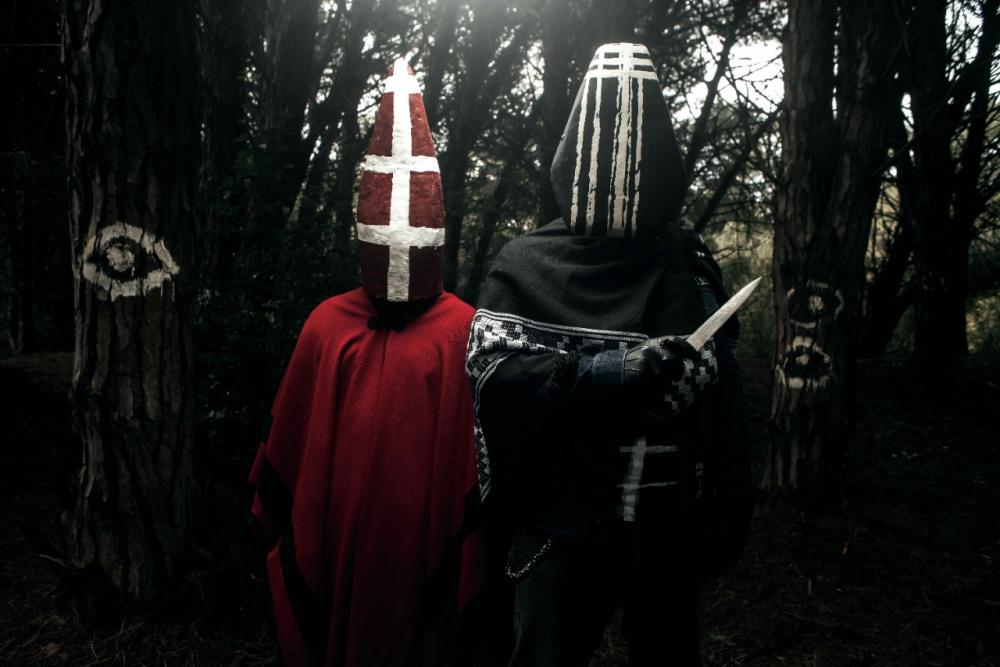
The darkness in Brazil's recent history is reflected even indirectly in the emergence of new bands, such as Falsa Luz, a black metal group that was formed during the lockdown, in 2020. The quartet's gigs are presented through a cloud of fog so that member's faces are not visible. They also don't reveal their names and decline to speak about their former musical projects. That's all because, as says the band's vocalist who goes by the initials D.C., »the music speaks for itself.«
»You can say that Falsa Luz was formed out of frustration. Frustration with the modern world, frustration with what was going on around us (including musically), frustration with the lack of perspective caused by the pandemic...,« he explains.
The band's first recordings, heard in the EP Vozes Penadas released in 2020, were made only by D.C. and guitar player D.D. As of today, the band is also formed by two other members and has released a few other records, including Obscurecido Pelo Fim in May 2022 and Breu Eterno in February 2023.
The themes of darkness, absence of light, the void, and emptiness are a constant in Falsa Luz's (which translates to »fake light«) music, which mixes second-wave black metal with a lot of punk influences. Although they deal with more personal points of view, the songs embody the possibility of »transforming the way you relate to the world, which is perhaps the greatest fuel for a collective positioning,« says D.C. »The idea of night and day, light and dark, brings different reactions and interpretations. The absence of light shouldn't seem so uncomfortable, and if we can hear in the void and see in the dark, everything becomes clear.«
Hailing from the south-eastern state of Minas Gerais, also home to the aforementioned Sarcófago and Sepultura, D.C. recognises a lot of those scenes' sounds and ethos in the creation of his music. »Those streets have a history with metal and there's no way to grow up listening to that kind of sound and not be impacted by those bands,« he explains. »Undoubtedly it was a scene that not only helped to shape metal in the country, but also in the rest of the world. Just look at [Mayhem's] Dead and Euronymous, on the other side of the world, at a time when access to everything was more difficult, wearing Sarcófago t-shirts in a photo. Or simply listening to [Blasphemy's] Fallen Angel of Doom and getting the influence.«
D.C.'s observations about the Minas Gerais scene exemplify what the scholar Nelson Varás-Diaz means when he says that metal music has »become part of the social fabric in Latin America,« present in every country with varying degrees of popularity and influence. Even if it has never made big mainstream splashes in the continent, it remains one of the most prominent ways of standing up to the various forms of oppression using extreme sounds.
Metal music in Latin America has also constantly been pursuing new tendencies and approaches apart from those in Europe and North America. Some of the most interesting and influential extreme metal sounds of both past and current movements and genres have been made here, because, as states Chilean musician Cinthia Santibañez of the band Crisálida, in the introduction to Varás-Diaz's book, »it's about giving back something other than hate and violence.«
Amanda Cavalcanti is a Brazilian music writer. She worked for four years as a reporter and documentary host at VICE Brazil, and has bylines in The Wire Magazine, Bandcamp Daily, Folha de S. Paulo, and UOL, among others.
This text was commissioned as part of CTM 2023 – Portals.