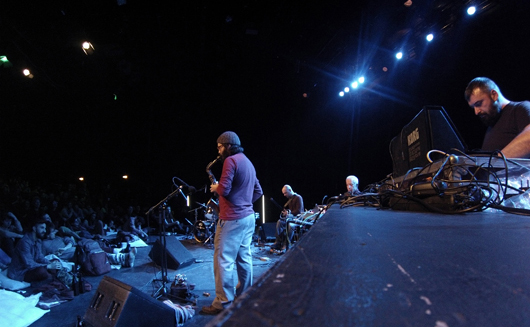
Beaini grew up on Lebanon’s Mediterranean coast during a period of civil war. Without formal disciplinary structures at home or in school, he says he oriented himself through direct experience in the context of a sometimes volatile »survival environment.« These years spent developing critical awareness and adaptability constituted his earliest exercises in improvisation. He didn’t join up with the militias, nor align with the traffickers around Beirut’s harbours. »My dad at this time did not say, ›don’t go with these people.‹ He never told me this. I just did not do it by myself. And my friends at that time knew not to bring me inside their businesses. They never even tried, not even once, to involve me in anything, not even carrying, or holding a gun in my hand… And that was not fear, but I knew there was something wrong in the political system. I couldn’t take any decision or be on a side with someone else’s ideals, because those ideals were often changing.«
As a DJ and producer, Beaini negotiates de-territorialised, mutable sound worlds largely created through improvisation and recorded in one-take sessions. He began his career in music DJing first in Lebanon, then Italy after leaving architecture school. Recognised for his raw, industrial-influenced techno, his sound integrates redemptive, freewheeling strands of Lebanese folk songs; classical Indian ragas; free, spiritual, and cosmic jazz; noise; and modular electronics – all brought into eruptible dialogue or dismantled and recycled for parts, their residual energy still stinging and singing through tonal or structural skeletons. »There’s always a sense of melancholy, a weird dark feeling, and there’s always a bright thing, a bit of hope,« he says of the resulting play with dissonance. »And these two things are always expressed in my music, often simultaneously.«
Beaini embraces atonality and opposition as parts of libratory practice. »You start realising how to live in it, how to, in a way, understand the code of it,« he says, likening the process to acclimating to the anarchic metropolitan rhythms of Beirut, or internalising the abstract, exploratory logic of avant-garde electronic composers such as Stockhausen or Cage. This is pedagogical, as well as personal. »I like that people gain their own consciousness about things and know that there are other ways, and there are other worlds – not just this world that is drawn in front of us,« he explains. »There is another thing out there, and you just need to start learning how to listen.«
In his live and DJ sets as Morphosis, he pushes listeners to confront their own limitations, even rupture them. »I have to capture them into a cage and start throwing things at them,« he says. »That’s the only way. Because if they are free in a field, I cannot reach them.« You have to lure listeners in, he says, speak to them in their own language, then detonate and set them free.
Beaini founded Morphine as a platform for sharing such music, which he considers an educational tool. He describes the label, known for analogue, outsider techno from the likes of Hieroglyphic Being (aka Jamal Moss aka IAMTHATIAM aka The Sun God) and Philadelphia-based experimental noise duo Metasplice, as a multiplicity of ideas without stylistic strictures governing its output. The label maintains strong allegiance to its peripheral position to the dance music industry, issuing releases without much hype and minimal artist promotion. Beaini is not aiming for a universally palatable sound; he says he actually wants to filter Morphine’s audience to discourage appropriation. But the label’s releases have come to critical recognition, not as products of haphazard experimentalism, but deliberate and dedicated no-bullshit free form.
»I don’t want to call it pioneering, but in a way, yes, it’s inspired,« Beaini says of Morphine. It doesn’t subscribe to trends, because trends fall. It’s not pretentious; it’s just a story, a container for strong and singular voices. »I wouldn’t put anything that would age out,« he says. »I would like music on the label to stay eternal, timeless in a way.«
Beaini first encountered Morphine label artists Metasplice through his interest in the American noise scene. »Their sound was a new form of sci-fi,« he recalls in a recent email interview from Lebanon. »Futuristic tones based on an improvisational structure, and incredible techniques on their gears.« Through improvised dialogue, the duo instrumentalises discomfort with the manipulation of sonic extremes. Their sound escapes literal interpretation, but its affective, corporeal power is undeniable. »This is a very rare case of genius in my opinion,« Beaini says. »In a way, it’s like going inside a bar and screaming at people. People don’t understand what you’re saying, but they understand that there’s something going on. Some people will follow you out, and some people just stay sitting at the table. The people that go out will do the revolution with you, even if they didn’t know it was a revolution going on. They were just carried by the strength of this screaming guy in whatever language.«
Kenneth_Lay (aka hair_loss) of Metasplice had been collaborating with fellow Philadelphia experimental musician Charles Cohen as Color Is Luxury, and it was he who introduced Beaini to Cohen’s early recordings as Ghostwriters with Jeff Cain. Cohen has been developing his own musical discipline, notable for its stylistic continuity, for the past 40 years. He is one of the few artists to own and have mastered Donald Buchla’s Music Easel, a rare portable synthesiser built from two modules of the Buchla 200 Series, from which he procures an expansive sound palette with the intuition, nuance, and careful listening of a virtuosic instrumentalist.
»The world of electronic music as it was unfolding in the early 1970s resembled an Odd Fellows picnic, emerging pell mell on the outskirts of the 60s pop explosion,« Cain writes in a reflection on Cohen published on the inner sleeve of Music for Dance and Theatre. »A new genre of sound was being conjured from strange looking boxes, makeshift whatnot and whirligig contraptions. An evolving landscape shaped by an unlikely continuum of practitioners – erudite and otherwise, the likes of Terry Riley and Morton Subotnick sharing audience subsets with less fluent rock and roll stalwarts. Amidst this haphazard backdrop, Charles Cohen quietly slipped in through a side entrance. Well, maybe not always so quietly. Charles’ pioneering work was, and continues to be extraordinarily original and refreshing…uniquely capable of bringing unimagined worlds to life.«
Beaini was initially struck by the drum sequences and patterns from the Buchla synth and MatrixDrums on the track »Dance of the Spirit Catchers« from Ghostwriters’ Remote Dreaming album – then one of Cohen’s few works to have been officially released. »I thought it was so revolutionary for its time,« he says. »It had no reference to anything that was yet produced until that era – ’79 – and [is] still fresh nowadays.« A limited run of 12”s had been issued in 1980, and Kenneth_Lay put Beaini in touch with Cohen to discuss the possibility of a repress, which morphed into a larger project when Cohen gave Beaini access to decades worth of old reel tapes. »I hated to put out a single piece from an artist, a repress and a remix on the B-side. It sounded a bit like a ›DJ friendly‹ work, and this is something I always try to avoid on the label,« Beaini reflects. »The overall scheme is to reach people that aren’t necessarily DJs, but that would like something diversely related to dance music.«
Much about the collection resonated with Beaini – the influences of African and Indian music in Cohen’s patterns, his command and creative dexterity with rare instruments. (Beaini himself works primarily with analogue gear – drum machines, synthesisers, and sequencers, plus a couple of string instruments: the kudede, the santur, a rababa, a Chinese harp.) Many of Cohen’s tracks had been recorded not in studios, but as scores for music and theatre pieces or in live performance or improvisation sessions. Cohen’s music also had the added value of introducing a historical perspective to Morphine. While Beaini’s productions as Morphosis nod to vintage house and techno currently experiencing a renaissance, as well as the kraut music of pioneering German artists like Conrad Schnitzler (with whom Cohen collaborated for the split LP C to C in 1985, ultimately never released), or Sun Ra’s revelatory astral jazz, the label’s repertoire lacked any distinct chronologic affiliation. Cohen’s works, some produced 35 years prior, exemplified an early breed of electronic folk discernable in more recent dance music that still sounded resolutely contemporary. From here, the idea for a retrospective series took shape.
Though well established in the improvisational, avant-garde, and jazz scenes of the East Coast, Cohen has, until recently, flown under the radar. Due to a preference for process over production and improvisational practice, a relatively minor percentage of his music has ever actually been recorded. »Improv sessions are often related to the momentum of music, the birth and death of sound,« Beaini explains. »These sessions are not regularly meant to be recorded and eventually released.« Only with more recent developments in portable, affordable, and reasonably good quality sound recording equipment has the immortalisation of such sessions become possible, resulting, in Beaini’s words, in documents marking that momentum.
Charles Cohen: A Retrospective of Early Works, 1978–1989, a vinyl triad comprising Music for Dance and Theatre, Group Motion, and The Middle Distance, was released in November 2013, along with a 12” of two »Dance of the Spirit Catchers« Morphosis remixes. (The first Morphine CD release of the material is forecast for the forthcoming year.) It’s not clear exactly why, after so many years, Cohen has entrusted Beaini with taking care of his work, nor can Beaini fully articulate what exactly made the undertaking so important. »It was time for this to come out,« he says simply.
At CTM 2014, following two years of communication, Beaini and Cohen will meet and play together for the first time. The programme includes solo performances from both artists, as well as a joint live session with Beaini’s Upperground Orchestra, a loose collective of self-described jazz nomads who explore the intersection of jazz and analogue electronics in improvisation.
By collaborating with Cohen and issuing part of his musical legacy, Beaini also, in some way, reifies it. But helping vitalise Cohen’s legacy also advances Beaini’s broader aspirations for Morphine, shared by CTM and, arguably, most who contribute to music in some way: to provoke critical thought around music and expressive practice, and to facilitate communication across generations, spaces, places through »this spreading tool, which is the vinyl.« The emissary? »The emissary, yeah. Transmission.«
Katerina Leinhart earned her BA from Ithaca College in 2011, with a focus in cultural studies and critical theory. She is a recipient of a US Fulbright research fellowship in ethnomusicology, and conducted fieldwork on ritual music in Morocco from 2012–13. She currently works with CTM Festival.
This text was commissioned as part of CTM 2014 – Dis Continuity.