»A standard way of relating politics to art assumes that art represents political issues in one way or another. But there is a much more interesting perspective: the politics of the field of art as a place of work. Simply look at what it does – not what it shows.« (Steyerl, 2010)
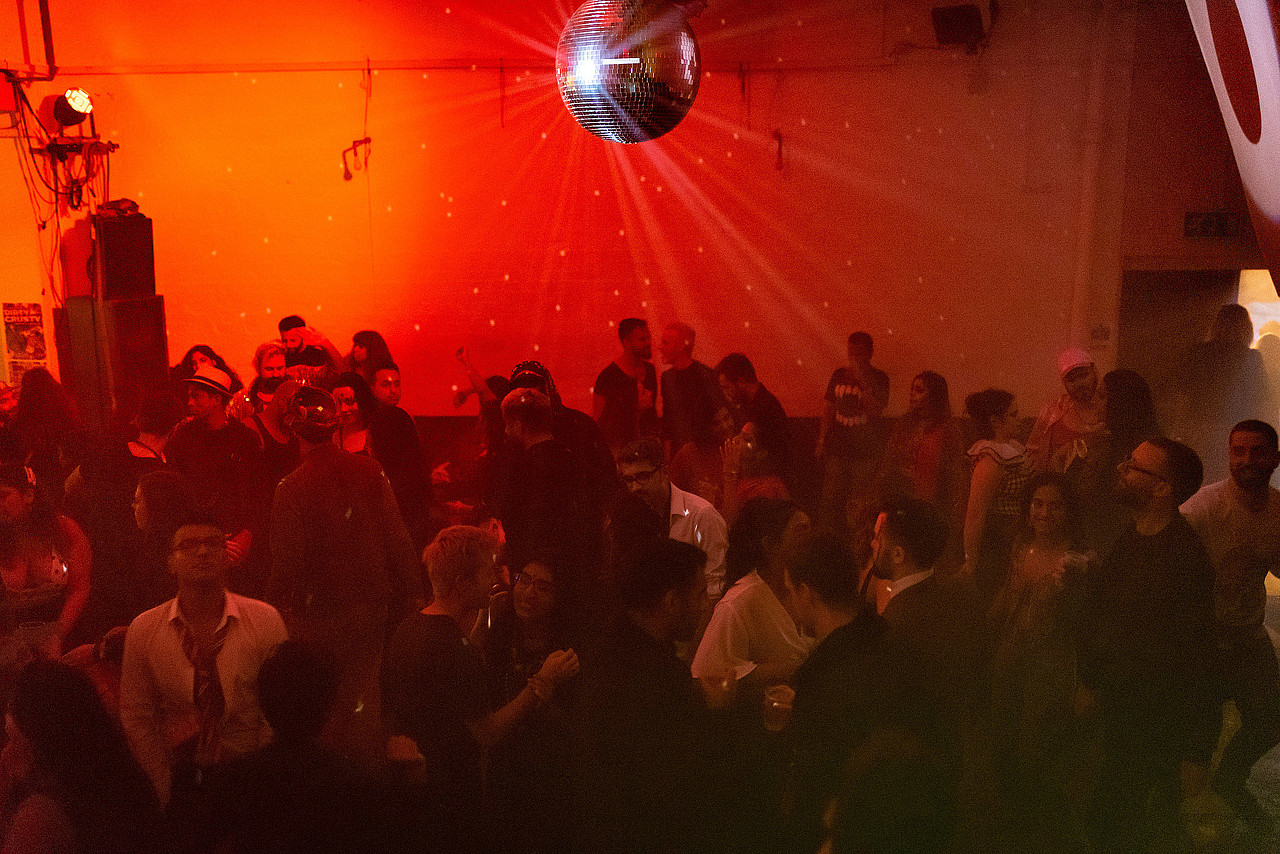
Clubs have long been held as progressive forces in cities; spaces for freedom, creativity, and escapism which inspire music, art, and fashion. Nightlife is celebrated in narrative accounts of letting loose and losing oneself in the dance. But what is often left out of narratives of dancefloor euphoria is the people that make it all possible. Despite the embodied experiences found in dark, smokey basements, nightlife doesn’t just happen in the spontaneous ways it is recounted. Less visible to regular punters are the groups of people working together to transport heavy sound systems, arrange the lighting and tech, manage the door, clean the venue, set up the bar, handle safety issues, and so much more. DJ, academic, and author, Madison Moore reminds us that »nightlife doesn’t just happen« but emerges instead through broader infrastructures without which clubbing would not exist.
The escapist experience of clubbing is a manufactured one that rests on a wide range of club labour. There is a gap between dreamy anecdotes of clubbing as transcendent, progressive, and anti-establishment, and the realities of people who earn a living from clubs. Working conditions present a far less glamorous view. Given nightlife’s increasing visibility in institutional strategy and state policies, it is high time we confront labour issues in clubs and fight for the dignity of its workers. Looking more closely at clubs as a place of work becomes especially urgent when we consider their significance amongst communities at the intersection of race, gender, sexuality, and class.
Historically, queer racialised people have found a home in clubs as sites for community-building. Indeed, riots in 1969 in the Stonewall Inn, a gay bar in New York, catalysed the modern gay liberation movement. In 1980s New York Ballroom culture, Black and Brown queer people formed »houses« and battled each other in dances and on runways for prizes. Not only were »houses« a way to market parties to specific communities, but they also provided essential support systems, shared resources, and housing amongst communities largely excluded by heteronormative society. The creativity and resilience of queer nightlife’s history is embedded in exclusion, struggle, and risk. In this sense, as Madison Moore describes in his book about fabulousness, dressing up and going clubbing can be political gestures that give people a sense of agency to resist the status quo.
This role that clubbing plays as a community space for urban queers persists today. Clubs offer opportunities to showcase creativity beyond institutions, foster connections, and find work for people experiencing higher levels of exclusion in civic life and employment. While clubs provide a level of social safety for minoritised workers and artists, their union power and workers' movements are categorically worse than other comparable cultural fields. These conditions are not being improved by employers, institutions, and state policy, which monopolise the terms and conditions under which this labour happens. While labour issues in in the club economy are global, this article focuses on queer nightlife in London and the UK.
In the past, nightlife was considered a social problem to be regulated. However, in the UK today it is increasingly visible in strategies surrounding the night-time economy aimed at developing new commercial markets and profit-generating leisure activities that appeal to a wealthy, mobile urban class. These strategies are based mainly on the needs of property developers and entertainment conglomerates at the expense of independent workers and grassroots cultures. In Regulating the Night: Race, Culture and Exclusion in the Making of the night-time economy, Deborah Talbot undertook an ethnographic study of London’s night-time economy, and goes as far as to call it the »colonisation of nightlife« due to its exclusion of Black cultural venues through policy. Efforts by London’s Night Czar to protect LGBTQ+ nightlife spaces continue to prioritise venue owners over queer racialised workers, who are less likely to own and frequent some of these venues. The night-time economy has opened the doors for an array of new work opportunities. Despite the club's significance amongst queer communities and its increasing visibility in wider culture and urban policy, its conditions as a place of work remain precarious and under-protected.
The Romanticisation of Precarity
During the 1990s in the UK, the rave scene emerged as a popular response to the adverse effects of neoliberalism. As an economic ideology, neoliberalism prioritised individualism, free markets, and competition, which led to a cultural shift in our understanding of work and creativity. Through austerity, deregulation, and privatisation, neoliberalism has a detrimental effect on workers’ rights. Rave culture was considered an antidote in its encouragement of collective celebration and the reclamation of public spaces. In their shift into the commercial industry, rave and other club cultures are often considered to have been co-opted and dampened.
However, contrary to what is often imagined, raves and clubbing may not have not been co-opted in such a straightforward way. Instead, these cultures may have developed alongside commercial industries’ penchant for precarious labour. A line can be drawn from the entrepreneurialism and celebration of independence that emerged from early 90s British rave, directly to the neoliberal logic of today’s club culture industries. The night-time economy can be traced back to New Labour’s »Creative Britain« campaign in the 90s which positioned music, culture, and clubbing as essential parts of Britain’s economic and national image. Its purpose was to open-up new independent commercial markets for investment. The swing from policing nightlife to its sudden inclusion in government strategy showing how club cultures are utilised within state ideologies. The effects of this set the stage for work within nightlife.
Creative work encouraged by the night-time economy follows a neoliberal model, underpinned by values of entrepreneurialism, individualisation, and a reliance on commercial sponsorship. Angela McRobbie describes the consequences of this as the decline of workplace solidarity, eradication of fixed hours, a collapse of the separation between work and leisure, and its replacement by »network sociality« – where multi-skilling, risk-taking and de-specialisation are expected. This is ultimately influenced by the casual and entrepreneurial nature of club work and government strategies like the night-time economy encourage the »freedom« allowed by this kind of labour. Precarity in cultural work is an instrument of governing and of self-governance to the extent that it becomes aspirational in accounts of creative success stories and artist trajectories:In the book, Creative: Making a Living in the New Culture Industries, Angela McRobbie suggests that»The seemingly exciting compensation for work without protection is the personal reward of being creative.« The embeddedness and expectation of risk within the pursuit of creativity is a problem for workers.
Now that a large proportion of the cultural sector is made up of freelancers with very few protections (like sick pay, pensions, parental pay, holiday pay), not only are we doing away with normal working conditions, but we are actually romanticising precarity under the guise of creative autonomy. Given the struggles that went into establishing them, once hard-earned labour rights disappear it is very hard to reinstate them. Club work therefore not only reflects but actually propels the transition towards a new world of work where nightlife dovetails straight into the ideologies it purported to work against.
Precarity in cultural work is an instrument of governing and of self-governance to the extent that it becomes aspirational in accounts of creative success stories and artist trajectories.
Club work is marked by low pay, precarity, inequality, and a dangerous conflation of labour with moralism and identity. The number of creative workers who operate as freelancers is double the UK economy's average. The music industry specifically is even worse, with a staggering 70% of the workforce as freelance. Furthermore, a survey by the Creative Industries Federation revealed that 89% of creative jobs are held by white people, despite Black and Brown people accounting for 40% of London's population. Autonomy, a think tank focussed on the future of work, highlights precarity as a defining feature of night work. Approximately one in nine people in the UK work during the night, and those on zero-hour contracts are twice as likely to work at night instead of during the day. To make matters worse, workers in London's night-time economy are twice as likely to earn below minimum wage, and the limited availability of public transportation and childcare options only exacerbates the challenges faced by night workers. It's essential to note that migrant workers are disproportionately represented in low-paying night work, including cleaning.
While many workers might sign freelance contracts that agree to a level of precarity, some are less lucky and aren’t contracted at all. Many instead rely on informal agreements, meaning as a worker, you have very few rights to claim in the face of exploitation or conflict. The casual nature of club work pushes risk away from the employer and onto the worker.
Consider the case of Sara*, an experienced professional who has worked in various welfare, security management, and bar supervision positions in London for more than three years. Despite working regularly at the same venues every week, all of these roles have been freelance, offering little job security. While DJ fees inflated, frontline positions like security roles paid less than London living wage. Neither bar or security positions provided signed agreements or contracts. Sara expressed a strong desire for signed contracts, paid leave, and better safety policies at work, as these are basic rights that should be afforded to all workers. Unfortunately, like other workers I spoke to, Sara was not a trade union member, making it difficult to advocate for these changes. The issue is further compounded by the fact that many clubs operate at night, where job insecurity is not only more prevalent, but celebrated as part of the realm of cultural work. Efforts to bring about change often focus on creative talent at the expense of other roles.
Recent advocacy work in club cultures has prioritised the visible inclusion of minoritised artists. This is crystallised by inclusion riders used by DJs to advocate for more representative lineups. While DJs leveraging their position to affect change via an inclusion rider is helpful in the area of visible diversity in line ups, it doesn’t necessarily guarantee equity for all workers. Diversity campaigns whose endpoint is the visibility of underrepresented artists fall short of ensuring the protection that unions and an adequately funded welfare state can. While these initiatives are viewed as progressive, they also highlight how demands are celebrated insofar as they are visible, discretionary and apply to creative talent like DJs and musicians, who are only one part of a much bigger ecosystem of workers. I wonder how a fair pay rider, or financial transparency rider would land?
During the pandemic, the exclusion of nightlife workers from furlough policies, cultural emergency funding, and the possibility of remote work highlighted the vulnerabilities in club work. It is concerning that only 21 nightclubs out of over 2000 organisations received Arts Council pandemic recovery support in the UK. According to Michael Kill, of the Night Time Industries Association, this exclusion is due to the perception that nightclubs are not considered genuine cultural or creative institutions like theatres or opera houses. However, it is ironic that despite this exclusion, club cultures are becoming more and more visible in wider cultural arenas.
Nightlife @ the Museum
Cultural institutions are increasingly showcasing queer nightlife cultures. Museums and galleries have followed a trend of »late« events, where club collectives and DJs take over, turning stuffy, static white cubes into living, breathing dancefloors for a night. This brings nightlife that tends to exist in basements, in the dark and out of sight, directly out into the bright lights and white walls of established institutions. The model for »lates« usually goes something like this: a curator or programmer invites a partner organisation to curate and organise an event at their venue. Financial models vary but typically, the partner organisations (club collective or promoter) are paid a flat fee, and the institution generates revenue from ticket sales (although some late events are free), food, and drinks.
Museum audiences are notoriously homogenous: Arts Council England reporting on audiences from 2018 showed that 84% of audiences for national portfolio organisations (meaning they have long-term public funding) were white. It’s not hard to see how a one-off late event organised by a popular QTBPOC+ club collective could dramatically diversify audiences, enabling institutions to secure funding dependent on diversity reporting, and from individual donors. The value that club cultures bring to institutions is enormous, and extends beyond the realm of cultural value into financial value. However, this value isn’t necessarily being reinvested back into club workers.
While diversity campaigns are viewed as progressive, they also highlight how demands are celebrated insofar as they are visible, discretionary and apply to creative talent like DJs and musicians, who are only one part of a much bigger ecosystem of workers.
As evidenced by the popularity of »late« events, cultural institutions are turning to club cultures as a source of inspiration, engagement and activation. Unfortunately, these institutions often fall short in supporting and sustaining nightlife, opting for short-lived one-off collaborations instead. This approach disregards the artistic ingenuity and financial precarity of grassroots party organisers, who operate on shoestring budgets in a commercially-driven landscape. The flat fees offered by institutions pale in comparison to the revenue generated by museums through sales or funding. Though these partnerships provide funding and cultural capital for institutions, club workers themselves are largely excluded from public arts funding. It’s no secret that queer nightlife is profitable, but there is a hierarchy of cultural value at play here which has material ramifications for which cultural forms are nourished and supported on a longer-term basis and which are considered diversity cash cows.
Like inclusion riders, institutional partnerships need to be enhanced by work towards fair pay, financial transparency, union building and proper resource allocation. The drive towards visibility in institutions is perhaps fuelled by the belief that the greater the amount of representation, the higher the chance of securing sustainable work opportunities. But the problem with one-off institutional events is that there is no follow-up, and these successes are individualised. There is no job development in the gig economy. In recent times, big institutions have been known to undertake organisational change, shed their workforce as a result, and then take them back on as self-employed, showing one mode in which labour rights are being eroded in the cultural sector. A worker-centred club culture will not be found in terms set by extractive institutions and the goal of system change, reduced to optics. Although it was believed that the focus on expression and creativity within cultural industries could allow minorities to flourish, their collusion with neoliberal economies has shown that the opposite may be happening.
Reconsidering Clubs: A Worker-centred Approach
I've had the privilege of surveying and speaking with queer club workers about their vision for a worker-centred club culture. Through our conversations, recurring themes emerged, including financial transparency, community ownership of venues, fair wages, solidarity across creative and behind-the-scene roles and a rejection of traditional employer hierarchies. I've been inspired by the collective efforts of those working towards this vision and am excited to see how these values will continue to shape the future of club spaces.
Grassroots queer nightlife in London relies on loose groups like collectives to run club nights. Collectives often have a shared mission and work collaboratively, acting as an informal nightlife infrastructure for racial and gender minorities in London. These models are not new within the scene; collectives follow in a historical lineage of clubbing repurposed as social infrastructure for Black and Brown communities derived from movements like 80s New York Ballroom and Caribbean Soundsystem culture. These loose formations allow a certain flexibility to experiment against traditional hierarchies and work collaboratively. To survive increasing job precarity, party organisers continue to band together to make work happen.
While collective models are not new, state and institutional interest in queer nightlife is. In this new context, informal collective models don’t necessarily combat worker vulnerabilities. During a conversation, Victoria Wilson aka Gin stressed the importance of collaboration and the value of understanding business structures. As an event producer and DJ involved with UK Black Pride, sex-worker led Sex + Rage, and Faggamuffin Bloc Party, Hackney Carnival’s first queer sound system, she emphasised the need to transition from informal models to more radical business structures: »I am trying to learn about how not to be so DIY. DIY has its limitations. I think formalising our structures and organisations can give us a lot more control over our productions [...] Sometimes there is a problem with a lack of ownership. Ownership needs to be defined in order for people to feel okay with collective projects [...] specifically in club culture. I am searching for organisational structures where we don't have to be at the mercy of someone else's business. At the end of the day, if we do it in a venue, we're at the mercy of what the venue’s business needs are. If we do it outside, we're at the mercy of the police coming and shutting us down. If we do it in an exhibition space, their licensing policies will hold us back. So I keep asking myself how can we control our environment, to be able to be free in that environment?[...] I am interested in developing radical forms of business structure[...] It's difficult to know what business is and how to get around roadblocks with business, venue culture, and capitalism when you don't fully understand its depth. You can't resist it if you don't understand it. You need to understand how it functions to find workarounds. There aren't many, but there are some.«
Another party organiser I spoke to emphasised that while it was important to reject traditional hierarchies in organising club nights, the informality of collectives can hold workers back: »For me, collectives are completely non-hierarchical, and it was very important to maintain that. It's a conscious rejection of traditional structured forms of the social groupings that we're used to. However, what I'm learning now is actually, you need structure. […] There's no way that there's no structure, and even if the structure is not visible, structure kind of just happens. There is an essay called »The Tyranny of Structurelessness« by Jo Freeman. She talks about how grassroots organisers avoid structures because they think that structure automatically means hierarchies, whereas in reality structures naturally form. [...] Leadership can change and doesn't necessarily mean hierarchy. What defines collectives is accountability and an awareness that these dynamics are always shifting. The idea of structurelessness for me now is that it doesn't work and it doesn't necessarily exist.«
Like inclusion riders, institutional partnerships need to be enhanced by work towards fair pay, financial transparency, union building and proper resource allocation.
In acknowledging the concentration of capital in institutions, another worker I spoke to made an interesting point about sourcing funding for club cultures: while social spaces for their community were essential, the money to create them should not necessarily come from these communities. To them institutional partnerships were a tactical way of achieving opportunities and resources for Black and Brown queer club workers. They spoke about leveraging their cultural capital to ask institutions that reached out to them to commit to internal changes that might benefit workers in the collective or in the institution, like agreeing to training opportunities that spoke to the collective's core values. This is one way of effecting change via institutional partnerships. However, the responsibility for ethical partnerships does not rely solely on club workers themselves. As cultural platforms on a national and international stage, institutions are also responsible for improving partnerships. Art-Coop is an initiative that educates funders on the solidarity economy, and the propositions they put forward are a far cry from the typical »late« events model. Beyond institutions, venues are also being reimagined to better suit their workers.
Friends of the Joiner’s Arms is a campaign group that started in 2014 to fight against the closure of the Joiner's Arms queer pub in East London. Today, they are an organisation that is passionate about creating and preserving queer spaces. They are spearheading collective ownership initiatives in London by planning to open the city's first community-run LGBTQI+ space. To fund this venue, they have allowed members of the community to purchase shares. These shares are different from typical company shares in that they cannot be sold, traded, or transferred between members. When you buy a share, you become a member of Friends of the Joiner's Arms and an owner of the organisation and its assets. You are also entitled to vote in decision-making. Owning more shares does not give you more decision-making power, ensuring the venue will not be run by those with the greatest investment. The organisation has already outlined some of their working policies for the future venue, including an inclusive hiring policy and a flexible working policy. As a community benefit society, any profit made will be reinvested back into the venue for the benefit of the queer community. Friends of The Joiner's Arms is committed to financial transparency and is offering a model for a more worker-centred venue that existing organisations and venues can take inspiration from.
Club culture has always shown itself to be innovative and resilient, weathering vastly differing state policies, ranging from policing to institutional interest. Steps in the right direction certainly involve promoting collective ownership and supporting union movements, while also improving on partnership models. Creating a club culture that truly values the rights of workers requires a multi-faceted approach and a continued process of creativity and imagination that is no doubt a feature of club creativity. While efforts to promote diversity among DJs and musicians are important, it is crucial to recognise that club cultures also rely on a diverse range of workers. By acknowledging clubs as places of work as well as creativity, community, and abundance, we can prioritise the needs and rights of those who ultimately make these spaces possible.
Anjali Prashar-Savoie is an Acadian-Punjabi cultural producer, yoga teacher, and DJ. Her work focuses on collaboration, alternative modes of making and being together and creating opportunities that challenge inequalities within the cultural sector. Anjali holds a BA in Social Anthropology (SOAS), an MA in Art & Politics (Goldsmiths), and has completed a research residency with The University of The Underground – all with a specific focus on clubbing and community organising.
This text was commissioned as part of CTM 2023 – Portals.
The author would like to thank their research participants for sharing their wisdom and Texture Mag for commissioning an earlier iteration of this research