There are many that I know and they know it.
Are.na is a collaborative research and social media platform run by Charles Broskoski, Daniel Pianetti, and Chris Sherron that allows users to organise pieces of information – links, text, images – »blocks,« in Are.na parlance – into collections or »channels.« The platform’s functionality, which unites and morphs aspects of Tumblr and Pinterest, is bolstered by the ethics and vision of its development and the dedication and curiosity of its user base.
Iterating on community-enabling, utopic computing ventures, Are.na eschews clickbait, »likes,« and ephemeral publishing, championing instead the collection, connection, and retention of data-becoming-information and information-becoming-knowledge. Are.na is a play of links and images – a repository for intuitive connections, an archive for rigorous research, and a lounge for budding collaborations. Over the past seven years, Are.na has developed one of the most engaged, thoughtful communities that I have ever encountered on the internet.
Are.na is made for collaborative research
They are all of them repeating and I hear it.
I love it and I tell it.
Are.na is committed to remaining advertisement-free, and thus positions itself as a conscientious contender to Facebook, Twitter, and other networks that profit primarily off of user data, activity, and attention. The ash heap of the internet is strewn with failed »alternative« social networks – rebuttals of Twitter, Facebook, and Tumblr that arise solely in opposition to the existing platforms and offer no differing, compelling functionality.
Are.na’s primary functionality – collaborative research – has set it apart from other networks and made it a darling of artists, academics, and researchers. Are.na doesn’t do »everything« that a user might require from social media: it provides no direct messaging functionality, for example. Instead, it does research archiving, the collection of content, and the connection of ideas very well. In functionality, it is most similar to Pinterest or Tumblr, but the priorities of its developers and the objectives of its existing user base have allowed the platform to evolve its own niche.
Are.na’s architecture is designed to allow the development of ideas over time. »Blocks« on Are.na are allowed to exist in multiple »channels.« When a block is selected, the interface displays all of the channels with which it is associated, as well as — if applicable — the URL from which the block’s content originated, and all other channels that contain blocks with identical URLs. These provenance records allow for the contextualisation of Are.na content, both for users who are seeking similar channels and profiles, and for researchers searching for citations. This contextualisation plays well with Are.na’s emphasis on the collection of ideas over time. The social network has a chronological feed, which shows you when users and channels that you follow have added new content, much like other social networks. But content on the feed and throughout the site is always presented alongside a »connect« button, thus encouraging its connection to existing channels: the collation of the new with the old.
The research focus and provenance allowances of Are.na provide constraints that have – thus far – prevented it from sliding into the context collapse and memory loss of the major social networks, which privilege content over context and instantaneity over the time-necessitating maturation of concepts. To further combat the decay of context, Are.na provides privacy controls. In addition to not being required to use their »real« names, users can make their channels »open« to any other collaborator; »closed,« only available to certain collaborators but browse-able by everyone; or »private,« only accessible to the creator and any approved collaborator.
Are.na comes with tools. The platform provides desktop users with a »bookmarklet,« which allows users to add websites to their Are.na channels without opening a new tab. Developers recently released an iOS app, and an Android one is on the way. Are.na provides an API for users who want their channels to serve as a website backend. The code for the Are.na platform itself, as well as that of its apps, has been open-sourced, thus allowing anyone to follow along with and extract from its development. Open-sourcing the code is also a political statement: in a time when social media algorithms are closely-guarded secrets designed to manipulate and addict users, Are.na’s transparency is heartening.
This is what I hope the next generation of social media will be: an ecosystem of apps that complement each other while remaining distinct, independent, humane, and respectful of user privacy.
Are.na users can opt for »pro« accounts ($5/month), which allow an unlimited number of »private« channels, the ability to hide profiles/channels from search engines, and early access to new features. Free accounts have access to a fully functional version of Are.na, so users who are unsure about or unable to commit to a »pro« account can still properly use the website.
»Pro« accounts are one way that Are.na makes money. The platform has been open about its need to sustain itself and its strategies for doing so, with an emphasis on remaining ethically above-board by refusing to integrate advertising. »Pro« accounts will not fund the network at scale (currently, it has about 25,000 active users). Becoming a non-profit brought the continual need to find new grants – many of which would not be for substantial amounts of money or long periods of time. Instead, the network decided to seek capital investment, in one case from an investor whose research, design, and strategy company, Consortia, was already using the platform for its work. By targeting investors who share certain common ground with Are.na (for example, a dissatisfaction with the current state of social media), and who are interested more in long-term goals than short-term gains on their investment, Are.na hopes to secure funding that allows it to continue running the platform with its current vision and ethics.
Many of the major social networks have sought to be all-encompassing. Facebook in particular has attempted to subsume other platforms — by acquiring Instagram and WhatsApp, by adding marketplaces, by creating its own internet service. It is refreshing to see Are.na only iterating on a related series of tasks. This is what I hope the next generation of social media will be: an ecosystem of apps that complement each other while remaining distinct, independent, humane, and respectful of user privacy.
Are.na is made for musicians (and everyone else)
There are many kinds of men and women and I know it.
They repeat it and I hear it and I love it.
Are.na is not a music-specific platform, but the organisational, archival, and playful impulses that it facilitates are useful for any kind of creative thinking. The platform demands content: instead of virtue signaling and self-promotion, you are challenged to connect your ideas with others who find similar ideas compelling, and, together, find new ways of relating to the ideas. When I wrote Are.na for a list of music-focused channels that might be of interest for this piece, they noted that several prominent musicians are using Are.na under pseudonyms – encouraging because it shows people are »prioritizing ideas rather than popularity on Are.na.«
For years, Are.na has been my primary archive for project research. In private channels, I compile YouTube playlists, images, texts, links to Google Books page previews. The platform is an extraordinary tool for drawing connections between pieces of information, tracing out conceptual frameworks. If I feel that my channel is becoming coherent enough to share, or that it might be useful to others, I make it »closed« instead of »private,« allowing others to view its contents. I have used Are.na for numerous collaborations since 2013, and every one of them has benefited from the platform.
Many channels related to the music world seem to grow out of similar impulses.
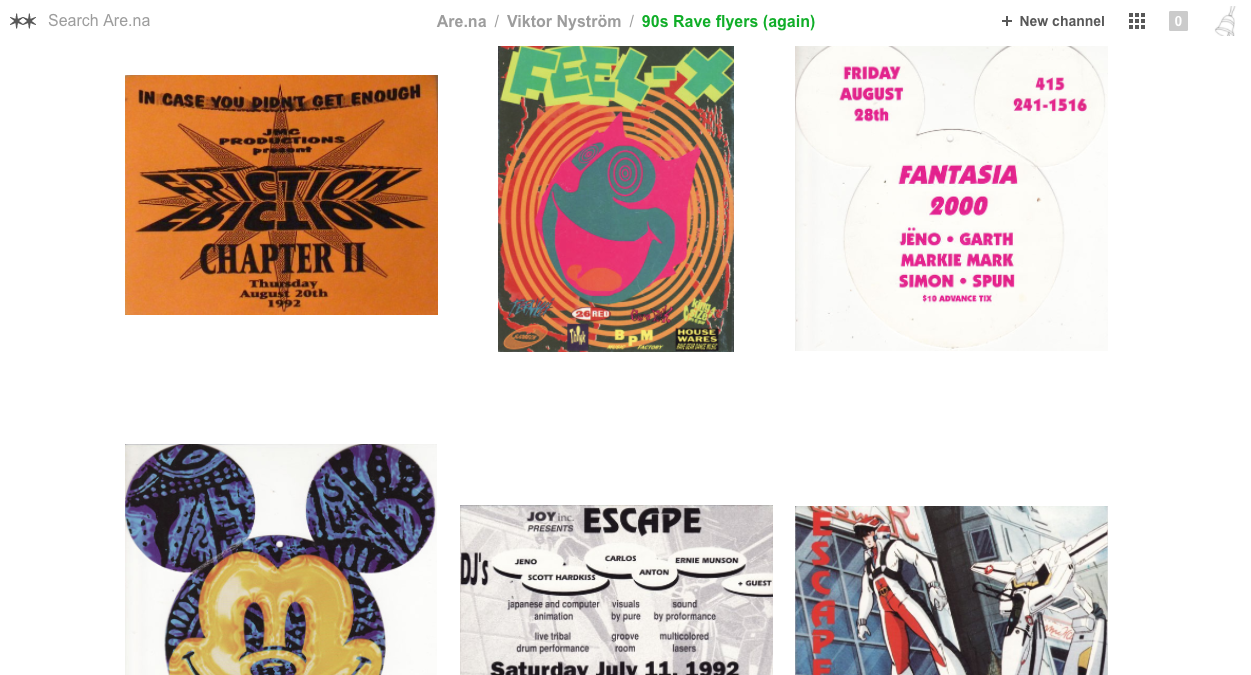
»Club Architecture,« a channel by Christina Badal, collects images of nightclubs — past, present, and future. The images range from photographs of Manchester’s The Haçienda to drawings of Berghain to Martti Kalliala’s diagrams of club ruins, as created and classified by some future archaeologist. There are several channels devoted to rave flyers, such as »90s Rave flyers (again)« by Viktor Nyström, which contains scans of the fronts, backs, and (sometimes) insides of colourful, absurd advertisements for long-since raved raves. There’s a Pauline Oliveros channel; a Robert Johnson channel (one of a series of nightclub channels by Chris Sherron); a »sound identity / audio branding« channel, and an »Interspecies Music« channel, containing videos of animals playing human instruments.
Charles Broskoski has created a prototype, mac.are.na, which turns channels into playlists, playing a channel’s mp3s and YouTube links in succession. Efforts like this point to Are.na’s potential as a tool for musicians — both as an evolving interface for research and archiving, and for developers, as an open-source infrastructure that encourages any number of experiments.
Are.na is made for the future (emergent in the past)
I love it and now I will write it. This is now a history
of my love of it. I hear it and I love it and I write it.
One block on the »Arena Influences« channel, which is controlled by users central to Are.na’s development, contains the Gertrude Stein fragments from »The Making of Americans,« included throughout this article. Others contain PDFs of writing and short quotes from computer and internet pioneers Ted Nelson, Douglas Engelbart, Vannevar Bush, Alan Kay. One block is a link to the Wikipedia article for the »tree that owns itself,« a white oak in Athens, GA, which, rumour has it, was deeded to itself some time before 1890. This early imagination of the subjectivity and agency of objects calls to mind the recent measure in New Zealand to grant a river personhood, and the ongoing debate on most social media networks about ownership of data. Are.na, which explicitly states that it does not make claim to user data and will never breach users’ »private« channels, is one of the few centralised social networks to establish itself as a champion of user privacy and agency.
In an article for the Walker Museum of Art about Ted Nelson, Are.na’s Charles Broskoski quotes from Nelson’s 1974 book Computer Lib/Dream Machines the supposition that »›[k]nowledge‹…and indeed most of our civilization and what remains of those previous — is a vast cross-tangle of ideas and evidential materials, not a pyramid of truth. So that preserving its structure, and improving its accessibility, is important to us all.« This concept describes Ted Nelson’s spectacular Xanadu project – the still-in-progress construction of a structured library of all human knowledge. With Xanadu, Nelson coined terms like »hypertext,« which are still relevant today in describing the linking, non-linearity of information-seeking and information-connecting on the web.
The ash heap of the internet is strewn with failed ›alternative‹ social networks — rebuttals of Twitter, Facebook, and Tumblr that arise solely in opposition to the existing platforms and offer no differing, compelling functionality.
Like Nelson’s Xanadu, Are.na allows the »vast cross-tangle« of ideas to be endlessly reconfigured, with blocks shifting into new channels and channels containing channels containing channels. As Are.na notes, »The intention behind Are.na, similar to what Ted Nelson imagined for Xanadu, is that a user is not just passively consuming information, but also continually recontextualizing information into new ideas.« Various futures arise out of configurations of the past that are only possible when people have the agency to explore and re-arrange information.
Are.na is made for you and me
This is now a history of the way they do it.
When developing a prototype of the website, a mentor encouraged the Are.na founders to build in some kind of quality controls. They opted to do this culturally, not technologically, by encouraging their friends to use the network. This has, for the most part, proven to work. Are.na now has a strong community behind it, and the development in the past years has tended towards the community’s needs, as seen in channels such as »Feedback and Feature Requests,« and »Archived: Feedback and Feature Requests.« The former contains a block of feature requests by users; the latter contains feature requests that have been implemented in the platform.
Are.na actively engages with the community, by inviting users to write blog posts; by offering »micro-grants« for users to develop certain projects on the platform or related to the platform; by offering »pro« users the opportunity to test out certain features (such as the iOS app) before they launch.
In an interview, Broskoski says: »[t]he biggest compliment for us is when someone describes Are.na as healthy.« The entries in »How do you describe Are.na at a party?«, a channel open to submission from any user, seem to deliver the compliment again and again: »a place for productive coveillance,« »social media that doesn’t damage your brain,« »a toolkit for assembling new worlds from the scraps of the old,« »a site to cross-pollinate research within creative fields,« »Like a mind map between everyone on here. and theres’s no likes <3,« »The best dating site in the world.«
Are.na’s co-founders, who come out of design and art backgrounds, have spoken of the platform as a lifelong project. Broskoski first began developing Are.na when, frustrated with his art practice, he came to the conclusion that the most generous thing you can do as an artist is make tools for other people to use. This ethos has carried through to Are.na in its present form. According to Broskoski, Are.na values lifelong education as »the most important thing.« It has already become an integral part of many users’ self- and co-educations. I hope that Are.na will continue for years and years. While it exists, and even when it no longer exists, it will provide a great model for other nascent networks, an insistence that something else is possible.
On the dominant social media platforms, time drains away. On Facebook, we react to its passing with infantilising emoticons, »thumbs up,« »heart,« »angry face.« Are.na demands cognitive effort, and provides much more in exchange than the dopamine rush of receiving »likes.« From Are.na’s end-of-2017 blog: »[w]ithin the limits of our time and attention, we have access to an incomprehensible amount of knowledge. Our digital tools and communities should help us navigate that diversity of thought in ways that foster our curiosity and allow us to learn from one another over the course of our lives.« Here’s to Are.na, the social network that deserves the future.
For new users wondering where to start, the »Classic Channels« compilation contains »Timeless classics from the Are.na community.«
This is now a history of the way I love it.
Claire Tolan is an artist and programmer living in Berlin.
This text was originally published in CTM Magazine 2018 – Turmoil.