
»What is the sound of turmoil?« the festival asks, and this is indeed the burning question. Yet it’s one that a festival of this sort cannot answer, as it happens, because coming up with a comprehensive answer would necessarily spell the end of the festival in its present form. CTM sees itself as an agent of emancipatory art and thus the »sound of turmoil« that it seeks in its current iteration is first and foremost the very sound in and through which »we« – which is to say, we enlightened, liberal, left-wing, anti-sexist, and anti-racist bodies who produce and/or take part in CTM – hope to give expression to how contemporary politics leaves us shaken to the core.
But of course that is just one side of the present turmoil – and just one side of the current relationship between pop culture and politics. The other side is the realm of those who see the current political trends not as a rollback but as something to applaud and promote. Such turmoil has not come out of the blue but is rooted in a widespread resentment of liberal society. And anti-liberal politics are made by people, of course – people who also happen to make and listen to music. They too define themselves in terms of pop cultural mechanisms, more nonchalantly and skilfully than any anti-liberal movement before them. One need only look at the American Alt-Right’s use of social media, viral memes, and the like. Hence, any serious inquiry into the »sound of turmoil« is compelled to consider the sounds of the New Right: What music moves the Alt-Right movement in the USA these days? What are supporters of the French or German identitarians tuning in to? At the same time, it remains unthinkable for a leading progressive festival to feature artists and musicians who plainly support reactionary political programs, nor would we fans like to mix with their respective followers. A festival such as CTM is, after all, not only a venue for political debate but also a safe(r) space for those among us who are watching the present social turn from a minority perspective and increasingly feeling the heat. Hence, inquiry into the entire spectrum of contemporary political music soon comes up against its own principled limits.
Not that a festival of this sort could ever present the entire spectrum of contemporary political music. CTM would be hard-pressed even to answer the question, »What is the sound of turmoil?« comprehensively, given the difficulty of identifying »New Right music« and musicians who are open about their political affiliation. A peculiar silence surrounds this movement. The most glaring evidence of this to date was the inauguration of Donald Trump in January 2017. While Beyoncé, Jay Z, James Taylor, Aretha Franklin, and other major lights of the pop cultural scene had gladly shown up to celebrate that of his predecessor, Barack Obama, Trump had difficulty finding anyone at all to perform on his big day, finally mustering only an obscure line-up of rock and country B-listers, such as 3 Doors Down and Toby Keith.
The New Right may want pop culture – which is to say, a cultural profile that makes an impact far beyond the bounds of political activism – but what it has is pop culture without pop music.
Since then the Alt-Right movement has repeatedly tried to instate one or the other popular musician as its figurehead: Taylor Swift, for example, whom right-wing commentators and bloggers extol as an »Aryan goddess« while avidly hunting out hidden hints of pro-Trump leanings in her texts – although Swift herself maintains silence on the matter. Not so Depeche Mode, whom American neo-Nazi activist Richard Spencer, one of the organisers of the Charlottesville march, declared in early 2017 were »the official band of the Alt-Right.« The band's retort was swift and clear: »That is a pretty ridiculous claim. Depeche Mode has no ties to Richard Spencer or to the Alt-Right and does not support the Alt-Right movement.« Depeche Mode fans, creative as ever, were quick to pour scorn on Spencer, and one brief YouTube clip went viral: it shows a left-wing protestor punching him in the head – in a loop cut to the beat of Depeche Mode’s »Just Can’t Get Enough.«
Spencer is a great fan of Depeche Mode because the band’s music demonstrates – in his view – ethnic purity. In the case of both electro pop and industrial, he claims, we are generally talking about genres that have completely freed themselves from pop’s African-American roots and are therefore well placed to give expression to white supremacy. This presumably also explains the popularity of »Trumpwave« and »fashwave« (»fash« here clearly stands for »fascist«) among those who openly promote the ideas and iconography of the Alt-Right: the two electro genres basically consist of minimalist rhythms and 8-bit sounds, so combining a nostalgic yearning for the technical and musical achievements of bygone days with an indeterminate futurism. In essence they are new takes on a genre sometimes called »vaporwave:« a highly ambivalent, quasi futuristic and yet nostalgic-dystopian music decisively shaped since around 2010 by artists such as Daniel Lopatin (alias Oneohtrix Point Never) and James Ferraro, who have appeared inter alia at CTM Festival.
Yet while Lopatin and Ferraro put together eclectic patchworks of sounds and icons in the spirit of globalisation and digitisation, advocates of Trumpwave and fashwave choose to use symbols that glorify Nazis and Donald Trump to fill in the gaps in this minimalist music – music that is after all compatible with pretty much any kind of content. The most famous fashwave musicians go by the names of Xurious, Cyber Nazi, and Storm Cloak, while their songs have titles such as »Right Wing Death Squads« and »Galactic Lebensraum« (Cyber Nazi), or »Demographic Decline« and »Identity Evropa« (Xurious). Pieces published under the heading Trumpwave – mostly without naming the artist – either have unsurprisingly slogan-like titles (»Make America Great Again«) or so effusively pay tribute to the president (»Donald the Eternal«) that they sound like parodies of their avowed political intent.
So the music of the Alt-Right, like the Alt-Right movement overall, is not only a product of the internet but also deeply ambivalent; and given its conflation of politics and aesthetics, sheer provocative cynicism, and aggressive stance – its blatant racism, for example – it is very hard to get to grips with. That means that if Trumpwave and fashwave can be read as the sound of the current turmoil arising within right-wing circles, then such turmoil characteristically consists not in a clearly formulated political programme but, firstly, in a deliberate blurring of the borders between satire and political sincerity, secondly, in the conscious use of provocation, and thirdly, in a sheer delight in destroying established democratic traditions and values so as to hasten the rise of an allegedly »archaic, pure, and natural« order. To this extent, music of this sort really does reflect Donald Trump’s political links with Alt-Right ideology. Yet in reality – and unlike Donald Trump himself – it fails to reach a mass audience. Few tracks, even those by the most successful artist in this field, Xurious, ever gain more than 100 000 YouTube clicks. And the anonymous Trumpwave and fashwave musicians neither play concerts nor DJ sets. Their sole infrastructure is the internet.
One possible reason the New Right doesn’t have a leg to stand on, culturally speaking, is that its very ideology, its striving for ›purity‹ – despite the evident interdependence of every last atom in the cosmos! – precludes any true acceptance of pop culture.
Likewise in Europe, pop music from the New Right barely makes it off the margins. This is true in France, where the Bloc Identitaire and its youth wing, Génération Identitaire (in English, The Identitarians), can look back on an almost twenty-year history. Its leading pop stars are Les Brigandes, an all-women quintet who made a splash (in a certain scene) last summer with the song »Merkel muss weg (Merkel Dégage!)« (Merkel Must Go). As the title shows, Les Brigandes draw more directly on topical slogans and issues and parliamentary policies than their US counterparts do. Le Grand Remplacement (The Great Replacement), their debut album from 2014, took its name from the eponymous central policy paper penned by Renaud Camus in 2011 on the allegedly mass immigration to Europe and on the Islamification of Western societies. In the case of Les Brigandes, too, it is hard at times to distinguish between irony, cynicism, and serious propaganda. Cheesy organ beats, electric guitars, and clipped vocals come over in their videos like a fusion of cabaret, chanson, and New Wave. The band wears frumpish, twee clothes – but also leather »Zorro« eye-masks, as if they’re about to run off to a BDSM party. The video to »Merkel muss weg« features toxic stereotypes of rabid Muslims while the women themselves flit about the deserted narrow streets of a medieval town like scared children – in fear of the »grim immigrant rapist« possibly lurking in every doorway, waiting to seize his chance.
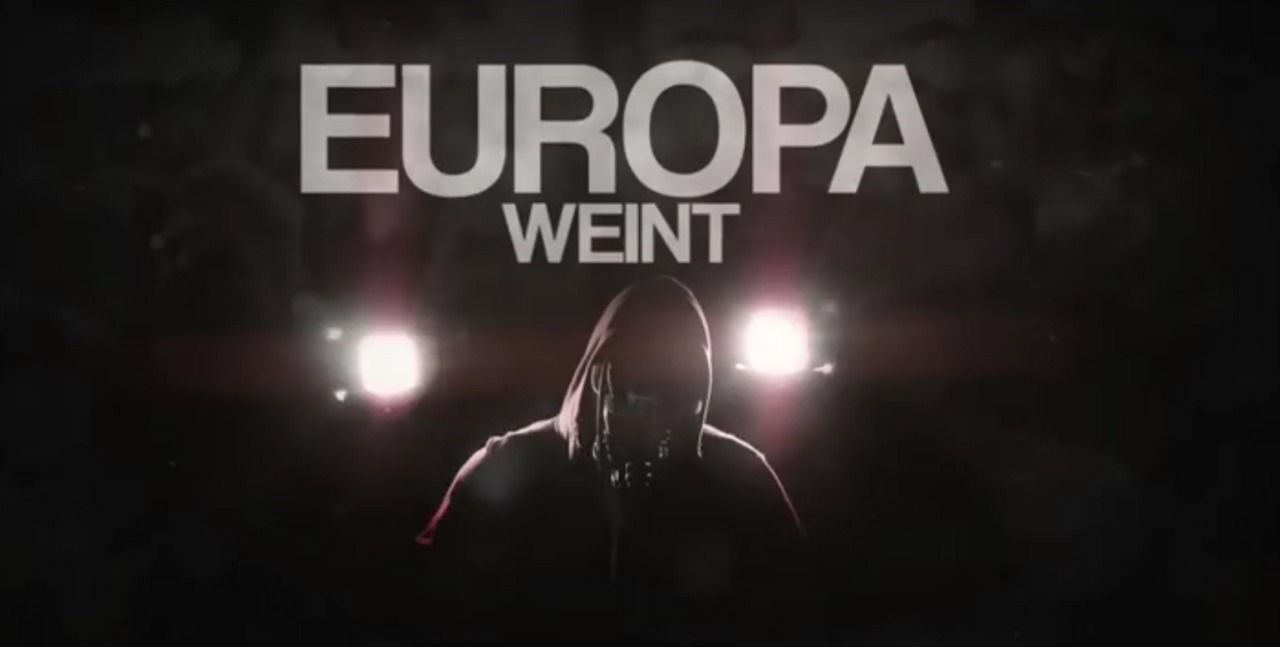
Like Trumpwave and fashwave artists, Les Brigandes strive to remain anonymous, have never performed live, and essentially tread a thin line between earnest message and fake news. So anyone watching the »Merkel muss weg« video with no previous knowledge of the band can’t tell for sure whether it’s consciously-created propaganda or a bizarrely-overdone caricature. The frontmen in Germany’s New Right music scene are similarly ambiguous. An example is Komplott, the »identitarian rapper« from Halle an der Saale. In 2016 with »Europa,« he pretty much delivered an anthem for the identitarian movement in Germany and Austria. Unwittingly comic, he also voices concern in this track for the, in his view, inadequate protection of listed buildings in his homeland: »Ich sehe romanische, gotische, klassizistische Bauten / langsam zerfallen zu ’nem toten abgerissenen Haufen / Europa weint, Europa schreit / nach dem Ende, der Wende« (I see Roman, Gothic, Classicist buildings / slowly falling apart in a dead, demolished heap / Europe’s weeping, Europe’s screaming / for an end, for a change in direction).
Komplott sings to uninspired gangsta-rap beats of the menace posed by »foreign infiltration,« he complains about »no-go areas« for Germans, and he calls for the »revolutionary awakening:« »Es ist an der Zeit zum Verteidigen des Eigenen / Macht euch bereit« (It is time to defend one’s own / Get ready). In contrast to the American New Right, he makes no reference at all to sci-fi or the future. This clearly reflects the ideological differences between these two reactionary currents: while the New Right in Germany is supposedly concerned first and foremost with preserving cultural heritage (hence the emphasis on the protection of historical landmarks) and also combines its racist ideologies – newly dubbed »ethno-pluralism« – with a yearning for bygone days when nations were allegedly still clearly distinct from one another, the New Right in the United States promotes »a racism that comes from the future,« thereby echoing the term coined by their British mentor Nick Land in 2014 in his widely-read virulent text »Hyper-racism.« Their concern is not to preserve a historically-evolved racial diversity, but rather to optimise DNA and hence humanity itself – in one word, eugenics – and this explains their penchant for sci-fi and cyborg iconographies.
The German identitarians, for their part, are attached to the iconography of »classic« German and European culture. Numerous references to Romanticism can be found in Komplott’s videos, for example, from the grandeur and transcendence of impenetrable forests through to Teutonic armies in battle. Despite – or precisely owing to – this constitutive obsession with past glories, the German identitarians see themselves as the cultural avant-garde: as the self-declared successors to the allegedly unabated dominance of the liberal left wing since 1968. Many among the latter have recently taken the same view. The author Thomas Wagner, for example, writes in his highly readable study Die Angstmacher (The Scaremongerers) that the New Right has hijacked the provocative political strategies of the 1968 generation and carried pop culture off into its own camp.
Indeed, the identitarians have copied many of the tactics pioneered by the movement of 1968, keeping themselves in the public eye in recent years mostly by disrupting »left-wing« panel discussions and theatre performances. Yet parallels with the »68-ers« pale when it comes to pop cultural foundations: the absence of mass support (or even interest) in identitarian pop is glaring here too. True, Komplott’s music blares from the speakers at every identitarian protest march, yet outside the New Right’s youth wing no one in Germany has even heard of this supposedly »major« pop star.
So, things in Germany don’t look all too different from things in France or the USA. The New Right may want pop culture – which is to say, a cultural profile that makes an impact far beyond the bounds of political activism – but what it has is pop culture without pop music. The New Right has no pop stars, no concerts, no clubs, no soundtrack; its »culture« consists in nothing but protest, in publicly airing political slogans and arguments, and it thus stands in striking contrast to the political turmoil triggered by the real 68-ers. This tumult was orchestrated by Bob Dylan and Jimi Hendrix, by Joni Mitchell, The Grateful Dead, and the Rolling Stones. In Germany there was Krautrock and Ton Steine Scherben, later punk and new wave. Then came emancipatory lesbian, gay, and trans activism (forerunner of today’s LGBQTI* movement) with disco and eventually house and techno explosions.
The »new 68-ers« of today’s New Right have nothing at all – or next to nothing; the online operations of a few clandestine producer nerds, a lone rapper from Halle, and a French female quintet do not add up to a right-wing Woodstock. Writing cultural manifestos is complicated, too, in such a cultural wasteland. This is obvious to anyone who leafs through the book Kontrakultur published in summer 2017 by Antaios Verlag, the identitarians’ foremost publishing house in German-speaking countries. »Activist« Mario Alexander Müller, born in 1988, attempts therein to map the New Right’s cultural foundations in alphabetical order, from A as in Gabriele D’Annunzio to Z as in Zentropa. Also to be found there, as usual, are the fathers of the Conservative revolution: Carl Schmitt, Ernst Jünger, and Martin Heidegger. We learn, too, that identitarians enjoy manly muscle and massacre comics such as Frank Miller’s 300, also in their cinematic editions.
But ask which music the New Right in Germany listens to, or which beats they like to dance to, and the responses are not only limited in range but also often – and involuntarily – hilarious. The »greatest anthem« recommended at the moment »because it rocks« is a soldier’s ditty from the 1920s, and when young right-wingers take to the dance floor, their moves of choice are the Radetzky March and Sternpolka, the »living heritage« of folk dances being in any case preferable to »the glittering stroboscope light of disco;« or so they say. This disdain for club culture in Germany means that opportunities seized by the US-American New Right to take its message to the people via electro beats are out of the question here.
Neo-folk and industrial – the New Right’s top genres from around 1990 to 2010 – are also not really the German identitarians’ cup of tea. If the Kontrakultur book is to be believed, the only more recent types of pop music acceptable to them are 1990s black metal, 1970s punk rock, and the straight-edge movement’s hardcore wing: Minor Threat, for example. The reason for this is the same as that behind Richard Spencer’s enthusiasm for Depeche Mode; the music finds favour exclusively on account of its »ethnic purity,« as apparently it is produced exclusively by white men and is in no way related to the African American musical tradition. This is nonsense of course, at the very least in the case of 1970s punk rock. British punk – especially that of The Clash, which Kontrakultur particularly highlights – would never have seen the light of day without the inspiration of Jamaican reggae and dub.
One possible reason the New Right doesn’t have a leg to stand on, culturally speaking, is that its very ideology, its striving for »purity« – despite the evident interdependence of every last atom in the cosmos! – precludes any true acceptance of pop culture. Pop culture is living proof that hybridity rocks. Without an endless circulation of signs, without the shifting permutation or fusion of every cultural tradition under the sun, pop culture simply would not be. There is nothing in pop that doesn’t refer somehow, somewhere, to something else. This is of course also true of hip hop, a genuinely African American style. Accordingly, when interviewing identitarian rapper Komplott, the investigative YouTube channel Jäger & Sammler asked whether it wasn’t perhaps a contradiction on his part to use a musical genre forged by migrants to call for an end to all immigration. It seemed, for one brief moment, as if a light had gone on in his brain: »right,« he answered. »Rap is not very German at all, now that you put it that way.«
Whenever advocates of the New Right turn to pop culture, they leave behind either a cynical-eclectic impression (in the USA) or a clueless, uptight, and dimwit impression (in France and in German-speaking countries). And how could it be otherwise? If they hope to transfer their political ideology’s rigid requirement for cultural purity to the realm of pop culture, then they have no alternative but to retreat into the tiny and irrelevant residuals of music. If the men of the New Right in Germany – and men are the majority in the movement – reject all the more modern forms of dance music as well as nightclubs, then one wonders where they will ever meet the women with whom they hope to found those families whose »consolidation« and »preservation« they themselves claim is so dear to their hearts.
The lack of pop cultural foundations or roots has little influence on the electoral success of right-wing populists, for the moment at least. But be sure to bear this gaping lack in mind if ever you find yourself succumbing once again to the fascination of the New Right’s supposedly »avant-garde« pop discourse. As in the past few decades, right-wing pop in its current incarnation is masculinist and marginal, unsexy and unglamorous. It is in no way »purely of its own design,« original, or even of aesthetic interest. It is merely a bit of plunder that is good for nothing but padding out noxious slogans.
Jens Balzer is an author and journalist based in Berlin. He contributes to German newspaper die «die Zeit», «Rolling Stone», and German radio stations Deutschlandfunk and radioeins. He is the author of Pop. Ein Panorama der Gegenwart (Rowohlt, 2016), Das entfesselte Jahrzent (Rowohlt, 2019), and Pop und Populismus (Edition Körber, 2019).
With thanks to Jill Denton for her critical input and translation from the German.
This text was originally published in CTM Magazine 2018 – Turmoil.