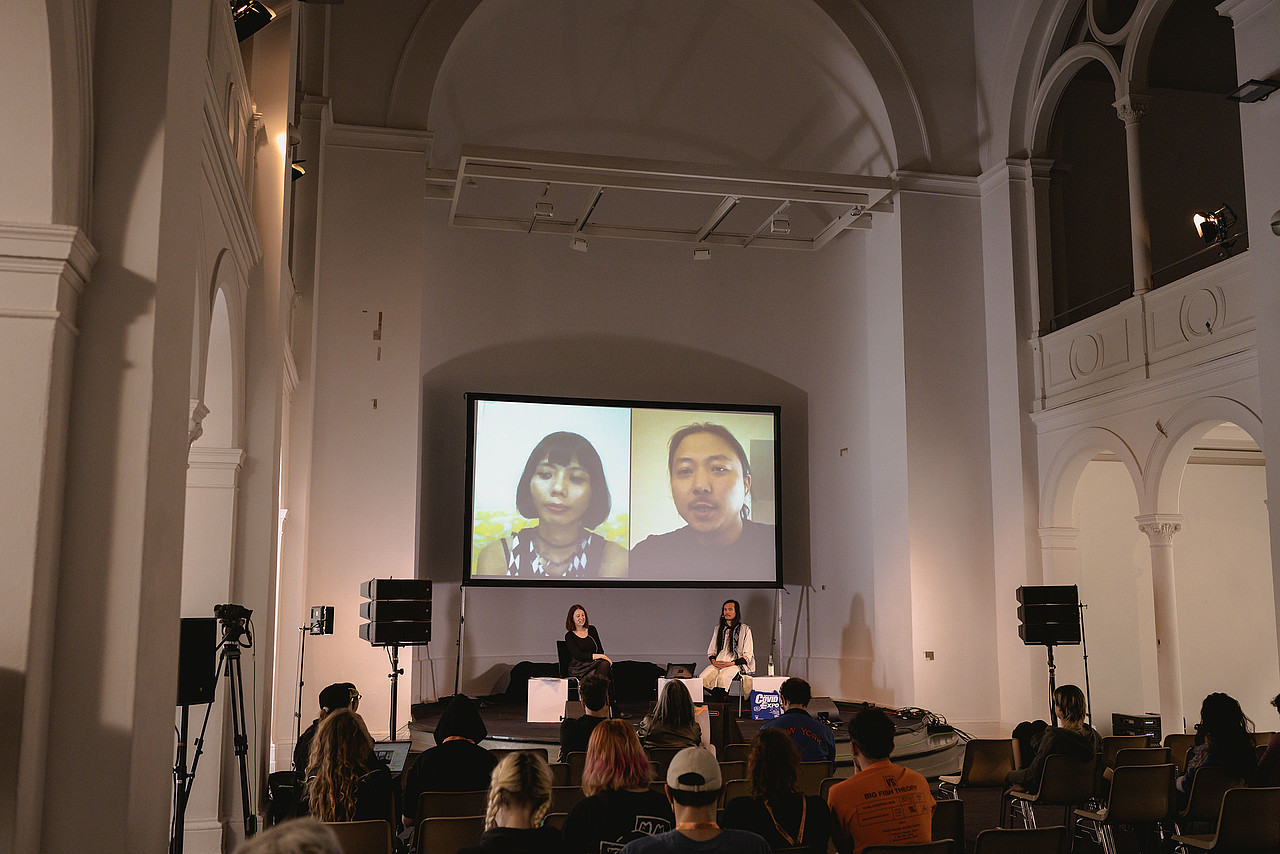
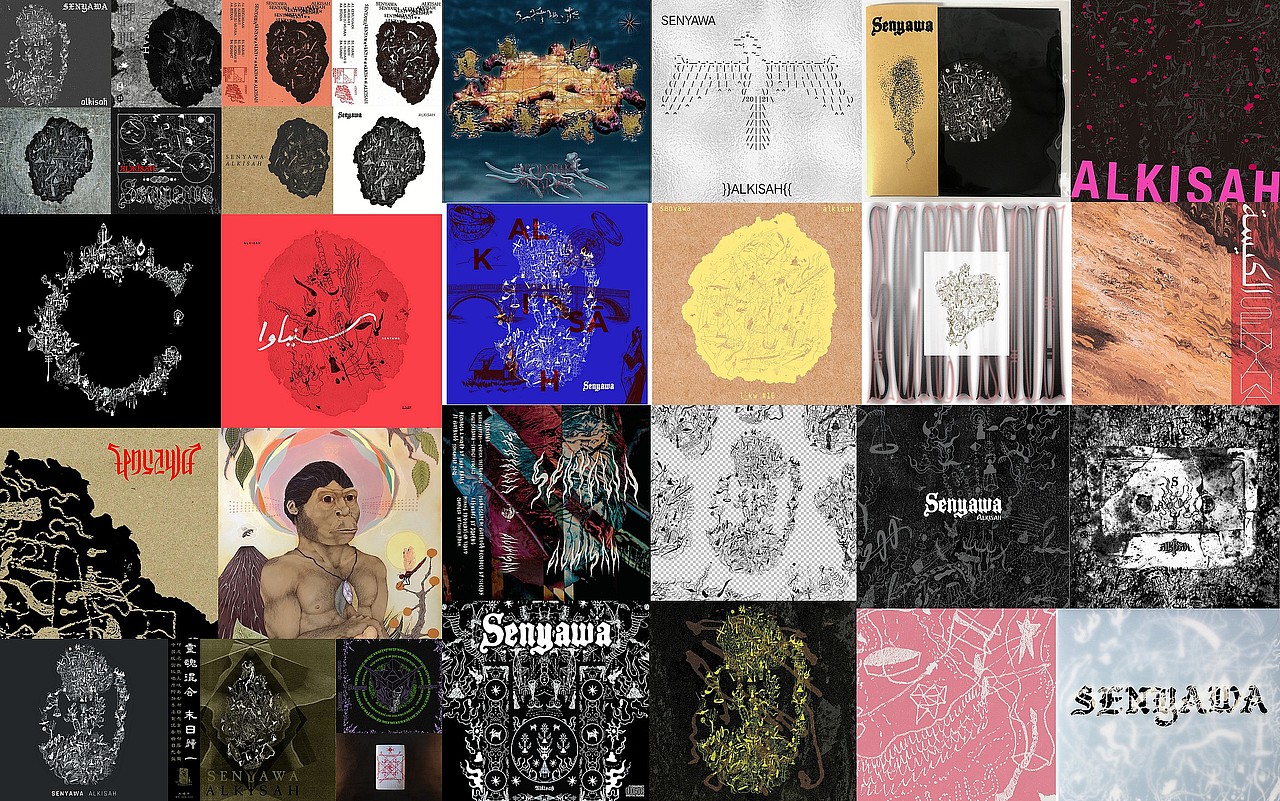
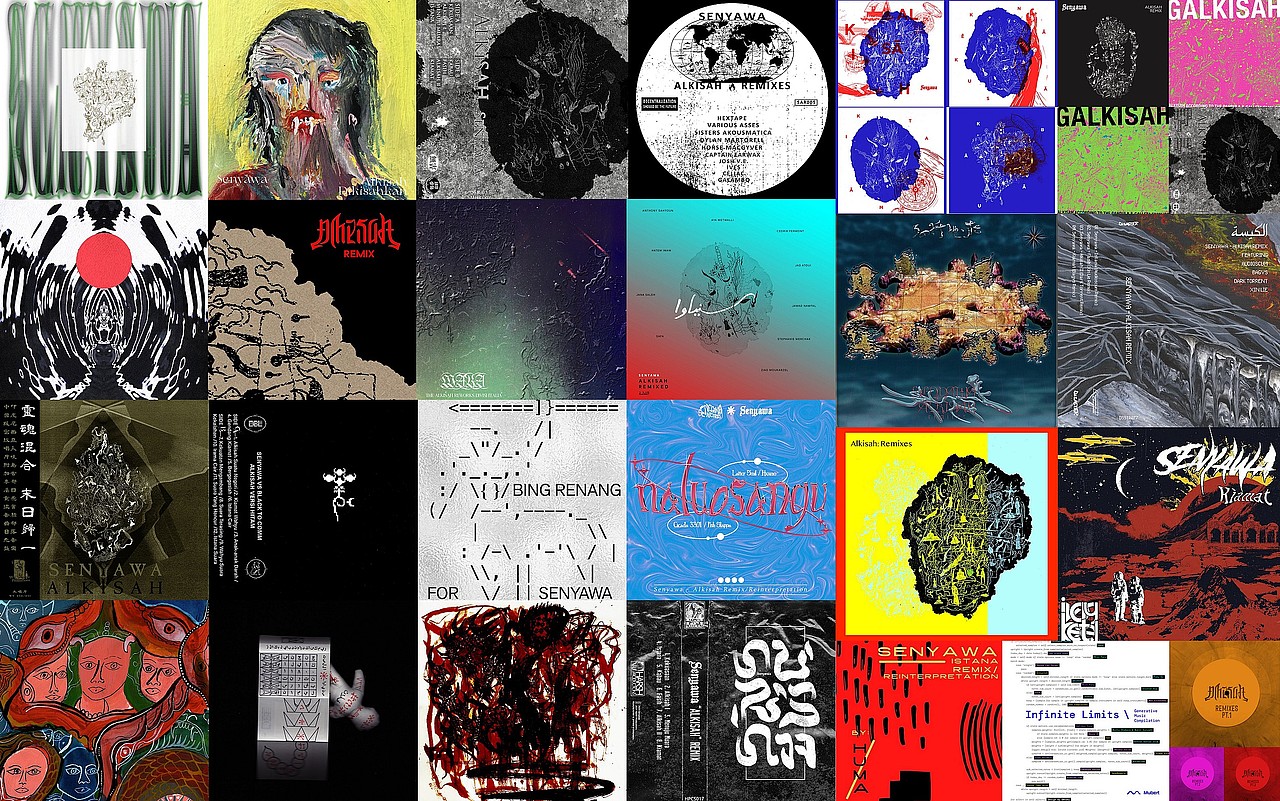
To confront this productive structure, which the duo saw as hierarchical, bureaucratised, and centralised, Senyawa offered participants the opportunity to realise their ownversion of Alkisah – both independently yet also as part of a collective work. Alongside providing the album’s masters and original artworks, the band encouraged imprints to make their own decisions regarding formats, number of copies, graphics, production, distribution, and promotion strategies. The logic was to create a network to »avoid [the] overlap of distribution...minimise shipping distances, and empower smaller scattered powers to grow and connect.« The guiding principle was that »only the locals know what’s best for them.«
Alkisah was not an exercise in logistics. Senyawa encouraged remixes and reinterpretations by local artists, in an effort to stimulate heterogeneity and context-specific variety. Encouraging this kind of diversity meant striving for album production and reception processes focussed on wide-ranging approaches, practices, and interpretations – local answers to a global task.
After over a year of development, what has the undertaking led to? Given recent social crises, what do such experiments help us discover and learn about actual and possible artistic networks of care? How did global and local musical ecosystems interface to redistribute power and knowledge?
The guiding principle was that ›only the locals know what’s best for them.‹
What shape for the global underground?
As a global network of cooperating labels, Alkisah was, above all, an experiment in distributing power via musical means. Senyawa’s wealth – if only in the form of internet clout – could be shared with the various participants. Through transnational, digital exchanges, social and creative resources were integrated by communities shaped by multiple forms of locality. Collectives from different cities, regions, and nations engaged at once with networks of varying scales.
Participants saw the release unfold in an ambiguous space of physical (localised) and virtual (decentralised) encounters – a more balanced power dynamic between the scales was facilitated. In receiving this power each label had to confront concrete possibilities: what kind of impact could the release have in these respective contexts? What kind of economic and / or social output could the release generate? How could each release work, both as stand-alone and as a variation on Alkisah? What kind of execution would best embody the project’s core?
As an answer, physical and digital infrastructures were employed and iterated upon in order to coordinate the various trajectories. The process allowed everyone to become the receptor, interpreter, and transmitter of a collective, experimental methodology whose results would vary greatly, remaining uncertain and unpredictable for the most part.
On the one hand, this approach has proved logistically successful. The experiment has single-handedly rivalled the profitability of the music industry’s traditionally monolithic productions with little effort and a comparatively low economic investment. Scattered labels and collectives have produced and circulated a surprising number of cultural artefacts – records, merch, as well as audio-video content in both digital and physical formats – disseminating them with territorial efficiency and a myriad of different approaches. Perhaps the most striking result is that the release has forged many new collaborations between artists and individuals who did not previously know each other, including the two authors of this piece.
On the other hand, a few frictions also inevitably emerged. Indeed, the purpose of the release has partly been downplayed by marketing logics and structural biases. First, some of the labels adopted traditional production and distribution models, unwittingly leading them to compete with the local markets of other involved imprints. Their versions would appear on marketplaces such as Amazon as well as in local record stores thanks to extensive, corporate distribution methods. Secondly, geographical position and linguistic context limited participation; often the balance would skew towards English-speakers and Western IRL events and initiatives. Thirdly, the release was often received and presented in ways that arguably misrepresented its purposes, often even glossing over the assortment of collectives primarily from the global south. Finally, the presence and influence of womxn and non-binary subjects have been hardly more than scant. All in all, eurocentric and business-oriented productive models influenced the releases. Because of logistic, digital, and resource asymmetries, Alkisah benefitted its requisite parts unequally, privileging participants based in the West; the more developed imprints; and the the major music markets in the UK, EU, and US. Local focus, however, was always somehow relevant, and so partly defused potential conflicts.
Alkisah was, above all, an experiment in distributing power via musical means.
In short, it seems that collaborations managed to generate shared value and impact, through utilising the network’s global-but-local reach. Conversely, sharing accumulated power with smaller imprints didn’t fully take off. Most did not manage to adapt production methods to avoid distribution overlap and competition, nor did many media outlets and fans grasp the complexity of the enterprise. Where for some of the participants Alkisah was a tool to foster artistic communities, for others it was just another release – or worse, a new business model.
The network’s developments show how both fragmentation and interdependence between music scenes on different scales increasingly define the global, popular underground. Short-lived communities of artists defined by geographical proximity and physical encounters interact with one another online. If this map of exchanges could be drawn, it would show how, despite utopian ideals, even the network was divided into centres and peripheries determined by capital and power.
A story of local knowledge and transformation
Alkisah was a provocative experiment in that it challenged common practices surrounding hierarchies, economic inequalities, and representation of marginalised groups in music. The strength of the project lies as much in the distribution of power as in the distribution of knowledge. If we move away from the project’s economic outputs and focus on its social and cultural foundations, foregrounding the enterprise’s methods of producing and distributing knowledge, Alkisah’s›local‹ value becomes much clearer.
Alkisah’s local core does not necessarily have to focus on physical space or geographic context. The Alkisah Network seamlessly interweaves global and local and their constantly transforming, porous topologies – but locality should be understood more broadly than in simple territorial terms. It prioritises cooperation and sharing (over competition); »[i]t is not about survival of the fittest. It’s survival of those who share,« emphasised Wukir Suryadi in an interview. Here, cooperation comes from an assemblage of minor actions, made by smaller local communities and their concrete practices of mutual support. The relations between delocalised local communities – labels and associated creators – helps them situate themselves in a broader, global context. Changing one’s perception and testing their abilities through practice becomes a way of producing knowledge. The key, however, is sharing. Development and distribution of local knowledge make it possible to empower each element of the network, leading to the growth of not only individual actors, but also the entire network.
The story is created locally, is processed globally, and returns transfigured to the local.
The importance of local knowledge and its distribution is emphasised by the project’s title, which translates to »once upon a time« as the incipit of a story. As Rully Shabara noted in an interview following the release, »a story, once it’s been told to somebody else, is translated and becomes local. So, the story depends on who has it and what kind of story they want to tell to other people.« The story told by Senyawa, relayed through lyrics and music, is constantly transformed by an interplay between scales. The story is created locally, is processed globally, and returns transfigured to the local. The act of retelling, like the one of translating, is not innocent; it is up to the storyteller what, when, how or where it will be told, and what/who will be omitted and erased. The way the narrative is formed, the language employed – it all matters. Therefore, it is essential to ask: who produces what knowledge? And who benefits from it?
When we ask those questions, we equate these various forms of knowledge with their corresponding power structures. It is significant that the global South, that Indonesia, has undergone processes of Western colonial exoticisation and exploitation. For centuries, the nation was substantially denied the right to develop and represent itself autonomously. Alkisah shows that even if the existing world hierarchies have not changed, there has been a significant shift: Alkisah wasn’t conceived by those considered major centres of power and knowledge. The conversation was one that started in a fundamentally different place.
One shift entails another; a new opening is a new perspective; new places of knowledge production demand changes in the distribution of power. Cooperation and solidarity do not erase differences between global and local actors, nor the boundaries between the network and its often Eurocentric perception. However, as we have seen, collaboration can confront and question such issues, encouraging others to do so too.
The house is built but empty
After long term engagement and a growing, intentional absence of Senyawa after the album release, it becomes pivotal to discuss how and if such a network should continue producing relationships and new creations. For now, as beautifully put by Morgan Sully of the L_KW label and Soydivision art collective, »the house is built but empty. Still, it’s ready to be occupied.« This musical and social network is just a starting point: an infrastructure that can be developed, modified, replaced, and multiplied according to many different needs. It’s a path showing the manifold possibilities that letting go of control opens.
In fact, contrary to what could sometimes appear as disapproval of the project’s global result, it would be unfair to judge it under the success / failure binary. Instead, the focus is constantly on what should come next. Alkisah shows how experiments probe and test the limits of artistic practices and their ethos – how art can become a tool to shed light on larger, uncharted portions of the map.
It’s a path showing the manifold possibilities that letting go of control opens.
Action proved a fundamental entry point to understanding the complexity and layers of the global music industry as a political infrastructure. Alkisah allowed participants to problematise their work on different scales and develop knowledge about possible outcomes. In doing so they built the preconditions for a more mature and self-conscious discussion on how we want our communities to look and how we see them in the larger musical ecosystem.
If nothing else, Alkisah shows that alternatives to dominant narratives, albeit still imperfect, are at hand and can help include new, previously marginal actors. Astoundingly, Alkisah does not constrain participants: nobody has to repeat this experiment. Nobody has to continue it, and indeed, most network members are indeed happy with the results – although nowadays, most of them have moved on and do not see Alkisah as a site for further work. Instead, it will transform, gain new shapes, organically exploring new fields and possibilities. How we perceive it will depend on the position and perspective we observe it from.
The biggest takeaway for those concerned with the shape and impact of communities is that now the house is built and functioning. It can be used for many purposes and inhabited by different subjects. Each time it will be used, it will bring new knowledge and new power issues. Even with a new name or form, it carries a certain hands-on, collective spirit that is not afraid to try, fail, repeat, abandon, or change.
Alkisah invites us to take care of ourselves as musicians and communities, expanding relentlessly on a question through practice, halfway between a feedback loop and a koan: »what is power when the end is nigh?«
Marianna Lis is an independent scholar interested in contemporary wayang (shadow puppetry), theatre, performance and music in post-traditional Indonesia. Her research focuses on the potential of traditional arts to address the most urgent issues for the future, and artist-activists and their roles in raising awareness and local community engagement. She received her PhD in theatre studies from the Institute of Art of the Polish Academy of Sciences in Warsaw in 2017. In 2019 she published a book titled Wayang. Javanese Shadow Puppet Theatre. She is also a widely published theatre and music critic.
Luigi Monteanni is a PhD candidate in music studies at SOAS under the AHRC CHASE. He studies the relationships between contemporary transnational pop music genres and regional music and, particularly, the indigenisation of extreme metal in Bandung, Indonesia. He is also the co-founder of Artetetra Records and the duo Babau: a music label and music project pursuing practice-based inquiries regarding notions of digital folklore, world music 2.0 and exoticism in late globalisation. Among others, he has collaborated with Norient, Simon Reynolds, Club To Club, Scuola Cònia, Terraforma, The Attic, NON-Copyriot, ISMMS, Aural Archipelago, Kiosk Radio, NTS, Rai Radio 3, and Roskilde Festival.
This text was commissioned as part of CTM 2022 – Contact.