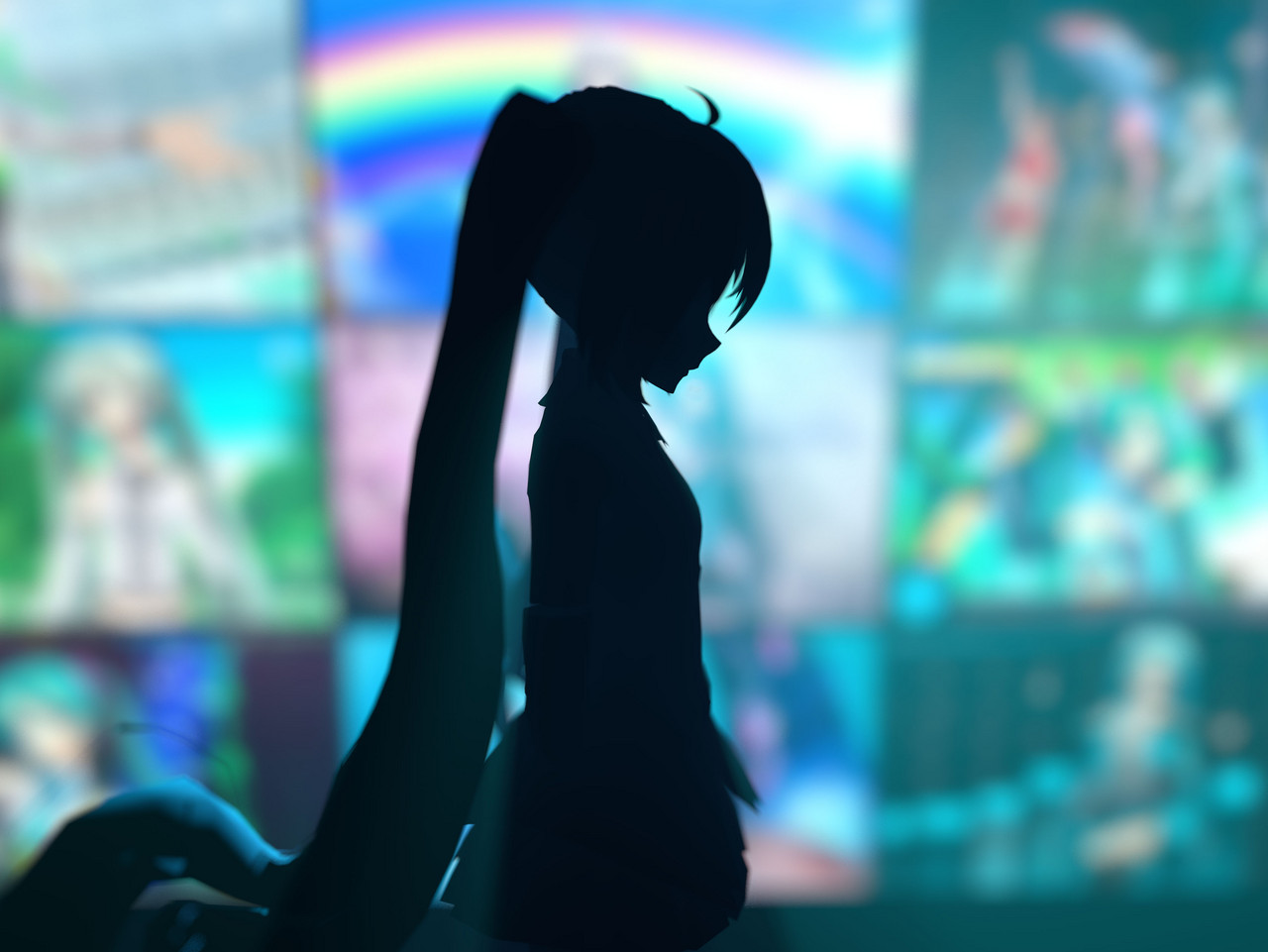
Hatsune Miku (whose name means »first sound of the future« in Japanese) is a virtual idol. She is the third and most successful in a series of animated pop stars developed using the Yamaha Vocaloid engine. She was launched in 2007 by Crypton Future Media under a creative commons license and subsequently adopted by a vast community of online users. Miku has since become a kind of mirror, revealing to each new user their own desires. »She is the product of what (Walter) Benjamin called ›phantasmagoria‹ and ›the desire of the masses,‹« writes media professor and Hatsune Miku expert Mitsuhiro Takemura. Simultaneously, she is an advertising gimmick, an entity without any original form.
This is not the first virtual idol to have ever been created, but none has enjoyed as much success or attention as Hatsune Miku. In 1996, a talent agency in Japan called HoriPro produced Date Kyoko (DK-96). Combining the best computer graphics technology available at the time with the voice of an unnamed artist, they created a character with cropped hair and a crop top, and cast her in music videos. While the distinctly 1990s aesthetics of the creation would appeal to today's obsession with retro, only a handful of fan sites still contain traces of Kyoko. In 1999, French artists Philippe Parreno and Pierre Huyghe bought the copyright to a Japanese manga character and made her into an open-source character named Ann Lee. Yet if virtual entities aim to supersede the lifespan of a real-life idol, no attempt has come near to achieving this. Even Miku's popularity has waned in Japan in recent years, despite the fact that she has achieved a great deal of autonomy for a character that was created as a Vocaloid ad.
Vocaloids were initially developed to eliminate the need for backup singers in recording sessions, thus cutting time and costs for the artist or label. Due to increasing numbers of home-studio producers, the ratio of singer to producer was also becoming problematic. The Vocaloid was seen as a long-overdue development in electronic music synthesis, as almost every other known instrument had already been synthesised decades ago. Drum machines and synthesisers had become integral to the music production process, and while vocal effects such as the vocoder or its predecessor (the »Voder« from Bell Labs) did exist, there had never been much success in making an instrument out of the voice. The Vocaloid, which gave producers total control over melody, timbre, and even emotion, was the closest anyone had come, but it was never conceived of as a center-stage product.
Recorded human voices form the base material for the Vocaloid. These recordings are then dissected and strung back together in the synthesis engine, according to an operator's commands. Early trials utilised the voice of a professional singer, and in the case of Hatsune Miku, a vocal actress named Saki Fujita was chosen specifically for the »Lolita-like« quality of her voice. The voices of well-known J-pop singers have also been recorded, packaged and sold: Gackt, a popular Japanese musician, became the Vocaloid »Gackupoid« and the voice of Japanese singer Meg became »Megupoid.« With the advent of this new technology, unique voices once housed in the bodily architecture of stars suddenly grew legs and walked free into the market.
The Japanese pop industry is centred on delivering the utmost dream to fans, namely the illusion of an attainable fantasy. As such, the industry has always cashed in on the pop idol who is never quite perfect, and whose imperfections make them all the more desirable. In order to avoid shattering the illusion of attainability, all precautions must be strictly followed. This comes at a price for real-life entertainers, whose discipline and endurance is tested throughout their careers. For instance, pop idols sign a contract promising never to engage in a real-life relationship so as to perpetuate the image that an encounter or even a date could one day be possible for the fan. It is interesting to note that since the advent of the »perfect« pop star, imperfections have been projected onto her rather than being inherent.
User-generated software such as MikuMikuDance owes itself to this principle, too. Users can choose from a vast pool of models (also user-generated) and make the models move, again using user-generated movement files. The character licensing specifically forbids any usage that might harm the character's image, but this has not stopped users from flooding the internet with sexual or violent scenes involving Miku anyway. For example, MikuMikuDance and MikuMikuMove gave rise to the persistent need to lift Miku's skirt, leading to thousands of attempts documented in YouTube clips. If the surface of Miku's body is a metaphor for collective public desire, could it be that we find the dark web under the layers of her skirt? Crypton does not target explicit content for removal – there is simply too much. But, more cynically perhaps, it's also just good publicity.
Miku's licensing was also implemented to accommodate an already existing structure, the Doujin circle, where »secondary derivatives« of original and more widely circulated animation characters (such as Doraemon or Sailor Moon) are exchanged and sold in the form of manga comics, illustrations, or other merchandise at fairs. Companies looking to use the character for commercial purposes are required to contact Crypton Future Media and ask permission first, taking into account that she is already associated with various businesses and that the concepts and ideologies of the new companies might clash.
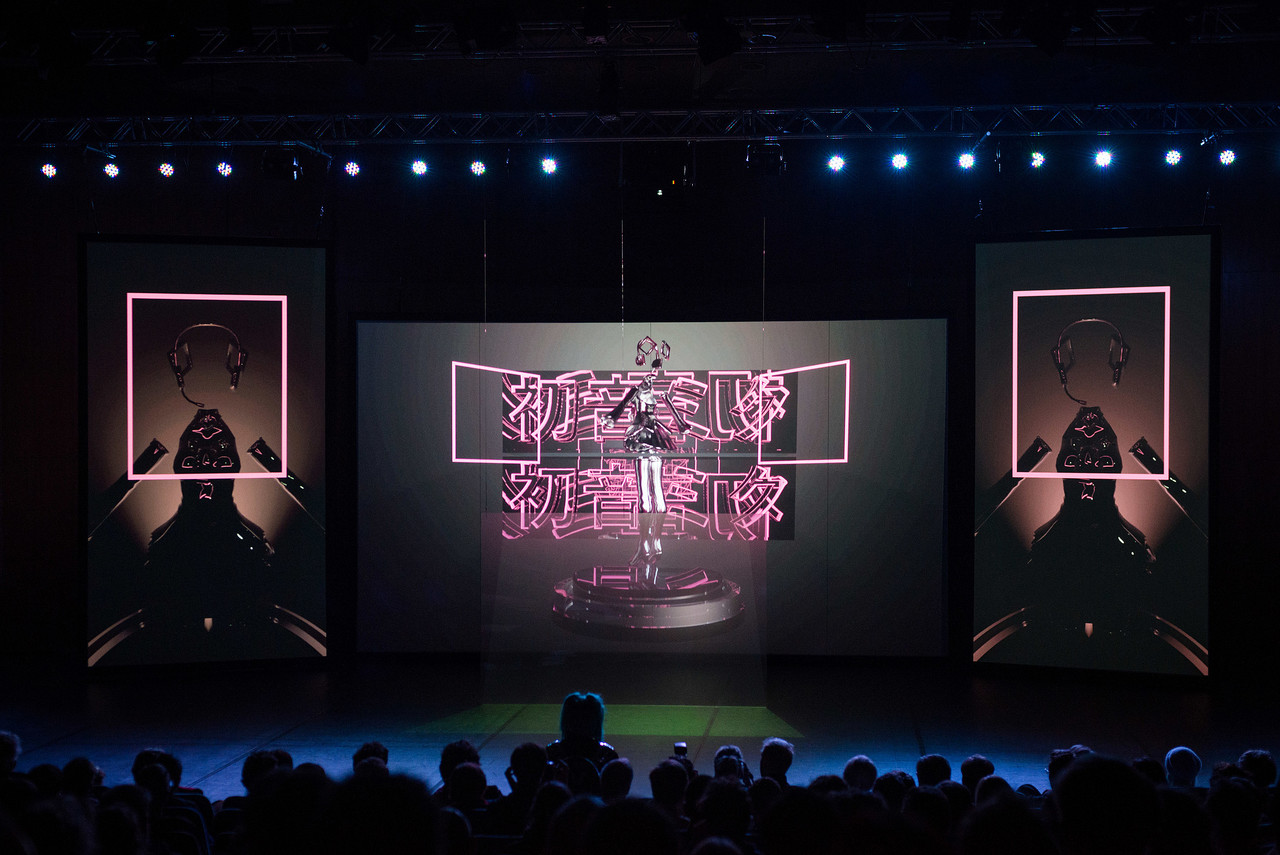
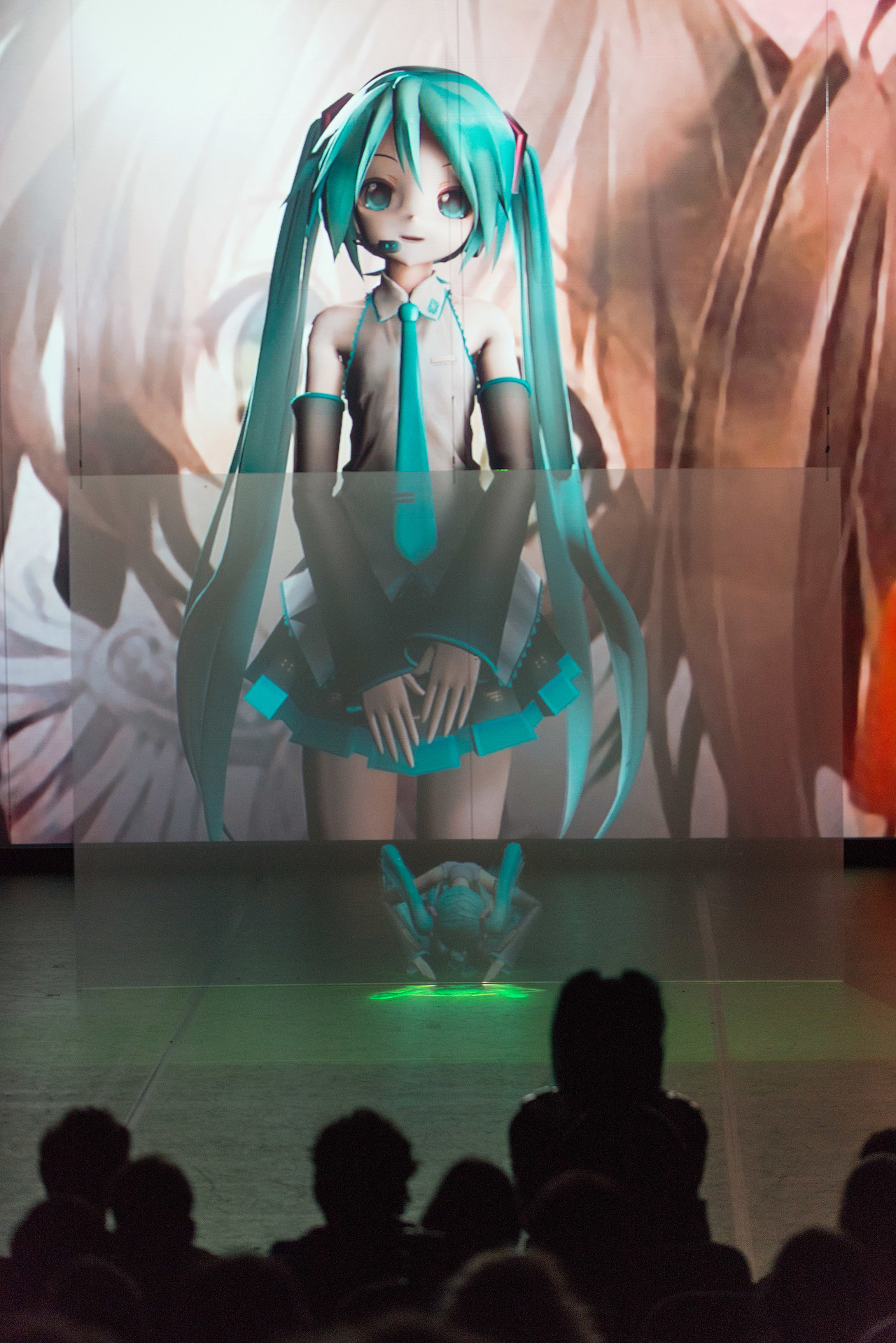
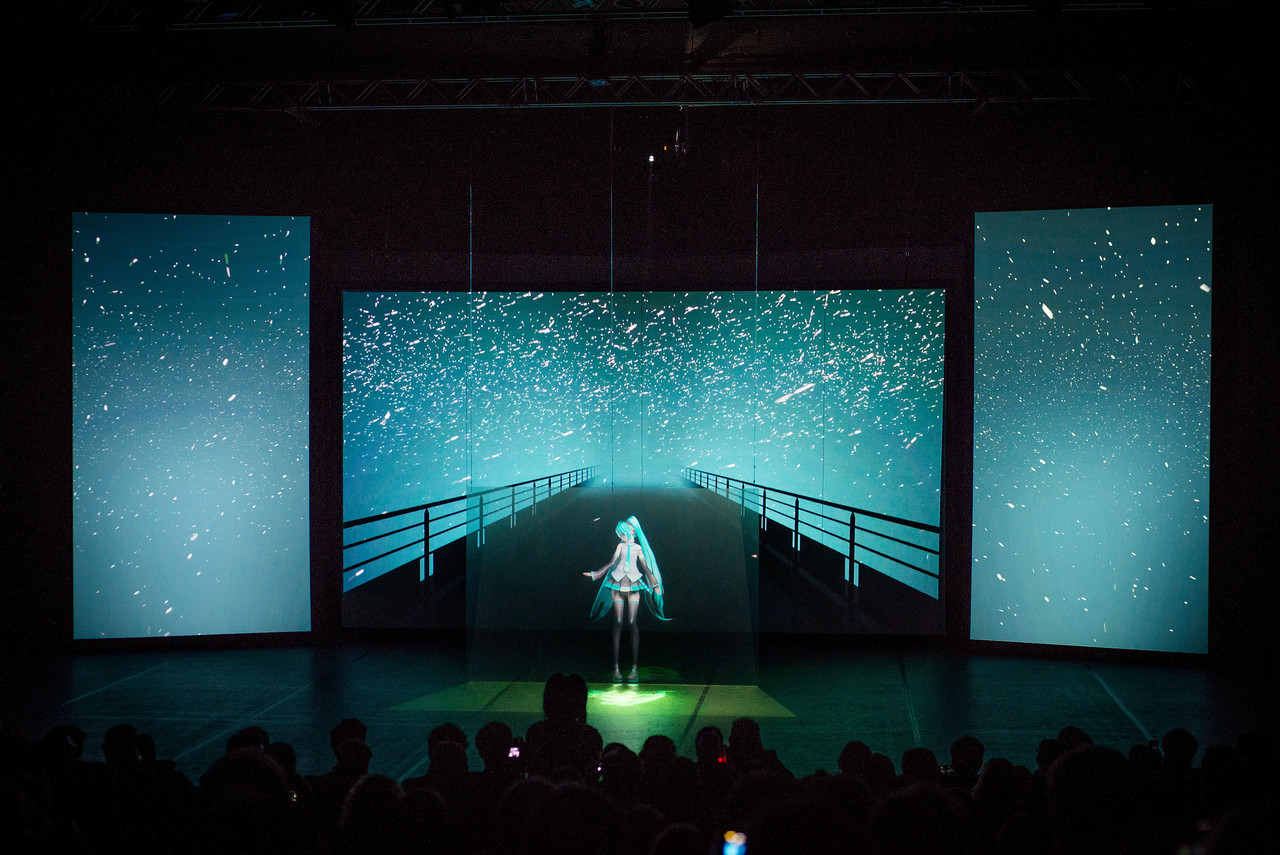
How does the »Still Be Here« project, presented at CTM Festival in 2016, fit into all of this? Staged performances like this one take place in a grey zone between utopian, collective vision and capitalism. It's not as direct as selling T-shirts and mugs emblazoned with the character's image, nor is it as benign as superimposing Miku's image onto the family Christmas card. Audiences must come to terms with Miku as both a marketing tool and a medium for emotional information and experience.
In comparison to the Vocaloid idol's massive success in Japan, Miku's reception in the West has seemed slightly more skeptical and amused. Could the Japanese readiness to accept another's voice as a vehicle for one's own lie in a tendency to negate the self – and therefore the voice – in favour of the community? In turn, is the West's lack of conviction a result of an emphasis on the »self« and the voice? Social concepts of the »self« vary drastically between the two cultures.
It could be said that if the production of a Western »self« is constructed through differentiation to the »other,« then the Japanese »self« construction is through identification. (It is maybe worth noting that the use of the personal pronoun, ie. »I«, »you«, »he/she« etc, is frequently omitted in everyday spoken Japanese language.) Social psychologist Geert Hofstede defines individualism as »a society in which the ties between individuals are loose: everyone is expected to look after himself or herself and his or her immediate family only« (Hofstede, 1994: 261), and collectivism as »a society in which people from birth onwards are integrated into strong cohesive ingroups, which throughout people's lifetime continue to protect them in exchange for unquestioning loyalty« (Hofstede, 1994: 260). If we replace the notion of self with the voice, the lyrics created by Miku's users show these tendencies literally and metaphorically. »As usual, you're hated, pushed away when you haven't done anything. Even though you tried, the reason is ›vague‹ and you're both confused and sad. So, you should use my voice – some people say it's incomprehensible and dissonant, an unattractive voice, but I'm sure it will be of use to you so please let me sing with your own, your very own words« (from Odds&Ends/ryo). One must not forget that Hatsune Miku derives from the otaku community, a subculture often (but not always) associated with social inferiority. The term defines people with obsessive interests, commonly huge anime and manga fans, who often seek empowerment through channels such as cosplay (costume play).
According to Tomonori Shiba, music writer and author of the essay »How Hatsune Miku Changed the World,« the wave of creativity triggered by the phenomenon of the virtual idol is comparable to a »third wave of the summer of love.« The first wave was Woodstock in the 1960s, the second was the rave scene of the 1980s, and his claim is that the utopian ideals and infectious euphoria surrounding Hatsune Miku in online communities constitutes the third wave. If this were true, the effects in Japan were relatively short-lived, and even the virtual idol was chewed up and spat out by the ruthless pop-production machine. However, I am inclined to agree that, even if it is not the music itself that brings these users together, unity is generated through a communal sense of being at the cusp of something revolutionary, be it free love, drugs, or free creation – a concept of sharing which is inherent to musical experience. Perhaps Hatsune Miku could be seen as a metaphor for a long-lost voice in Japan finding a global stage, a vehicle for shared experience. The fever has caught on outside of Japan, but it is exciting to see how she will develop now, not just in terms of location but also between genres, cultures, and disciplines.
Mari Matsutoya is a Berlin-based artist originally from Tokyo. Her work focuses on language as a mirror to reality and as a medium that sits on the fence between the visual and the sonic.
This text was originally published in CTM Magazine 2016 – New Geographies.