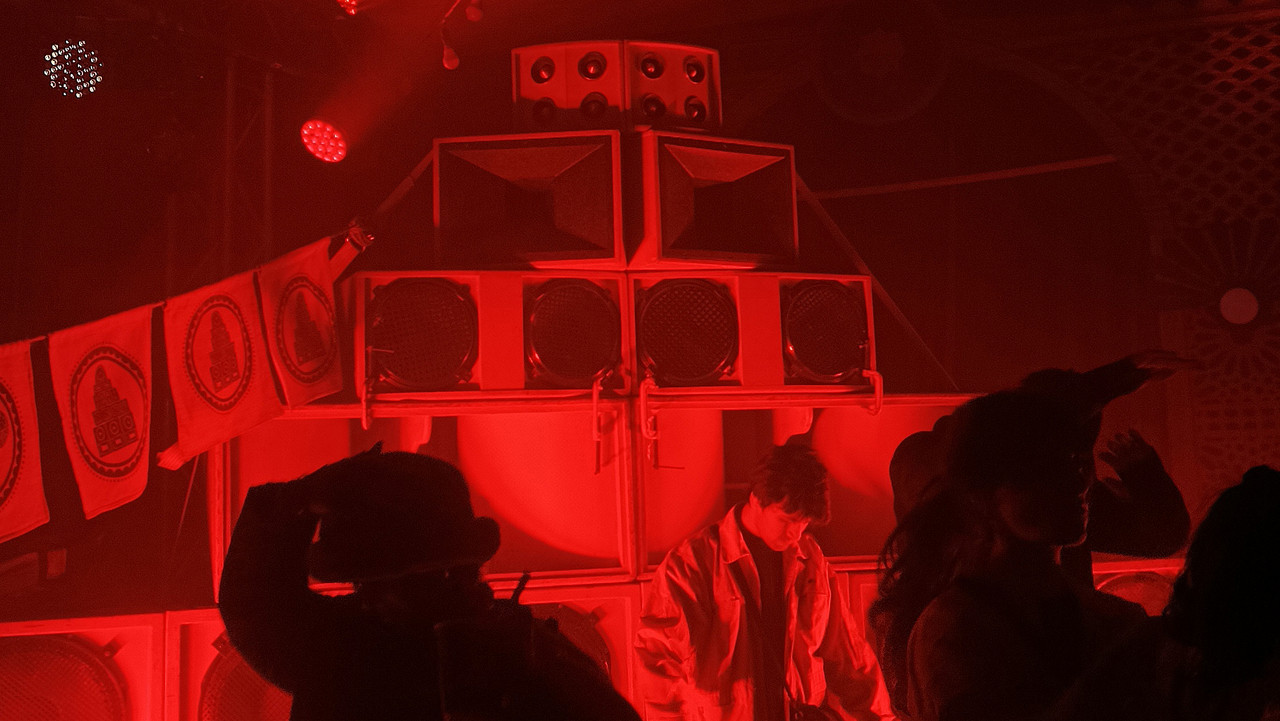
The past decade has witnessed exponential growth in anti-Muslim and anti-minority violence in India. Hindutva – a Hindu nationalist political ideology encompassing the cultural justification of Hindu nationalism and the belief in establishing Hindu hegemony within India – has gouged at the pre-existing communal and social rifts in Indian society, making the divide even deeper. Here, sound systems have served as an imperative technological tool in advocating for or against the dominant political discourse of otherisation across the country.
This essay examines the role of such sound systems in (re)defining the political landscape of India, by shedding light on how such sound systems have become crucial tools in propagating the radical ideology of Hindutva nationalism, but also how Jamaican sound system subcultures of India amplify the voices of the marginalised, thereby offering an alternative engagement with sound systems technologies. In detailing how sound systems have played a dominant role in charging India’s ambient urban atmosphere through sound, we see how sound systems can be understood as part of a larger socio-political fabric – one that is equally informed by technology and mediality.
6th December 1992,
Ayodhya, Uttar Pradesh, India.
The seeds of communal rifts in India weren’t sown in recent years. Instead, these rifts have a deep history of othering embedded into the country's political landscape. Perhaps one of the most infamous incidents of such rifts erupting into communal violence in the contemporary history of India is the demolition of Babri Mosque in the state of Uttar Pradesh in 1992. To give some background, that same year the Bharatiya Janta Party (BJP) – a right-wing political party – organized a political and religious rally across India, the »Ram Rath Yatra« (chariot journey for a principal Hindu deity, Ram). The rally's purpose was to gather support to erect a temple for Ram on the site of the Babri Mosque in Ayodhya, India.1 The Hindus claimed the mosque had been built on the site of the birthplace of Ram and hence advocated for its replacement with a Ram Janmabhoomi Temple honoring, and dedicated to, the birthplace of the deity. The agitation was led by various right-wing political Hindutva outfits such as Vishwa Hindu Parishad (VHP) and Rashtriya Swayamsevak Sangh (RSS), which aligned themselves with Hindu-Aryan superiority.
After traveling through the country, the procession eventually reached the town of Ayodhya, where on the 6th of December 1992 an antagonised crowd of about 150,000 »kar sevaks« (right-wing volunteers) led by political leaders ended up demolishing the 16th century mosque. This event has set an alarming precedent for state-sanctioned anti‐Muslim violence and has been used as a political agenda by the BJP to unite Hindu votes across the country. Consequently, minorities in India have experienced an unabashed increase in economic, bureaucratic, and physical violence against them – one which is normalised by drowning the voices of anyone who critiques the ruling party.
The spread of Hindutva separatist ideology which advocates for India to be reserved for Hindus, and the expulsion of Muslims from the country, has largely been determined by its effective techniques of cultural production – an exercise in capturing people’s imagination, especially that of the Hindu majority. Sound and speech have played an integral part in this cultural production. A day before the mosque’s demolition, Atal Bihari Vajpayee (then a member of the BJP) addressed the »kar sevaks«in his speech encouraging them to »level the ground.« On the day of the demolition itself, chaos ensued owing to the speeches and antagonising calls which turned the procession into a violent mob.
22nd January 2024,
Ayodhya, Uttar Pradesh, India.
Today, 32 years later, surrounding much controversy and political and bureaucratic pomp, the Ram Janmbhoomi Temple in India was inaugurated in place of the demolished Babri Masjid in Ayodhya. Alice, a friend of mine, happened to be visiting the Taj Mahal in Agra on the same day. For context, the Taj Mahal, apart from being one of the wonders of the world, is another Mughal monument in the state of Uttar Pradesh, India which has increasingly found itself amid Hindutva contestations of occupying the site of a pre-Mughal Hindu temple. Revisiting the day, Alice detailed how she felt the urban environment charged with a different kind of violence – ambient instead of physical – made possible with the use of sound systems blurting antagonising communal songs.
For the said occasion, most sound systems got booked months in advance in various towns and villages in Uttar Pradesh and other parts of North India. »We are playing at a village in UP called Vikramjot (19 kilometers from Ayodhya, UP). There is a booking for one day – it’s the day of the inauguration of the Ram Mandir« Shamshu Pandey, owner of the Baba King DJ sound system mentioned. Pandey added that his DJs will be playing songs about the Ram Mandir inauguration. The use of sound systems such as Shamshu Pandey’s for the dissemination of political propaganda disguised in the garb of religion largely contributed to polarising the ambient urban environment.
Due to this effectiveness, sound systems and popular culture have increasingly found their way into the Hindu right-wing cookbook to dish out Hindutva ideology. This entanglement of sound and politics has created an entire section of Hindutva popstars. Through his book H-Pop (or Hindutva Pop), Kunal Purohit details the life and work of one such Hindutva popstar – Kavi Singh, who is on a mission to »spark patriotism among Indians who seem to have forgotten traditional values or ›desh prem,‹ love for their country,« but her perspectives »do little expect to push the Hindu nationalist thought further.«2
Communal songs by Kavi Singh and her peers are largely polarising and geared towards swaying public opinion and instigating mobs. Some of the popular songs include »Topiwalas« (skull cap-wearers), »Banayenge Mandir« (we will build the temple), »Ho Gya Faisla Ram Mandir«(we have decided about the Ram temple), and others. Such songs together with the recent increase in the use of sound system technologies, have created a hotbed of otherisation and anti-Muslim sentiment in the country. Such sonic landscapes and assemblages have been effective in disseminating political propaganda and antagonizing populations under the current BJP regime thereby altering the social fabric of the country. This sentiment has, time and again, burst forth in different forms of communal clashes and violence across the country.
What is an »Indian« Sound System?
Perhaps it’s best to start by understanding what an »Indian« sound system is and if such a taxonomy is even warranted. If so, what sets it apart from the otherwise-studied sound systems emerging from other geographical contexts?
The mediality of sound systems is entangled with the social and cultural life in India. Regardless of its intent, sound is an efficient tool in permeating the physical and social barriers of our environment. Consequently, sound systems as extremely accessible means of production are effective in rendering ideas, spaces, and formats of life that otherwise get sidelined from the dominant narratives that frame an understanding of our society. Sonic media and sound system technologies help transcend the otherwise highly segregated spaces and social structures (caste and class) in India as they allow the means of production to be owned and encountered by the subaltern. It is this accessibility and ownership offered by sound and sound system technologies to a wider spectrum of society that reframes social narratives and consequently shapes our sonic environments.
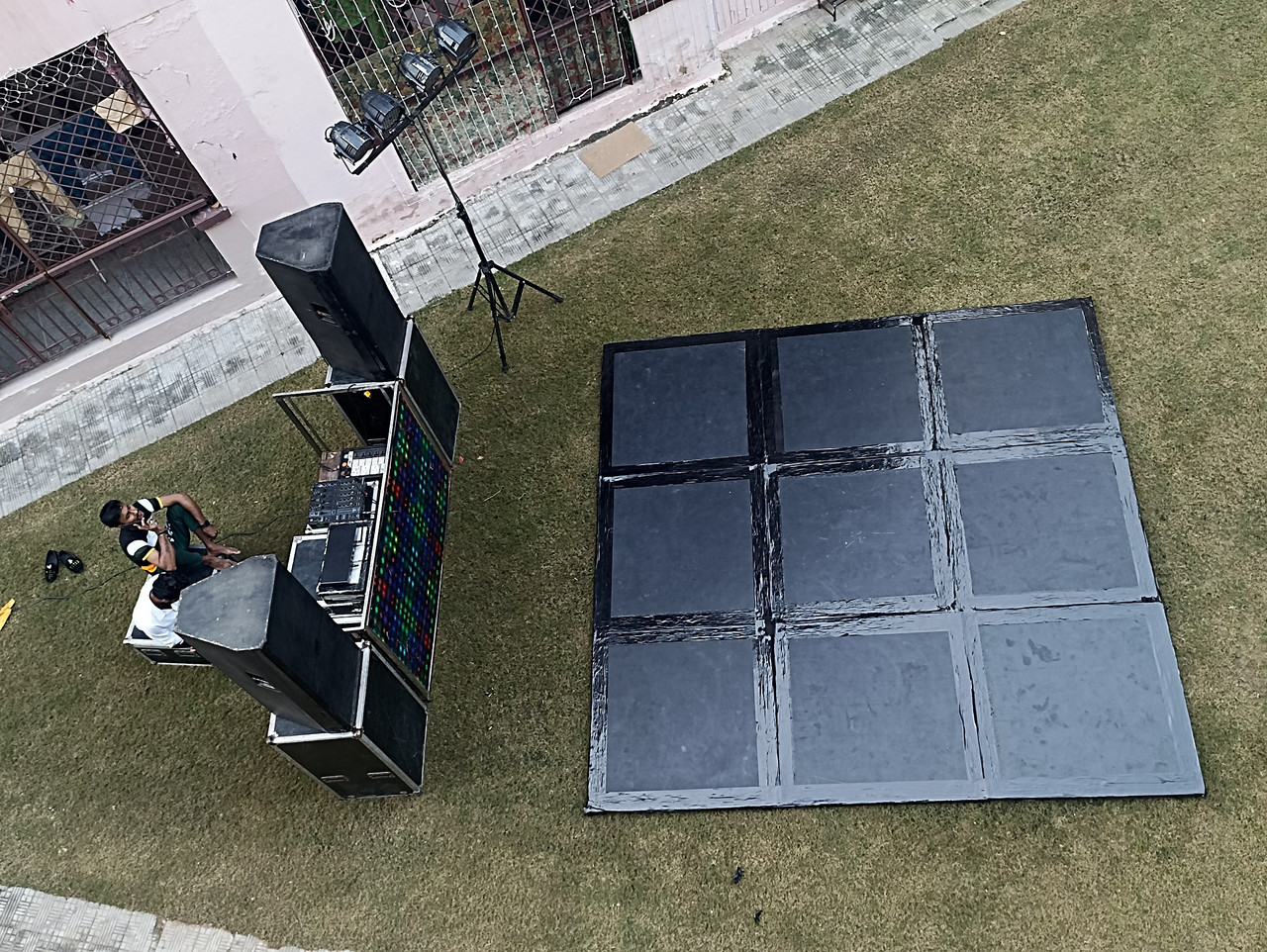
Sound systems – being much sought-after medial devices for the reproduction of sound – are rented for socio-cultural, political, recreational and religious events such as festivals, marriages, wedding functions, political rallies, and in some contexts even death anniversaries. These create a nebulous demand and supply of sound systems in India and have a »medial base in that the operation of technology is a constitutive part of collective experience.«3 Cultivating this collective experience through sound system technologies is extremely affordable too. An average sound system rental consisting of two bass units along with two tops, a DJ floor, and a 4 PAR light system amounts to 5000 INR (55 €). Curation included, the DJ can play a diverse range of Bollywood hits, remixes, and communal songs to suit the occasion for up to five hours at a stretch. This sound system could either be stationary or mounted on top of a tractor or an open truck, suiting the occasion and the needs of the client.
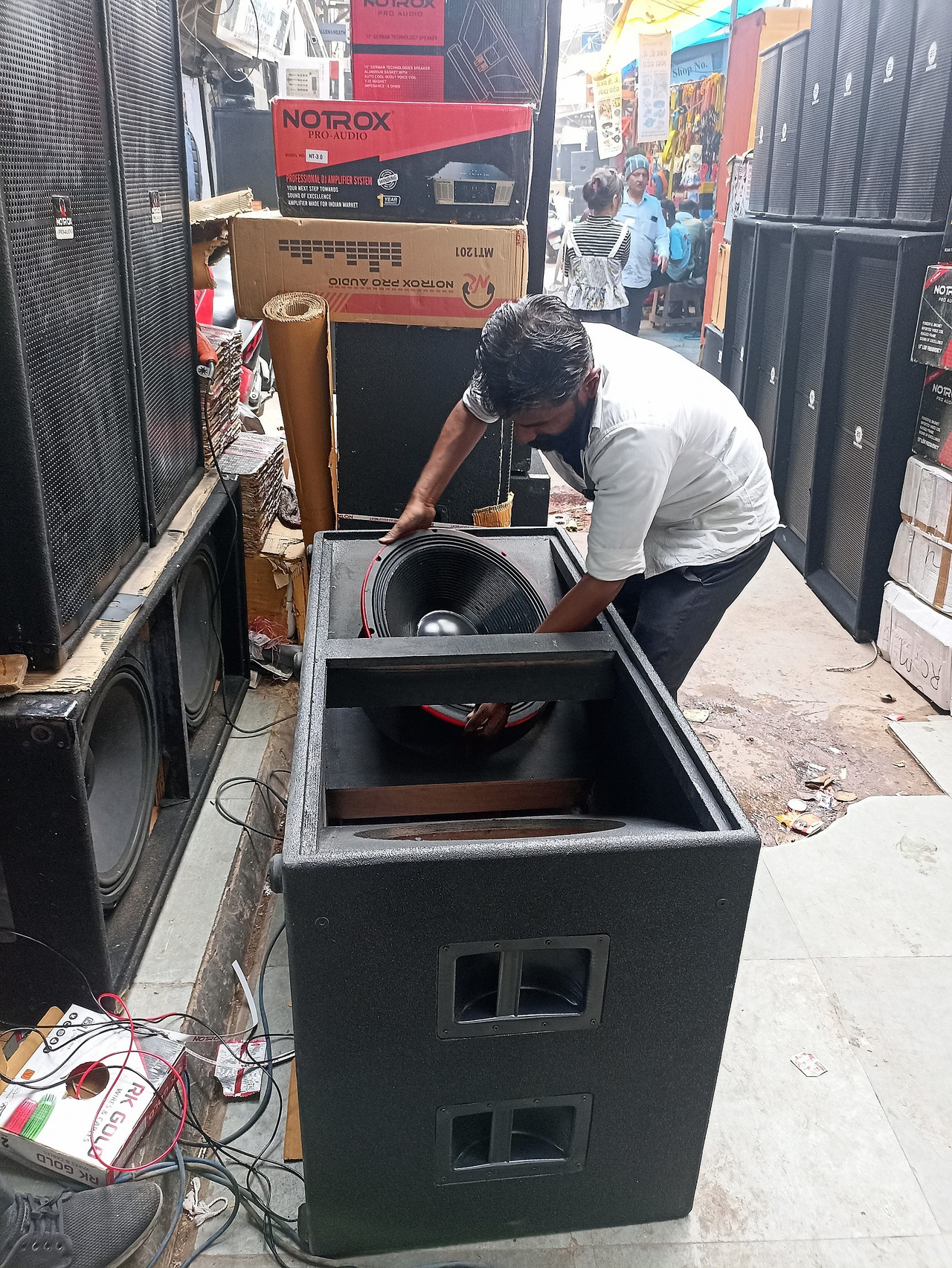
To understand the operations and the demand and supply flows behind sound system technologies better, I visited Delhi’s Old Lajpat Rai market – a predominant market in northern India for acoustic, lighting, and electronic technologies. This market also has a high concentration of vendors who sell and rent sound systems across India. According to Nishant Seth, the proprietor of Seth Audio, the demand for sound systems follows a cyclical pattern of events and each festival that makes use of sonic rituals comes with its unique specifications. This includes the Ganesh Chaturthi festival in Maharashtra, Goa and southern India, the Kanwar Yatra in north Indian states, especially around Delhi, Rajasthan, Punjab, Haryana, Uttar Pradesh and Bihar during the Monsoon season, as well as the Navratri festivalseason around October and November each year.
The employment of sound systems has helped in developing and forming a unique sonic expression of the socio-religious landscape across the country. In his seminal work titled »Techniques of Inattention: The Mediality of Loudspeakers in Nigeria« (download PDF), Brian Larkin details that »these media are not simply neutral technologies, but are the affordances that any particular medium possesses to order human life and ›culturalize the natives of that society.‹«4 One can then conclude that the Indian sound systems are not as much a byproduct of the country’s geographical dictates, but more importantly, are technologies through which dissemination of sonic media helps organize and order the cultural and social landscapes of the Indian society. Sound systems and loudspeakers hence cultivate what Jonathan Sterne referred to as »audile techniques«5 and which Larkin describes as »practices of listening that distract people or call them to apply and that take place in relation to religious norms and the medial quality of the loudspeaker, and constitute part of broader social, religious and psychic configuration of urban life.«6 It is this value of sound system technologies that makes them an apt tool for propagating politico-religious ideologies.
Streets and the Mobility of Sound Systems
How, when, and where we interact with sound shapes our ambient experience of environments. In relation to sound systems, two aspects of study demand our attention – the mobility of sound systems and the street as a democratic social space.
An interview with Raheem Bhai (owner of DJ Sabka Malik Eksound system) revealed that their rentals most often depend on whether the event takes place indoors or outdoors. Political and religious functions are seldom restricted to indoor environments – such as closed-off clubs, event halls, and gathering spaces with restricted access – and are almost always supplied with sound systems that pack enough power to effectively amplify sound across busy streets and open public spaces. Most of the sound system owners have also modified their systems in a way that accommodates mobility, which makes it easier to relay sound even further. Shamshu Pandey (Baba King DJ sound system) details that their sound systems can be mounted on top of open trucks and trolleys rented on a per-day basis. Together with elaborate lighting systems and LED screens, such mobile audio-visual assemblages are an effective tool employed for road shows.
Larkin details a similar example from Nigeria about how Muslim movements sponsor cars with large loudspeakers fixed on the top, relaying their »wa’azi« (preaching) as they drive slowly from street to street. Such mobile sound systems activate the urban space and help expand the definition of amplification – one that is not only dictated by the technological amplification of sound and sonic media but also by the impact it has across collective urban space over shorter, yet more frequent periods of time. In other words, such sound systems attempt to assert »mastery of airborne space« over time.7 Here the streets provide an opportunity to create conscious and unconscious medial and techno-political assemblages and become ideologically charged with the help of aural, visual, and mobile technologies.
Amplification and Loudness
When understood as the site of reclaiming, challenging, or asserting dominance, the street becomes a potential site for the contestation of differing ideologies and belief systems. Back in 2022, Sri Rama Sene (another Hindutva outfit) chief Pramod Muthalik alleged that the use of loudspeakers in mosques creates disturbance caused by »azaan« (Muslim call for prayer). Accusing the Karnataka state government of inaction, members of the Hindutva organization took matters into their own hands and played »Hanuman Chalisa« (a devotional hymn in praise of the Hindu deity Hanuman) on temple loudspeakers in Karnataka to counter the alleged »disturbance« caused in public space. The domination and othering hence take place sonically instead of physically, which has proved to be a more sustained and ritualized tool of aggression employed by these right-wing groups.
Such contestations heavily rely on technologies of amplification of electronic media and sound. Most of the amplifiers employed in such sound systems operate between 12,000 to 15,000 Watts and most sound systems are almost always equipped with more than one amplifier. The amplifier and the associated wattage signify the power these sound systems encompass to move air as sound. This power to move air translates to a power to dominate sonic space, eventually altering the aural experience of our environments thereby enabling sonic contestations. Domination via appropriation of sonic space eventually dictates our perception of the ambient environment and our ability (or lack of) to manipulate it.
Attention and Inattention
On 23rd January 2024, a day after the inauguration of the Ram Temple, I happened to be visiting one of South Delhi’s bustling urban villages. The entire neighborhood was adorned with loudspeakers blaring political and religious songs. A street vendor informed me that the speaker systems were installed by the local political representative of the ruling party, BJP, to show their support and appreciation towards the »reclamation of Hindu rights in the country.« Upon asking if it was causing any nuisance in the neighborhood, the vendor said they had gotten used to it.
Reflecting on this conversation, the vendor seems to have cultivated inattention as an ability to shield themselves from large masses of stimuli they are subject to in the urban environment. Brian Larkin frames these techniques of inattention as important facets of perception that help in creating the ambient sonic urban experience, stating for example that in Nigeria »urban streets are technologized, and everyday life emerges in relation to the machine of the loudspeaker. To live in this environment, urban Nigerians have to develop certain cognitive and practical skills.«8 Such cognitive and practical skills of inattention play out in the Indian context too, where the propagation of antagonising ideologies through sound makes the urban environment pregnant with the possibility of violence. To survive such ambient violence and to prevent it from turning into a physical one, cultivating inattention is one of the select few tools available to those subjected to such ambient violence – until such inattention cannot be afforded.
Purohit highlights the utilization of inattention in the Indian context by taking an example of a Ram Navami(a festival celebrating the birth of the Hindu deity Ram) festive procession in Gumla, Jharkhand back in 2019. Purohit writes that on the day, the procession consisted of »a caravan of open trucks with DJs, alongside powerful booming speakers, playing loud music to keep the crowds energized.«9 Tensions started running high as the procession turned onto a lane housing a mosque in a predominantly Muslim neighborhood. As the procession turned, the music switched to antagonising pop songs. The crowd eventually started chanting »Hindu slogans in ways that onlookers perceived were meant to be aggressive and deliberately provocative to Muslims.«10 On that day, the antagonising content relayed through sound systems charged the ambient urban environment. The response of the neighbourhood’s Muslim population was the cultivation of inattention – a tool of perception that helped negotiate the boundaries between ambient and physical violence.
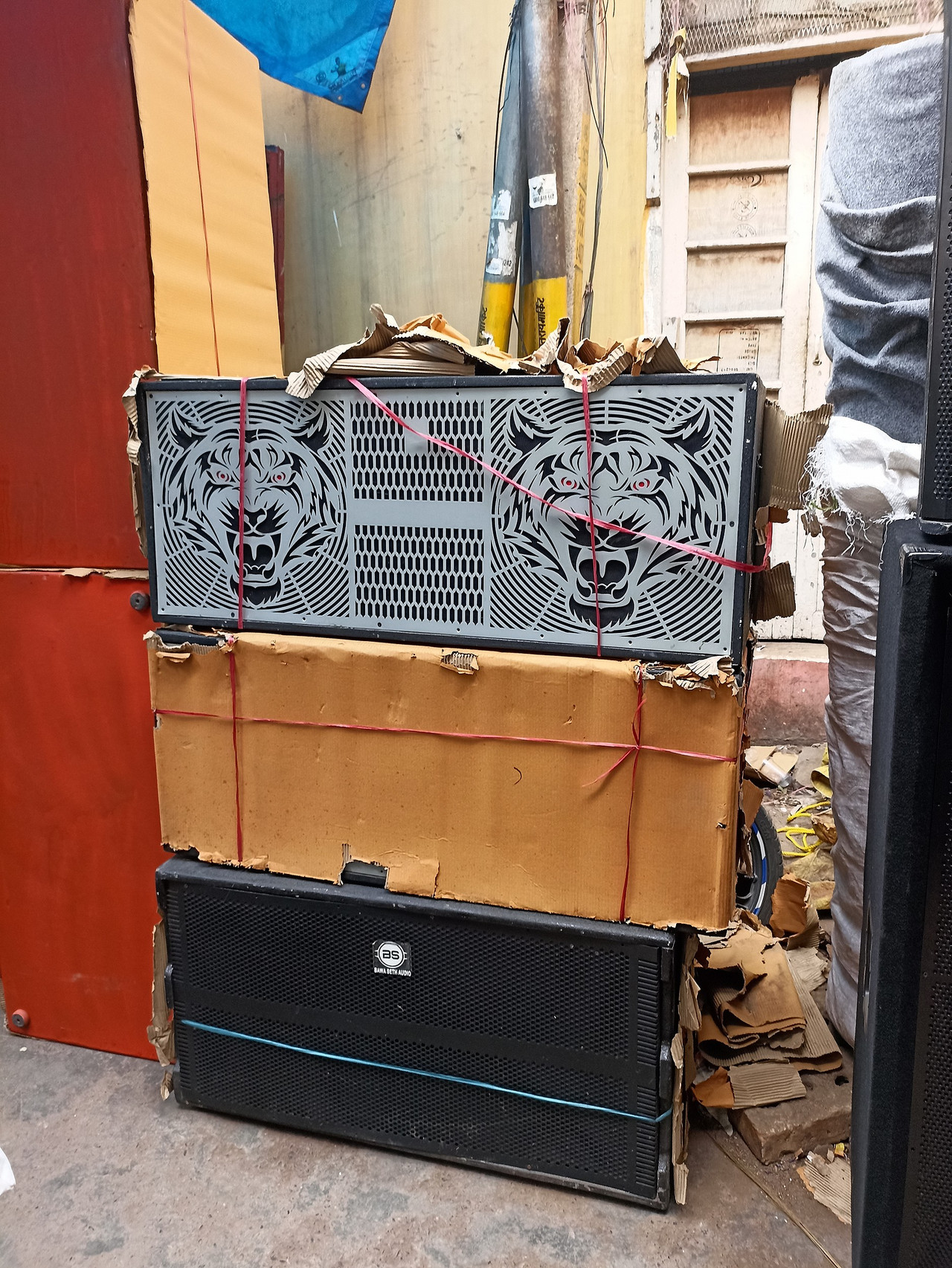
Here, sound systems not only help in the dissemination of ideology and propaganda across physical and visual barriers but are also visual devices of their own significance, »drawing attention to themselves as a medium of relay.«11 The aesthetics of these sound systems become part of tipping the balance between inattention and attention. Nishant Seth adds a mandatory speaker grill adorning a stenciled face of a lion with red eyes to his cabinets as a show of the sonic power his sound systems are capable of exuding. This mandate of attention extends to the accompanying lighting and visual systems too. Mayank (High Class sound system) stresses this demand for visuals: »People find something being played on the LED screen with music much better. Nowadays the demand for LED walls has increased. Even in political rallies, we carry small LED screens displaying the symbol of the concerned political party.«
DJ Monu – a sound system hailing from the town of Meerut, Uttar Pradesh boasts of the most expensive and most powerful sound system setups in India. Packing a total of 20 bass units, along with 16 units of line array equipped with mid-frequency drivers and the remaining tops – the total cost of the tractor-mounted mobile sound system adds up to a whopping 3 Cr INR (approximately 335,000 €). An additional 2 Cr INR (approximately 223,000 €) includes the lighting system comprising 20 PAR lights and LEDs, a generator system with its associated fuel costs – all managed by a team of 25 people. Such a massive sound system infrastructure – even without the utilisation of its audio-visual abilities – itself becomes a visual spectacle and an assemblage of sonic and visual power and dominance which, by virtue of its mere existence, makes inattention impossible.
Their associated aesthetics hence contribute to how such sound system technologies, as aural and visual tools and devices, are perceived as expressions and assemblages of power – as an apparatus. The sound system as an apparatus, a form of technology, has »the capacity to orient, determine, intercept, model, control or secure the gestures, behaviors, opinions or discourses of living beings.«12 By blurring the thin line between attention and inattention through sonic and visual modalities, the sound system becomes an apparatus of state control, which not only propagates the ideological stance of the state but also catalyses its overt physical manifestations.
Anatomy of the Song
Raheem Bhai (DJ Sabka Mallik Ek) and Shamshu Pandey (Baba King DJ) both pointed out that playlists are curated in advance by their DJs based on the requirements of the events. Most of the songs are downloaded from the internet/ YouTube. Online libraries are full of songs dedicated to the cause of propagating nationalism and antagonizing mobs. A quick YouTube search for »Hindu DJ playlist« or »kanwar Dj gaane« will yield thousands of songs and playlists dedicated to the cause alike. How then, do certain songs find their way into the hands of sound system DJs? To answer this question, we must try to understand the anatomy of the song.
A vital resource in understanding the anatomy of Hindutva pop songs was the recently produced documentary, A Sound Democracy. Written and directed by Dhananjai Sinha and assisted by Pranoy Kanojia, A Sound Democracy »details mechanics and mathematics of producing music that incites, leads, or pacifies violent tendencies in contemporary India and its relentless manufacturing of a homogeneous nationhood.«13
As part of framing this argument, the documentary sheds light on the work of Bucks Boy – a Hindutva popstar who has risen to fame with his track »Bhagwadhari« (someone who adorns the saffron – a colour associated with the RSS ideology and the Hindutva movement). Bucks’s Instagram account gives us an idea of the many hats he wears – rapper, lyricist, and music producer – while boasting of his 300K+ YouTube subscribers. In the documentary, while detailing his choice of lyrics and production decisions, Bucks stresses that his lyrics are meant to create euphoria and the feeling of valour among his listeners. To tap into this feeling, Bucks vehemently advocates for aggression through his lyrics.
Both Kavi’s and Bucks’s lyrics are a testament to this insight. Kavi Singh’s lyrics and the political messages encoded in them aim at serving justice, swaying public opinion, and shunning all voices of dissent around crucial political issues and policies. Purohit gives us the example of Kavi Singh’s song »Sacche Hindustani – jansankhya kanoon lao, desh bachao« (»True Indians – Usher in the Population Control Law and Save the Country«) released as a response to the widespread protests against the discriminatory Citizenship (Amendment) Act, which »fast-tracked the citizenship of only non-Muslim refugees from neighboring countries.« The song, Purohit details »vilified the protesters as anti-nationals, warned of anarchy and an Islamic takeover of the country, and pitched a bill to regulate the country’s population as the answer.«14
The temporal and spatial context of consumption of these songs not only informs their content and lyrics but also the ways in which sound is synthesized and produced. While reflecting upon his production decisions in A Sound Democracy, Bucks recalls: »›Jai Shree Ram‹ to maine aise hi bana diya tha... par maine ›Bhagwadhari‹ planning ke saath banaya tha. Ye planning ki thi, ki ye gaana DJ pe bajega.« (»I made my track ›Jai Shree Ram‹ without much planning... but my next track ›Bhagwadhari‹ was made with an intention. I planned it in such a way that it is played on sound systems (DJ).« For Bucks, changing the BPM of the track to suit a more danceable range of 140 to 160 BPM was part of this plan – a way for him to ensure that his tracks would be curated by sound system DJs into their playlists. Bucks here hints that he became aware of the context of consumption and the technological assemblage that his music becomes a part of once it’s reproduced in the sonic environments created by sound systems. Where his music is played, and how it is played and interacted with, informs how he produces his music and shapes his sound.
Another scene in the documentary shows Bucks producing his tracks on a digital audio workstation, detailing his production decisions on camera. The software instruments used by Bucks in the production of his famous breakthrough track »Bhagwadhari« include the conch, war drums, and bells. These instruments are particularly chosen by Bucks for they evoke »shaurya« – valour on the battlefield – and incite aggression among his Hindu listeners. In doing so the sonic media and instruments remind the devotees of their need to become a warrior (just like Ram) and take up arms against the »common enemy of the Hindu state – Muslims.«
Consequently, the work that Bucks puts into producing his music is informed by the potential of his music to alter urban space. At the stage of music production, Bucks’s production decisions become part of the ambient violence his music is meant to evoke even before it has been consumed/ listened to. The content of such songs – along with the context within which these songs are reproduced – both equally dictate the production techniques of the songs themselves. Here, Bucks’s switch from making songs made for amplifying religious messages to making songs made to be consumed through sound systems is a radical one. Bucks details it as a transformation of the listener from a »Ram Bhakt« (a devotee of Ram) to a »Ram Yodha« (a warrior for Ram), a transformation which is made complete by the media and technological assemblages of sound systems. The body and the senses are regulated by the sound system as an apparatus.15 The political therefore becomes the corporeal.
Jamaican Sound System Subcultures in India
Both Kavi and Bucks shape narratives of the country’s nationalist leanings through their work without being affiliated with any Hindutva organisations, thereby »creating an illusion of independence.«16 As a growing countercultural movement, the Jamaican-style sound systems in India help the masses detach themselves from this illusion of independence and consequently support their own narratives. Taru Dalmia (Delhi Sultanate), the owner and selector of the Delhi-based Bass Foundation Roots (BFR) sound system believes that »sound systems are not just a stack of speakers, but a way to take things into your own hands and to find ways to take music straight to the people.«
Jamaican sound system subculture and roots reggae music aren’t new to the Indian sonic landscape. The likes of Kush Arora, Apache Indian, and Bally Sagoo have helped popularise these sounds and associated cultures in the 1990s and 2000s. Their pioneering synthesis of reggae, dancehall, and roots music together with the realities of identity and social struggles of the Indian diaspora in the UK gave us genres such as bhangra dub and bhangramuffin. Their choice of identifying with bass music to talk about their struggles and carve their identity was no coincidence. Apache Indian aka Steven Kapur was raised in Handsworth, Birmingham, UK, a racially mixed area with large Black and Asian communities, home of reggae bands such as Steel Pulse and UB40. Kapur’s upbringing in a marginalised community which found its voice through soundsystem cultures largely helped him shape his own narrative along with that of the South Asian diaspora.
Increasingly since, Jamaican-style sound systems along with their associated groups of DJs, MCs, and selectors have cultivated a way for their communities to own their narratives and break away from the ideology propagated by the state-owned apparatus. This accomplishment is largely owed to the belief in owning the means of production and reproduction of sound – the sound system. A sound system is hence both the medium and the message, propagating the ideology of those who own the means of production.
In the recent history of alternative music in India, Jamaican-style sound systems and roots music have gained popularity owing to selectors such as the Reggae Rajahs crew consisting of DJ Mo City, Diggy Dang, General Zooz, Ziggy The Blunt and BeLights, along with sound system owners, MCs, and selectors such as Delhi Sultanate and Begum X of the BFR sound system (Delhi), Dakta Dub of the Monkey sound system (Hyderabad), 10,000 lions sound system (Goa), Anand Tandava sound system (Goa) among many other initiatives.
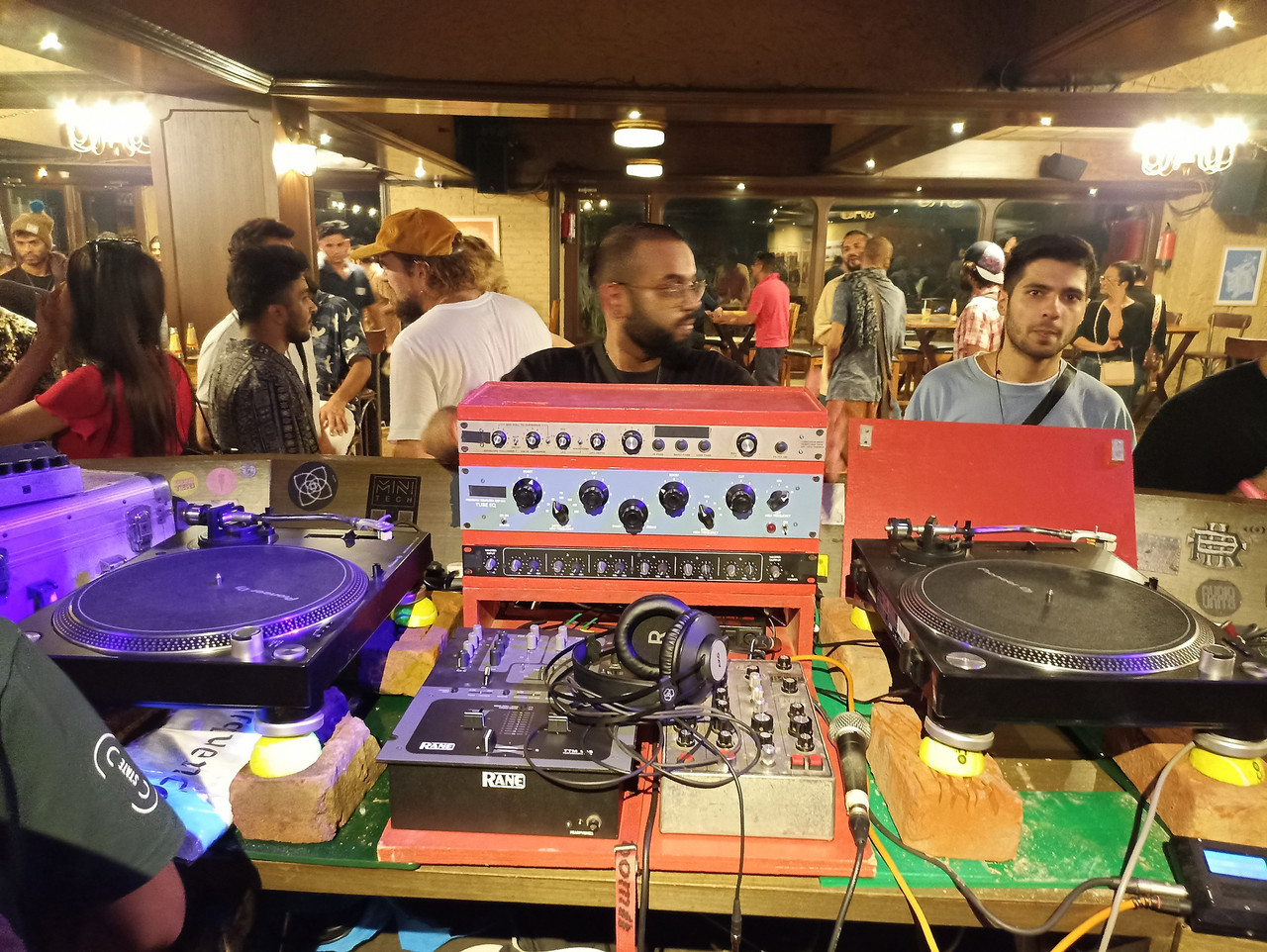
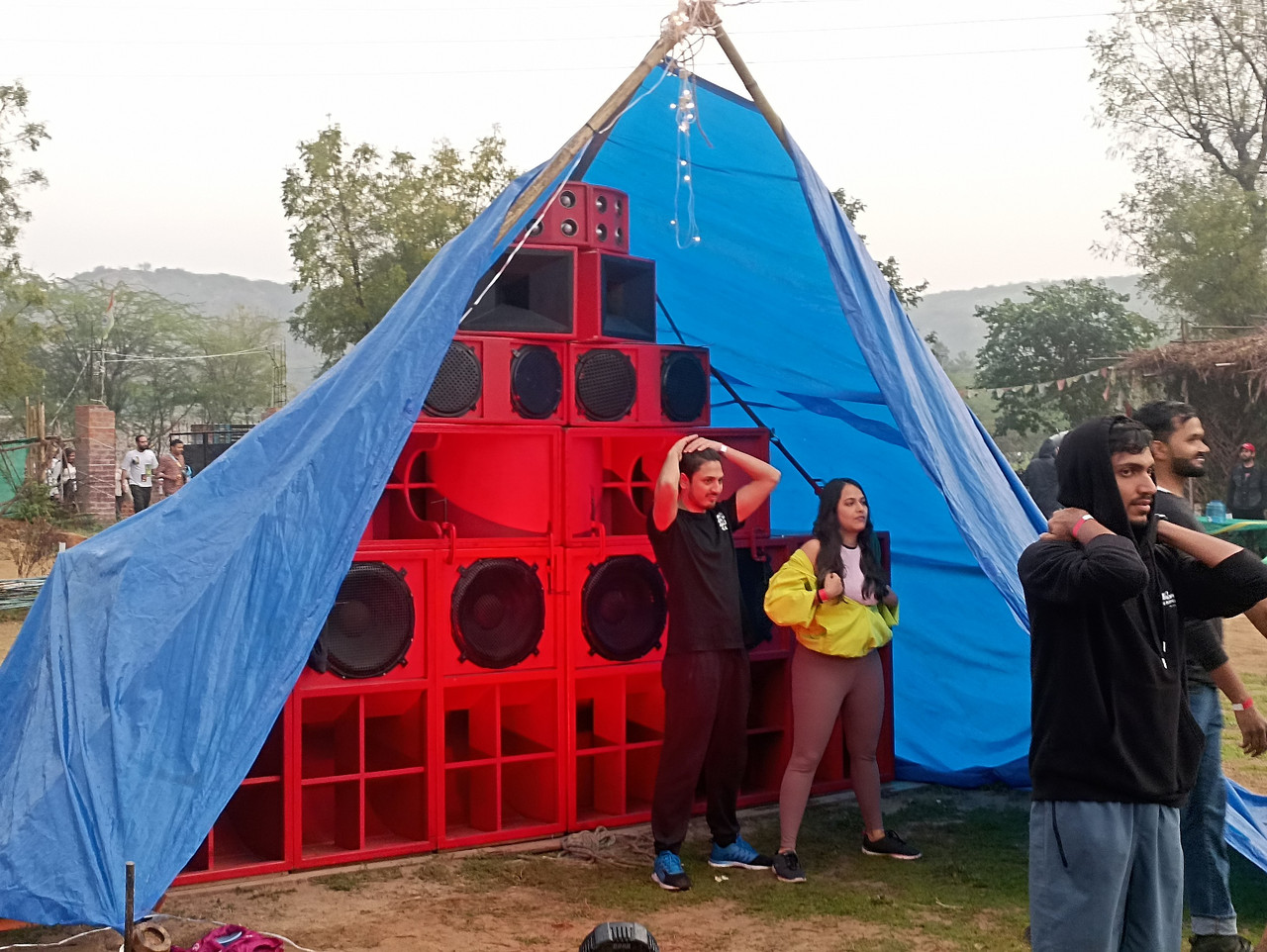
The Bass Foundation Roots sound system has been invited to perform at universities, clubs, parks, music festivals in the past. Since the sound system has been set up at a number of diverse public spaces of varying hierarchies, the demographics at any given BFR gathering are a mix of people from all walks of life. Back in March 2023, I attended my first Bass Foundation Roots sound system immersion. Organised at a farmhouse on the outskirts of Delhi, the sound system and the decks faced each other while packing space for about 300 dancers in the middle. The decks were armed with two turntables, a few effects units, and a tube equalizer painted red adorned with the words »This Machine Kills Fascists.« While spinning dub, reggae, and dancehall dubplates and records, layering them with occasional dub effects and calls against fascistic and separatist ideologies, Delhi Sultanate and Begum X urged dancers to face the sound system rather than themselves. While orienting the dancers to the sound system, they emphasized the importance of sound in demolishing state propaganda, and the importance of their sound system as a vital tool of resistance. The sound system demanded the embodiment of music, rather than merely listening to it. This embodiment was made possible by the bass frequencies which dominated the dance arena. Both MCs propagated the ideology of liberation and free thought rather than that of the conservative and nationalist Hindutva ideologies. The political hence became corporeal yet again, only here it facilitated the resistance to the dominant narratives of the state.
The locally-owned sound systems used for the propagation of nationalist ideologies and the Jamaican-style sound systems used to resist state propaganda sit at the center of clashing ideological stances. In a 2017 interview Taru emphasises that »all of us who are involved in cultural production on some level, want to capture people’s imagination. We are up against powerful forces. Power consists of asserting your version of reality, of affecting or even dominating how people interpret the events around them or even themselves. It is in this context of competing narratives that I view our musical activity as ›soundclashing.‹«
Language plays a vital part in this fight for ideological sonic estate. Spinning dub plates etched with songs by local MCs and Punjabi and Marathi rap artists from across the country, the selector makes sure the songs transcend the barriers of language. In the early days of the BFR sound system, Taru faced doubts about the elite quality of his music, which largely propagated the narrative of free thought in English. Eventually, the selector brought in a mix of Hindi and Marathi lyrics and invited Swadeshi,17 a trio of rappers who rapped about revolution, to perform. This shift from using purely English tracks to a mix of English, Hindi, Punjabi, and Marathi dubplates made their movement more accessible, both by transcending the boundaries of gated venues and of languages.

The different sound system cultures detailed in this essay all aim to make their vision accessible to large masses, thereby gaining access to their imagination. The propagation of ideologies, irrespective of their alignment, uses sound and music as a tool of cultural production. In the article »Why the Toxic Beats of Disc Jockey Hindutva are so Dangerous for India« Brahma Prakash writes, »unlike the boundaries of ideology, music is open and participatory. Music becomes the point of initiation into politics. In an unequal political sphere, music gives you the chance to feel as if it is your own. Once you have participated in it, you feel you proudly own it because the participation gives you impunity. It becomes culture. That is why it is more dangerous.«
At the same time, Jamaican sound systems and selectors prove that this very property of appropriating music and sound can be greatly liberating too. Contributing to fracturing state/conservative ideological alignments, the Jamaican sound system subcultures in India are helping us achieve a slow but sure shift from the dangers of radical political leanings. The sound system is a device that has the potential to amplify forms of propaganda and forms of resistance at the same time – depending on who owns the means of production and on the forms of solidarity built upon their respective ideological alignments.
Anandit Sachdev is a researcher, teacher, music producer, DJ, and sound artist based in Delhi, India. He is the founder of Antariksh Records, an independent record label promoting underground electronic music and sound cultures in the Indian subcontinent, which is also home to the Antariksh Sound and Media Collection (ASMC) – a nebulous artist collective exploring dialectics of being and becoming through sound and visual media.
This text was commissioned as part of CTM 2024 – Sustain.
- 1
Christophe Jaffrelot, »The Hindu nationalist reinterpretation of pilgrimage in India: the limits of Yatra politics« in Nations and Nationalism (2009), 15: 1-19.
- 2
Kunal Purohit, H-Pop: The Secretive World of Hindutva Popstars (HarperCollins India, 2023), 2.
- 3
Brian Larkin, »Techniques of Inattention: The Mediality of Loudspeakers in Nigeria« in Anthropological Quarterly, Fall (2014), 991.
- 4
Brian Larkin, »Techniques of Inattention: The Mediality of Loudspeakers in Nigeria« in Anthropological Quarterly, Fall (2014), 991.
- 5
Jonathan Sterne, »The Audible Past: Cultural Origins of Sound Reproduction« (Duke University Press, 2003).
- 6
Brian Larkin, »Techniques of Inattention: The Mediality of Loudspeakers in Nigeria« in Anthropological Quarterly, Fall (2014), 993.
- 7
Alain Corbin, Village Bells: Sound and Meaning in the Nineteenth-Century French Countryside (Columbia University Press, 1998)
- 8
Brian Larkin, »Techniques of Inattention: The Mediality of Loudspeakers in Nigeria« in Anthropological Quarterly, Fall (2014), 992
- 9
Kunal Purohit, »H-Pop: The Secretive World of Hindutva Popstars« (HarperCollins India, 2023).
- 10
Kunal Purohit, »H-Pop: The Secretive World of Hindutva Popstars« (HarperCollins India, 2023).
- 11
Brian Larkin, »Techniques of Inattention: The Mediality of Loudspeakers in Nigeria« in Anthropological Quarterly, Fall (2014).
- 12
Girogio Agamben, What is an Apparatus? And Other Essays (Stanford University Press, 2009).
- 13
Text provided by The Conflictorium, India. The Conflictorium – Museum of Conflict, are the producers of A Sound Democracy.
- 14
Kunal Purohit, H-Pop: The Secretive World of Hindutva Popstars (HarperCollins India, 2023), 13.
- 15
Brian Larkin, »Techniques of Inattention: The Mediality of Loudspeakers in Nigeria« in Anthropological Quarterly, Fall (2014), 997.
- 16
Kunal Purohit, “H-Pop: The Secretive World of Hindutva Popstars” (HarperCollins India, 2023), 2
- 17
Swadeshimeans homegrown/ produced within the country/ not imported.