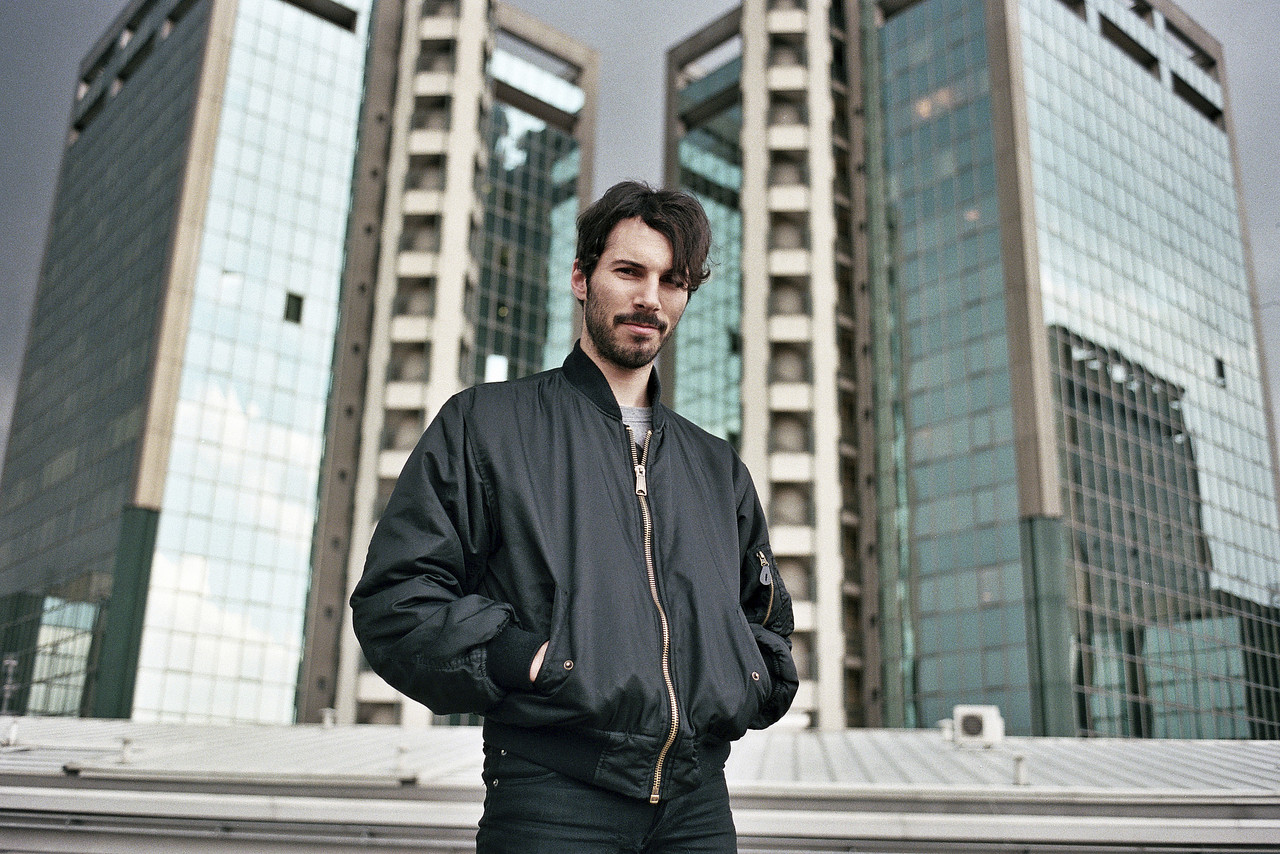
zweikommasieben: Let’s start off with the main focus of your recent work: build-ups, as they are applied in T tracks. What is it that makes you investigate this very specific phenomenon in such a focused, isolated, sober manner – like a scientist in a laboratory?
Lorenzo Senni: I think of the build-up as the most important part of a T track. I don’t really like drum beats in T songs – they are almost all the same because they account for the genre. The build-up is the part where the artist can express himself in a more »creative« way. It still needs to be functional and bring you back to the kick. However, I like build-ups because there are rules and, at the same time, many ways to approach and play with them... That’s why I think build-ups are dense, full of musical information. The idea was to extend those parts into five-, seven-, or ten-minute pieces of music.
Now build-ups have a dramatic progression from zero to 100 percent – which is too much for what I want to do. Therefore, my progressions are within a range of 65 to 80 percent. I also wanted to work in a more »dry« territory, and make a kind of real track from the structures at hand. Creating tracks with just one simple idea and forcing build-ups into a typical non-build-up situation is a good starting point to make a non-uplifting track that implicitly preserves its emotional tension and drama.
ZKS: How far can you push your investigations?
LS: I don’t know, it’s all about attempts. AAT could be a good example of something that is related to my previous work but tries to go in a different direction. It’s a multi-channel piece that’s about breakdowns, falling basses, re-starts, and sparse sonic activities after static moments. This piece of work ought to initiate a dialogue, through my approach of course, between abstract computer-generated music, cold canyons of static, and short, epic, full-on supersawed moments.
ZKS: Going in a different direction with AAT, are you trying to get a different reaction from the audience? What would that be?
LS: Yes, a state I’d call »circumscribed euphoria.«
ZKS: What will you do once you complete your studies on T — is there any other subject you can imagine researching in a similar way?
LS: I already started working on pointillistic T, flat T.
ZKS: You stick to T. Could you imagine working with themes outside of this realm?
LS: For now I’m happy with what I’m working on and I’m always trying to push my research a bit further. In all honesty, I’m open to brutal changes and shifts if my interests go in a different direction. I don’t want to be stuck in something, but I’d love to have »my sound« and apply it when required.
My last record, Superimpositions, is different from the previous Quantum Jelly. With Superimpositions I tried to apply the same method to a wider range of musical possibilities, and I think it worked pretty well. Especially in some tracks; you can see where they come from, yet a thin crucial switch transforms them into something else – breaking the rigid statement of my first work.
I was also working on the new How To Dress Well record, for which I made two main synths and chords; one of them for the first single, »Words I Don’t Remember.« That collaboration would be a good example of how my approach to music can also fit into other musical fields.
ZKS: Are you applying your approach to music in other disciplines as well?
LS: I worked a lot with lasers. I presented a laser-based work named »Oracle« at Sonar’s 20th anniversary at the MACBA Hall. I also showed that work in Belo Horizonte, Brazil, during a CTM showcase at Eletronika Festival last year. My approach to lasers is the same as to music: there are very small modulations over a long period of time, no classic amusement park laser-style. I use a very limited range of repeated movements and very few colours... The idea is to detect structures and archetypes behind the use of this beautiful coherent light in a club and rave context.
I don’t care if I’m attracted to T because when I turn on the radio I hear T synths everywhere, or because when I was 14 all my friends were gabbers and I went to many hard T parties, or because I just find it could be challenging to deal with some of the main characteristic of this music… It’s too difficult to tell why I am interested.
ZKS: Back to music. How do you compose your tracks – are you writing the loops from scratch or is there some kind of sampling involved?
LS: I write the MIDI-score while the synths are playing, I adjust sound parameters and notes at the same time. No hierarchy. They constantly influence each other and when I’m happy with something I try to go deep and focus on a specific area. There is no sampling involved, only synths – digital or analogue, I love both. No prejudices – I’m interested in the sound. In terms of gear, Quantum Jelly is only about Roland’s JP-8000; for Superimpositions I also used the JP-8080, TB-303, JD-990, and my beloved Dimension SDD-320 Chorus (hardware).
ZKS: What is the reason that you don’t sample at all? From an outside perspective sampling would be an obvious technique of choice for someone investigating a specific field of music in such a manner...
LS: My background is in computer music and for many years I’ve been working with software like Max/MSP and SuperCollider. My main interest at that time was to create my own sounds through digital synthesis. I’ve never been fascinated by sampling, maybe because I felt I needed more »control.« When I started working with T build-ups I decided to go straight to the question of: »what’s the T synthesiser?« The answer was obvious: »it’s Roland’s JP-8000!« This was the first synthesiser featuring the legendary Supersaw waveform. I think using this synth is way better than sampling. On top, it’s an even more accurate reference in my eyes, since the sound created with the JP-8000 is undoubtedly recognisable.
The closest thing to sampling that I do is to collect build-ups. That was and still is a very important field of work to me. I have a huge archive of sound files that last between 30 seconds and two to three minutes. Collecting those files was vital for the development of my work. Anyway, I rarely edit and place them together; the only exception is when I do mixes. I use them to explain my creative process. For AAT I will be including samples, but I’m not going to process them in any way; I need them because I think they are already perfect as they are. Build-ups are a different matter – I need to be crafting them from the first stage.
ZKS: We observe a growing interest in more »vulgar« or marginalised domains of dance / club music by various contemporary artists – M.E.S.H. or you are examples. We think that, let’s say ten years ago, genres like T were marginalised institutions coming from more arty or academic domains. Would you agree?
LS: I think the answer to this question is not as obvious as it seems to be. It really depends on the point of view. I understand what you mean, but for example T was not marginalised at all for thousands of people; T’s popularity is growing, transforming, creating subgenres; »the sound« is more and more present in pop songs. Coldplay just released a track last year with a trancey anthem at the end, so I think that pop influences art and vice versa. Probably it’s just a global feedback loop with no beginning and no end.
Furthermore, I don’t care if I’m attracted to T because when I turn on the radio I hear T synths everywhere, or because when I was 14 all my friends were gabbers and I went to many hard T parties, or because I just find it could be challenging to deal with some of the main characteristic of this music... It’s too difficult to tell why I am interested. Lisa Blanning put it nicely however, when she shared her article about me for The Fader on Facebook. She wrote: »how I learned to quit worrying and embrace trance, or me writing about Lorenzo Senni.«
ZKS: To finish off, let’s talk about other artists. Where is home in terms of music?
LS: Even if I’m still working on my build-ups, I discover great stuff and I jump into it. To me it doesn’t matter if it’s old or new... The artists that made me think of electronic music in a different way are definitely all Mego-affiliated – Florian Hecker, Pita, Russell Haswell, EVOL, or Farmers Manual, for example, and obviously the more »academic« computer music pioneers are dear to me as well... Later-on, Plastikman became an obsession. In the most respectful way I would say that one can recognise my obsession with Plastikman in the approach to some of my tracks.
With Presto!?, my own label, I try to get involved with artists I admire – my heroes. While putting out their work I hope to become a part of it. I’d call this positive creative cannibalism.
Lorenzo Senni is an electronic music experimentalist currently based in Milan. His productions, largely dealing in deconstructed trance, have been released on albums for Boomkat Editions and the venerable Editions Mego label. He is the founder of Presto!?, which has served since 2008 as a platform for both complex computer music and high-concept pop from artists like Evol, Palmistry, and Florian Hecker. Senni also operates under the alias Stargate and as One Circle with fellow Italian artists Vaghe Stelle and A:RA.
zweikommasieben is a magazine based in Switzerland dedicated to documenting contemporary music and club culture. The collective also organises concerts, club nights, raves, and other events in various cities throughout Europe.
This text was commissioned as part of CTM 2015 – Un Tune. Other interviews with Lorenzo Senni were published in zweikommasieben 18 and online.