Jakub Juhás: In general I am very interested by the question of why an artist would want to involve recipients in experience of the more extreme sort – be this by volume, aggression, unusual tuning, or psychoacoustic effects or by slowness, contemplation, fragility, sensitivity – assuming that intensity does not only derive from something forceful or aggressive, but also from the opposite, of course, from delicate sensitivity.
Lucio Capece: All the aspects that you mention are fundamental for me, and express, in a very focused and concise way, my expectations regarding what I would like to offer when I make music.
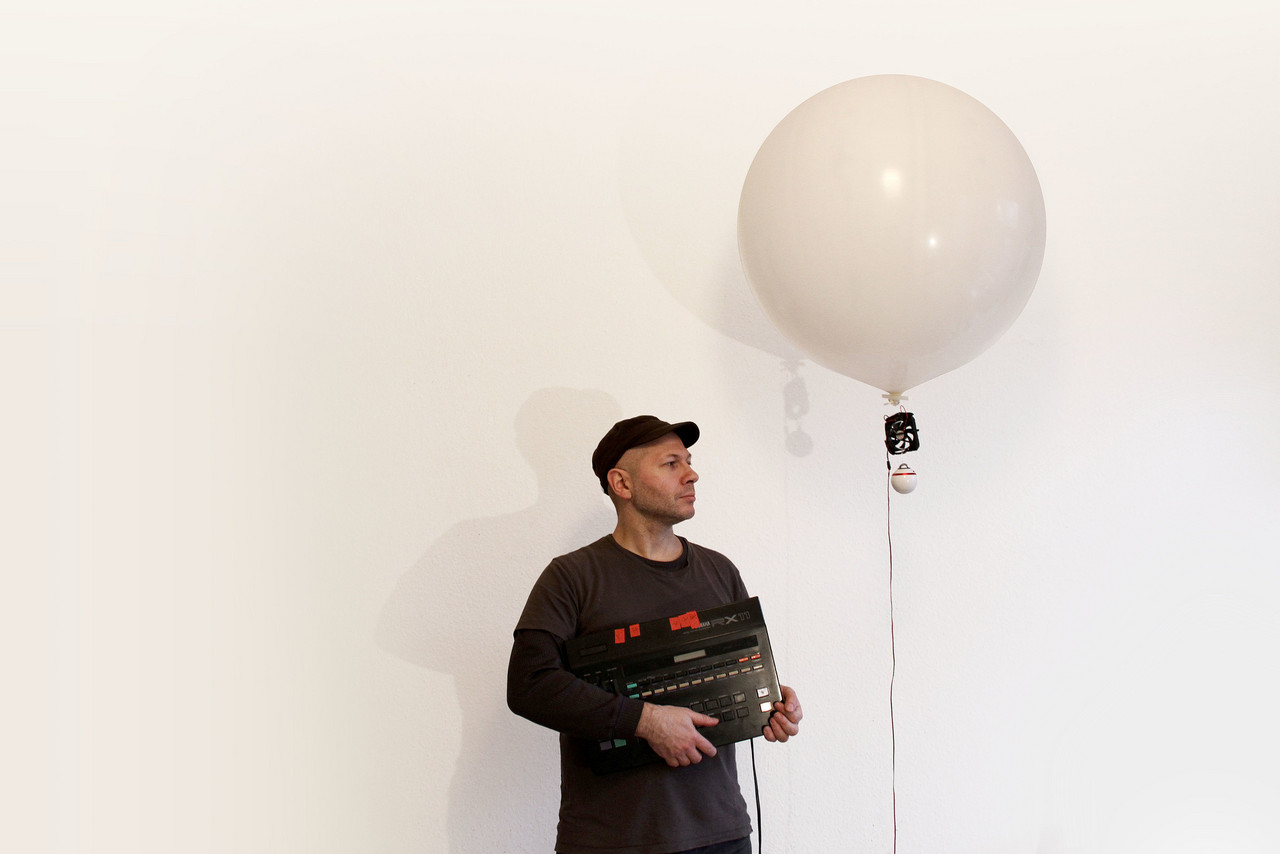
First of all, the majority of the music I make is indeed very quiet, but not the project that I will present at HAU2 in the context of CTM, which is a piece based on the characteristics of the Yamaha RX-11 drum machine. The machine was built in 1980 as one of the first digital drum machines ever made, and has several independent outputs for its components. Basically what I do is plug wireless transmitters into these outputs and amplify the machine’s middle-high register sounds (hi-hats, riders, claps, etc.) using one tiny wireless speaker hanging from a helium balloon for each output. Four of these balloons will move slightly in the space, pushed by propellers. Both the low and high components of the drum machine will be amplified by the main PA. Several other aspects round out the work, which I will not mention here so as not to make this description too long. My intentions are mainly to work with aspects of perception. Even if quietness and contemplation are basically my home, I do not intend to be part of or to create an aesthetic around them, but rather to offer and build a perception experience together with the audience.
What I do is music. I’m not a conceptual or performance artist. My main intentions and motivations are joy and knowledge, and I find those by going as deep as I can into the perception experience via sound, together with other elements that modulate that experience. To work within the perception experience itself is not even the main intention. It is rather the process through which I get in touch with the strangeness of everyday life that I find absolutely fascinating. I do not want to offer a spectacular or shocking experience, but instead to suggest the exceptionality of everyday life. To work on this is very exigent and requires a lot of discipline. It is not just sitting down and watching, but really working on myself and trying to deconstruct habits in perception that make us experience events around us without noticing them. The greater part of these events are very complex, but appear to us as astonishingly simple. As a tendency I can say that I work on the beginning of these events, that is, when they start to become reality and take on a certain concrete existence. In that moment there is an ambiguity of behaviour in the events and in how we perceive them. This shifts the events and ourselves away from the automatic understanding that we usually have of them towards something more difficult to define and closer to their and our natures.
If what I want to offer is a perception experience, it is clear to me that the less I do, the more the focus will be somewhere else. Here the audience will be creating an experience, which is much more interesting than being seduced by what I do on stage. My aim is thus to be as unnecessary as possible in creating this experience while remaining very strong and focused in that necessary minimum presence.
In this context I have found it necessary to work in a context of quiet and precision. But in the last few years I began to become more aware of how these interesting events occur in areas not necessarily determined by my chosen context and its meditative mood. This is very new to me, and dangerous, because it forces me to abandon my safe place. There are temptations like becoming absorbed by other musical languages, or becoming a musician who develops projects according to the work division that exists in the music market, which has nothing to do with research, but rather with getting jobs.
JJ: Could you please explain your decision to use the Yamaha RX-11 drum machine? What place does this instrument occupy in your work?
LC: I have a personal history regarding this specific machine. It is basically related to Luis Alberto Spinetta, an Argentinian songwriter who passed away two years ago, and was the first musician to astonished me with his work. He performed as a songwriter backed by jazz musicians, created abstract lyrics, songs with strange shapes. In 1986 he made a solo album called Privé, totally self arranged, and with full-on use of an RX-11 drum machine for the first time. The album had a confrontational pop approach but was not at all commercially oriented. It is a very rare work. Spinetta was heavily criticised by the press and his fans, including myself. Through the years I began to appreciate his strength to step out of his own comfort zone and his talent to create a brilliant album going against his established path. Today Privé is my favourite album of his, and one of my favourite records of all time for its freshness and musical quality.
I bought the drum machine several years ago and played on it for years, but couldn't find a way to use it in my own music. Recently I began to think not about using the machine in a more »interesting« way than what it was originally meant to do, but rather about using it for what it was designed to do, which is to play rhythms; this in itself could be interesting enough. The machine’s independent outputs are part of its personality and allowed it to become part of my deepest aspirations when I connected seven wireless speakers to it. The drum machine itself became my room, and the room became rhythms and beats. I started working with the balloons around four years ago. The main element of sound is movement. It is a vibration – from the beginning to the end of its existence a sound is the vibration of something. The first time I used an amplified sound in movement was when I hung a tiny iPod and a headphone from a helium balloon to diffuse pre-recorded sine waves. I wondered why, if sound is basically movement, the speakers are not also used in motion. A bit later I got hold of wireless speakers that allowed me to amplify sound produced in real time.
JJ: Taking off from there, I would be very interested in how you think about the balance between communal experience and subjective individual experience, which obviously – in the case of your performances – take place simultaneously. Do you actively try to shape these parameters?
LC: These are fundamental. Music always has a subjective element, and changes according to the listener’s position in the room and many other aspects. But honestly, I do not think this is usually considered thoroughly enough. We take it for granted that you will create a personal experience according to your own history and to the place you currently find yourself.
Music tends to be very projectional and has a lot to do with impacting the listener and with focusing attention on the performer or the tools they use. I try to work in terms of diffusion (instead of projection) and on the self-creation of experiences. In the case of my drum machine piece, my approach combines highly defined elements (the PA system, the static balloon speakers, the average illumination of the room during some sections of the performance) with others that are much more ambiguous (four slowly moving balloons, UV light in some sections of the performance, specific sound elements in each of the seven wireless speakers that sound later than the PA speakers due to wireless transmission). The clash between defined and ambiguous elements intends to subtly confuse with regard to what is stable and what is not. If everything is in motion, then movement is the stable element. If something moves and other elements do not, then none of the elements are stable enough to create that safe background feeling. Trying to put that instability into the performance room demands that each person makes their own adjustments.
Regarding the difference between individual and collective experience, I basically work with the same idea. I work with the friction between the general elements that everybody can listen to or see, and the specific elements that remain more prevalent to specific members of the audience. These elements can change their position and relative importance, as if they were walking in the room as further members of the audience.
Then there is another element that I find interesting, namely what happens to me as a performer when I focus on the above aspects. When you focus on diffusion and on the perception experience as a sound creator, searching for your materials and tools according to this intent, the experience becomes very strong. The experience is quite different when you focus on the tools or materials you offer to the audience and consider a certain space as the given environment for your music without paying specific attention to it.
I do not intend to shock or impress the audience, but rather to call on the impressive tools that inhabit us
JJ: In looking at your previous work overall, it becomes apparent that you like graceful movement on various musical fronts. Whether we talk about sound architecture, space philosophy, aspects of silence, activity of sound frequencies, sociology of listening, or about interest in new technologies in musical performance, I’d rather refrain from sorting which forces a musician uses, in order not to narrow their interests. But in your case the concept of »the sonic« (as defined by Wolfgang Ernst) arises quite naturally, exactly for the reason that the sonic permeates (transgresses) boundaries between sound and music, composition and improvisation, music and acoustics, light, space, time, and technical vision of a piece. Do you see these phenomena as a single structure or do you explore them separately?
LC: I never had the intention to work on several musical fronts. On the contrary, I have always tried to be very focused. What happened is that I recently changed my focus. I was working within one context and now find myself in a new one that is related to – and attempts to develop and go deeper into – ideas that I had previously worked on. In the first decade of 2000 I had mainly focused on what was called electroacoustic improvisation, music that happened in a context of quietness and precision of instrumental sound choices. Most importantly, this field was concerned with developing a non-narrative approach to musical discourse. Initially it was simply fascinating to research my instruments (bass clarinet and soprano saxophone) and what came out when I began to work in the context of quietness. The instruments revealed unknown behaviours, which was very refreshing.
One of the main ways of keeping this kind of work interesting, keeping it from becoming an »introduction« to something else, was to be able to keep the interest of the musical discourse without needing to create a momentum, which is usually achieved by raising the volume and the amount of gestures and musical material. Creating this steady interest opens up a non-narrative discourse that, philosophically and in terms of perception, makes you aware of what happens in each present sound and in the performance as a whole, rather than focusing on building a story. This kind of »still« playing allowed me to understand and become conscious of the non-narrative possibility in music, that is what could be defined as music »as time« instead of »in time,« as Keith Rowe says. Following that experience, I tried to work on the possibility of playing louder while keeping the structural idea of »stillness.«
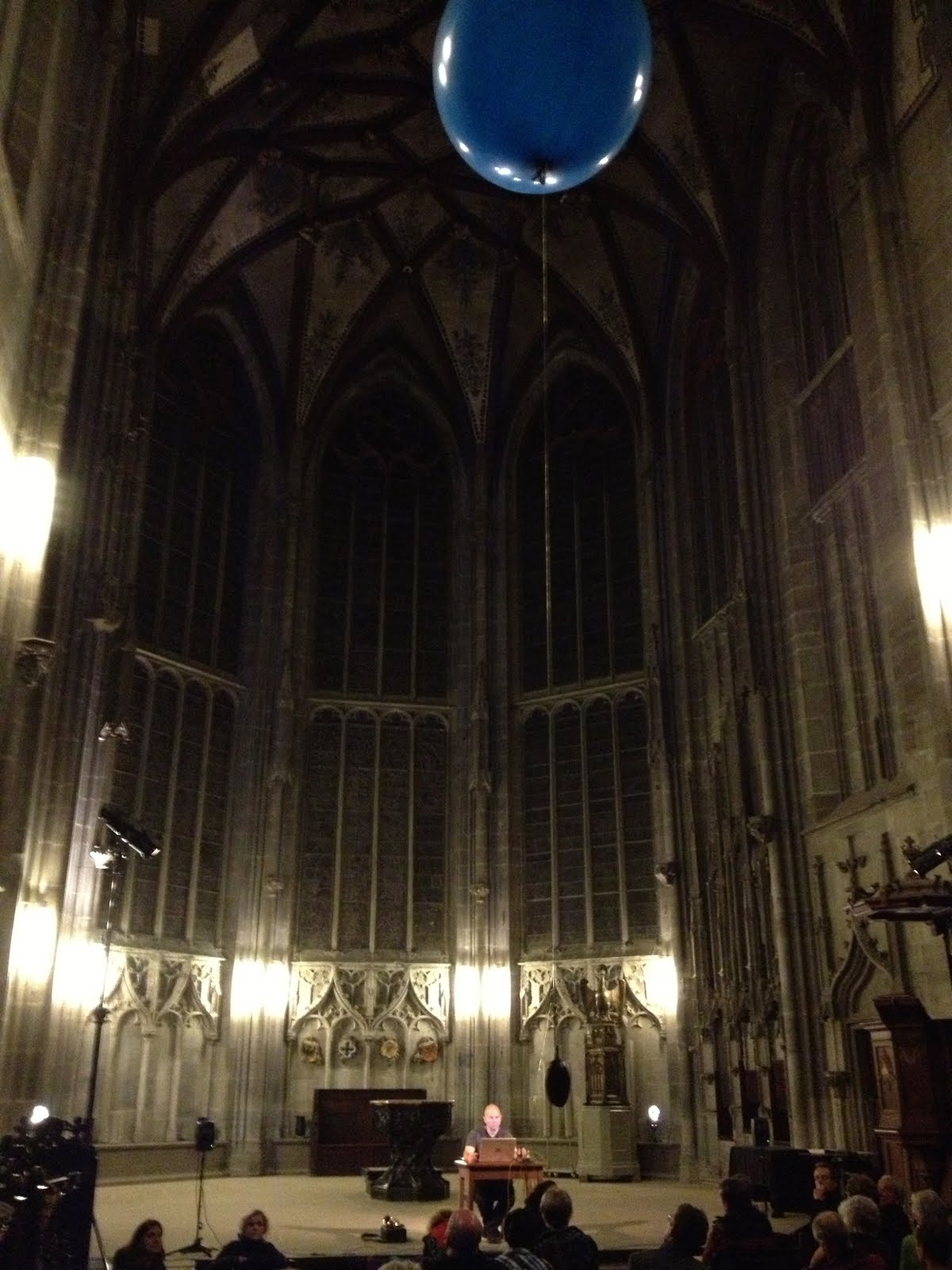
The clash between defined and ambiguous elements intends to slightly confuse with regards to what is stable and what is not
Around 2008 the Berlin scene changed, and to play with the criteria of stillness (mainly playing quietly) somehow came to a creative fade-out. The new tendency was to put together the two main elements of improvised music, which until then had been seen as a dialectic process between the »proactive« approach and the »reduced« approach. I understood that the reductionist approach had arrived at a circular moment, meaning that it was imitating itself, but I did not find that my experience had to be determined by this new social scenario. I thus went on working on reductionism, mainly trying to develop my understanding of it and finding new ways to go further.
My main experience had to do with the question of what happens to your ears and your perception of a space when you play quieter than what the space might suggest you should, thinking of a sound in terms of diffusion and not projection (even if you play a bass clarinet), and considering each sound as the most important element of the whole performance. My intention was to keep working on those aspects, going beyond the importance of the presence of the musician or musical instrument – fixing attention on the space itself, even if I am performing on stage.
This change also has to do with being in a new and different personal situation. I have three small kids, which has made my life very different. My time became more tight. But mostly the arrival of my kids was a very intense life shock, very liberating, wild, and deep in many ways. I began to work alone, mainly, and with a few people that had the time and patience to work with a busy dad. I dropped the importance of any one instrument, and stopped trying to do something »interesting« or »creative« on stage, and instead began trying to build contexts for shared experiences. In that frame I developed the use of speakers hanging from balloons, and speakers as pendulums, the use of ultraviolet lights and spectral analysis, the examination of the acoustic characteristics of rooms and the way our ears, body, brain, and perception of space work.
To answer the last part of your question, I can no longer perceive sound as an isolated phenomenon. It is rather a living organism that occurs together with visual, spatial, and social elements. It is not my intention to become a multidisciplinary artist, but I cannot consider sound alone. This pushes me to investigate other aspects as well as the way sound behaves in everyday life, which includes tools and elements that are used or occur in the context of other socio-aesthetic approaches. I cannot enter all aesthetics and social approaches, but if I approach facets of perception not only in physical terms but also in social terms, I do not want to be scared of using any element that can be coherent with that research. The limit that I fix to this research is that it must have to do with my own life experience.
My motivation is indeed to propose a holistic experience in each performance. This means that if I use a light or a colour, I do not want it to decorate my presence on stage. For example I have used balloons coloured according to different colour theories, relating that to the physical and historical background of the spaces where I have performed. I have to be careful and try to be as clear, simple, and precise as I can. It is as if you hang a painting on a wall, look at it, and then find that the wall around the frame is as important as the painting. You then get rid of the frame and start working with the painting and wall as one thing, without adding more elements. The wider the focus, the fewer elements you choose, so as not to become confused or lost in its vastness.
JJ: In the context of this year’s CTM Festival, you try to detune rather than tune spatial conditions. You present sound (a living organism as you say) to the audience, which spreads into the concrete space in a very specific way. What do you expect from the interaction between musician, space, and audience? What does it mean to you?
LC: There are some specific technical aspects of the space in question, such as using particular sine waves based on the frequencies of the room modes. The piece experiments with what happens when these frequencies, which are usually those that sound engineers try to avoid, are played in motion within the space. Also the room’s dimension will be used, the piece profits from the delay between amplification via PA and the wireless speakers. This somehow highlights distance in the room, making the space itself more noticeable, such that it stops simply being a place where music happens. These are a few of several technical aspects, not the piece itself.
The performance should be joyful and in a way, that’s it. I cannot rely on the concept to give more body to the performance than what the performance should naturally have. In this sense I hope the performance will not focus on me, the tools I use, the way I use them, or my ideas, even if I’m conscious of my responsibility in being there. The pleasure should be about what happens to us as we experience the performance together. The particular difference with such a specific musical composition is the intention to relate with other aspects of ourselves that are not strictly happening in the music. In this sense, what I expect is that the audience will experience enjoyable music together with aspects of our collective presence, which usually are considered marginal when listening to music but which I consider as crucial as the music itself. This doesn’t mean that the piece is a multidisciplinary work. Instead it is about the multiplicity of aspects of one thing, namely us.
The performance’s appeal is based on fragility. Everything is somehow handmade, from building the propellers to the simplicity of the balloon, or the careful placement of the transmitters in each of the drum machine’s outputs. The drum machine itself is a toy compared to the machines available today. This is not casual – I do not intend to shock or impress the audience, but rather to call on the impressive tools that inhabit us. I tend to find that if I do it with subtle power then those tools are not intimidated and come out as the main characters of the evening. These are not structural elements but rather part of the spirit of the living creature, which is something that is happening in and among us. I hope we can have a moment of sensitivity and closeness.
JJ: You are a cultural nomad who believes that the perception of music is not dependent on cultural boundaries, and is able to destroy all cultural boundaries and differences. These beliefs are shared by groups which came into being at a similar time and with similar sound concepts, but in different locations – for example, in Japan’s Onkyo; the philosophy of Erstwhile Records; the international group Wandelweiser; Austrian reductionism; or American composers and artists such as Michael Pisaro, Jason Lescalleet, and Kevin Drumm. How do you see this nomadism of sound and ideas, global interest in silence, minimal sound expression, reclusion, pure sine waves, and the poetics of space?
LC: I respect and admire all of the musicians that you mention in your question. Some of them are friends with whom I have shared precious moments. I think that music with the characteristics that you describe has a lot to offer in terms of aesthetic pleasure but also in terms of social organisation. Its characteristics offer relief and joy and ask for committed involvement with careful listening not only to the music itself, but also to the world we have in our hands. The focus is on societies as opposed to over-informed, rapidly-made commodities and ephemeral relationships. To a certain degree you can identify it as a scene. Certainly all these people know each other; their work shares points in common.
Nowadays it is not necessary to live in the same area in order to feel that a certain group of people are part of a collective force. At the same time, in social terms, it is difficult to determine what makes ideas and people belong to or be seen as outside of that collective force, to define who determines this division and how. I have wished and managed to find many of those positive characteristics in peoples’ gestures or in events of different characteristics that are or are not part of any scene. I identify with those elements and consider them as gems to discover, enjoying and sharing with the only one scene that is life, everyday life and everyone, individually and as one thing. This is a crucial aspect that we can observe in these musics themselves and that we must consider especially relevant.
I try to relate with that joy and offer it back without counting on being part of more than that. This is beautiful enough for me.
Lucio Capece is an Argentinean-born musician based in Berlin since 2004. His expressive tools include the soprano saxophone, bass clarinet, analogue electronics, the Shruti Box, and wireless speakers suspended from helium balloons. Tirelessly exploring the use of silence and stillness in music, Capece’s work revolves around electroacoustic improvisations, and collective and individual perception and experience of sound.
Jakub Juhás specialised in Cultural Studies at the Constantine the Philosopher University in Nitra, Slovakia. He completed his Master’s degree in Theory of Interactive Media at the Masaryk University, Brno, Czech Republic. His diploma thesis compared the sound poetics of Yasunao Tone and La Monte Young. His current focus is the concept of silence, emptiness, boredom, and slowness in the context of sound reductionism in the 21st century. He also works in music journalism, with a special interest in mapping Slovakian experimental music.
This text was commissioned as part of CTM 2015 – Un Tune.