In music theory, a »feminine ending« is defined as the conclusion of a melodic phrase on a weak beat, the weak part of a beat, or the weak part of a bar. The »cadence féminine« or »weibliche Endung« has been a common musicological term since its inception in the mid-eighteenth century by German music theorist Hans Christian Koch. While it is still often taught in schools as such today, feminist musicology has taken issue with the equation of »femininity« with »weakness,« »imperfection,« and »lack,« and the term has become increasingly unfashionable in recent decades.
Susan McClary’s dissection and reappropriation of the term »feminine ending« in her musicological writings highlight the inherent sexism of (Western) musical discourse and practices. Fear of being politically incorrect has led to a gradual waning of the term, but the historical conditions which led to its creation and perpetuation have of course not so easily faded out. The removal or erasure of offensive terminology plays a small part in countering real existing inequalities, be they racial, gendered, or with reference to other marginalised groups, and clearly this is not the whole battle.
The issue of women in music, more specifically women in electronic music, has been hotly debated recently, as the statistics released by female:pressure in 2013 show shamefully how festivals and labels predominantly in the so-called developed world represent only a meagre average of 8.2% female artists (women-only acts, with a further 7.3% mixed acts, not including »women festivals«). Last year’s CTM 2013 Festival itself clocks in with a paltry 9.9% of female artists (and a total 15.5% of women-only, mixed, and transgender acts).
These are certainly numbers to chew on, with fairly wide-reaching media coverage and many newspapers and blogs covering these statistics, as well as women-led festivals such as last year’s Perspectives Festival in Berlin making tracks in countering this massive discrepancy in female representation in experimental and electronic music. Curators and club and label owners are also forced to confront the biases in their own practices. Arguments of there not being enough female options slowly lose ground, and the common excuse of female options not being »of a high enough quality« or fitting in the programme reveal deeper-seated structural prejudices in music cultures and the wider music industry.
Between patchbay nuns and techno queens
Aside from this strong critique on the grounds of female under-representation in electronic music, backed by the necessary numbers, the other notable area concerning women in electronic music has been the resurrection of forgotten or neglected female pioneers. Thankfully we can now name several; Daphne Oram, Elaine Radigue, Delia Derbyshire, Pauline Oliveros, Maryanne Amacher, Laurie Spiegel, Ellen Fullmann, as well as not as often-mentioned Else Marie Pade, Maddalena Fagandini, Hildegard Westerkamp, Susanne Ciani, and Ivana Stefanovi, to name only a fraction. The work of the UK-based Her Noise project, which celebrated its tenth anniversary in 2012, has done much to contribute to this change in attitudes. Lina Dzuverovic, one of Her Noise’s co-founders, humourously reflected upon the difficulties of finding hosts in the sixty-four venues they approached at the time: »the terms ›feminism‹ and ›sound‹ were both so unpopular that the combination of the two was lethal«. This was over ten years ago and gladly the situation has at least somewhat improved for both of these previously undesired subject areas since.
...putting these composers and inventors on pedestals runs the risk of creating myths of what she jokingly yet aptly refers to as ›patchbay nuns,‹ nurturing a fetishisation of the black and white photos of women standing in front of vintage synthesisers...
Yet amidst this laudable enthusiasm for women pioneers, an article by Abi Bliss in The Wire Magazine in April 2013 describes a problem lurking here too; putting these composers and inventors on pedestals runs the risk of creating myths of what she jokingly yet aptly refers to as »patchbay nuns,« nurturing a fetishisation of the black and white photos of women standing in front of vintage synthesisers and handling these typically male-dominated electronic machines. This now-familiar narrative, whilst commendably creating positive female role models, is problematic in a different way; it relegates women into performing certain roles and raises them as curious exceptions within the dominant narrative of history. Anecdotes by women DJs and musicians, ranging from amusingly pathetic to morally repulsive, testify to the worrying perpetuation of similar opinions in many supposedly »forward-thinking« fields.
As Judith Butler argues it, the task of gender studies is essentially two-fold; it is not only to enquire how the category of »women« might for example become more fully represented, but also to understand and critique the very categories and structures of power in which gender discourses operate. Whilst the former is tackled by feminist activism, such as the work of networks like female:pressure and the arduous campaign towards equal representation, the latter seems lost in the murky depths of theory, leaving more fundamental questioning open to criticisms of being purely academic, too abstract for the real world and unfettered with real material concerns. It’s a complex question: how can we talk about feminism without simply assimilating the role and figure of the female into the dominant discourse? How can we discuss the category of »women« without overlooking the restrictiveness of the binary of biological sex (recently publicly exemplified by Germany’s new law of a third sex).
Zeros + Ones (cyberfeminism 101 or better said 1100101)
The term »cyberfeminism« emerged simultaneously from two different ends of the world in the early 1990s. With both to some degree indebted to Donna Harraway’s seminal 1985 »Cyborg Manifesto,« Australian collective VNS Matrix famously declared »the clitoris is a direct line to the matrix« in the cyberfeminist manifesto in 1991, and British-born Sadie Plant’s cyberfeminist work Zeros + Ones: Digital Women and the New Technoculture, published a few years later, almost succeeded in bringing the term into the mainstream. As Cornelia Sollfrank summarises, just as feminism before it was not a unified movement, cyberfeminism’s »100 Anti-theses of Cyberfeminism« shows how it had no claims towards complete unanimity, and how the various understandings of the term make it escape easy definition.
Reacting against the dominant view of technology as a primarily male-occupied domain, cyberfeminism activated concepts of cyberspace and the euphoric connotations that now give the »cyber-« prefix a rather dated yet perhaps endearing 1990s slant. It reinjected this excitement about cyberculture into the somewhat stale energy that the second-wave feminism of women’s liberation movements of the 1970s had incurred. Second-wave feminism was criticised for its essentialising »earth-mother-nature« stance and leaving the male-dominated realm of technology precisely as that – a »man-thing.« Sadie Plant’s strategy was manifold; it included an alternative historiography of digital culture through the figure of the so-called »first computer programmer« Ada Lovelace (1815-1852), a refrequenting of the psychoanalytic signification of »1«s as male, definite, whole, a symbolic penis and »0«s as female, nothingness, »a lack,« »not-whole« or »not-one,« a symbolic vagina, as well as references to the historic and contemporary contribution of female labour in technology (from operating telephones to assembling machines in factories). In its fragmented and delineated textual style, these made compelling arguments to align women and technology much more closely than they had previously been. Cyberfeminist theorists were often also net-artists, hackers, and activists using art as an outlet, putting these ideas into action and co-opting the internet to explicate continued norms and prejudices. For artists such as VNS Matrix, who smuggled their images and texts in various online and offline locations, the internet had great potential to be subversive, yet problematically, it still predominantly contributed to the objectification of women and thus replicated age-old stereotypes of femininity.
Harnessing and subverting the utopic potential of the internet can be broadly considered a core intention of cyberfeminists. The supposed neutrality of technology was under attack for repeating the dominant structures under which it was created. This can be compared to that of traditional musicology or music theories, which would also claim a similar neutrality, yet the debate around »feminine endings« acts to uncover this, at least to some extent. The continued predominance of white, male, able-bodied individuals in positions of power and the continued inequalities for everyone else, within music and technology, is met with a naïve mystification today. Yet the fact that the status quo goes unquestioned is itself the most mystifying aspect of the debate.
Working to critique and expand the notions of the feminine and the category of »women« in relation to technology was undertaken with considerable success by cyberfeminism in the 1990s. More than twenty years later however, there are still fewer women programmers by far, fewer contributing to the content of the internet (with just 9% of female Wikipedia editors according to a Wikimedia survey in 2011), and a large and not-much-decreasing gender gap of women in high-tech jobs. With some incremental increases in representation, since cyberfeminism boomed, it is still difficult to be optimistic about assessing the topic of women and technology today. Recent debate surrounding the idea of a feminist programming language and subsequent hoaxing and hostility make for more worrying and fascinating insights into general views on females and feminism within technology.
Micro-feminine Sonic Warfare
Whilst the representational battle of women in electronic music is still being fought, other strategies are required to tackle the second part of the two-fold problem outlined by Judith Butler. That is, how to question the very categories in which we think and speak, the very categories which create the gendered subjects we commonly call »male« and »female.« Although the main works of cyberfeminism did not deal at any great length with sound, the purported decentralised, non-linear, and non-hierarchical nature of cybernetic culture, and characterisations of sound as an ephemeral, emanating force, gives occasion to link the two as sonic cyberfeminism.
Micro-feminine warfare, for Parisi, grants a potential third way out of the problematic binary given to us in the simple categories of ›male‹ and ›female,‹ and the dominant debate which characterises the feminine as passive and disordered (nature), and the masculine as active and ordered (culture and technology).
Tara Rodgers’ work towards a feminist historiography of electronic music in her book Pink Noises: Women on Electronic Music and Sound seems to straddle both levels of the two-fold task. In interviews with women composers, musicians, DJs, and sound artists, she is on the search for individual approaches and alternative methods and practices in the male-dominated world of sound and electronic music. On a more fundamental level, a sonic cyberfeminism would delve deeper. German physicist Hermann von Helmholtz made several huge contributions to science, and his work on acoustics laid the foundations for how most analogue synthesizers were and are designed and built, and how digital sound synthesis is generally undertaken today. However Rodgers takes issue with the unquestioned authority that Helmholtz’s findings have had, resulting in homogenised synthesiser design practices up until today. The idea of a god-like creator, analysing sound waves, breaking them down into constituent sine waves, and resynthesising these to re-create any existing sound, rings like an all-too-familiar narrative.
Rodgers refers to the synthesisers and instruments designed by Jessica Rylan at Flower Electronics, which actively incorporate chaotic and unpredictable systems. She could also have mentioned other synthesiser and electronic instrument designers outside of the mainstream who, although not women, have undertaken similar pursuits, for example Michel Waisvisz, Rob Hordijk, and Peter Blasser. Her focus on women is clear for obvious reasons, but there is space for a more nuanced discussion, namely as she is keen to emphasise that the perpetuation of dominant cultural practices can be enacted by individuals of any gender; being female doesn’t necessarily make you a feminist, just as being male doesn’t necessarily make you a male chauvinist.
If Sadie Plant’s analysis down to the level of the »0«s and »1«s of binary code did not go far enough to deconstruct the binary of »male« and »female,« or its multiple and rhizomatic style made its intention too diffuse, a further approach, which has been developed since cyberfeminism and boomed in the 1990s, can be considered. Luciana Parisi’s Abstract Sex challenges fundamental assumptions in biology and evolutionary theory and tackles what is often taken to be the unassailable truth claims of Darwinism and neo-Darwinism, with the alternative evolutionary theories of Lynn Margulis and Elaine Morgan. The very ideas of »survival of the fittest,« competitiveness, and genetic superiority, which pervade modern conceptions of evolution, must also be seen within the social contexts under which they arose and prospered. Opening up a third way beyond the constrictions of binary modes of thought, and zooming in on bacterial sex and its corresponding bio-technological developments (e.g. in genetic engineering), she offers another alternative view on what could be called cyberfeminism, though she herself does not use the term.
Micro-feminine warfare, for Parisi, grants a potential third way out of the problematic binary given to us in the simple categories of »male« and »female,« and the dominant debate which characterises the feminine as passive and disordered (nature), and the masculine as active and ordered (culture and technology). Fusing this with the concept »Sonic Warfare,« surveyed by Steve Goodman in his book of the same name, shows not only how sound can be used as a weapon in a literal sense but also on the much less tangible level of vibrational force, of bodies affecting and being affected by other bodies. One of the three definitions of »unsound,« as sounds not-yet-heard, provides the realm of potentiality linking the »cyber« of cybernetics, cyberfeminism, and a sonic cyberfeminism.
The cyberfeminist utopia which suggested a complete assimilation of the body into technology, can also however be read as risking the disappearance of »woman« into the machine. As Parisi puts it in reference to cybersex and bio(digital)technologies, we are in danger of witnessing »the ultimate dream of disembodiment« as the triumph of the patriarchal order. A new conception of feminine desire is needed, one that goes beyond stereotypical ideas of femininity. In a theory towards an ontology of vibrational force, Goodman states, »if we subtract the level of human perception, everything moves.« It is less a question of what micro-feminine sonic warfare might sound like, and more a question of what it moves.
Annie Goh is an artist and researcher. From 2013-2016, she was a co-curator of and contributor to the CTM Discourse programme.
This text was originally published in CTM Magazine 2014 – Dis Continuity.
Sound, Gender, Technology – "Where to" with Cyberfeminism?
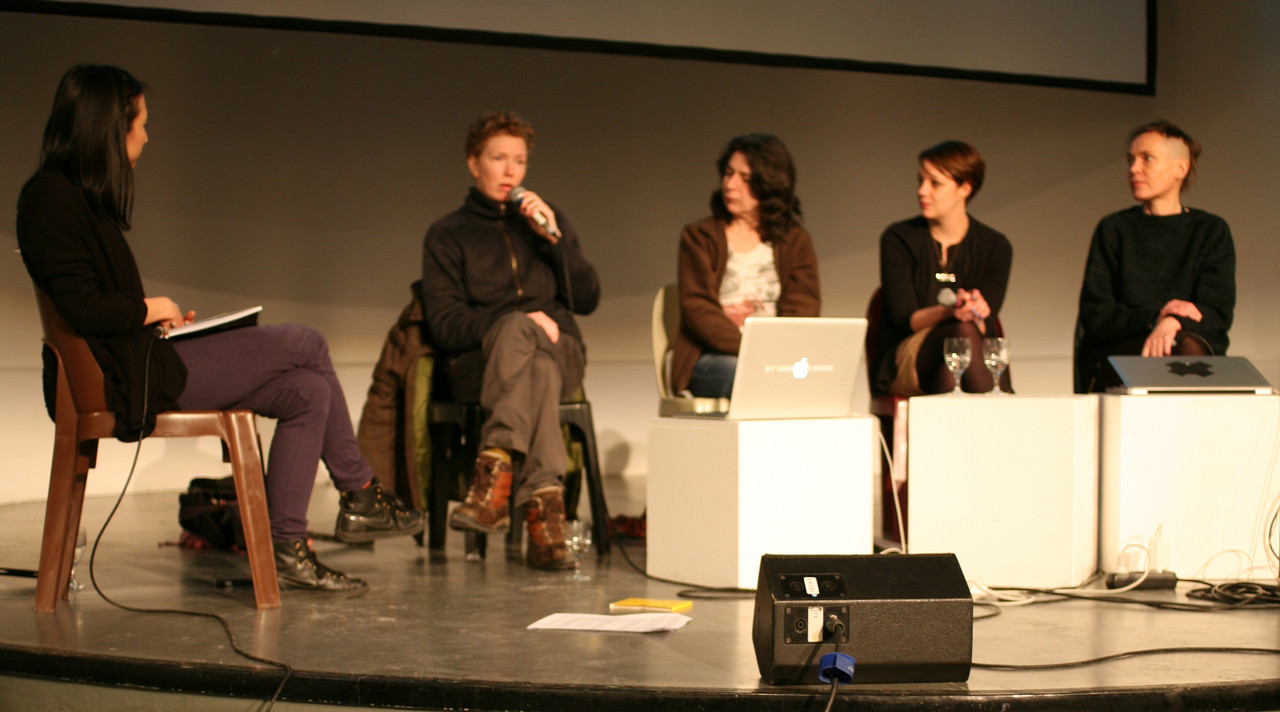
Lectures & panel discussion at CTM 2014 with Sadie Plant, Susanne Kirchmayr, Fender Schrade, Marie Thompson. Moderation: Annie Goh.
Sound, Gender, Technology – "Where to" with Cyberfeminism?
Lectures & panel discussion at CTM 2014 with Sadie Plant, Susanne Kirchmayr, Fender Schrade, Marie Thompson. Moderation: Annie Goh.