»If you don’t fully understand music, you end up working for the technology instead of the technology working for you.«
— Quincy Jones, musicradar 2020
Published shortly before the Covid-19 pandemic wrestled our over-expanding global village to a halt, I wrote an article titled »How Platform Capitalism Devalued the Music Industry« thatset out to mark time2 at the end of the decade and meditate on the major shifts in the standards of music consumption and criticism in the 2010s.
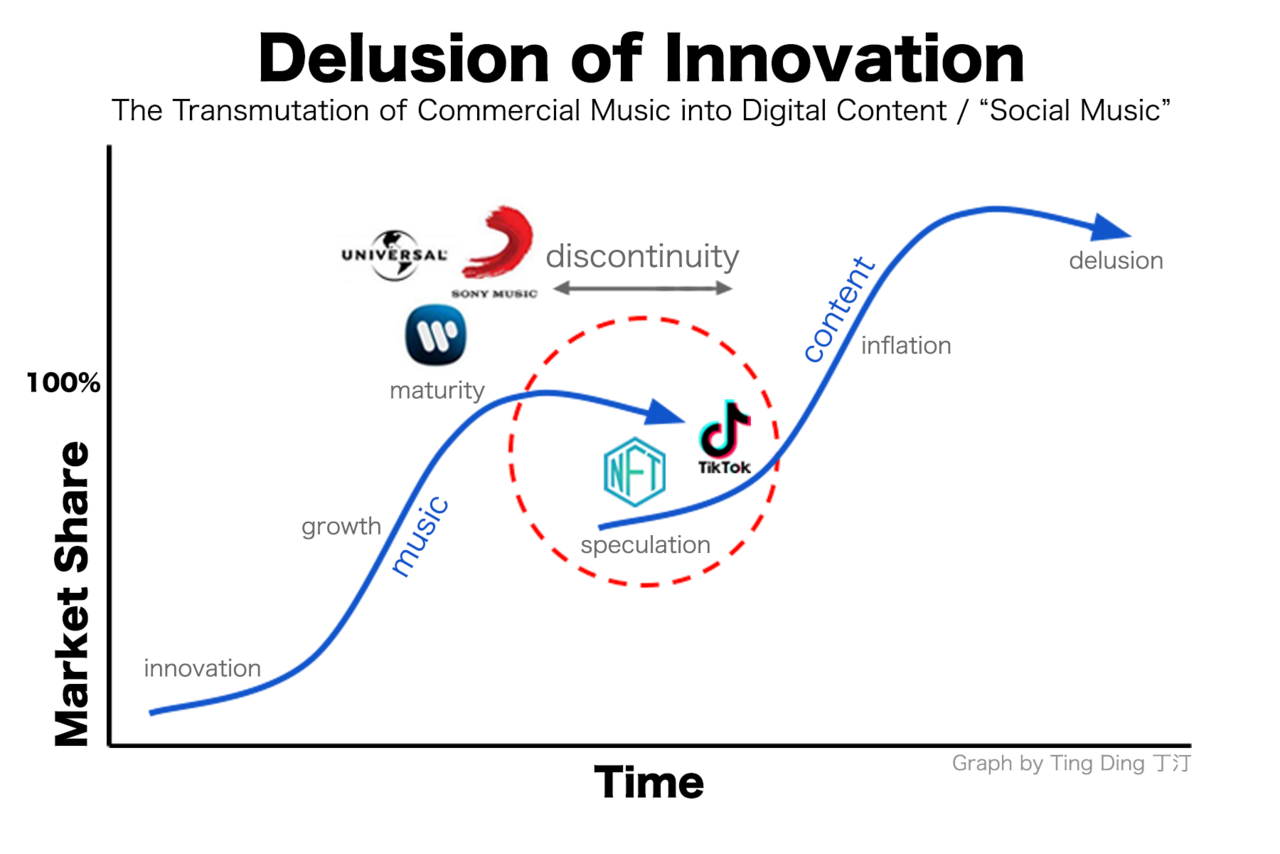
To briefly recap, album sales, as well as music retailers as a whole, have been in sharp decline since 2001, with streaming services such as Spotify capitalising on the untapped wealth of music catalogues in an increasingly oversaturated digital market. In August of 2020, my statistical analyst partner Ting Ding 丁汀 and I wrote a music revenue report called »Edging the Glass Cliff,« in anticipation of a new age of aspirational, or delusional, greed and financialisation initiated by content producers and amateur tycoons, pontificating amid diminishing expectations from the general consumer population and multiple waves of mass death. After a decade of failed and failing ventures in paid media advertising, global PR campaigns, and an industry-wide pivot from text to image to video-oriented content – which was proven to be inflated and manipulated by hosting platforms like Facebook as far back as 2016 – the music industry has found itself in a place in which we can’t seem to remember why we even listen to, let alone, pay for music. Empty promises of saving a dying – now dead – music industry with a shift in focus away from the current long term contractual scam to multiple work-in-progress »alternatives« have occupied the misguided thoughts of majority white male analysts who neither consume nor produce nor listen to music, but feel the need to monopolise the remaining scraps of music value in order to revitalise, repurpose, and repackage what is essentially leftover dead stock from a music industry of yesteryear towards a flaccid and unsustainable future of culture.
A 2020 end of year report on vinyl sales by Discogs showed a seeming rise in music purchases, misleading readers into imagining that the industrialisation of music and culture is both natural and worth saving. »Growth in global physical sales through the Discogs Marketplace is up 35.78% to 8,845,534 orders over the prior year,« the article states, adding that »in total, 16,290,197 pieces of physical music were sold around the world, bringing an overall 40.12% increase year-over-year.« To paraphrase a previous assertion written in »Edging the Glass Cliff« in comparison with Discog’s trend report: »[t]he music industry as a whole grossed $20.2 billion in annual revenue by the end of 2019, but its revenue for physical units has shrunk from 97.9%, or $22.9 billion, of all global music industry revenue in 2001 to 21.8%, or $4.4 billion. Simultaneously, downloads and other digital formats began experiencing modest levels of success, peaking in 2012 at 30%, or $4.4 billion, of all global revenues, only to lose their footing again.« At the same rate, music synchronisation – a music licence granted by the holder of a song’s copyright to allow a song to be synchronised for film, television shows, advertisements, video games, movie trailers, etc. – appears for the first time in 2010 grossing only 0.3% of the overall revenue of the music industry. This small sliver of profit will be important in the coming years as major label artists within the Recording Industry Association of America, such as Dolly Parton, Bob Dylan, Lil Wayne (and by proxy Nicki Minaj and Drake) have begun to make the decision to sell their masters and copyrights to the largest music company in the world, Universal Music Group, who recently signed a multi-year licensing agreement with Spotify – despite synchronisation only growing to be approximately 0.5% of all music revenue in 2019.
At present, artists and copyrights are indentured and intertwined assets in a music industrial complex that no one has any intention of fixing. On February 19th, Bloomberg published a video that peered into how investors are »using music as a new asset class« to make money that the artists in the current contractual agreements haven’t received (and perhaps never will), noting that »many musicians are giving up rights to their own music.« As a result of wayward speculations on how to sell music without designing a proper backbone for rational production and distribution, an inevitable industry-wide cash out is due to occur in the following months and years by musicians who are fed up, and have given up on the idea that the music industry has, or had, any intentions on systemically paying artists and providing music to its consumers fairly. In response, the Make Techno Black Again campaign, powered by HECHA / 做, was started in 2016 as an attempt to assert sustainable and equitable payment and donation models within our immediate community, donating 50 percent of its revenue to Teen HYPE (Helping Youth by Providing Education), a Detroit-based youth arts nonprofit.
At present, artists and copyrights are indentured and intertwined assets in a music industrial complex that no one has any intention of fixing.
Inspired by NYTimes reporter Nikole Hannah-Jones’ 1619 project, which re-examines the horrific and criminal enslavement of Africans in the United States as a foundational component of racial capitalism and settler colonialism, I wanted to lay out a historical project through my writings and works that promotes the history of techno and its relationship to the collapse of Detroit’s automotive and music industries as a warning to the present music and culture industry that Detroit techno – and its global distribution and appropriation into business techno – was always about the idea of being involuntarily subsumed into a commerce-oriented society. The term techno is a prefix of the word technology, but could be further extended to encompass technocracy, meaning a society or government run by technical experts. The properties of a technocracy was explained in detail in the 1980 book The Third Wave by futurist and businessman Alvin Toffler, which a 19-year old Juan Atkins read in a high school class called Future Studies before developing his vision for techno music in the midst of a Reaganomic urban reality. Detroit Techno struggled to surface in the inflated CD-focused American music industry after a few initial breakthroughs with Cybotron’s »Clear« selling 50,000 copies and reaching number 52 on the Billboard Black Singles charts in 1983, and Inner City’s »Big Fun« hitting number one in both the US and UK dance charts in 1988. Juan Atkins would remark in a 1998 retrospective of the rise of Detroit techno, »[i]n the US, a Black kid can come up with something profound in his basement, and won’t get noticed in his own backyard. But kids in the UK can discover it. Because of its racial politics America is falling behind the rest of the world.« In a 2007 interview with Sven von Thülen in De:Bug, Underground Resistance’s Mike Banks would similarly reflect on the formative years of the European electronic dance music industry that emerged after techno left Detroit, divulging that many Detroit producers thought they would be able to market their music in the US through support from the UK and Europe: »[u]nfortunately what they didn't know was that European Record Companies not only lacked the interest, but they also lacked the muscle and experience to compete in the urban US market.« Despite some musicians and DJs gaining success in Europe, a frustrated Mike Banks imparted, »[i]nstead they repackaged the shit and sold hundreds of thousands of records into the UK and Europe only! An easy sell market we had already established! Totally neglecting the States!«
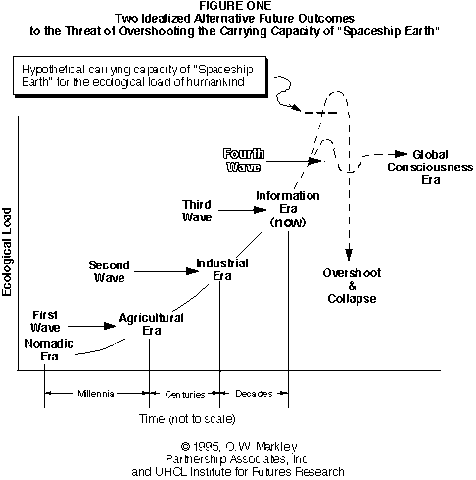
Largely left out of the closed-circuit collective drug-induced psychosis of the UK and European electronic dance music industry reminiscent of the »dancing plague of 1518«, the US industrial complex was tipping over into what Alvin Toffler described as a »corporate identity crisis,« in which the mass market demographics that defined the industrial era of civilisation were beginning to shrink and split into the »ever-multiplying, ever-changing sets of mini-markets that demand a continually expanding range of options, models, types, sizes, colors, and customizations« associated with the shortsighted, tragically myopic, and data-obsessed information era. Toffler explained that the acceleration of transactions amongst subdividing consumer demographics that ought to be thought of as individual human beings would dramatically peak before reaching a »general crisis of industrial civilizations as a whole,« writing that »unlike any other crisis in history,« this economic crisis would »bring inflation and unemployment simultaneously, not sequentially.« This could be correlated to the effects of Covid-19 and our present crisis, given that the »now« in Toffler’s chart below represented the year 1980. Fourth Wave options of the utopian global consciousness era, or the more realistic outcome of an overshoot and collapse, were placed around the year 2020.
In 1992, Ross Perot, an independent candidate in the presidential election and Texas billionaire industrialist, began a series of media reports on the economic reality of the United States. Pulling from his background of being enlisted in the US Navy in the 1950s and his work as a salesman at International Business Machines Corporation, or IBM, before starting his own company, Electronic Data Systems, Ross Perot’s analysis of the US economy was broadcasted as a speculative town hall meeting and infomercial in which he showed charts projecting that Federal spending would increase by 25% between 1950 and 2020, while also showing that the established US government was unaware that the country had fallen into a recession in conjunction with a drastic and historic low in payroll employment, consumer spending, and industrial production. President – then Democratic nominee – Bill Clinton would ultimately win the election due to a spike in voter registrations of young 18 to 24 year old first time voters spurred by the Music Television channel (MTV) partnered Rock the Vote campaign founded in 1990 by Virgin Records America co-chairman Jeff Ayeroff – only two years after Virgin’s UK sub-label 10 Records distributed Techno! the New Dance Sound of Detroit into a global market in 1988. In short, the music industry was set up for failure 30 years ago, just as the US economy and subsequently the global electronic dance music and drug culture industry would begin to soar off into the inflated scenarios spelled out by Alvin Toffler and Ross Perot.
Detroit techno – and its global distribution and appropriation into business techno – was always about the idea of being involuntarily subsumed into a commerce-oriented society.
As concluded in the writing on platform capitalism, independent music-sharing platforms like Bandcamp and SoundCloud would remain as potential mainstays on the game board of user-controlled content while non-music, video-based brands such as Twitch (a subsidiary of e-commerce and digital distribution company Amazon) and Chinese video-sharing platform TikTok (formerly Musical.ly) have begun integrating music into their platforms for a more »social« format. To quote the essay directly:
»A new ‘social music’ allocated by platforms implies that the changes in music packaging and distribution during the 2010s is correctly reflective of an overall shift in listening habits, and ultimately how much music is worth on an economic market. If the album format changes, everything about the music culture industry changes. Perhaps what must be considered is that music’s value isn’t respectively tied to the number of units moved, dollars made or approval by critics; but with a platform as the sole administer of music, maybe what consumers believe and value no longer matters — platform capitalism within a closed loop conversational extraction from its users will decide the future of music for us.«
Liz Pelly, a contributing editor at the Baffler, published an article on February 16th proposing the idea of a socialised streaming programme that could at the very least preserve the existence of the availability of music at the end of its eventual monopolisation: »[t]he recommendations are boring, the payola is boring, the advertisements are boring.« Having written on the subject of Spotify and platform economics that buy and sell music wholesale since 2017, Pelly’s writing is understandably direct and seemingly exhausted. Her plea for music production and consumption to be democratised is admirable and true to her beginnings as a member of the community arts space, Silent Barn, in New York, but ultimately, I’m unsure that Western society has ever shown that it has the capacity to value any culture or human life at scale. Pelly put forth the apparently novel concept that music is a public good that ought not be monetised in the way that it has been, sharing music lawyer Henderson Cole’s 2019 proposal for an »American Music Library,« published in David Turner’s weekly music streaming newsletter, Penny Fractions. Pelly urges that the proposal would subvert the financial instability of the music streaming industry and allow free music to be hosted and freely available, which presents a very big problem for a free-market venture capitalist industrial republic such as the United States. Under the proposal, music would be a protected and reserved resource that cannot be extracted for profit. Pelly went on to reference Aaron Swartz, a 26 year-old computer programmer who tragically committed suicide in 2013 after being charged with a felony for downloading academic journals with intention to share them in a campaign for a more free and open internet. Following the financial loss of the DotCom bubble burst from 1995 to 2001, the internet – which was introduced with the promise of expanding minds across the world, but by the time of Swartz’s death was already heavily colonised and only somewhat regulated by the government – saw a major turning point in the real-time social and behavioural experiment of the worldwide web and its accumulative vault of big data. The point is simple: everyone and everything in the US is for sale.
ultimately, I’m unsure that Western society has ever shown that it has the capacity to value any culture or human life at scale.
When do you listen to music? Where do you listen to music? Why do you listen to music? Perhaps we ought not approach phenomena in life within the fixed terms of rising and depreciating value; instead consider selflessness and care as a functional alternative. Before discussing business, ownerships, and payouts, we should ask ourselves outright, right now, what is music for? When I consider Pelly’s suggestion for a socialised streaming platform, it calls to mind Benedict Anderson’s study on »the origin and spread of nationalism« in the 1970 book Imagined Communities, in which he notes that societies and civilisations gather around a single archive or historical monument. But how do we actually socialise within the planned architectural environments of the Industrial Age? And how has that been optimised – for better or worse – with the algorithm- and behaviour- based social media platforms of our global Information Age? On January 25th, an article concerning »the dangers of seeing human minds as predictive machines« was published, warning of the long-term effects of what Asian-American artist and programmer Ryan Kuo would indicate in his 2018 exhibition The Pointer as being a symptom of living within the constructive mental, social, economic, and racial frameworks of a post-European, US-American-manufactured whiteness – »an unremitting affective failure that erases bodies, including its own, in its search for a neutral point of origin.« Such is this Pavlovian society, where technological innovations exist alongside an overt obsession with choreographed work and leisure activities that occupy your time while pushing and pulling the attention span up until an eventual saturation point. Kuo’s discussion with media theorist Wendy Hui Kyong Chun in Art in America the next year furthered the understanding of whiteness as a cult of technocratic predictive logic. Chun, who authored the book Updating to Remain the Same: Habitual New Media in 2016, suggested that the robotic neutrality that pervades whiteness is an act of nullifying itself from the very frames that it projects onto others. Kuo responds with a parable in the form of his next work of art, »Family Maker,« which he says »comprises infinite pop-up windows« that reflect on family tensions. In disentangling the selfish desires of a fanatic coloniser-oriented ontology, Kuo acknowledges that »it’s too much to process each member’s feelings and perspectives at the same time, so they’re broken up into windows. It’s a runtime engine, which means each time I play I’m building and scripting the work, just like building a family: you can’t undo your mistakes.«
Before discussing business, ownerships, and payouts, we should ask ourselves outright, right now, what is music for?
Much like the metaphor of ouroboros, a traumatised snake eating itself, whiteness and its programmatic logic towards endlessly unsatisfactory growth and consumption has monopolised music ownership and distribution without a long-term plan for renewal. In short, music, a dying stock, has been revitalised and privatised wholesale by amateur investors who are betting against the current system of valuation and distribution in order to extort money from the three largest record companies that make up the US-American recording music industry and eventually the concept of music »ownership.« To this end, on February 24th, Wired reported that the Amazon-owned live video streaming service, Twitch, had begun to send letters to users playing copyrighted music in their streams notifying of violations against the Digital Millennium Copyright Act (DMCA). Sarvesh Ramprakash, who DJs as Icarus Redux, tells Wired that »[i]ntellectual property has always been a dicey subject in dance music production and performance, but with streaming in general – not just livestreaming – we're in a new era of being slapped hard by intellectual property laws.« Subsequently, DJ, music producer, and managing editor of Africa is a Country Boima Tucker would publish the article »What is whiteness to a cyborg?,« connecting the devastating effects of American settler colonialism to the mass inequalities of our current tech-evangelist and determinist visions of a digital future:
»In what many thought was a new reality of a post-scarce digitally permanent world, the reign of the regime of copyright briefly found itself in crisis. Music was the most fertile ground from which to declare one’s liberation, but it wasn’t the only one. And while interaction with the old guard of racial capitalism allowed a tradition of gatekeeping and cultural appropriation inherited from vaudeville to continue, what had emerged within the confines of the virtual world—torrent libraries, file sharing sites, personal blogs, forums and chat rooms—collectively could be thought of as a sort of digital Congo Square. The response from the United States Department of Homeland Security, alongside other policing efforts, was to raid the safe houses of free exchange and try and put an end to it all through intimidation.«
Much like the metaphor of ouroboros, a traumatised snake eating itself, whiteness and its programmatic logic towards endlessly unsatisfactory growth and consumption has monopolised music ownership and distribution without a long-term plan for renewal
In 1473, when the concept of music was initially contained on sheet music printed by the novel technology of the printing press, the only two ways to hear music would be to experience someone making it in front of you, or making it yourself. In 1877, the invention of the phonograph and the concept of »home-listening« threatened to destabilise employed musicians who belonged to unions. In the first half of the century the three largest record labels in the music recording industry, Sony Music, Universal Music Group, and Warner Music Group were founded in 1929, 1934 and 1958, respectively. Introduced in the 1910s, the concept of A&R (Artists and Repertoire) scouts would be formidably optimised by the major three record labels to become a fleet of hunters, resembling the disruptive function and procedures of slave patrols, an early US-American form of policing – that would seek out musicians and songwriters to create commercial music outside of their ownership, and offer them contracts that promise to increase their earnings and audience reach beyond their community. American Forces Network (AFN), a free radio and television service installed in Western Europe in 1945 by the US government, would coincide with the creation and state-funding of a cultural ambassador programme in which Black jazz musicians would tour the globe as a Cold War propaganda weapon. The removal and alienation of an innovative artist from their home with the promise of a new financial future of opulent gains made from their own unique talent quite quickly led to a system of indentured servitude that is routine in US-American financial ventures, and would define what the music industry would be and how it would operate. Take early African-American musicians such as Thomas »Blind Tom« Higgins, an enslaved multi-instrumentalist child prodigy, promoted as the »Wonder of the World,« who performed and toured America and Europe uncompensated for decades both before and after the Emancipation Proclamation was passed in 1863. Another example would be Robert Johnson, the traveling Delta blues musician in the 1930s, known to have gotten his musical ability from a Faustian deal with the devil; he gained mainstream success after his death when Columbia records compiled and distributed his music in the 1961 album King of the Delta Blues Singers. Mamie Smith recorded the first blues song »Crazy Blues« in 1920 at a time when African-American music was being marketed as so-called »race music.«
The modern music industry has its precedence in the early 1800s with the Black cultural gatherings in Congo Square in New Orleans, Louisiana, and P.T. Barnum, who would exploit enslaved African-Americans and other societal outcasts as a part of a touring circus show meant to »entertain the masses.« The format of African-American military-style show bands would be innovated and spread in the late 1800s by the bandlander P.G. Lowrey, and would later been seen and adapted in my hometown of Birmingham, Alabama, by John T. »Fess« Whatley. Known as the »Dean of Birmingham Jazz« and »maker of musicians,« he would teach and structure an independent music education curriculum in my neighbourhood through the violently segregated and racist Jim Crow era of the Deep South in Black-only schools and universities throughout the state. Many of the musicians that would come out of his pedagogy would later move north to join the jazz ensembles of bandleaders such as Duke Ellington or spread their own musical message – like one of Whatley’s most famous students, Herman Poole Blount, or Sun Ra and his Arkestra. Founded in 1959, Berry Gordy’s Motown Records’ »hit factory« – named after the portmanteau of »motor« and »town« – would parallel the success of Detroit’s automotive industry, earning 110 top ten hits on the Billboard charts throughout the 60s, and fulfilling a version of his dream to »educate customers about the beauty of jazz« by selling optimised soul music from African-American ensembles of vocalists, session musicians, and studio engineers. They were recruited and assembled under contract to produce copyrighted populist earworms, »pop music« to be consumed and felt by all demographics under the slogan »The Sound of Young America.« Universal Music Group would buy Motown in 2005 for $61 million, leaving only three record labels united around the Copyright Act of 1909, passed by the US congress to protect original published works from being reproduced without consent. This resulted in an overall depreciation of value, not unlike the outcome of when the Big Three automotive companies in Detroit, the experimental city of the future, monopolised urban planning, housing, and labour before collapsing entirely – framed on either end by the 1943 and 1967 race riots.
In the little over a hundred year long monopoly game for economic supremacy over the ownership of music copyrights, the music recording industry – and the outlying investors currently extorting its accumulative valuation – have begun to imagine new fraudulent futures of creative valuation. In a January panel on the subject at CTM, New Models, an information and culture aggregate platform and podcast run by Caroline Busta and LILINTERNET, moderated a discussion between Cherie Hu, a journalist and researcher who runs the music business newsletter Water & Magic; Trevor McFedries, the co-founder and CEO of the technology startup Brud and the creator of virtual pop star Miquela or Lil Miquela; as well as writer and developer Jean-Hugues Kabuiku, in which they attempted to »grapple with the chronic inequality and unsustainability embedded in creative industries’ technological and infrastructural frameworks.« In an introductory reading from Caroline Busta, there is the suggestion that the monopoly game of music – now broadened and flattened into any and all things »creative« – valuation is transitioning from the »old legacy music industry economy« to what she refers to as an »emerging Web 3.0 economy.« Cherie Hu in response briefly explicates the power structures of what is now apparently the old music industry, Spotify’s underhanded efforts to »democratise« music ownership for its own profit, and a previous promise of alternative futures of music economies along the blockchain; she ultimately concludes that the years 2020 and 2021 will be important markers in the shift of music ownership, noting that there is »real money to be made and exchanges to be made in these more decentralised economies around art.« The panel overall struggled to imagine discussing music as a form unto itself, instead speculating on scenarios at which it has been and can continue to be sold to engage and optimise social events, while proposing that the pipedream of Universal Basic Income in the capitalist republic of the US could be a means of funding artists during our present economic and unemployment crisis. When Kabuiku suggested that tech determinism may have infiltrated the music industry's urgent discourse around issues of valuation, New Models shifted to propose that »we are now on some other side« of the existing problems of both the original music recording industry and the newly introduced streaming economy. Though it was admitted that »all of the problems have not been solved,« Busta would close the discussion by stating that »we are thinking on a completely different plane now that is so exciting.« She further asserted that »whether it’s through UBI, whether it’s through tokenisation, whether it’s through mutual aid networks, we are establishing a new kind of economy, and I think humans don’t want to live without music. I think that’s going to be there regardless,« before suggesting that there are new frameworks for us to think through. Despite this hopeful parlay away from tangibly answering what ought to be done about the hundred year old conundrum of music valuation, the issue appears to be – much like race relations – someone else’s problem.
NFTs are like Beanie Babies or Pokemon cards, which have swept up another generation of white and white adjacent financially motivated grifters to stir up hysteria around yet another new financial venture.
Spotify is silently rebranding itself from being a music streaming service to being a multi-media provider with the full support of Universal Music Group, the presumed winner of the music ownership game of old (though Kanye West wanted to buy the company for 33 billion, as he told Joe Rogan in October while appearing as a guest on his Spotify-hosted podcast, The Joe Rogan Experience). Meanwhile, the alternative future economies enterprise has gained traction following the people’s take-over of GameStop stocks in January through the amateur stock investment app Robinhood. The newest scam of non-fungible tokens (NFTs), or »non-refundable« investments into a closed stock and bond agreement between owners and users/investors, creates a frightening new future for the music business. Like Spotify, the alternative economic futures aren’t satisfied with just music, they want all of creative content to be available to trade on a free market. In effect, NFTs are like Beanie Babies or Pokemon cards, which have swept up another generation of white and white adjacent financially motivated grifters to stir up hysteria around yet another new financial venture.
Recently, the innovation scam is beginning to be met with responsible apprehension from people/patrons from marginalised communities and experience, who share a perspective of disgust over the level of greed and disregard for sustainability being so openly displayed. On February 17th, David Turner’s Penny Fractions published a newsletter titled, »Is There Independent Music in 2021?« In the letter, Turner questions what the term independent could mean in a industry where ownership and the platforms in which that ownership is being traded is owned by a few tech and finance-oriented white men: »[t]he increased discontent of musicians, seen in nascent efforts to unionise or push towards ideas like non-fungible tokens, points towards certain communities’ refusal to accept agreements made by big indie labels and streaming platforms.« Imagine if the most creative minds of our time were more interested in fixing the old infrastructural problems caused by previous iterations of Beanie Baby fever and hapless greed in general, instead of lurching full speed ahead into the most recent and ecologically unsustainable scam.
Meanwhile, in the real world at the time of this writing, 500,000 people in the US have died of coronavirus, approximately 10 million workers are unemployed, while 7 million people in Texas lack heat, food, and water during preventable blackouts caused by a winter weather climate disaster striking a vulnerable decentralised power grid that has spurred opportunistic energy companies to spike the billing for electrical and propane power into the $1,000s. Texas Senator Ted Cruz was caught fleeing the country while the Chairman and board members of the Electric Reliability Council of Texas resigned from their positions without prosecution for the death and endangerment of the millions of citizens they were all responsible for as elected officials and monopoly holders. Lost in the dream of automation, alternative currencies, and the tangible possibility of a world without work as presented to the most privileged of world citizens during our first year of living with Covid-19, and the devastating arrival of the long-ago forecasted and ignored climate crisis, the technocrats have flocked to the newest scam of cryptoart and NFTs. The California Gold Rush from 1848 to 1855 had a severe impact on the environment, and the new false economic futures being presented by a small minority of tech-obsessed colonisers will also lead to unreasonable ecological damage at a pivotal moment in the intensification of climate change to climate crisis. Olúfẹ́mi O. Táíwò, an assistant professor of philosophy at Georgetown University in collaboration with Beba Cibralic, a PhD student in philosophy at the same university, would pen an essay titled »The Case for Climate Reparations« for the magazine Foreign Policy in October 2020. Drawing on Táíwò’s research on political and social philosophy based in anti-colonial thought and the Black radical tradition, the article argues that, »[i]n the context of the climate crisis, the West is responsible for more than secondary harms experienced within the international refugee regime.« They suggest a »reparatory approach« to climate change as well as the consideration of the structural colonial industrial measures that exacerbate a looming crisis, writing that a »historically informed response to climate migration would force Western states to grapple with their role in creating the climate crisis and rendering parts of the world uninhabitable.« On February 23rd of 2021, Guardian published »Climate crisis hitting 'worst case scenario', warns Environment Agency head« while Sir David Attenborough, during an eight minute virtual address, warned the UN Security Council that »climate change is the biggest threat modern humans have ever faced.« The next day, Al Jazeera published an article stating that John Kerry, the US special presidential envoy for climate, told the UN Security Council that refusing to address climate change was an act of »marching forward to what is almost tantamount to a mutual suicide pact.«
Lost in the dream of automation, alternative currencies, and the tangible possibility of a world without work as presented to the most privileged of world citizens during our first year of living with Covid-19, and the devastating arrival of the long-ago forecasted and ignored climate crisis, the technocrats have flocked to the newest scam of cryptoart and NFTs.
But the US is too busy working; a hybrid model of working in the US has created large expenses for companies paying for office space while employees work bullshit jobs remotely from home during the pandemic. Meanwhile, delivery jobs increased by 26% in the last month of 2020, creating a boom in food delivery apps while workers struggle. And in my own home in the suburban town of Bessemer, AL, Amazon workers in my entirely Black community fight to unionise against the massive company owned by Jeff Bezos, the richest white man in the world; meanwhile the state of Alabama as well as large swaths of the Black Belt region in the American Deep South begin to experience drastic increases in severe weather with reports of 184 deadly tornadoes in the month of March alone. Much of these developments were foreseen in The American Revolution: Pages of a Negro Worker’s Notebook, written by political activist, automotive worker, and fellow Alabama native James Boggs in 1963. During his off-hours, Boggs would bide his time and notate a detailed multi-structural on-the-ground survey of Detroit’s pre-techno history and an evolutionary theory that would extend beyond Karl Marx’s increasingly outdated critique of the industrial capitalism of the 19th century. Bogg’s observations from the specific vantage point of an African-American essential worker in the accelerating industrial colonial project of the United States predicted that the over-optimised thinking of automation-oriented production models would eventually leave him and many other working class people in Detroit and industrialised America unemployed while the investors and their employers continue on with the next form of labour and wealth extraction. »Automation is a change in the mode of production which is more radical than any since the introduction of the assembly line,« Boggs would write in the second chapter of The American Revolution, forecasting the lean production schemes that ran Detroit becoming even leaner by relying more heavily on automated machinery in 1955. In the same way, it had seemed that the technocrats had suddenly surged forward into a future without its core labour force, and only part of its consumer demographic. Detroit was the example of what a technologically enhanced city of the future could look like, and its collapse showed that something was very wrong with the way in which white people were conceiving of and designing a future for US-Americans – the resulting economic disparity and race riots took the future away from its Black population.
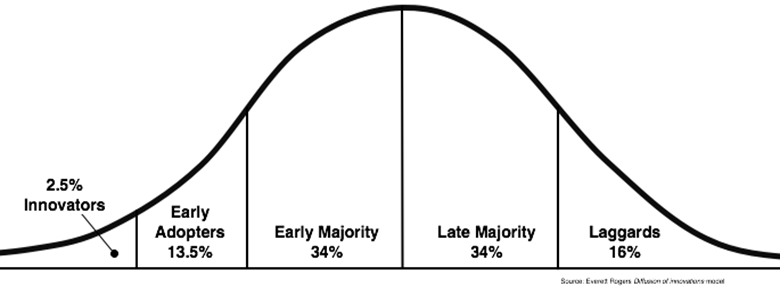
Fast forward to August of 2020, Jesse Walden, a founder/investor in the venture capitalist firm Variant, spoke as a guest on Mat Dryhurst and Holly Herndon’s Interdepence podcast, which stages »conversations with figures shaping 21st century culture.« Despite the jovial conversation with the musicians-turned-podcasters, Walden’s thought process and technical approach to culture as a project, rather than as a communal expression, offers a perfect example of what could be likened to a modern day oil salesman, speaking in abstractions, buffering meaning into place as the structural momentum of their scam and entrapment scheme solidifies behind the scenes. In a brief but telling introduction, Walden listed his decade of experience working with platforms such as Red Bull Music Academy, Boiler Room, and Spotify, after managing artists such as Solange and Dev Hynes (Blood Orange) through multiple artist promotion startup ventures – which he describes as »projects« that mysteriously end and cyclically transmute into »new projects.« Walden spoke candidly about his tight knit online group of »pirates« within a larger demographic of presumably all, or majority white males coming of age in the 2000s, who grew up stealing music, films, and other copyrighted media and intellectual properties in tandem with the inventions of Napster, BitTorrent, Pirate Bay, and other internet piracy websites. With no knowledge or experience of valuing culture at market value, without any of the real world aspects of culture and community, these groups of pillaging millennial white males considered themselves to be early adopters, or innovators, of a new form of peer-to-peer cultural valuation exchange. Furthermore, a generation of thieves who feel no regret nor shame for the long term structural effects of their past crimes or present-future financial ventures have made a lifestyle and business-profit model from smuggling and stealing copyrighted media while destabilising what’s left of the market value of music as a product. Mat Dryhurst would raise the comparison of cryptocurrencies and platform capitalism to Ted Nelson’s Xanadu, a pre-internet innovation of hypertext named after the first capital of the Mongolian Empire in the 13th Century. Nelson designed Xanadu to be a »digital repository scheme for world-wide electronic publishing.« In 1995, Wired magazine would publish an article called »the Curse of Xanadu,« describing the project as an »amazing epic tragedy« and »the longest-running vaporware story in the history of the computer industry.«
Detroit was the example of what a technologically enhanced city of the future could look like, and its collapse showed that something was very wrong with the way in which white people were conceiving of and designing a future for US-Americans
With our »new normal« of the global pandemic and surfacing climate disaster as a clear and ever present reminder and opposition to the tech deterministic concepts of colonial economic futures, Jesse Walden’s writing in June of 2020 on the »ownership economy« is quite concerning as it pitches the very concept of »owning« and »ownership« as »the new frontier of consumer software.« A following piece in December of 2020, titled »Leadership in The Ownership Economy—Scaling Decision Making while Minimizing Securities Risk,« Walden in collaboration with Connor Spellisc – a co-founder of Blockchain Association (»the unified voice of the crypto industry«) – attempt to speculate themselves out of the rut of 1,000s of years of tautological – and quite useless – Enlightenment logic by imagining new ways of »democratising decision making,« »allocating earnings,« and »relying on the contributions of share and debtholders.« They also consider the problem of founders, or cult leaders, who »step back from leadership, hindering innovation« for the cult of stakeholders who are collectively invested in the leader’s hapless, idiotic, and typically fraudulent vision. One must ask themselves after 1,000 years of psychotic wars and religious crusades, 500 years of violent slavery and white supremacist settler colonialism, over 100 years of an exploitative music factory of indentured performers, and one year of deaths topping 2 million people worldwide amid a mutuating and multiplying pandemic, at what point do you stop to evaluate what terms like »ownership« and »futures« mean when the end result routinely positions white men and their stakeholders as the winners of a gamefied gold rush and land grab fueled by hysterical state(s) of death cult populism?
DeForrest Brown, Jr. produces digital audio and extended media as Speaker Music and is a representative of the Make Techno Black Again campaign. Primary Information will publish his first book, Assembling a Black Counter Culture, in 2021.
This text was commissioned as part of CTM 2021 – Transformation. It follows a workshop that Brown, Jr., held at the festival as part of the Rethinking Music Ecosystems series, titled »Assembling a Black Counter Culture.«
- 1
»Marking time« is a military term for when soldiers march in place, moving their legs as in marching, but without stepping forward. Many terms and idioms in US English are based in military logistics.
- 2
»Marking time« is a military term for when soldiers march in place, moving their legs as in marching, but without stepping forward. Many terms and idioms in US English are based in military logistics.