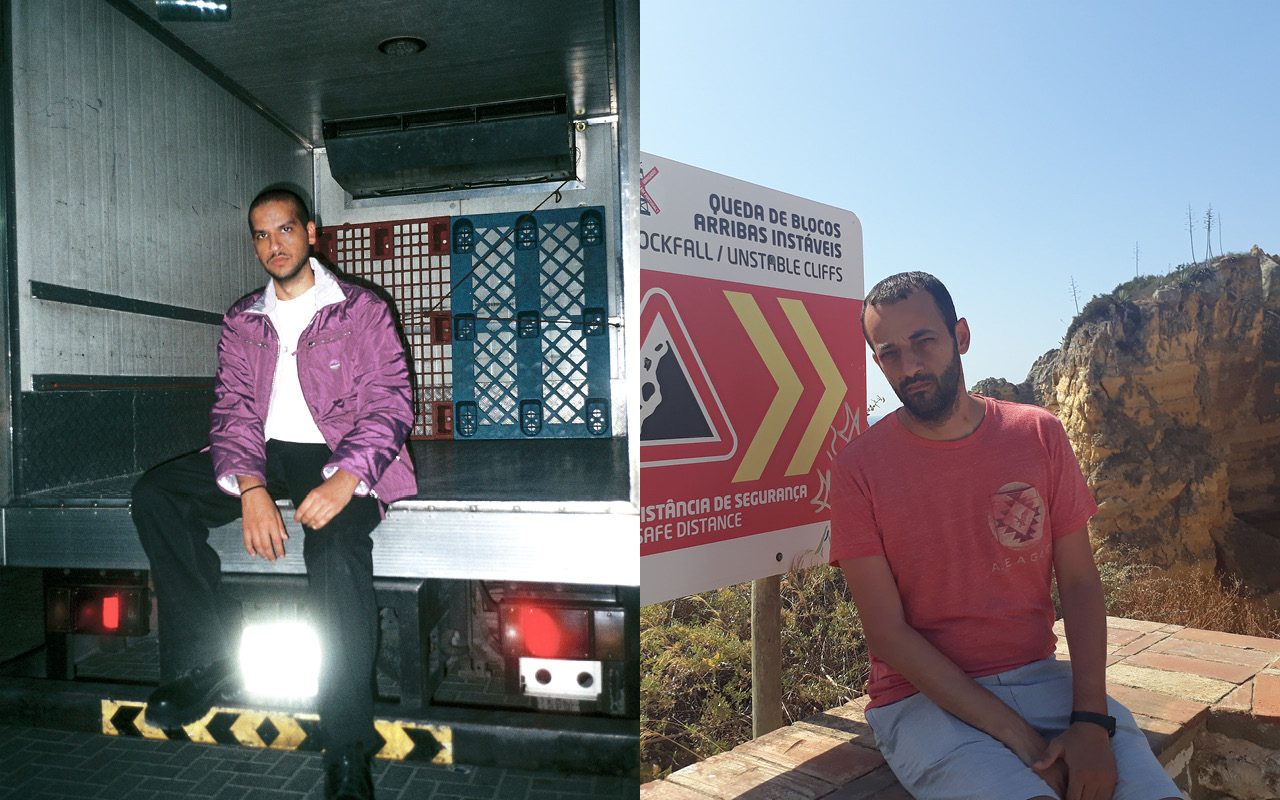
Coincidentally, I've reached them in the same spot – even though they originally met online, during the lockdown and these days, live thousands of miles apart, in Berlin and Kuwait, respectively. They are both sitting in a nondescript hotel room in Cairo, as I connect from Eastern Europe, via Zoom. ABADIR and Van Boom have both had well-received albums out in the last year, Mutate on SVBKVLT and Prostethics on Cease 2 Exist, respectively, alluding to some of the topics we discuss: hybridisation, mutation, isolation, tension. But we also delve into their backgrounds, censorship, the Arab music scene, exoticisation, inspirations…
Lucia Udvardyova: Was it a coincidence that you are both in town at the same time?
Van Boom: It was definitely a coincidence.
ABADIR: I think it's easier for us to meet in Berlin than to meet here [in Cairo].
VB: I haven't spent much time in Cairo lately. My family and I last went there in 2015. I'm also part Egyptian from my grandmother's side. I used to visit her and see family here. More so than being in Europe, being in a location like Cairo and having a connection to the locals and surroundings makes you feel at home. Just feels more authentic.
A: I met Hamad online. And then we met for the first time in person in Berlin.
LU: So, you met online first. The online, global scene is big and small at the same time. Sometimes the everyday life of the IRL and URL worlds couldn't be different though.
VB: I've known Abadir since I released my first EP on ANBA. Back in 2020 I connected with a lot of Egyptian acts, because it was mainly an Egyptian / London based label. And I remember that year, in addition to Abadir having his own release, I had my own one coming out. That period was frustrating because of the whole lockdown situation. However, we bonded through the quality of our work in the arts and music, and the way we construct narratives so that others can truly get who we are as individuals. Being a part of that online community greatly aided my creative engagement. Having nothing to do during lockdown made me feel more sociable than ever. It seems like there wasn't much going on, but everyone was making great music and interacting with lovely people.
LU: It seems that community is important for both of you.
VB: Every artist, in my opinion, has a sound that essentially conveys the narrative. Abadir uses a lot of Arabic elements, which signify his identity. He has been on a tremendous journey while touring all around. But I'm glad to see him doing things that represent him, especially coming from such an isolated space. As artists, I think we are all aware that this is where we are most comfortable. This is how we may use our thoughts to gather previously unheard samples and integrate them into end goods, like music.
LU: Rami, you were mentioning how you initially didn't want to use Arabic elements because you didn't want to exoticise yourself. And you were commenting on how these elements were used by Western culture. How did you both carve out your sonic signatures?
The record that I just released on Cease 2 Exist called Prosthetics is a narrative of where I'm coming from, questioning the idea of an individual, what is forbidden and what is binary.
VB: I suppose when it comes to Western sound, and all these things that inspire us to do what we do today, they also helped us to get an idea of what kind of sound we could manipulate generally, how we can intersect it with our culture, and how we can use, say, Arabic scales in such a different way. It's a special sonic universe that few musicians typically really understand. Idiophonic sound, a component that is heavily used in Arabic music, was something I mentioned in one of my earlier interviews.
Knowing how idiophonic sounds work in conjunction with the concept of self-sounding instruments means that you, as a person, are the instrument that illuminates culture. It comprises sounds that mimic those made by people, such as clapping in response to music or just hitting objects in general to make noises. This aspect of idiophonic sounds is quite important in the Gulf area, notably in Kuwait. It provides a clear grasp of the origins of sea music and has helped many artists in the region to find a way to preserve cultural aspects. As a result of this habit of collecting pearls from the sea, it came to represent hope. Rarely did a sailor touch a rope without singing. Only shanties (chanties) and labour songs were played aboard pearl diving ships. Even though this was back in the 1920s and 1930s, that doesn't mean we were the only ones utilising that type of sound at the time.
Aside from the historical background, It's not easy to be an artist in Kuwait in this present era. Contrary to popular belief, it's a lot more complicated than that. There is very little nightlife here; none at all. There are laws that, in essence, impose limitations on you as an artist. It merely creates obstacles for many things. I identify with myself as an outsider because I appreciate exploring new things and experimenting. I prefer creating something new out of already-existing components. Being in a place that is so constrained and limited engages me as an artist. Since we live in such a restricted society, I use these components to convey who I am and where I'm from while also having a sort of response.
The record that I just released on Cease 2 Exist called Prosthetics is a narrative of where I'm coming from, questioning the idea of an individual, what is forbidden and what is binary. And that was just my direct response to the whole subject matter. The sounds that you hear have a lot of elements of percussion and interesting scaling that I tried to incorporate. I'm sure Abadir has a different perspective on sound. But I myself stand with the grounds of it being an artist in Kuwait. However, a lot of the existing Western European sound has also served as an inspiration for those elements I've been working on. At the end of the day, it's a way to combine and manipulate sound to create something raw.
Prosthetics, by Van Boom
Prosthetics, by Van Boom
LU: These days sound is hybrid, mutating across various temporal and spatial spheres. Hamad, you also mentioned being inspired by Kuwait's industrial landscape, the image of burning oil wells during the Gulf War has been ingrained in our minds from the TV reports of the war back in the day.
VB: What you’re saying reminds me of Kuwaiti artist Monira Al Qadiri’s work »Behind the Sun« (2013) which juxtaposes found footage of the burning oil wells with audio monologues from Islamic TV programs. There was something truly apocalyptic about that time. I was born in 1997 so I experienced religiously conservative post Gulf War Kuwait.
Prior to the war, Kuwait was a pioneer in the arts and culture with Arab artists flocking to the state to record their albums and express themselves freely. Much of that changed in the late 80s and led up to a post-war Kuwait.
A: I was already eight years old when the war started.
VB: Growing up in a country with so much censorship has been completely normalised to me, until I came to Europe. I look back at how exhausting it is in Kuwait and other Arab countries to have new laws that ban trivial things like yoga, public displays of affection, or a rainbow (in reference to LGBT pride). It’s frustrating to see an ignorance of what true artistic expression can bring to the country. Although Europe also grapples with issues of censorship occasionally, it’s been incredible to be able to share my music without having to deal with all that.
LU: I was born in a communist country, where there was also censorship. In music, what the censors focused on was mostly the lyrics, purely instrumental music had it easier, with experimental music being created in state radios, for instance. How is it in Kuwait?
VB: An average Kuwaiti audience could view my production as diabolical if I were to present it to them. Given that religion permeates your everyday life, it would be inevitable. They are not to fault. But they're not receptive to exploring anything new. Actually, I simply craft sounds on my laptop in my bedroom. But it's fascinating to observe how people respond to it.
LU: The reactions are also determined and informed by the environment.
VB: I believe I've come to the realisation that I no longer care what other people think about my work. What matters is whether someone can understand it.
A: I always make fun of this surveillance thing that the West is obsessed with. When it comes to surveillance, we have been surveilled in Egypt since 1952. If I walk in the streets around 3am, I can get stopped by some random guy dressed as a civilian, who could interrogate me and check my mobile phone. We are really testing the idea of surveillance in our region physically. It's not about »Oh, my dear data has been leaked to Amazon and Google,« no, we are speaking about something really, really serious. So I think in Kuwait it could be that people want to avoid headaches, and face real surveillance and real problems with the government, and they don't want to get interrogated or run into any trouble. So that's why they ended up sitting in their bedrooms. Right?
VB: Exactly. You are completely censored as an individual if you reach a decision and take action. To blend in, respect the culture, and make sure you don't want to get yourself into problems, you basically have to practise self-censorship.
A: In Cairo, it's different. I mean, censorship is still something very present. There are so many entities that could be a real pain in the ass but they are mostly busy with other people from other scenes, like the rap scene, for instance. The rap scene is making lots of money and the authorities in Egypt want to make money through it as well, they want to take advantage of them. But in our scenes, things are completely different.
The electronic scene dates back almost 20 years. There was a label called 100 Copies which started from 2006, 2007. I think they weren't facing so much trouble from the authorities at the time. During Mubarak's rule Egypt had a very liberal regime. I think the atmosphere back then was quite open. There were many cultural centres. Foreign cultural institutes like the Goethe-Institut, British Council, Pro Helvetia, were very active. 100 Copies got some funding from them. They were not only supporting the music scenes, but also the contemporary dance scene, cinemas, experimental movies, etc.
100 Copies were doing an annual event called »100 Live.« They were inviting international artists like Kode9 to Cairo, who played in the same lineup with 1127 and ZULI. This period of the revolution (2011-2013) was very active – so much was happening. That 's when Mahmoud Refaat from 100 Copies started to gradually get out of the electronic music scene and focus more on mahraganat. Then Vent club opened and that was the second phase of the electronic scene in Egypt. Censorship was still not something substantial at that time. Vent ran for two seasons. Then came the third phase, and some people started to gather and create collectives, like Jelly Zone... Then there was Mapping Possibilities, which is me and Islam Shabana, running audiovisual-only events. In the beginning, we focused on the local scene.
In 2016 the British Council, Goethe-Institut, and other institutes apart from Pro Helvetia stopped being active on the scene. Ismail went on to organise listening sessions in people's houses with an Italian friend, Alberto Boccardi. Houses in Cairo are large compared to Europe, so people would gather in living rooms. It was very beautiful – 30, 40 people gathered to listen to a work-in-progress project in someone's living room. There was no cultural funding at that time.
After Covid-19, a new generation appeared who was really young. They formed a collective called MOSHTRQ, and they are very active. They have just booked Nazar, for instance. At the moment the collective has six or seven members, JellyZone are doing good things, also Irsh started to do this online live and DJ sessions and dropped two solid compilations at the beginning of Covid.
Releasing music online and collaborating with regional artists is my way of connecting with everyone, until we have a space where we can perform our work legally.
A: The problem is when it comes to venues. Because here's where you can test real censorship. If you want to organise an event, you basically have two venues in Cairo. You have to deal with a lot of entities in order to make it happen though.
You have music syndicates, which you have to become part of. They have a lot of authority, and can close an event. As producers, we are not part of the syndicate. And then there is the tax authority. They can come and ask you: »Yeah, who is playing? How many people are there? What are the names?« And you don't want to get into trouble with them, so you give them money, and they go away. And then maybe a random policeman could come and say, »Ah, okay, you're making so much noise,« and then you have to give him more money to make him leave. So many steps that you have to go through to make a party. It's not easy. So this is how we ended up in the online world.
VB: Both of us never really thought that we would reach this level of recognition when it comes to music. Especially from a virtual standpoint, because we live in a such – I don't want to say constrained society – we both have diversity, of course, but to see people from different areas around the world is really interesting, to resonate with, that collective, or community.
Mutate, by ABADIR
Mutate, by ABADIR
LU: What you both make is abstract, and perhaps it also resonates with how the world is today at large. This eeriness, and tension, that is not connected to any specific locality, but expresses our feelings via sound.
A: Everything is becoming like a hybrid right now because of the internet. It's easy to build a small community online. People spending so much time online are becoming really curious to know about music outside of their comfort zone. And of course, within that scene, the more you're digging, the more obscure stuff you're going to find. We've been very curious in Cairo to know about others, to discover producers within and outside of the Arab region.
Back in the day, I was working as an engineer and making music on the side but I was really interested in how people from different regions connect online. ZULI had a release on Lee Gamble's label, for instance, because he was listening to his NTS show. All these connections are created and initiated online. And then this hybrid sound started to appear. From a very superficial perspective, I would call it world music or fusion music. But the other way around there was also something very interesting happening. There was a release called Inner Worlds by TSVI that was quite influential for many of us in Cairo. It was made by an Italian producer with a very diverse style with Arabic influenced music. When he released that album in 2018, I was surprised. This guy really studied this music, mostly wedding music from the Levant region. If you listen to it, you would think that it's made by someone from Lebanon, Egypt or Syria. And that was quite a push for us. I was thinking okay, now 3Phaz is doing it and TSVI made it, so why not me? And I decided to use these cultural elements, which is something I had wanted to do for a long time, but I was really putting it under the bed. I don't want someone to exoticise it.
LU: You didn't want someone else exoticise it or someone else to think that you exoticise it?
A: I don't want someone to exoticise me. People have become more conscious about exoticisation and orientalisation. But in 2016 or 2014, I remember, without mentioning any names, a big music platform was speaking about mahraganat music or electro-chaabi and they framed it in a way that it was coming out of the slums of Egypt. And mahraganat is like a middle or a lower middle class thing, really. It's not coming from the slums of Egypt. And then they started to make a stupid analogy between mahraganat and gqom in South Africa. Of course, when you see this you start to steer away from everything that is related to your culture. I became really self aware, thinking if I do it, does it mean that I'm doing it to appeal to the West so they can book me? And then at some point I decided to let it go. I found people like 3Phaz and TSVI doing it, and others from South America putting sounds from their cultural surroundings into electronic music, which influenced me. Also in China labels like SVBKVLT and Chinabot, Genome 6.66 that I was listening to and saw they are not really shying away from their culture, or what they have grown up with. So why am I shying away from that?
I became really self aware, thinking if I do it, does it mean that I'm doing it to appeal to the West so they can book me? And then at some point I decided to let it go.
LU: Hamad, I'm also curious about how it was to grow up in Kuwait, also in terms of culture and arts and access to it?
VB: The festivals that take place in Kuwait are mostly few and lean more into Arabic pop music or traditional music – and I totally respect that. However, there just isn’t a demand for the music I make there and if anything, my work would either be heavily censored or banned. Distortion-heavy electronic music has been labelled as »demonic« time and time again so I don’t see myself performing there anytime soon.
A: You know, Satan likes distortion.
VB: Hopefully there's going to be a point in time where we can attract a certain audience that would embrace this kind of music in Kuwait. I’ve already tried my hand at performing in Kuwait, twice, and it was shut down immediately both times. Dancing is also prohibited in Kuwait. As of now, releasing music online and collaborating with regional artists is my way of connecting with everyone, until we have a space where we can perform our work legally.
LU: But I think it also resonates because there are a lot of people around the world who are living outside of the centres or even living in the centres but feeling isolated.
VB: I come from the Middle East, we have different perspectives. You are censored. When you’re in sights like Europe, you are pretty much yourself. You get to do whatever you want, because you are free as an individual. No one is going to stop you. Having something that I've always wanted to do, something I've always wanted to achieve, but I can never have it at home.
LU: Home as in your country, or your physical space – home?
VB: It's definitely my space. It's an intriguing way to express it. Going to Europe as someone from the Middle East means learning a lot of new things and having the freedom to be authentic there as opposed to only being censored at home. There is a lot to process.
LU: It's interesting that you create your music in the safe space of your home, but the music that you make is made for dance floors.
VB: It's a method of foresight. I feel like I could see so many thoughts and imagine how it could play out in such a distant area since I'm at a position where I feel separated and alone. I believe that anticipation is always fundamental to master, and I envision ways to recognise visual perspective in all kinds of art, from sound to audio.
LU: Both of you allude to the 90s and consumer culture and capitalism in some way.
A: I grew up in the 90s. And it's a very important phase as it shaped who I am right now. Globalisation was the word used at the end of 90s, early 2000s. I got introduced to MTV, for instance. From MTV and VH1 I started to build all my information about music, digging among the most obscure shows. That's how I got introduced to producers like Aphex Twin, Autechre, The Prodigy, Daft Punk, The Chemical Brothers, all UK trip hop. I studied at a French school but I taught myself English with magazines like Mixmag, Q, Select, etc. I was lucky that I grew up in that era. The generation younger than me grew up with the internet, at a very accelerated pace.
LU: Hamad, what sort of influences or cultural references shaped you when you were growing up?
VB: I was more a product of the very late 1990s to the early 2000s.
A: You're the lucky one that I'm speaking about.
VB: The obsession at the time was more with movies, video games, and binge-watching MTV music videos. My father used to literally spoil me with pirated video games. Due to Kuwait's lax copyright laws and the ease with which anyone can sell counterfeit goods.
A: I think that was even the topic mentioned on the liner notes for your release on ANBA.
VB: Yes, this statement is even used in my ANBA project. I was really into the Resident Evil survival horror game.
I suppose the series has influenced the type of artist I am today. As it was essentially one of the first video games I ever played. This game's soundtrack is what makes it so beautiful. To this day, I believe it to be the finest video game soundtrack aside from Silent Hill, of course that has contributed to the development of ambient music for video games.
Besides that, one of the first movies I've ever actually purchased as a five-year old – I think you'd be stunned – was Wesley Snipes' Blade. Even though it's cheesy and campy, it has one of the best soundtracks ever. There's Polygon Window, and a lot of other acts. I also consider the 2002's Resident Evil film to be one of my all-time favourite movies. The score by Marco Beltrami and Marylin Manson alone makes up the opening scene, which is arguably the greatest thing I've ever heard or seen. Despite the franchise's reputation for being horrible, I have a soft spot in my heart for this film.
Anything I work on needs to be really harsh, extremely twisted, and yet also quite pleasant. Even though it might sound strange, I still play my own music every time I'm in the car.
VB: Literally every mix that I've played has elements of edits from movies and video games.
A: What about in terms of sound design in video games?
VB: I like to think sound design is a way for me to look into something. Let's say, for example, when I look at conceptual designs, I tend to picture how a sound might sound like. But I find that I enjoy the hardcore aspect more and more. I won't complain; anything I work on needs to be really harsh, extremely twisted, and yet also quite pleasant. Even though it might sound strange, I still play my own music every time I'm in the car.
Every time I create an EP or album, I always ask myself, »Why did I create this?« You begin to dislike your debut album. But after that, there's a growth that many musicians find surprising since they've attained a certain high-end sound. »What the fuck have I been producing,« you start to wonder as you look back and consider your work.
Everyone who begins music at such a young age is, in my opinion, at the height of their creative potential since they may forge their own path as they go.
A: But it also has something to do with the pace of learning. For us, artists like me, ZULI, Ismail, 3Phaz, and others who are around the same age, we started making electronic music later. All of us are coming from rock and punk, post punk, etc. We lacked access to information, there was no YouTube to find out how jungle was produced, for instance. I was listening to Goldie's Timeless album and I didn't know what he's doing. The easiest thing to start with was rock music, and then later we had more access to appreciate electronic stuff, to learn about the production process, etc. Our learning curve has become quite exponential.
I'm one of those people who's learning from younger producers and DJs. For instance, Toumba's production. Someone like Rama taught me how to DJ and I'm also learning so many tips from Assyouti.
VB: The accessibility is more advanced than what it was back in the day. It's easier to get a hold of a certain interface, etc.
A: I don't feel surprised anymore when I see a producer at the age of 17 making better music than what Aphex Twin was doing in the 90s, for instance.
Lucia Udvardyova is a journalist, curator and organiser focusing on various cultural topics. She is co-founder of Easterndaze, a project that documents underground music cultures in Central and Eastern Europe and currently works for the SHAPE platform for music and audiovisual art. She has written extensively on culture, society and art in the Central and East European region and beyond.
This text was commissioned as part of CTM 2023 – Portals.