

Classical music was first used as a deterrent by 7-Eleven convenience stores in British Columbia, Canada. In 1985, branch managers began piping classical music into the stores’ parking lots in order to prevent teenagers from congregating there. The guiding premise behind the piped music was fairly simple: loitering teenagers and other social »undesirables« do not like and are thus irritated by classical music, so broadcasting classical music will prevent teenagers from hanging around and causing trouble. In the US and Canada, classical music has been used as a deterrent on public transport systems (the city train station in Portland, Oregon, broadcasts classical music and opera, for example, allegedly resulting in a reduction of service calls for help); but also in library foyers (the Central Library in London, Ontario, has used Vivaldi to deter smokers and other loiterers); and outside shops. Fast food outlets in poor, urban areas have used classical music to »improve« their clientele. In a 1997 article titled »McFugue, no cheese: Beethoven and the Dead European Males clean up notorious street corner,« Thomas Korosec reports how a McDonald’s in downtown Dallas used classical music in combination with improved street-lighting and litter prevention to improve the outlet’s image. According to Korosec, the »very urban« McDonald’s had previously been nicknamed »Crackdonald’s« due to »the myriad species of thug life that hung out there.« However, the broadcasting of baroque, classical, and early romantic music both inside the restaurant and outside onto the surrounding sidewalks and nearby plaza reportedly led to an »astounding« drop in police calls and arrests. According to James Oby, the former manager of the outlet, the classical music created a different atmosphere that discouraged criminal behaviour: »you don’t walk or act the same way when there’s classical music on...It’s just the way it makes you feel.« Consequently, Korosec reports that »[o]n a recent afternoon, there was no hangin’, no chillin’, no dealin’ – just office workers, commuters, school kids, and conventioneers queuing up for their Macburgers and fries.«1
The »Crackdonald’s« classical music performed two conflicting functions. On the one hand, the presence of an »undesirable« (i.e. non-white and poor) clientele was minimised, subsequently attracting more »desirable« customers. On the other, the classical music was perceived to improve customers’ behaviour – the music encouraged them to »walk« and »act« differently. In other words, it is implied that the music both drives out (and keeps out) those deemed »undesirable,« and transforms »undesirable« loiterers into well-behaved consumers.
Like muzak, weaponised classical music is ›functional‹ – it is intended to have a psychological effect, rather than simply being a source of entertainment.
Classical music has been deployed in similar spaces in the UK – namely public transport stations, shopping malls, and outside shops. The northeast of England was the first place in the UK to deploy classical music as a weapon: in 1997, the Tyne and Wear metro began broadcasting music by the English composer Fredrick Delius at some of their stations to target what was described as »low level antisocial behaviour« such as smoking and swearing. Speaking in 2005, Mike Palmer, the general director of the Tyne and Wear passenger transport executive (Nexus) stated that the aim of the music was »to provide a background of music that people who we are aiming at don't actually like and so they move away.«2 In an article for the BBC, Melissa Jackson described the music as creating a »win-win« situation: the (alleged) troublemakers are driven out, while passengers find the music helps pass the time whilst waiting for their next metro.3
The audio-affective crime deterrent: to soothe or remove?
The use of classical music as a deterrent is a particular manifestation of what is known as »crime prevention through environmental design« (CPTED). Other crime prevention through environmental design strategies include improvements in lighting; promoting and inhibiting pedestrian movement through certain spaces; the removal of overgrowth and shrubbery in and around car parks, buildings, and wasteland; bars and armrests on benches in order to prevent people from lying down or skateboarding on them; as well as the recent controversial »anti-homeless« spikes that are intended to prevent rough sleeping. Yet while the weaponised use of classical music is often described as a crime deterrent, what is meant by crime in this context is often ambiguous.4 The use of classical music as a deterrent, and discourses surrounding this practice, divide social subjects into two types: the respectable and desirable commuter/consumer, whose presence is to be permitted and encouraged, and the unpermitted, undesirable, antisocial, and (potentially) dangerous loiterer, whose presence is to be discouraged and abated. This latter – the primary target of weaponised classical music – is typically referred to via »dog-whistle« pejorative terms for working-class youth, including »yobs,« »thugs,« »hooligans,« and »hoodies.« The employment of these terms supports the (implicit or explicit) construal of target bodies as criminals, or — more accurately — potential criminals.
In dispersing those judged to be potential troublemakers, the weaponised use of classical music might be more accurately described as alleviating fear of crime. Indeed, it is telling that Nexus spokesman Tom Yeoman claims that even if the loiterers congregating at Tyne and Wear metro stations »didn’t have a violent agenda, they looked like they might have.«5 The groups congregating in stations were judged to be menacing by other passengers and so inhibiting their presence, via music, was understood to make the »right« clientele feel more secure.
Though its advocates claim remarkable effects, it is unclear precisely how classical music inhibits criminal and/or antisocial behaviour. It has been suggested that classical music has a soothing effect on potential troublemakers. A BBC News report on the use of music in the Newcastle Metro and London Underground, for instance, describes the music as having »a calming influence.«6 References to classical music’s capacity to deter crime due to its calming influence connect to a longstanding ideology that classical music can exalt, improve, and »civilise« individuals. Yet such explanations do not account for classical music’s power to disperse »undesirable« groups. Indeed, it is classical music’s capacity to prevent crime through the mobilisation of »negative« affects – its capacity to irritate, annoy, alienate, and consequently displace – that is more frequently referenced in accounts of its use as a deterrent.
When used as a weapon, classical music becomes an audio-affective deterrent insofar as it involves the use of sound to modulate feeling in order to inhibit a body from occupying or acting in a space. This »body« might be thought of as the individual body-as-subject, but it might also be thought of as a composite crowd or »group-body,« since weaponised classical music is primarily intended to dispel »gangs« of loiterers rather than (or as well as) particular individuals. Weaponised classical music aims to diminish the affective power of the »gang« or group by weakening or destroying its composition – it aims to break up the collectivised body and remove it from a space so that it no longer generates a threatening, menacing atmosphere. In doing so, classical music is understood to improve the »vibe« of a space: it inhibits »bad vibes« – feelings of fear and dread – and purportedly contributes to a sense of safety and security.
Rough Muzak
The idea that music can be a mechanism of social, psychological, and affective control has a long history. Plato, for example, proposed that certain musical styles, modes, and instruments are beneficial or detrimental to a harmonious and well-ordered society. Simple music was understood to encourage temperance, grace, and virtue, whilst music derived from complex rhythms and inappropriate modes was a threat to an orderly society — it harboured the power to corrupt, and inspired meanness, lawlessness, and promiscuity. Consequently, the »correct« musical education was vital to the moral well-being of a society.
Fast-forward from antiquity to the early 20th century, when the Muzak corporation began broadcasting ambient piped music into the workplace, restaurants, elevators, and shopping malls. Founded in 1934 by Major General George Owen Squier, Muzak offered »functional« music that was designed to slip under the radar of direct, conscious perception. Though barely noticeable, Muzak, it was claimed, could improve listeners’ psychological disposition. Careful programming of this largely inaudible but affective background was understood to boost employee morale and worker productivity.
Central to the Muzak corporation’s success was its patented »Stimulus Progression,« which was believed to boost worker efficiency at periods of the day when workers are at their least productive. Music was programmed in 15-minute blocks. Over the course of a quarter of an hour, songs would become increasingly stimulating, providing a sense of forward movement and quickening pace. The »stimulus value« of each song was calculated according to factors such as rhythm, tempo, instrumentation, and orchestra size. The most stimulating song of the fifteen-minute block would then be followed by 15 minutes of silence. This was thought to prevent listener fatigue and ensure that the music remains unimposing.
With the decline of Fordism and the rise of post-Fordism, muzak became increasingly audible in retail and service environments such as shops, malls, bars, and restaurants. In these contexts, muzak was understood to affect the psychological disposition of not only the worker but also the consumer. Muzak served to generate a pleasant ambience so as to attract and invite clientele, relax customers, and encourage them to spend more time in a sales environment. With the right musical accompaniment, browsing could be transformed into buying.
Like muzak, weaponised classical music is »functional« – it is intended to have a psychological effect, rather than simply being a source of entertainment. Unlike muzak, however, weaponised classical is not primarily intended to soothe, calm, and uplift: rather, its principal function is to irritate, drive out, and exclude the everyday enemies of propriety. Given its aesthetic blandness and banality, muzak is often deemed exemplary of »bad music.« R. Murray Schafer, for example states: »Moozak [sic] reduces music to the ground...it reduces a sacred art to slobber.«7 Conversely, the music that has come to be played at underground stations and outside shops is that of the canonical »greats:« it is that which is so often held to be the epitome of »good music.«
Another, perhaps more obscure point of connection, can be found between the use of classical music as an audio-affective deterrent and the English folk custom of »rough music.« Occurring up until the 19th century, rough music names a noisy procession and/or demonstration aimed at a person or people who had violated community norms in either a private or public context. Participants would make as much noise as possible, banging pots, pans, and kettles, rattle bones and cleavers, ringing bells, blowing horns, and reciting songs and rhymes. This raucous cacophony was often accompanied by mimetic re-enactments of violations and by the parading of effigies, which, at the point of climax, were burned or drowned.
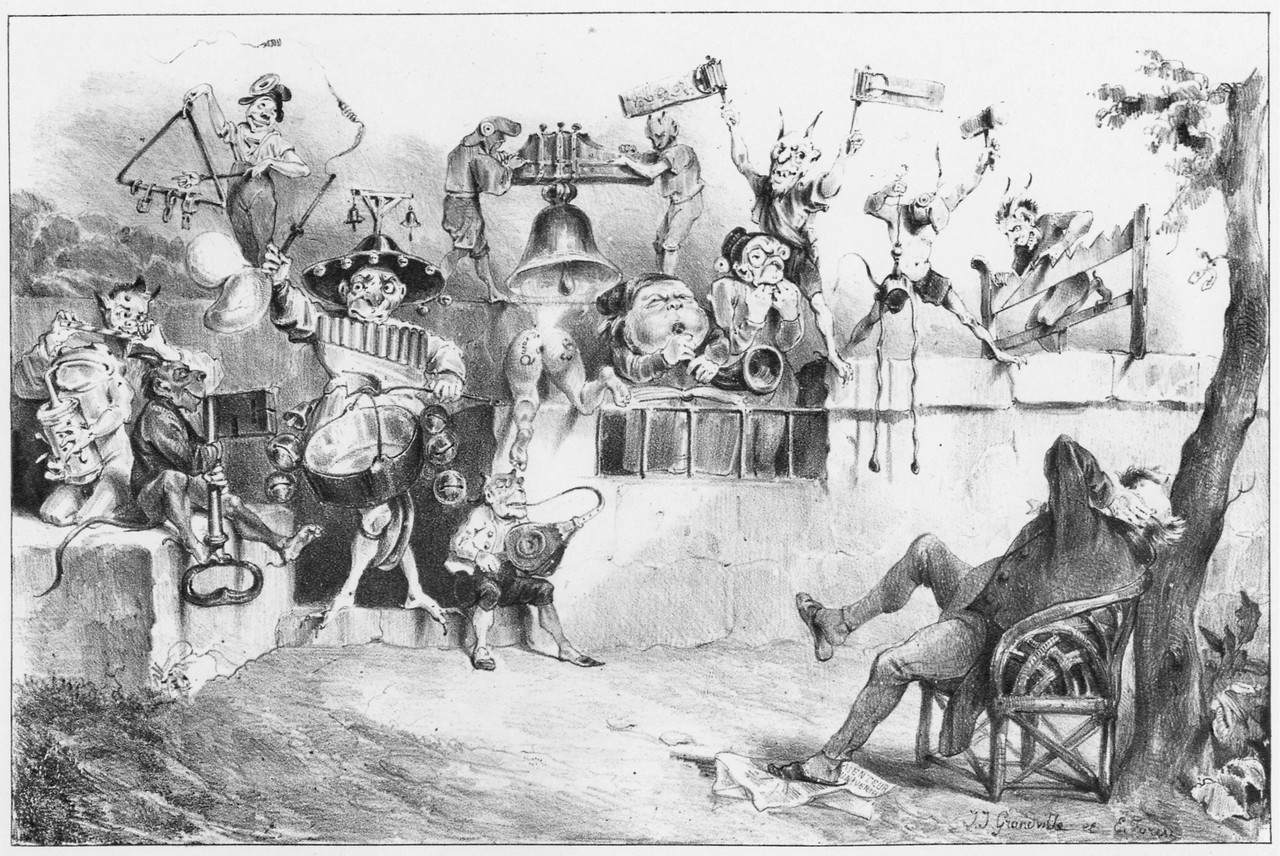
Though the pretext for the enactment of rough music varied significantly, common transgressions involved issues of sexuality, reproduction, adultery, domestic violence, and breeches of (a patriarchal) domestic hierarchy by scolds, shrews, »masterful« and nagging wives, or weak and submissive husbands, who fail to uphold their patriarchal authority. According to the historian E.P. Thompson, the satiric noise of rough music was an expression of community hostility, inducing shame and embarrassment. At its most extreme, rough music served to »drum out« the disgraced, encouraging them to flee their home. However, E.P. Thompson also notes that the ritual element of rough music can be thought of as channelling and controlling hostility, serving (sometimes but not always) as a substitution for actual physical violence.8 In this sense, rough music pre-empts the justifications offered by scalled »no-touch torture« procedures, which have often involved the use of sound and music. Other »no-touch torture« methods include sensory deprivation and sleep deprivation, and extreme solitary confinement. It has been suggested that these interrogative procedures are preferable to »actual« physical torture, as it (allegedly) causes only temporary and non-fatal damage.
The weaponised use of classical music might be thought of as a contemporary manifestation of rough music — or, perhaps more accurately »rough muzak.« As an audio-affective deterrent, classical music is used to irritate, annoy, and subsequently displace those who are suspected of threatening the moral and socio-economic orders of contemporary capitalism. This functional use of classical music clashes with a long-standing ideology that celebrates classical music’s transcendental, otherworldly status – its capacity to exist as art for art’s sake. Instead, classical music becomes embroiled in the micro-wars of the everyday, which, rather than occurring in faraway lands, are fought in shopping centres, public transport stations, and library foyers.
Marie Thompson is a writer and researcher interested in the affective and material dimensions of sound and music. She is a lecturer in Lincoln School of Film and Media, University of Lincoln. She is the co-editor of Sound, Music, Affect: Theorizing Sonic Experience (Bloomsbury, 2013) and has published on noise and affect; and noise and femininity.
This text was originally published in CTM Magazine 2015 – Un Tune.
- 1
Thomas Korosec (1997), »McFugue, no cheese: Beethoven and the Dead European Males clean up a notorious street corner,« Dallas Observer, 24 April; www.dallasobserver.com/1997-04-24/news/mcfugue-no-cheese/ (accessed January 2014).
- 2
Mike Palmer quoted in Melissa Jackson (2005), »Music to deter yobs by,« BBC News Magazine (accessed January 2013).
- 3
Melissa Jackson (2005), »Music to deter yobs by,« BBC News Magazine.
- 4
For more on the relationship between weaponised classical music and crime see Jonathan Sterne (2005), »Urban Media and the Politics of Sound Space,« in »Sound in Art and Culture,« a special issue of Open: Cahier on Art and the Public Domain, No. 9; p.p. 6—15.
- 5
Tom Yeoman quoted in Melissa Jackson (2005), »Music to deter yobs by,« BBC News Magazine.
- 6
BBC News (2006), »Tube heeds metro’s classical tune«, 13 February (accessed March 2014).
- 7
R. Murray Schafer (1992), The Soundscape: The Tuning of the World and Our Sonic Environment, Vermont: Destiny Books; p. 98.
- 8
E.P. Thompson (1992), »Rough music reconsidered,« Folklore Vol. 103/1; pp. 3—2.
CTM 2015: Noise, Affect, and the Politics of Transgression. Lecture by Marie Thompson by CTM Festival
CTM 2015: Noise, Affect, and the Politics of Transgression. Lecture by Marie Thompson by CTM Festival