
»Ritual is another word that needs a new definition... Ritual, as I use the term, refers to an artistic process by which people gather and unify themselves in order to confront the challenges of their existence.« – Anna Halprin
The shivering on your skin gradually builds like a soft electric shock that presses you down to the floor. The whole experience feels like an earthquake, with vibrations pricking through bone into organs. The affective tonality of the performance puts the body in a state of alarm, where listening turns into self-observation. Your perception is immersed in sensing the materiality of a room filled with other bodies, all attuning to the low frequencies resonating with the architecture of space, trying to maintain equilibrium. You refocus away from the artist to yourself and the rest of the audience, realising the depth of your feelings of total connection.
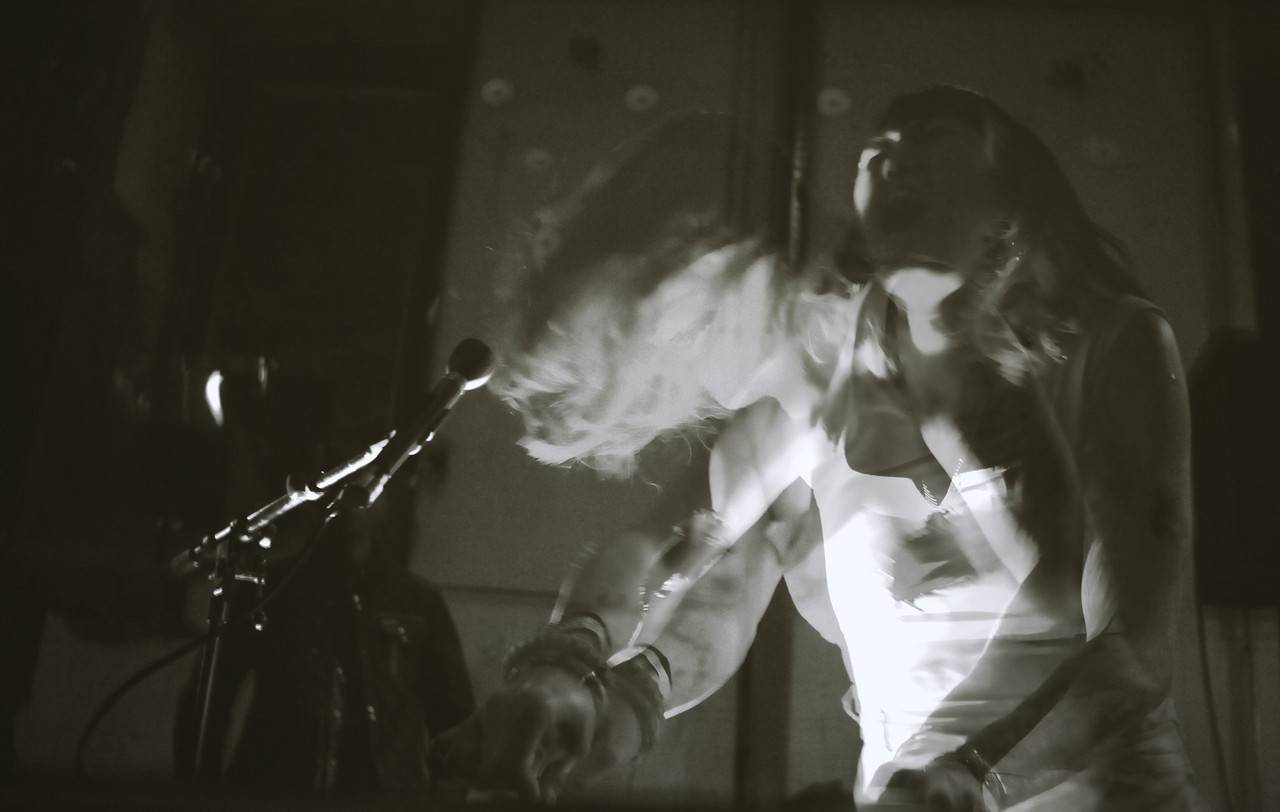
This transcendence comes through dissolving the boundaries of the body and the vibrational disturbance of one's kinesthetic sense of self in a room, or proprioception. As One Man Nation, Tara Transitory creates noise during her performances to offer out-of-body experiences for her listeners, a ritual where the unity of body and self dissolves. Using samples gathered through field recording and other sounds processed via her midi controller, 64 button Monome, and contact microphones on the tables and floor, Transitory catches her body moving and interacting with the instruments, amplifying the process of making sound in the here and now.
Transitory's artistic praxis enables me to explore the ways in which the body creates and receives noise. I define noise here as the unwanted and always-present materiality of (mis)communication. Transitory explores the body as a site of noise and disruption, working to disrupt the false narrative of unity pervasive in Western concepts of gender. Using cut-ups, noise, and ritual, she exposes the falsehoods of gender norms and repositions the body as a locus of possibility that allows for transgression and what Angela Jones and Baran Germen have called »queer heterotopias.«
Queer heterotopias and the rituals of self
Morning rituals like taking pills and brushing teeth produce the tiny noises of becoming one's own person, or at least moulding one's self into a presentable form. Repetition is a key element, making the process seem effortless and automatic. As Judith Butler discusses in Gender Trouble, everyday movements, gestures, actions, and ways of using and presenting one's body are framed by gender categories. Butler also demonstrated that gender is a performance made of repeating gestures and movements that are prescribed to male and female genders.
The everyday routine of Transitory's life, therefore, in a specific socio-political context, can seem unnatural and marginalised. Taking drugs every day changes the meaning of an action, whether the drugs are hormonal, supplemental, medicinal, or recreational. Still, the »natural,« as most queer theorists show, exhibits power only through the framing of social categories as transparent, creating an illusion of normalcy. However, while this post-structuralist perspective seeks an antidote to the normalisation of cultural schemes, it does not make clear what to do after destroying society's illusion. Deconstructionist perspectives produce a constant grating sound coming from the friction between the conceptual framing of body and the materiality of fleshly gender performance.
In other words, what didn't make the cut?
Cut-up spaces
As proposed by Brion Gysin and William Burroughs in The Third Mind, the cut-up method, an early analogue method resembling sampling, involved artists cutting up pieces of text and reassembling the pieces in a new form. This technique, used across different media, enables artists to create a self outside the limits of the body. In Burroughs' Invisible Generation, he describes creating a »cut-up« using a tape recorder. Recording, cutting up the tape, then reassembling it for playback allows the listener and the artist to become aware of a specific socio-cultural programming that Burroughs presents as a method of policing the self. However, remixing and repetition also opens spaces to reprogram ourselves. The tape recording cut-up becomes a multisensory stimulant used to create an other self through de- and re-construction. Furthermore, the body, working as a membrane, becomes transformed through the repetition of these new sounds; sound affects listeners simultaneously at the level of cognition as well as at the level of the body as a corporeal listening apparatus.
Genesis Breyer P-Orridge and Lady Jaye also explored the concept of the body itself as a cut up medium in their Pandrogeny project. They underwent the process by cutting up each other's gestures and behaviours through mimesis and cutting up parts of their bodies by undergoing plastic surgery in order to create a third being. The cut up material that they used is DNA, which they refer to as the »first recording.« They used the pronoun »we« even after Lady Jaye left her body (passing away in 2007), so the third being is not just a shared body, but a connection of minds and spirits across the divisions of gender and body. Making a cut-up of the body enabled them to create an other, a combined Genesis and Lady Jaye, the pandrogyne self, the We that is now Genesis and Lady Jaye. Pandrogyny is, in their project, a unified being presented as the double self in the negation of gender. It is a performance aimed to create a space for the connected consciousness, the third mind within a physical space of the body.
Cut-up spaces
As proposed by Brion Gysin and William Burroughs in The Third Mind, the cut-up method, an early analogue method resembling sampling, involved artists cutting up pieces of text and reassembling the pieces in a new form. This technique, used across different media, enables artists to create a self outside the limits of the body. In Burroughs' Invisible Generation, he describes creating a »cut-up« using a tape recorder. Recording, cutting up the tape, then reassembling it for playback allows the listener and the artist to become aware of a specific socio-cultural programming that Burroughs presents as a method of policing the self. However, remixing and repetition also opens spaces to reprogram ourselves. The tape recording cut-up becomes a multisensory stimulant used to create an other self through de- and re-construction. Furthermore, the body, working as a membrane, becomes transformed through the repetition of these new sounds; sound affects listeners simultaneously at the level of cognition as well as at the level of the body as a corporeal listening apparatus.
Genesis Breyer P-Orridge and Lady Jaye also explored the concept of the body itself as a cut up medium in their Pandrogeny project. They underwent the process by cutting up each other's gestures and behaviours through mimesis and cutting up parts of their bodies by undergoing plastic surgery in order to create a third being. The cut up material that they used is DNA, which they refer to as the »first recording.« They used the pronoun »we« even after Lady Jaye left her body (passing away in 2007), so the third being is not just a shared body, but a connection of minds and spirits across the divisions of gender and body. Making a cut-up of the body enabled them to create an other, a combined Genesis and Lady Jaye, the pandrogyne self, the We that is now Genesis and Lady Jaye. Pandrogyny is, in their project, a unified being presented as the double self in the negation of gender. It is a performance aimed to create a space for the connected consciousness, the third mind within a physical space of the body.
Tara Transitory explores the body as a site of noise and disruption, working to disrupt the false narrative of unity pervasive in Western concepts of gender.
One Man Nation's performances end with traditional Isaan morlam-style music (»mor« refers to the artist and »lam« is a kind of performance art where the artist tells a story using tonal inflections) sung by Angkana Khunchai, a 1970s pop-music singer. The pop-ish songs are calming and soothing after the intense experience of Transitory's performance. The text is a repetition of the words »calm down,« a therapeutic ending creating a sense of light from this cathartic performance. Transitory's use of morlam eases re-entry into one's everyday existence outside of the performance. The harmonies and softness of the song contrast with the harshness of noise performance as part of ritual – from transgressing the everyday and entering the liminal state that Transitory creates in her performances to better re-enter society.
Transitory's work conjures new rituals of transcendence and distancing one's self from the body. I treat the //gender|o|noise\\ as a hacking of the everyday experience of body. By creating a temporary heterotopia, Transitory reveals the tactics of hacking gender, generating a temporary space for alternative modes of existence. She creates flux in bodies and bodies in flux, thus affectively crafting heterotopic spaces, sites which are, as Brian Massumi states:
»…an open threshold — a threshold of potential. You are only ever in the present in passing. If you look at it that way you don't have to feel boxed in by it, no matter what its horrors and no matter what, rationally, you expect will come. You may not reach the end of the trail but at least there's a next step.«1
The everyday processes of becoming oneself by repeating practices become rituals when performed in different contexts. This ritual is a process of creating an affect, a space of potentiality that enables the body to reshape and change, much like Transitory refits old rituals into new skin. The ritual forms applied to actions of the everyday enable us to change their meaning and our perceptions, creating a sense of the transitory nature of one's body. Sonic rituals like Tara Transitory's are tactics to develop a self-conscious and creative approach to everyday activities and use them, as Anna Halprin says, to confront the challenges of existence.
Justyna Stasiowska is a PhD student in the Performance Studies Department at Jagiellonian University in Krakow, Poland. She is currently preparing a dissertation under the working title: »Noise. Performativity of Sound Perception.«
This text was originally published in Sounding Out! in 2015, and again in CTM Magazine 2016 – New Geographies thanks to the kind permission of editors Airek M. Beauchamp and Jennifer Stoever.
- 1
Massumi, Brian (2002), »Navigating Movements: A Conversation with Brian Massumi«, in Mary Zournazi (ed.), Hope: New Philosophies for Change, Psychology Press, pp. 210—243.