Before tapping into »new geographies« it is well worth ascertaining whether the allegedly »new« territories have not already been tapped into. Colonial-era European sea merchants claimed to have »discovered« both new continents and the people already living on them.
Discoveries and new inventions in the realms of science and technology are likewise not always as original as is often supposed. The invention of the steam engine triggered the industrial revolution in Europe, yet the technology behind it was already known in Ancient Greece, where temple doors opened automatically and kinetic sculptures with moving arms and heads played flutes and organs – all thanks to the power of steam, discreetly produced by heating water over a wood fire in an adjoining room. The Greeks didn't think the technology was of much use, however, and the »automata« described by Heron von Alexandria were anathema to the educated classes or, at best, merely an entertaining means of creating illusions, as in the case of the Deus ex machina in Greek tragedy: an actor playing a god who appears seemingly miraculously on stage, courtesy of a pulley construction.
A great variety of musical machines have been invented throughout history, sometimes several times over.
Outstandingly complex pneumatic devices were created by the Banū Mūsābrothers and Al-Jazari in the Arab world. Only monarchs, aristocrats, and priests had access to knowledge of machines, which was concealed within sacred books on alchemy and occultism. 20th-century futurist Luigi Russolo's »Intonarumori« had predecessors in Baroque noise intoners: these instruments, enormous machines comprising a kind of noise orchestra, were invisible to the audience, even though they surrounded the stage. They could produce natural sounds, such as those of wind, thunder, or rain. Leonardo da Vinci designed a hybrid instrument called »viola organista,« the strings of which were vibrated by rotating automated wheels instead of a bow, and selected by pressing keys on a keyboard. The development of music machines reached its climax in the 19th century with the music box, the pianola (a beloved attraction at fairs), the barrel organ with its encoded (pinned and stapled) cylinder, and, finally, the orchestrion, which could play whole symphonies by itself.
Before the Great Depression of the 1930s, 70 percent of some 350,000 pianos produced annually in the USA were player pianos – perhaps better known as pianolas – but all mechanical instruments lost their significance with the invention of recording and loudspeaker systems and, eventually, analogue synthesisers and computer music. However, music has had a strong connection with computation since its earliest days: from Pythagoras through Ramon Lull, Athanasius Kircher, Arnold Schönberg, and beyond, it has always been a code consisting of figures and symbols, and capable of undergoing multiple recalculations.
In essence, there are two types of automation in computer music: the automation of sound production (the loudspeaker as instrument, sound synthesis, etc.) and the automation of composition (algorithmic composition procedures, aleatorics, etc.). Both types look back on a long history. Take the sequencer, for example, which by the 18th century was already able to automatically reproduce rhythmic and tonal sequences thanks to the cardboard punch-card roll – not unlike the MIDI launched in the 1980s. Hermann von Helmholz's endeavour to reproduce the vowel sounds of the human voice culminated in the first analogue synthesiser: tuning forks were set to vibrate by electromagnets, so as to obviate the sound of impact. This generated a tone approximate to that of a sine oscillation. By variously blending these tones he was able to synthesise almost all vowel sounds.
The automation of composition likewise owes much to its early pioneers. In the 17th century the universal scholar Athanasius Kircher invented, among other things, an algorithmic method of composition and realised it as an analogue machine, the »arca musarithmica:« a complex filing system in which rhythm and harmony cards were combined according to certain rules, in a way such as to compose four-part canons.
Another 18th century combinatory composing method was the so-called »Musikalisches Würfelspiel« (German for »musical dice game«). Here, a layperson could roll dice (or draw cards) to randomly trigger set rhythmic sequences and thus »compose« a variety of waltzes, polonaises, or minuets. The most famous of these proto-aleatoric compositions is doubtless Mozart's »Würfelwalzer« (»Dice Waltz«).
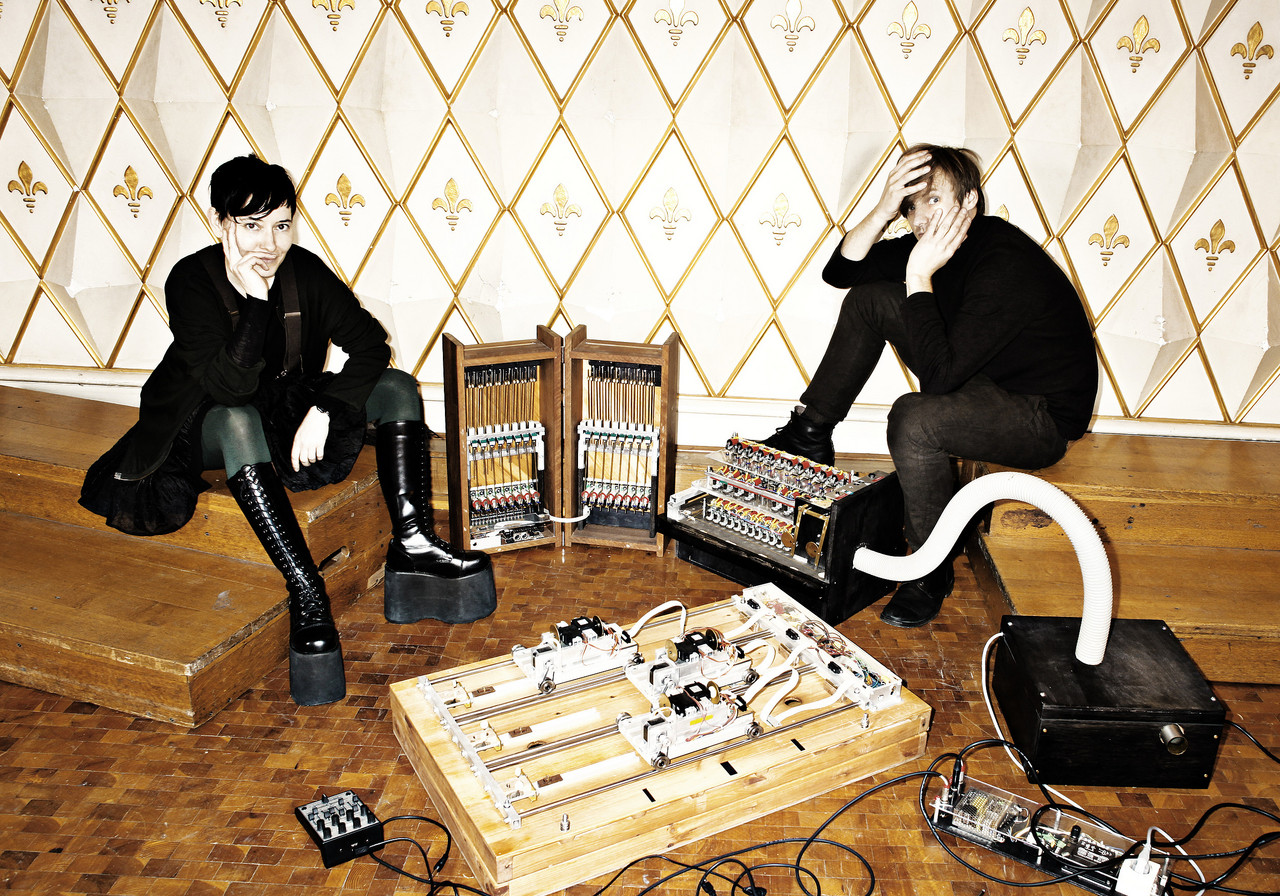
In cooperation with the instrument builder Gerhard Kern we have created several acoustic music machines over the last four years. The Avant Avantgarde festival prompted our pioneering venture, which we embarked upon in the company of Polish curator Michal Libera and some 40 musicians. It was on this exciting research trip into the pre-20th century roots of experimental music that we discovered the predecessors mentioned above.
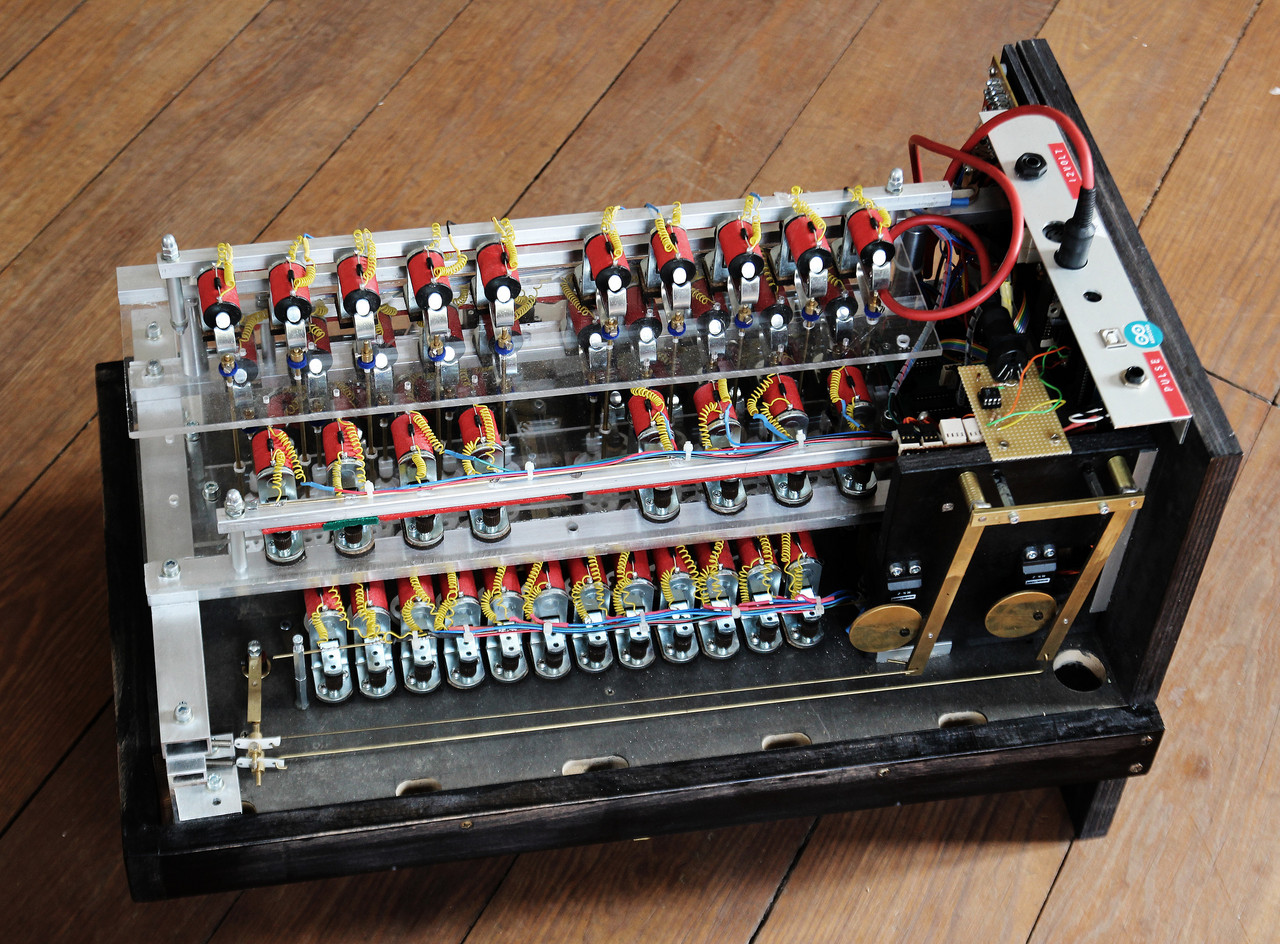
Our apparatuses generate acoustic sounds, such as percussion, accordion notes and string oscillations, which are vectored in turn by software developed with the programme Max4Live. This not only allows tones to be played but also brings to the fore more complex sound qualities: wind valves are regulated, stop handles continually modified, and the intensity of electromagnetic fields varied at will. Thanks to the micro-controller routing, the music machines are considerably more flexible than their pneumatic predecessors, which were based on punch-card systems.
Our music is shaped by the formulation strategies of contemporary electronic music: slowly developing rhythmic structures, timbre compositions, micro-harmonics, and deconstructed harmonic passages alternate with dramaturgically elaborated compositional gestures.
The palette of tone modulation effects and extremely diverse vocal systems is very comprehensive in non-European musical traditions, where one frequently comes across split tones, resonance effects, and a preference for overtone structures. While the European 20th century had to struggle to emancipate itself from consonance, in the cultures of Vietnam, Indonesia, or Central Africa the difference between tone and noise appears to be more of a continuum. In the case of string instruments such as the Vietnamese k'ni or the Central African and Congolese mbela, players use the mouth cavity to modulate the resonators and so achieve talk box-type effects. Analogies of this sort between electronic and traditional sounds are pretty common.
gamut inc applies a hybrid structure of acoustic sound production, digitally controlled yet driven by analogue electric circuitry. Any black-and-white distinction between electronic and acoustic sound therefore becomes pretty blurred. For instance, one of the instruments, the BowJo, uses magnetic fields to move its strings. Speakers equally move their membranes via magnetic fields. But if the same electronic technique is used to move two different components (string or membrane), how can we say definitely that the former is acoustic, and the latter is electronic? That these two worlds are on a continuum is surely self-evident. Music robots close the gap between acoustic and electronic music and foster new forms of expression in instrumental music. While they can only rarely imitate certain human ways of playing, there are many qualities of music machines that they alone can reproduce.
In addition to building instruments, we electronically process the sounds they make. This enhances our live performances and boosts their power, especially at the low end, thereby emphasising the setup's hybrid structure even further. When designing our instruments we focus on sound phenomena that human beings can hardly produce, as well as the diverse ambiguities incorporated in acoustic computer-driven sound production. One factor is speed, because extremely quick note repetitions allow continuous modulation within long notes, for example, as well as modulations in sound and separate rhythmic entities, much as in electronic music. Another important factor is the multiplicity of action, which obviates the need to compensate for human flaws, such as having only ten fingers and only two hands.
The process of composing begins with the design of the machine, much like the creation of customised software in electronic music. At the end of this process one might find oneself dreaming of a machine that can produce all electronic sounds in an acoustic way – a modular acoustic synthesiser. However, to build such a Frankensteinian machine would go way beyond our time resources. As it is, the machines already have us under their spell, and we live in hope that these reinventions of former technologies will lead us into more unexplored territories.
Our ensemble meanwhile includes the following machines:
Physharmonica
The physharmonica is an automated accordion. All its tones and all its registers can be computer-driven. They can be opened or closed in smooth transitions and thus facilitate various blends of register, in a similar manner to an electronic filter. Motorised valves control the air pressure of the instrument's wind machine.
BowJo
A three-stringed banjo whose strings are either electromagnetically made to vibrate using e-bows (which generates standing tones), or strummed using motorised plectra. The construction has motorised necks too, which, like the bottleneck of a guitar, facilitate glissandi.
Specht (German for »woodpecker«)
Our latest machine is a miniaturised version of the carillon. Claves of steel are struck or muted by electromagnetic hammers. Specht is our first modular music machine and currently comprises two identical eight-tone modules.
Cabasa
The Cabasa comprises an array of rattles that are either played in the classical manner of percussion instruments or continually rotated like some kind of acoustic noise generator. Varying the rotation speed produces different pitches.
Drums
The motorised kettledrum can be beaten extremely fast at different points. It is also equipped with an electromagnet that allows the tension of the head to be continually altered and thus different pitch levels to be rendered audible.
Marion Wörle and Maciej Sledziecki live in Berlin and Cologne. As gamut inc they play retro-futuristic music machines. In addition to staging musical theatre pieces, such as »Ghost Tape XI« and »One More Pioneer,« they run the music publishing house satelita Musikverlag, organise international projects in cooperation with the non-profit ZAM – platform for adventurous music, and work as film musicians and graphic designers.
This text was originally published in CTM Magazine 2016 – New Geographies.