Breaks and beginnings
This is an anniversary, one may safely presume, not just in any calendar: the release of Haunted Pair in East Berlin in 1984, a split tape from the bands Aufruhr zur Liebe and Ornament & Verbrechen. »Release« perhaps overstates the case in fact, for old Mireille Mathieu cassette tapes had to be recycled to produce this exceedingly limited edition. An x-ray style painting of a couple of copulating moose adorns the cover of Haunted Pair, courtesy of Ronald Lippok, who founded Ornament & Verbrechen with his brother Robert Lippok in 1983. There was even a label run by Ronald Lippok and Bernd Jestram, then guitarist and singer with Aufruhr zur Liebe, and a catalogue reference: »Assorted Nuts No. 1.« Haunted Pair was not to remain the new label’s only clandestine release for long.
Thirty years later, the tape is still a gem: Aufruhr zur Liebe’s side offers-up a mild dose of rainy-day avant-garde wave, including a cover of T-Rex’s »Children Of The Revolution« along with »bock auf nichts,« a decidedly skewed punk rendering of the eponymous poem by East Berlin poet Stefan Döring. Ornament & Verbrechen launches its side with »in g,« synth sounds and song, equally cool, and shot through with orchestral drama. The band follows up with »Duchess of Prunes,« a loose adaptation of Frank Zappa’s »Duke Of Prunes,« itself a psychedelic template from which Ornament & Verbrechen distilled every eerie moment.
This is »unerhörte Musik« (unheard-of music), as Susanne Binas-Preisendörfer (ex-member of another East Berlin experimental band, Der Expander des Fortschritts) describes it in the companion book to the Sound Exchange Festival – and, one must add, music all too rarely heard. In the 1990s Ornament & Verbrechen morphed into the internationally successful electronic line-ups Tarwater (Ronald Lippok and Bernd Jestram) and To Rococo Rot (both Lippoks plus Stefan Schneider). If one points out the origins of these bands, to their fans from the UK for example, one is mostly met by disbelief; yet that cedes to enthusiasm as soon as the guests get to listen to the older tapes. As is often the case, there is little relation between the quality of the tapes and the extent of their renown.
To amend this state of affairs was and remains the declared intention of the »Sound Exchange« event series conceived by Carsten Seiffarth, Carsten Stabenow, and their not-for-profit association DOCK e.V. »There’s a gaping twenty-year hole in history to fill,« says curator Seiffarth, in succinct appraisal of the fact that the West, as far as he can see, was interested in contemporary music from Central and Eastern Europe only briefly, in the early 1990s, after which »interest literally evaporated.« Yet in 1988, by contrast, Chris Cutler (Henry Cow, Art Bears, Pere Ubu) had initiated a series of seven albums in total, to be released on the ReR Megacorp label (ReR) as a survey of the experimental scene in Central and Eastern Europe. Cutler launched the series with Ritual Nova 2, an album by Yugoslav composer Boris Kovač, and followed up in 1989 with ZGA’s Riga, Strannye Igry’s (Strange Games) Leningrad, and Expander des Fortschritts’ eponymous debut. Then in 1990 came Up The River by the Polish band Reportaz; and in 1991 Currents Of Time by Slovenian Borut Kržišniks (still Yugoslav at the time), as well as Levitation by Hungarian Kampec Dolores. The series, titled »Points East,« just as the sub-label founded for the very purpose of publishing it, is due to be re-released, possibly later this year. The delay to date surely brings no joy to the label and illustrates the truth of Seiffarth’s statement.
How did things reach this point? A rather less-than-sympathetic attempt at an answer would be the question: how does the existence of an experimental music scene fit into the West’s image of Central and Eastern Europe, an image shaped after all by the 40-year-long Cold War? Briefly put, the question is: were those Commies allowed to experiment? Yes, they were. And, equally true: no, they were not. Their history is one of progress, obliged at times to pursue a zigzagging course and therefore often overlooked. Ornament & Verbrechen were able to release their handful of official recordings only after 1989. Yet the territory between East Berlin, Riga, Vilnius, Bratislava, and Warsaw has always been heterogeneous. Compare the fact that the Electronic Studio at the East Berlin Academy of Arts first opened in 1986, while the Experimental Studio of Polish Radio in Warsaw opened in 1957.
...how does the existence of an experimental music scene fit into the West’s image of Central and Eastern Europe, an image shaped after all by the 40-year-long Cold War?
On the other hand, it was only two years after the Warsaw Studio's opening, that is, in 1959, that Gerhard Steinke, former director of the (since demolished) Central Bureau of Radio and Television (RFZ) in Adlershof in East Berlin, initiated a team led by Ernst Schreiber to develop the Subharchord, an electronic sound generator designed specifically for use in experimental and electro-acoustic music production in radio, film, and TV studios. A shift in cultural policy put an end to the experiment in 1969. In 1973, by contrast, Polish composer Bogusław Schaeffer was able to develop his composition »Synthistory« in Belgrade. Schaeffer was there at the invitation of Vladan Radovanović, himself a composer as well as director of the Electronic Studio at Radio Belgrad where sound engineer Paul Pignion mastered »Synthistory« on the legendary Synthi 100, the technology that Peter Zinovieff had developed at the EMS Studio in London. Only a few such instruments were ever installed in the electronic studios of European radio stations yet, even so, a total of two were located in the Eastern bloc capitals of Sofia and Moscow, and one in the Eastern bloc’s non-aligned capital, Belgrade.
Not far from there, not even 100 km to the northwest, in Novi Sad, Ernő Király, a Yugoslav of Hungarian origin, created his first electronic composition »Poema o zori« as early as 1960. Király, who died in Serbia in 2007, wrote and played music inspired both by avant-garde music of the West and the folklore and cultural diversity of his native Vojvodina. Radio Novi Sad commissioned him to document the music of Hungarians, Serbs, Croats, Slovenians, and Roma, and his interpretations of such sources proved increasingly experimental.
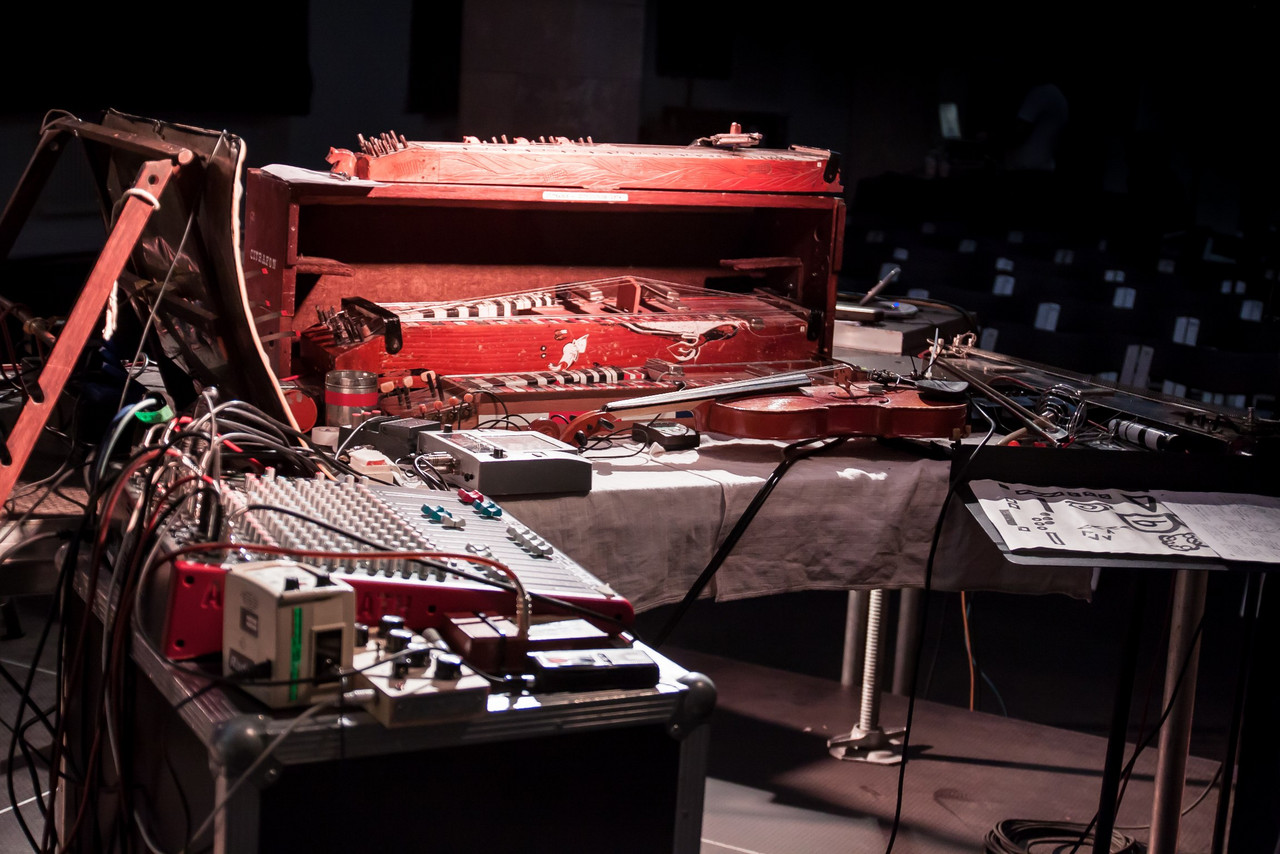
Király also designed and built his own instruments: the Zitherphone consisted of five variously sized and electronically amplified zithers, the Tablophone of a sheet of metal to which objects could be attached in order to create various sounds and a sheet of paper for drawings. Király relied not only on classical notation for his compositions but also developed a personal notation system based on geometric figures and primary colours. His sheet music and composition notebooks are hence artworks in their own right. His discography must be considered in the light of a catastrophic political schism. In the relatively liberal cultural-political landscape of Yugoslavia between 1967 and 1991 he was able to release four albums, three of which are no longer available. Following the outbreak of civil war in Yugoslavia, a further two albums were released, but abroad: Phoenix: The Music Of Ernő Király on ReR Megacorp and Spectrum on the French label trAce.
Sound Exchange: Kraków – Chemnitz – Berlin
Such stories have the makings of one book at least. And it was the wish to produce that book which led ultimately to the Sound Exchange Festival. The Goethe-Institutes in Munich and Prague had sent Halle-based musicologist Golo Föllmer off to research sound and media art in Central and Eastern Europe – and he thus had ample opportunity to meet a great number of colleagues, composers, and event organisers. The book was never funded. Instead, the research gave rise to an ambitious series of events.
Given the aforementioned breaks and schisms, to mirror the past and present of experimental music in Central and Eastern Europe in a series of concerts – in a festival format – initially seemed like a hopeless task. First of all one had to ask: what is »experimental music?« The Sound Exchange curators opted for a broad definition, gathering electroacoustic music, both composed and improvised, musical media art, and audio art under this umbrella term. They threw in several trips to the margins of popular-experimental sound production, for good measure. And they let locals select the participating artists.
Things kicked off with a one-day Sound Exchange event in Kraków on 18 November 2011, a format then repeated over the next 12 months in Bratislava, Vilnius, Riga, Tallinn, Prague, and Budapest. The tour ended provisionally with a weekend-long festival in Chemnitz – a city chosen, as Carsten Seiffarth explains, because »[it] is not overly burdened by academic music history.« More pertinently, perhaps, Karl-Marx-Stadt (as the city was called in the GDR) is home to legendary East German underground bands and projects such as Die Gehirne, Kartoffelschälmaschine, and AG Geige. Founding member of the latter band, Frank Bretschneider, founded the raster music label in the 1990s together with Olaf Bender, and later joined forces with Carsten Nicolai’s Noton to create raster-noton – the name that put Chemnitz on the electronic music map, worldwide and for all time. Bretschneider came to that first Sound Exchange weekend festival and performed »Kippschwingungen,« an audiovisual concert inspired by the sounds of the Subharchord.
With him in Chemnitz were the Hungarians Pál Tóth, alias én, and The Positive Noise Trio led by Zsolt Sörés, who each devoted their performance to Ernő Király. Whereas Pál Tóth melded Király’s compositions, sounds, fragments, and melodies to an evocative audio collage, The Positive Noise Trio presented excerpts from Király’s »Flora« cycle in a manner reminiscent of John Zorn. The booklet containing the cycle’s graphic scores was on display in the parallel (yet longer-term) festival exhibition entitled Visible Music That Anybody Can Listen To, along with scores by Fluxus artist Milan Adamčiak, the great old man of Slovakian sound experiments. Adamčiak turned up in person for the Ensemble Mi-65’s rendition of his work, which went under the title »TRANS music [VARIATIONS].« The ensemble’s interpretation filled the room with a protracted deep bass tone that yet seemed not at all heavy, mingled as it was with multiple strands of shimmer and crackle.
But this musical culture, like its counterpart in the West, is by its very nature unlikely ever to attract large numbers.
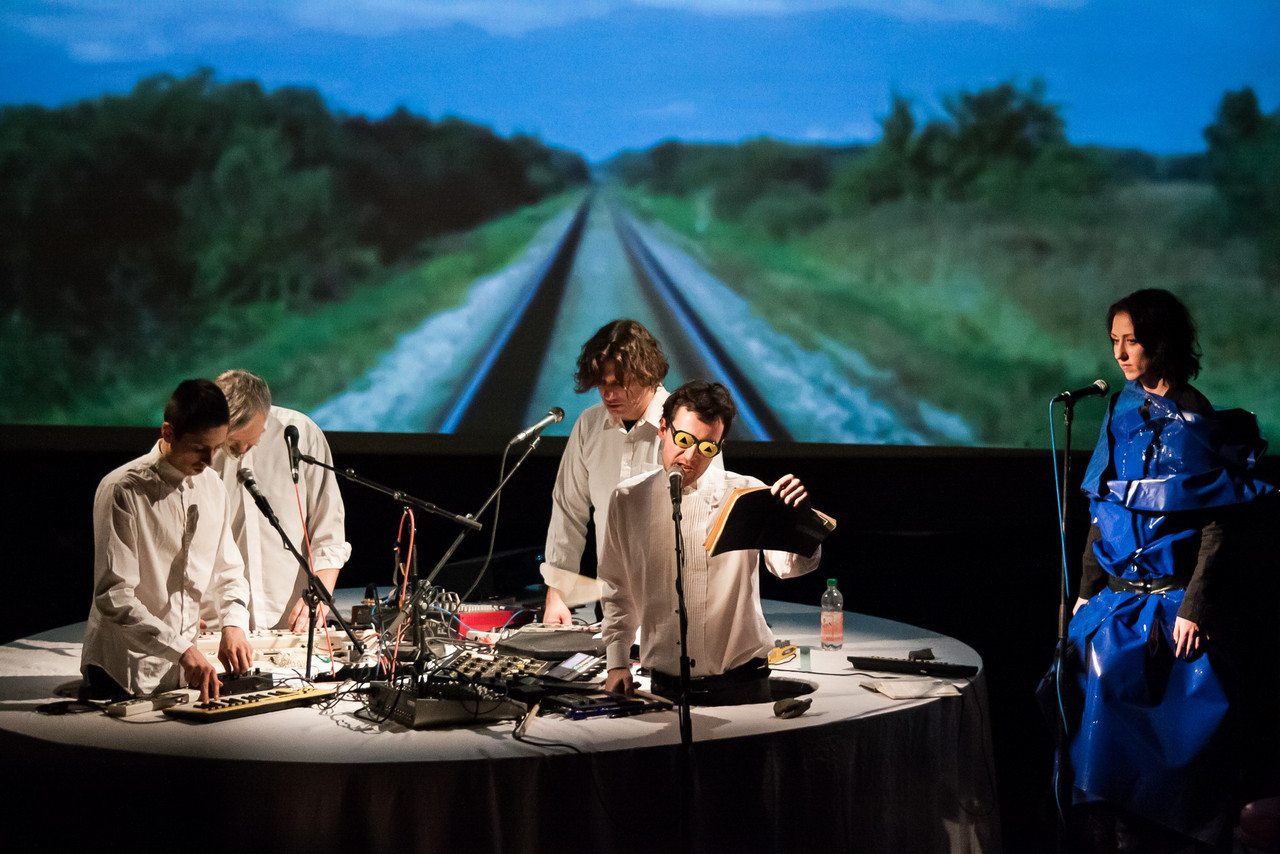
And then in rolled Łukasz Szałankiewicz from Poznán, a member of the Polish Society for Electroacoustic Music, historian, sound designer, and electronic musician, with Bogusław Schaeffer’s »Synthistory« in his luggage. At one point, one could detect the sound of some clockwork collapsing. Szałankiewicz thereupon played his own version of »Synthistory,« namely »Signalstory:« a real pumping loud, high- and low-frequency performance from within the magnetic field of a bunch of Walkmans. A multimedial concert whose aesthetics recalled the electronic excursions of the Brit group Coil was performed under the title »Dein Bart in Zeit und Raum« (Your Beard In Time and Space) by Latvian artists Andris Indans, Stropu Jurka, Normunds Griestin'š, Toms Aunin'š, Anna Kirse Aunina, and Indrik'is G'elzis, in memory of Hardijs Ledinš, the architect, pioneer of electronic music in Latvia and founder of the »Workshop For The Restoration Of Feelings That Never Were,« who died in 2004. This programme item gave rise to the combo The First Latvians On Mars. From neighbouring Lithuania came the DISSC-Orchestra: Jonas Jurku-nas, Antanas Jasenka, Vytautas V. Jurgutis, and Martynas Bialobžeskis. They played their composition »Venta« on Soviet synths: a performance that led one of those present to dub it »The Great Analogue Hurricane.«
It is to be hoped that this hurricane inspires others further afield. Central and Eastern European literature and cinema already have their readers and viewers. Experimental musicians in the region do not lack an audience either, although theirs is much smaller. But this musical culture, like its counterpart in the West, is by its very nature unlikely ever to attract large numbers. Numbers are in any case not the decisive point. If the broader public would only realise that Central and Eastern Europe’s contribution to music consists of more than Eurovision Song Contest acts and folkloristic live-cell therapy, we could already speak of heady progress.
Ornament & Verbrechen, the DIISSC Orchestra, The First Latvians on Mars, én aka Pál Tóth, the Ensemble Mi-65, and Łukasz Szałankiewicz – and, with them in spirit, Bogusław Schaeffer, Ernő Király, Milan Adamcˇiak, and Hardijs Ledinš – can all be experienced live this year at the 15th edition of the CTM Festival. In addition, Claus Löser (Die Gehirne, Chemnitz; now at the Brotfabrik, Berlin) and Alexander Pehlemann have compiled a programme of screenings about underground bands in the GDR under the title »Spannung.Leistung.Widerstand. Filmbanduntergrund DDR 1983–1990.« Pehlemann has been putting his energy into countering memory loss for some years already – among other things with the almanac Zonic, the 20th edition of which he recently published. And, last but not least, Ronald Lippok, Bernd Jestram, and the poet and musician Alexander Krohn recently released the CD Dear Mister Singing Club. Lippok once again took care of the artwork while poets such as Jochen Berg, Stefan Döring, Clemens Kuhnert, Andreas Paul, and Bert Papenfuß supplied the texts. In autumn 2009 the full line-up of Ornament & Verbrechen, who often used to set Papenfuß’s lyrics to music, played a reunion concert in Leipzig while, for the Sound Exchange gig at CTM, the original duo will take the stage: Ronald Lippok (drums and sampler) and Robert Lippok (guitar and electronics). The title »Béton Brute« says it all. We are talking about breaks and schisms, but also about continuities.
Author and journalist Robert Mießner was born in East Berlin in 1973, and studied history, philosophy, and library science at the Humboldt-Universität zu Berlin. He writes on music and literature for newspapers, magazines, and collections, and is co-editor of the Gegner magazine and the Zonic almanac.
Translated from the German by Jill Denton.
This text was originally published in CTM Magazine 2014 – Dis Continuity.