»Mittler zwischen Hirn und Händen muss das Herz sein!«
»The mediator between brain and hands must be the heart!«
— Metropolis (1927), dir. Fritz Lang
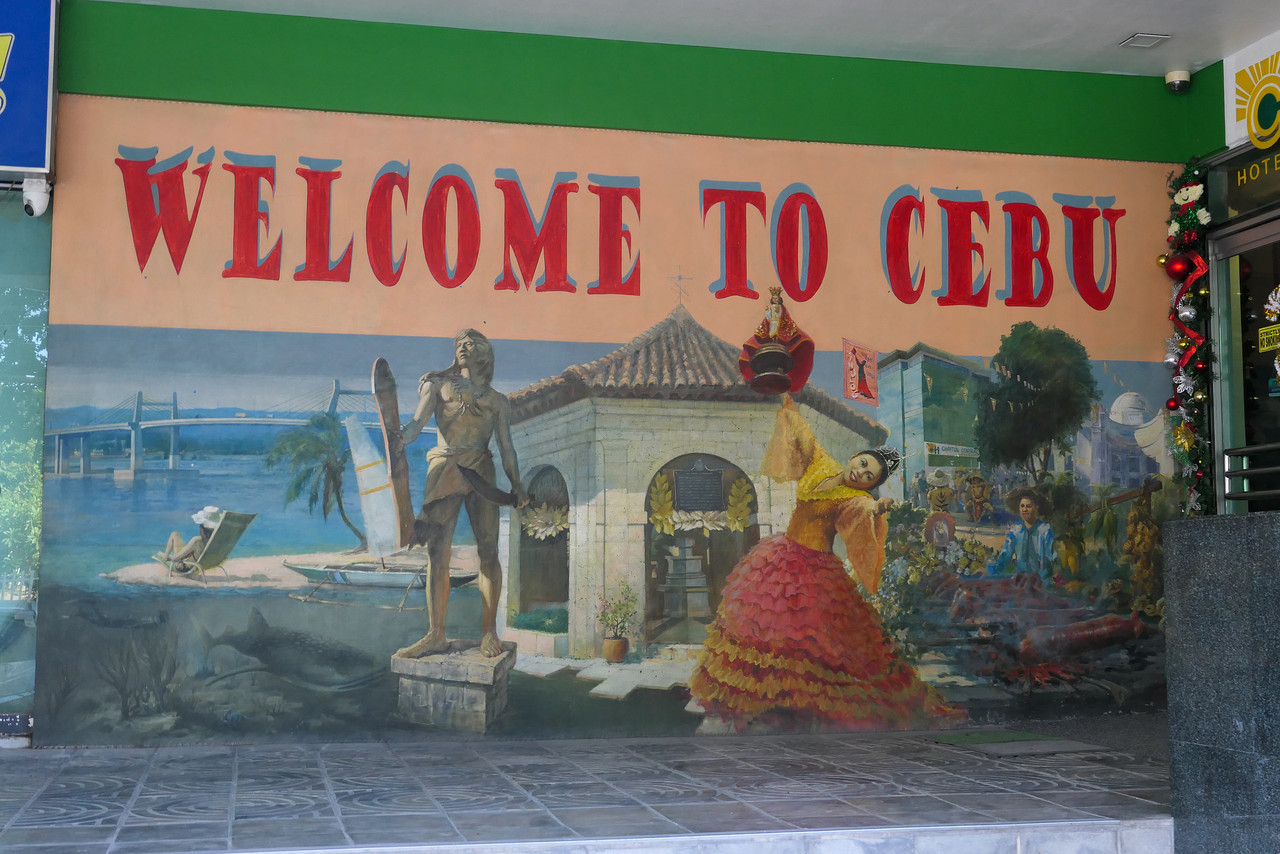
Fuente Osmeña Circle is a rotunda park in Cebu City that is a deafening amphitheatre of sound: Rattling jeepneys sputtering exhaust fumes, blaring sirens that can split an ear drum, and the distant drum beat of Lipps Inc.’s »Funkytown« rattling through makeshift sound systems.
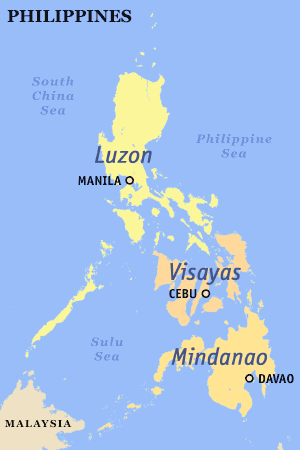
This bustling capital of Cebu province is located in the Visayas, one of three major island groups, including Luzon and Mindanao, that make up the Philippine archipelago. This southern metropolitan city served as a field site for the independent research you are about to read. We, Sai Versailles and Sean Bautista, are volunteers of Manila Community Radio (MCR), and this work expands on our team’s efforts to highlight a grassroots dance music genre from the Bisaya-speaking region called budots.
Distinguished by its bouncy bass lines, over-ornate melodies, and cartoonish samples from local entertainment culture, budots mimics the maximalist and whimsical quality of a dense Filipino city. While ubiquitous, especially among low-income communities in Visayas and Mindanao, it has received little attention in the study of Filipino music, where the focus is largely on Tagalog (the dominant language in and around Metro Manila) and English-speaking ballads.
In January 2023, MCR won Boiler Room’s Broadcast Lab grant to showcase budots music and its mutations, featuring pioneers of the genre, and emerging Filipino artists. This took place in April 2023 and while it was positively received by many, others criticised our »imperial Manila« gaze on a provincial subculture by packaging budots for the Western viewers of Boiler Room. For example, one Instagram post published before the event questioned whether it was culturally appropriative to showcase a genre outside its native context, implying negative connotations to middle-class »Manileños« being part of the dominant culture. Conversations within our community quickly sparked debate on whether it was MCR’s place to spotlight budots.
Admittedly, the class divide in the Philippines is striking, having one of the highest rates of income inequality in Southeast Asia. In 2022, the World Bank reported that the top one percent of income earners contributed 17 percent of the national income, versus a 14 percent contribution by the bottom 50 percent. If we look geographically, the National Capital Region in Luzon, where Metro Manila is located, contributed 31 percent to the country’s economy in 2023. This is a stark contrast to the Davao Region in Mindanao, where budots is said to have originated, which contributed five percent to the national economy in the same year. (It is worth noting that we met people in Cebu who contest budots’ origins in Davao, but this is a matter for another research project.)
Given these statistics, it’s not difficult to understand why people raised an eyebrow when budots was featured on Boiler Room. In Manila, some venues even restrict playing Filipino music, deeming it »uncouth« compared to more »polished« genres like house or techno.
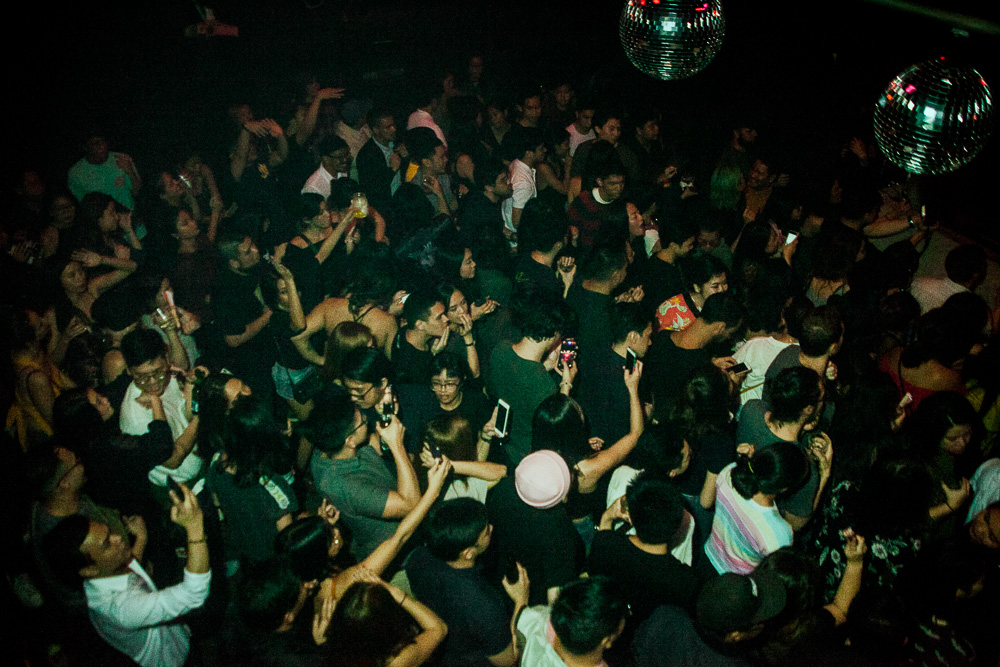
Needless to say, as educated, middle-class Manileños, our lived experience comes with biases resulting from privileges in our economic and geographic upbringing. In fact, our first encounter with budots, around 2016, wasn’t in its domestic context. We didn’t discover it in public transport or at neighbourhood basketball courts where local parties, colloquially known as »discos,« take place; it was through a viral video showing a half-naked man pretending to fall into a pool, before he broke into squatted hip gyrations to the tune of budots. The genre gained even more notoriety when politicians like Senator Bong Revilla, an accused plunderer, and former president Rodrigo Duterte, the country’s firebrand leader who instigated a bloody war on drugs, featured budots in their election campaigns.
Similar to the Harlem Shake or the Dougie, budots was an inescapable dance music craze and, for years, that’s all it was to many: a meme, ephemera, a passing fad. Some of our peers struggled to see budots’ potential beyond kitsch and humour. We chalked this up to our Westernised predisposition. We desired to »fit in« by seeking more globally accepted references, making the uniquely Filipino parts of our identity difficult to love. In the past decade, we’ve unlearned many of these insecurities by engaging with our local music community. For example, works like BuwanBuwan Collective’s Bakunawa Vol. 7: Rodrigo Duterte’s Summer Budots Party showed us how articulations in our vernacular can break free from »Manila-centric« dogmas, and initiate discourse with regions far away from the nation’s capital.
In what other ways has growing up in Manila shaped our preconceptions of what is »credible« cultural work? In this respect, the Boiler Room project revealed more contradictions that were waiting to be unpacked as we wondered how our experiences can create new ways to appreciate music.
But the extent our biases can help or hinder this curiosity is a question that resists easy answers.
Intersections in Artistic Influence
In a collection of essays written between 1962 and 1984 titled Revaluation 1997: Essays on Philippine Literature, Cinema, and Popular Culture, Filipino writer and scholar Bienvenido Lumbera illustrated a form of »cosmopolitanism« which persisted in Filipino culture in the mid-20th century.
During the American occupation between 1898 and 1946, the dissemination of Western frameworks in classrooms preoccupied Filipino students with matters of »form« and composition over »content« or subject matter. Referencing Filipino literature during this period, Lumbera described how poets exercised flexibility in the Filipino language through rigid structural elements like rhymes and metres, or Symbolist devices such as motifs and allusions. These Anglicised techniques, he said, effectively created »verbal constructs« that, by the mid-1960s, attempted to touch on Filipino social realities »by working around the subject, focusing [on] moral and intellectual dilemmas,« rather than the social conditions from which it was created. In doing so, many writers of this time attempted to prove that the Filipino language can adapt to a range of artistic influences – a condition perceived as necessary in »modernising« the Filipino identity.
Then, the declaration of martial law in 1972 and its subsequent 14-year dictatorship under Ferdinand Marcos sparked a wave of nationalism which re-examined holdovers from the Philippines’ colonial experience; it prompted a renewed appreciation of neglected native traditions, making space for a vision of society through works from vernacular and grassroots culture. First published in 1977, Lumbera details these observations in an essay titled »The Rugged Terrain of Vernacular Literature« – observations that align with our experience as cultural workers in proximity with grassroots music cultures like budots.
Lumbera notes issues within Filipino vernacular literature that are transposable into the broader promotion of vernacular music today – namely, that (1) access to resources is reserved for the highly specialised and educated; (2) how the history of vernacular culture has revolved around the achievements of English-speaking people, and; (3) people educated under Western frameworks are more attuned to the concerns of the foreign experience, while the social, economic, and political contradictions shaping native existence are rarely explored.
Such contradictions include the machinations of privilege, or being lucked into (mis)alignment with particular social norms. As Filipino-Manileños educated in Tagalog and English, is it possible to connect with provincial cultures from Visayas and Mindanao without reinforcing power imbalances? Lumbera offers a »tentative methodology« to humanise, historicise, and define (as a sociological document) vernacular works to further understanding of them, placing importance on the »descriptive« intention amidst lack of documentation. »The key word here is ›descriptive,‹ not ›critical,‹« Lumbera wrote, and how criticality involves the »delicate task of passing judgement.« A critical approach is bound to falter when applied to bodies of work where contexts are still »being defined, having been neglected for [decades] by our own scholars and critics.«
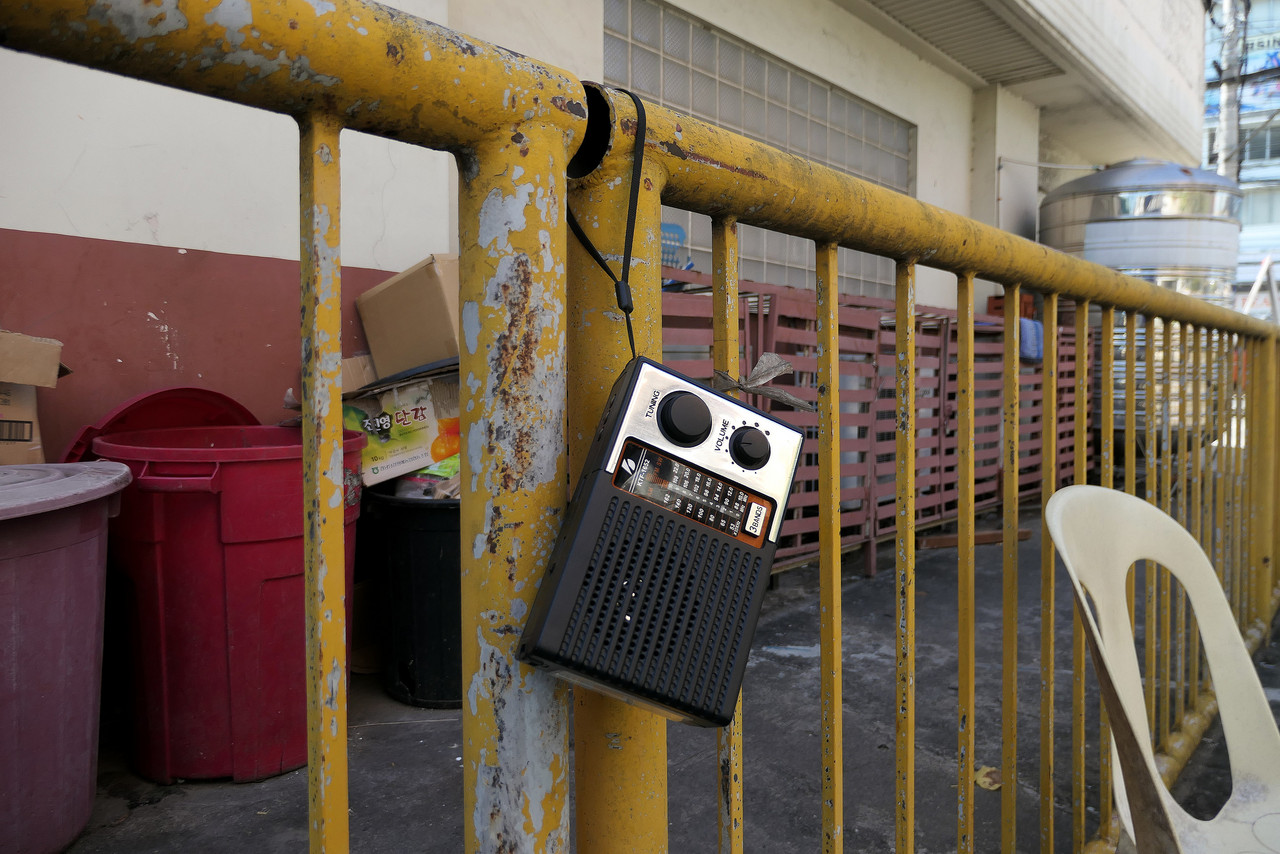

One such context sits 12 minutes away from Fuente Osmeña Circle: the 90.7 Brigada News FM radio station on V. Rama Avenue, which has the largest AM and FM listenership in Metropolitan Cebu. They are among many radio stations that dedicate two-hour time slots to daily programmes hosted by »mix clubs« that rotate between grassroots dance music genres like budots.
At the station, we met DJ Paul Gee, the host of Brigada FM’s »padisco« programme – which, in the Filipino language, means »to disco.« He described how FM radio broadcasts are simulcast on their Facebook page using a webcam microphone to not only bypass music licensing restrictions, but also reach new audiences. DJ Bombi, a Cebu Mix Club resident, told us how playing unreleased tracks exclusively for radio helped him land gigs in outdoor parties, colloquially known as »discos«. He went into detail about his DIY mobile disco sound system called the Black Mamba, which roves around parties in the Cebu province.
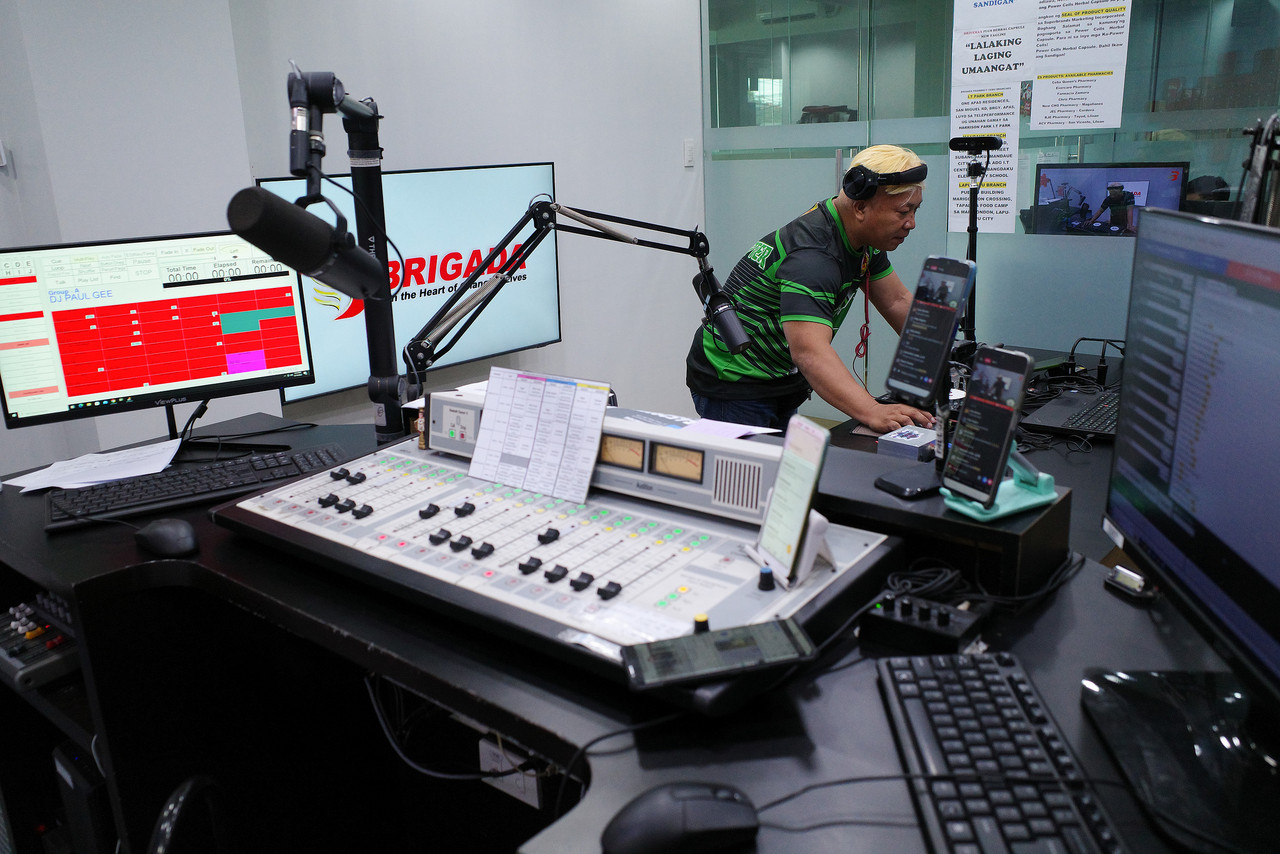
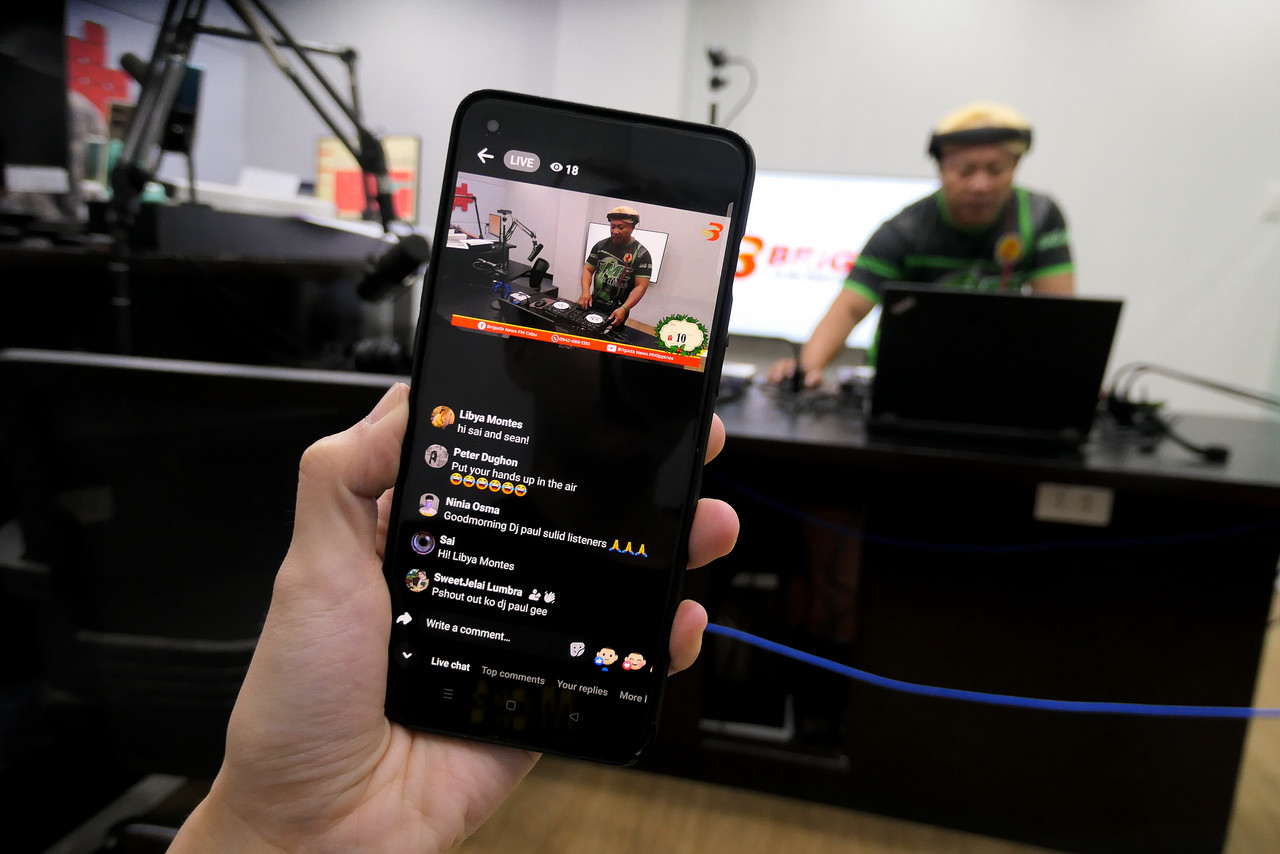
Part of Lumbera’s methodology is to »humanise« vernacular works by describing the dynamic between the creator, their work, and the social setting. The task of students of vernacular culture, he said, is to report the »various psychological and social pressures« that underlie creativity. But as outsiders looking in, it is equally important to »reflexively« situate our position in this narrative, or identify how our lived experiences can enable or inhibit particular kinds of insight. As volunteers of community radio, we’ve often felt crippled by the seemingly perfect facades of our US American and European counterparts – their stations equipped with the most high-end gear, broadcasting to audiences that seem to understand their value. But seeing that our provincial scene resembles early iterations of UK pirate radio and Jamaican sound system culture was inspiring. It helped us realise that creativity doesn’t exist in isolation, but always begets itself.
When asked about budots, DJ Bombi was careful to distinguish budots from a similar local genre in the Visayas’ »fiesta« circuit where DJs playing for traditional festivals are mindful of catering to family audiences. He called this genre »masa bounce« – »masa« being the Filipino word for »the masses.« Aside from mixes on YouTube, we couldn’t find much information on masa bounce. But from our observations, it incorporates elements of big room music, such as sidechained synths, a swinging beat, and a heavy bass drum, into remixes of popular Filipino songs. According to DJ Bombi, in masa bounce, choruses keep audiences singing, buildups keep people dancing, and drops allow for moments of rest. On the other hand, budots, with its shorter musical phrases, is distinctly repetitive, meaning older attendees struggle to dance for prolonged periods of time.
We saw these outdoor parties firsthand in the town of San Francisco, which has a population of 81,000. Located in the Agusan del Sur province of the Mindanao islands, the San Francisco government organised a Christmas »handugan« or gift exchange for the local community. DJ Love, a budots music pioneer who played at our Boiler Room showcase, was set to perform at the handugan alongside his close collaborator, DJ Ericnem.
Travelling to San Francisco from Cebu required a one-hour connecting flight to Surigao City, and then a five-hour bus down south. To save on expensive flight costs, however, many passengers travel by bus and ferry for two days to reach Surigao in the first place. It is a far cry from the ease of travel many touring DJs and audiences are accustomed to, and it made the geographic barrier faced by provincial artists more evident for us.
In fact, DJ Love was initially hesitant to take a plane to Manila for Boiler Room. But he appears unfazed by this way of working now. Since his performance in April 2023, DJ Love has played in cities across the Philippines while managing his own bookings. He has even received international inquiries, which prompted an application for his first passport. San Francisco was one of many gigs lined up for the Christmas season. The organiser who booked Love's first show, his former neighbour, didn’t shy away from explaining how proud he was of his friend’s success.
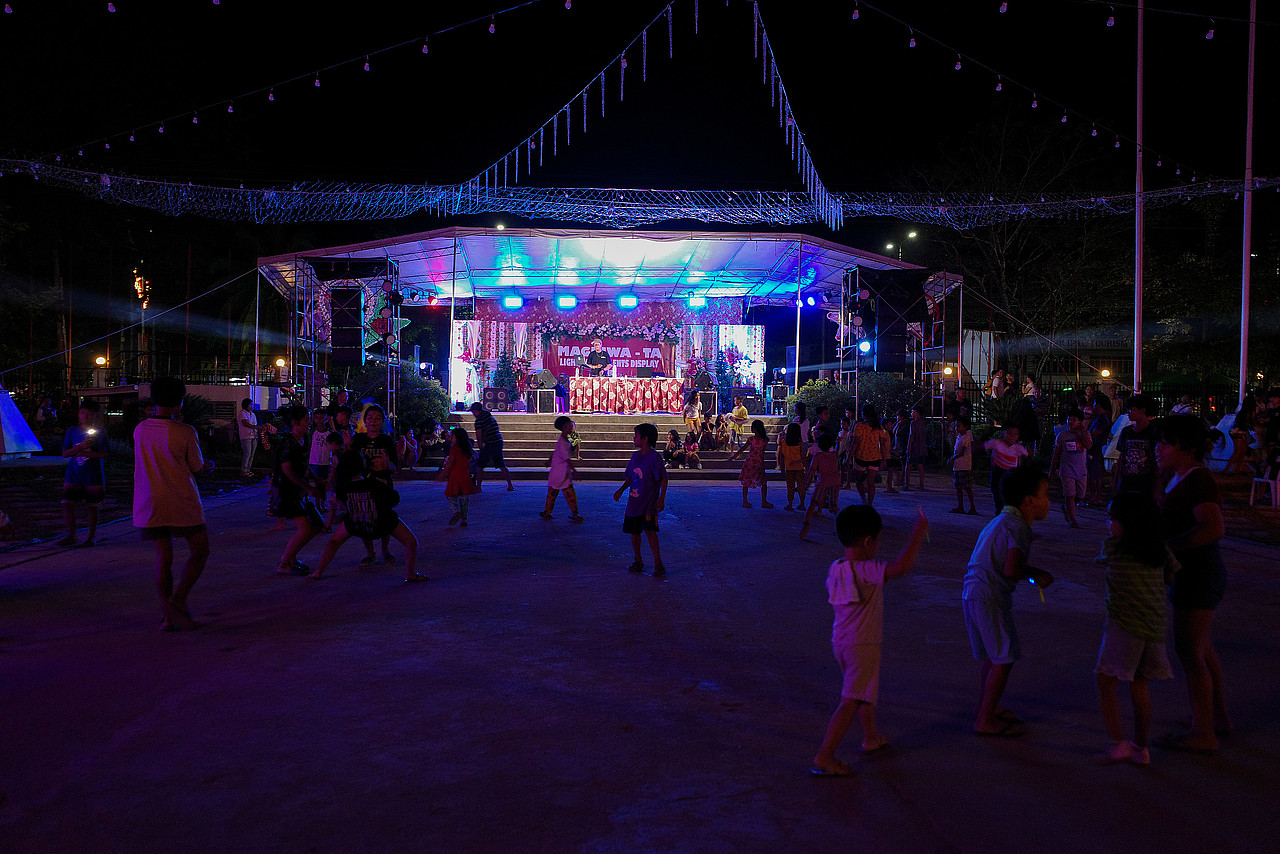
At ten in the evening, families gathered around the municipal grounds as DJ Love and DJ Ericnem blasted their ear-worm productions of budots, as well as genres like redrum (remixes with new drum patterns, or to »re-drum«), igat-igat (meaning »flirtatious« in Bisaya), and masa bounce. Despite a downpour of rain, crowds formed circles on the concrete dancefloor. Balancing on the balls of their feet, they wriggled their torsos and dropped their hips to the ground. They paid little attention to the DJ booth – a contrast to more familiar international dance music scenes where idolatry and mystique surrounded the DJ. The dancers were solely focusing on out-doing each other’s moves, which carried a language only those who knew could express.
»Did that sound OK?« DJ Love meekly asked us after his set. In that moment, he embodied a self-doubt that felt all too familiar; it was a poignant reminder of the inspiring moments music can evoke, juxtaposed with the daunting task of balancing it all.
Intersections in Individual Agency: Tracing the Roots of Budots
DJ Love, whose real name is Sherwin Calumpang Tuna, is a music producer from »Camus,« Davao City, in Mindanao. Camus colloquially refers to the J. Camus road extension in the Poblacion district, which runs half a kilometre south from an informal settlement.
After a six-hour bus ride from San Francisco to Davao City, Sherwin met us at an intersection on Jose Abad Santos Street. Concrete, bamboo, and palm trees textured this neighbourhood. Tarpaulins from previous political campaigns were repurposed as tablecloths, or as awnings held together by shredded rope. The houses appeared two storeys high, blending with one another to seemingly share one long roof made of corrugated metal. Tucked deep inside were more houses tightly pressed together. Sherwin led us to a dark alleyway that connects Jose Abad Santos to its parallel street, Elpidio Quirino Avenue; it extends for nearly 200 metres, and is just wide enough to raise both your arms.
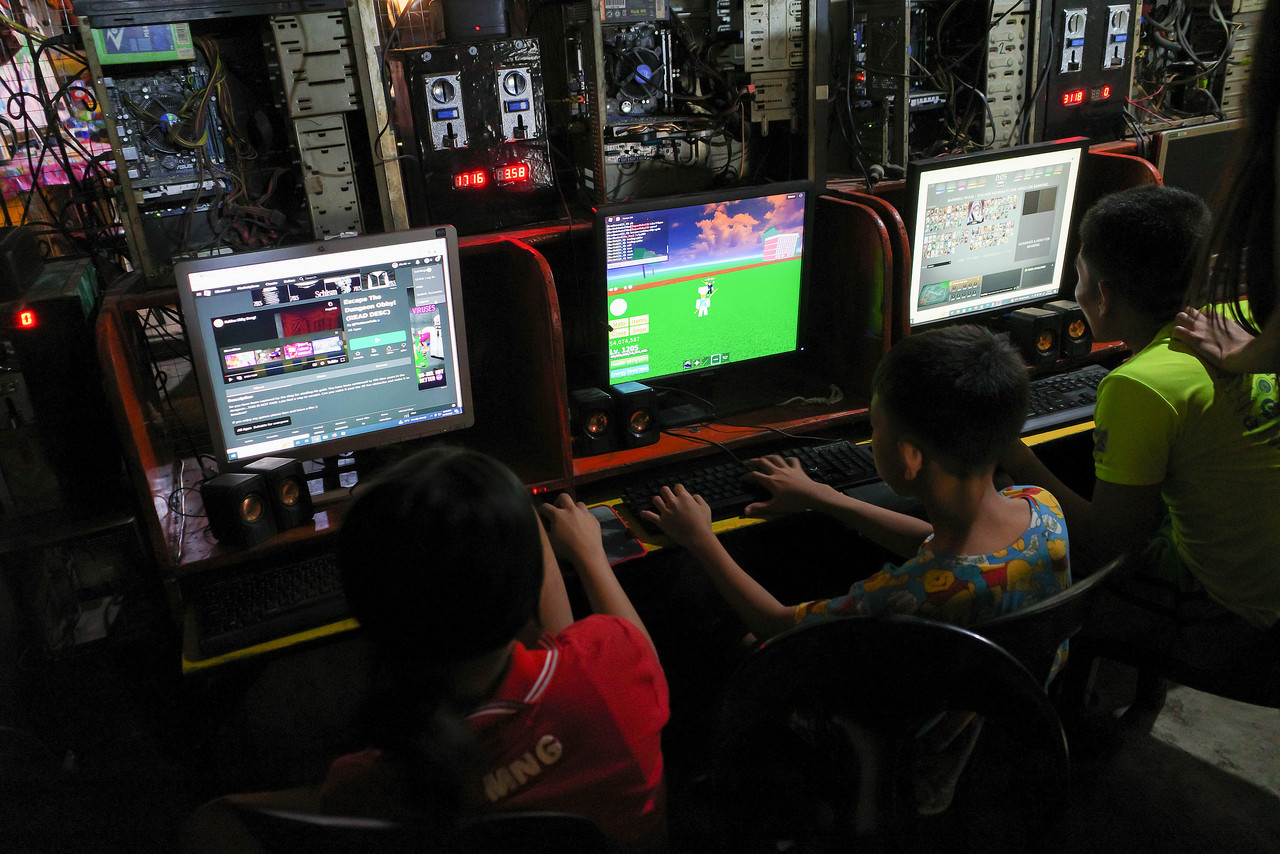
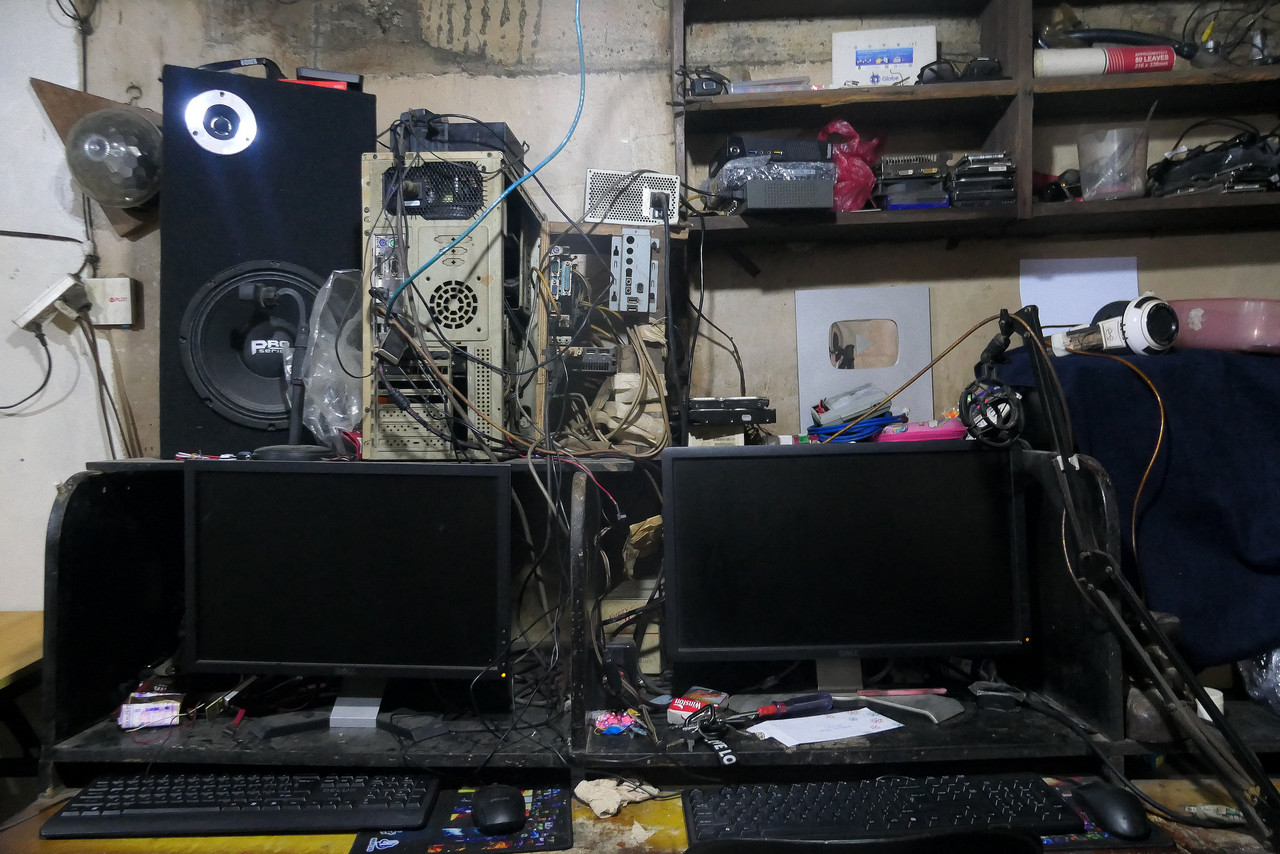
Inside were kids cramped in a coin-operated internet cafe, or »pisonet,« playing video games and watching YouTube videos. A plywood wall separates the pisonet from the kitchen, which doubles as Sherwin’s music studio. He had two desktop computers – one that still ran on Windows XP with the CPU tower hollowed out from its shell. After years of lugging his desktop between gigs, Sherwin told us that it’s nearly dysfunctional. But as it is the treasure trove of his unreleased music, he uses scotch tape to keep it working.
We hunched over Sherwin’s computer as he scrolled through his Facebook feed, pulling up photos from his past. Since elementary school, Sherwin was part of dance troupes that deepened his understanding of music, he said. His parents owned a sound system that was regularly rented out to discos, which he was the audio technician for. Sherwin became savvy with the dance contests and knew how to win them. He became a choreographer, and taught his neighbours the moves.
But the troupes never stayed together, said Sherwin, who has watched many »seasons« of dancers come and go. Some got married and had kids, others left town to pursue new careers. But Sherwin stayed and continued to dance.
As his parents’ sound system roamed around Camus, Sherwin developed a knack for playing music at the discos. With a single audio channel, he’d play tracks like »Amokk« by 666 or the Hockenheim Club Mix of DJ Visage’s »Formula 06« while people danced the »dayang dayang,« as Sherwin called it. He was, in fact, referring to the Pakiring, a native dance by the indigenous Sama Bajau where hips gyrate to mimic the wings of a butterfly.
Around 1995, a cassette tape circulated in the Philippines containing a live recording of a traditional Pakiring song with a carnival-like accordion. Titled Dayang Dayang, it was such a nationwide hit that the term evolved into the modern parlance for the traditional dance. The origins of the recording remain contentious, but it gave Sherwin an idea.
In the early 2000s, he started working at a pisonet in Elpidio Quirino Avenue, owned by a close friend who he taught how to dance. There is a culture akin to the French »flâneur,« embodied in the Filipino »tambay« – a portmanteau of the English »bystander« or meaning those who loiter without formal work. Sherwin’s pisonet became a hub for tambays, especially the »rugby boys« named after a local brand of contact cement as they sniff solvents recreationally.
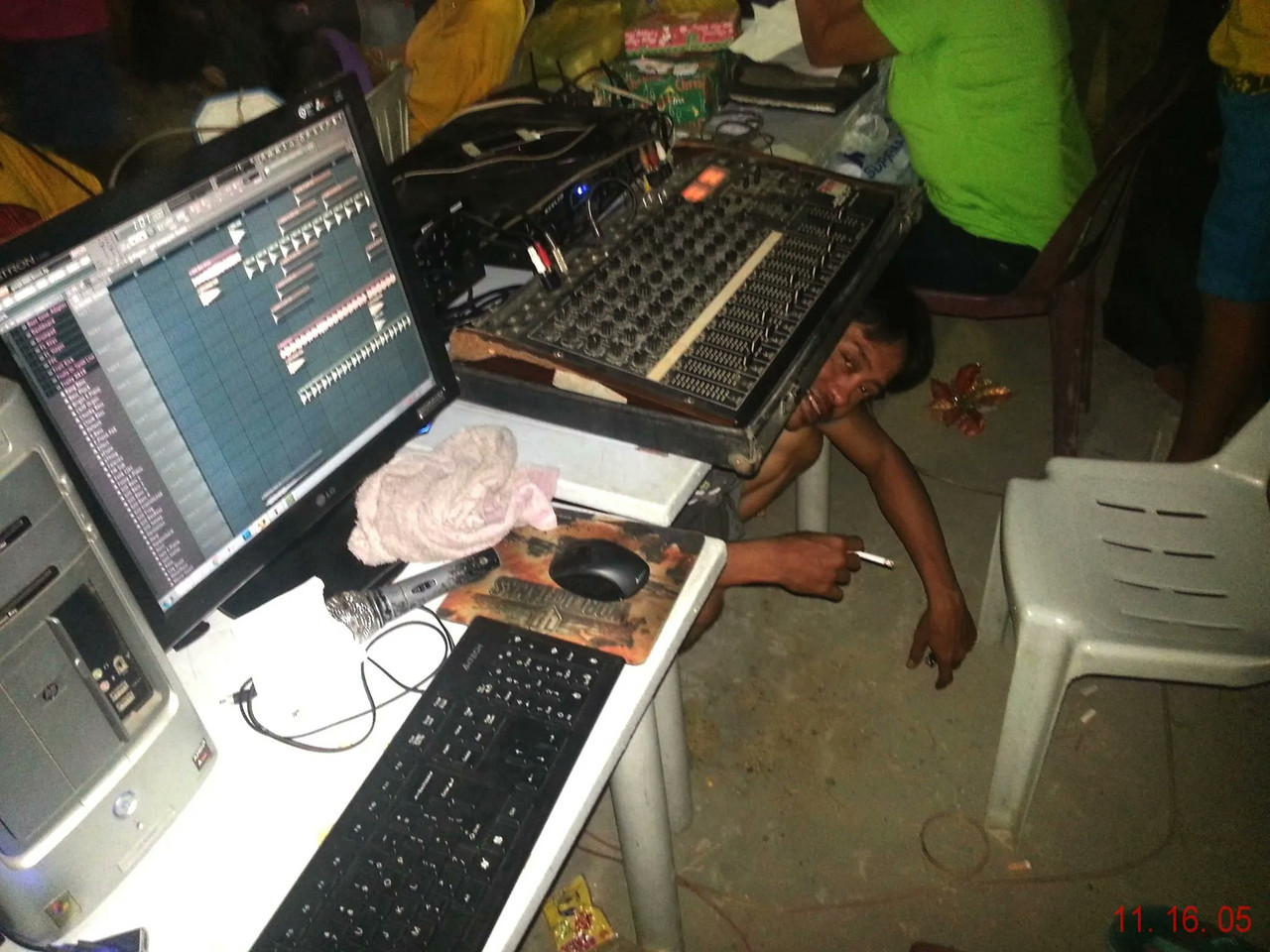
At the pisonet, Sherwin learned how to splice tracks on Mixcraft, a digital audio workstation, to create what he calls »non-stop mixes.« Later, a mentor introduced him to music production using FL Studio. With his friends, he found inspiration on Limewire, the peer-to-peer file sharing application. »There’s this one guy – too bad he’s in jail now – who was really good at looking for tekno music,« he recalled in Tagalog. Using keywords, they stumbled upon DJ Bomba, the German producer from the small town of Bismark in Saxony-Anhalt, who is one of Sherwin’s main influences. »That’s when I realised I wanted to create something of my own.«
Sherwin detailed to us the ways he kept productive at the pisonet. He provided food, shelter, and rum for the rugby boys, keeping them from loitering in areas where they could get arrested. This was when vigilante killings were rampant in Davao as Rodrigo Duterte, then-mayor of the city, began a pilot test of his war on drugs.
He took care of the tambays under two conditions: That they weaned off drugs, and showed up to work everyday. He taught them the dayang dayang to the tunes of Eiffel 65, the Italian Eurodance group, and new additions to the dance crept in: The clenched fist under the nose, mimicking the inhaling of rugby; or a finger gun to the head, a move Sherwin calls »sukarap,« a term in gang culture meaning to trip or fall over, hinting at the potential consequence of engaging in risky behaviour. Under the name Camusboys, they recorded their dances using a webcam. They uploaded the videos, with Sherwin’s music, on YouTube, and it was sensational.
»It was like a virus,« described Sherwin, who saw people dancing to his moves in the nearby funeral home. He recounted his gigs in Bonguyan Beach Resort when he graduated from a single audio channel to playing non-stop mixes burned onto a CD. »At the Bonguyan, they were all there: murderers, robbers, thieves. They all tambayed there,« Sherwin said. »But as soon as I played my mix, it got packed. You couldn’t find a place to sit. Then every weekend, the tambays noticed me. ›Hey, it’s the guy with the new music.‹ That’s how it all started.«
»We initially called it budong. Budong for men, budang for women. They’re considered the lowest level of society. But that was the reality of it. Budots is the sound of Camus, of the tambays, the ›squatters,‹« Sherwin said nonchalantly. When Lumbera insisted on historicising vernacular works, it was to situate the creator’s biography in a string of social, political, and economic events, which will undoubtedly leave an imprint on the creator’s mind and work. We knew »squatter« to be a derogatory term for people from the slums, yet Sherwin said it with such conviction, revealing a pride that added depth to his character.
»Do you think budots is underground?« we asked Sherwin in Tagalog.
»Right now, yes,« Sherwin replied.
»What does underground mean to you?«
»The most local of the local. What is the opposite of local, anyway?«
»International?«
»I mean, budots is already international,« Sherwin quipped. »But to be honest with you, we’re still some way away. We still have a lot to prove to other countries.«
Intersections in Community: The Boiler Room showcase
Three months of event planning came to a close as the Manila Community Radio (MCR) team prepared for the live Boiler Room showcase on April 29, 2023.
Many of us lost sleep the night before, figuring out whether we’d have electricity at the venue. How did we only have a generator without the wiring to power this literal disused boiler room? Somehow, it slipped through the cracks. Clearly, we hadn’t done this before.
Since 2020, MCR has operated in this organic fashion, being a volunteer-led platform. When a few of Manila’s nightlife organisers banded together in response to venue closures from the pandemic, little was known on how to manage over 500 different broadcasters, or archive more than 1,000 shows online. Juggling personal commitments with the radio’s operational demands was overwhelming at times, and many volunteers left the organisation as a result.
Yet, the vision of subverting the music scene’s top-down, profit-driven meritocracy fuelled many of us to persevere. For years, this alternative remained only in our imagination. So when spontaneous efforts culminated into a reality where power can be redistributed, many of us wanted to share this privilege with others.
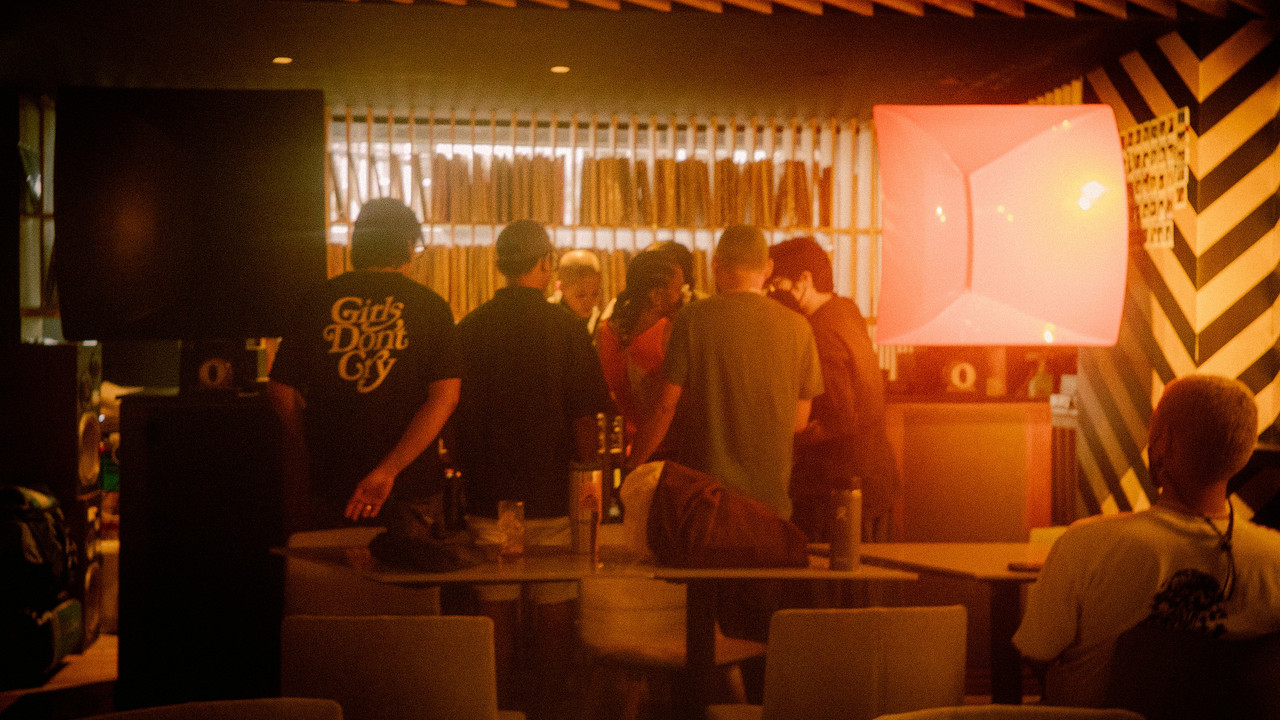
When we won Boiler Room’s Broadcast Lab grant, we were keen to offer a multifarious perspective of budots music. As nightlife organisers from Manila, we can’t claim ownership of a genre with origins in the provinces. But we also couldn’t ignore its impact on local dance music, inspiring producers across the country to share their interpretations.
In the planning stages, we were told by Boiler Room to treat the event like a shoot, rather than an event; to keep the venue undisclosed, and that ticket sales were disallowed. This wasn’t our ideal set-up because we wanted to make the event as accessible as possible. But we had to work around limitations that were very new to us.
A month before the event, the opening of a Japanese sneaker store in Manila caused uncontrollable lines that snaked through the mall’s four floors. It reminded us of the potential fanfare of a Boiler Room event, which was not to be taken lightly. Ensuring everyone’s safety was paramount. But as a few twenty-somethings, we seriously doubted we could handle such a crowd. Showcasing local music at an international stage is an immense privilege, and the weight of its responsibility was undeniably felt.
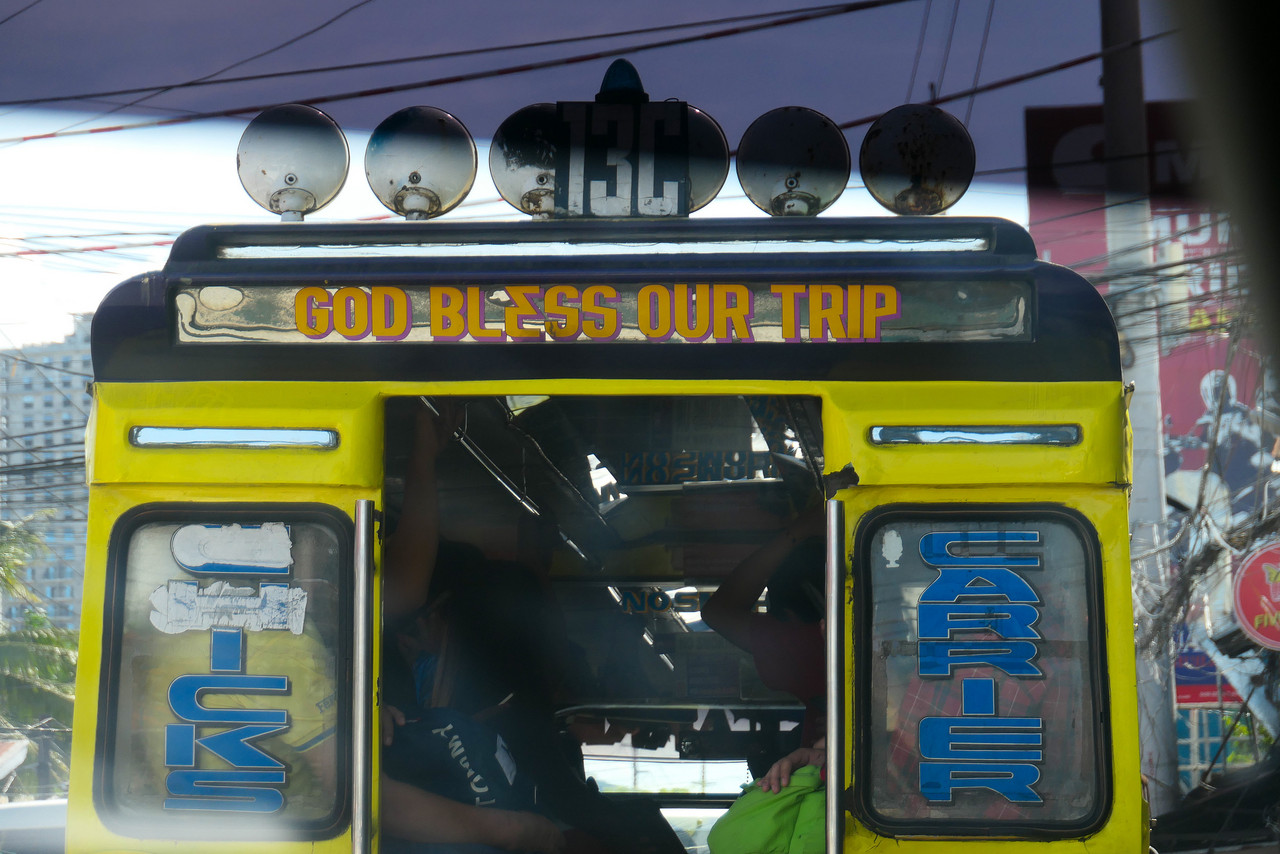
Nevertheless, there was trust in the process, and excitement to see the fruits of our labour. Thank goodness we found a lineman to power the venue because we only had four hours before sound check. The set designers prepared a meticulous stage that included airbrushed murals of Darna, the Filipinized Wonder Woman, and Marlboro-esque horses galloping with the wind. The murals read »God Bless Our Trip,« a common phrase found on most jeepneys, a local form of transport – which, apart from its cheeky hint of the night to come, felt like an omen. Will we get through this without a hitch? Screenshots calling the event »the biggest joke of the century« circulated our group chat. Heavy rain poured outside and the hellscape of Manila’s traffic immediately provoked the mind. Coronavirus cases were on the rise once again. After the artists completed sound check, they practised their sets in the holding room, which looked like one of Sherwin’s pisonets. Before doors opened, a dialogue between Sherwin and Elijah Pareño, a music journalist, was recorded, and the two easily fell into a rhythm that is shared by lovers of music.
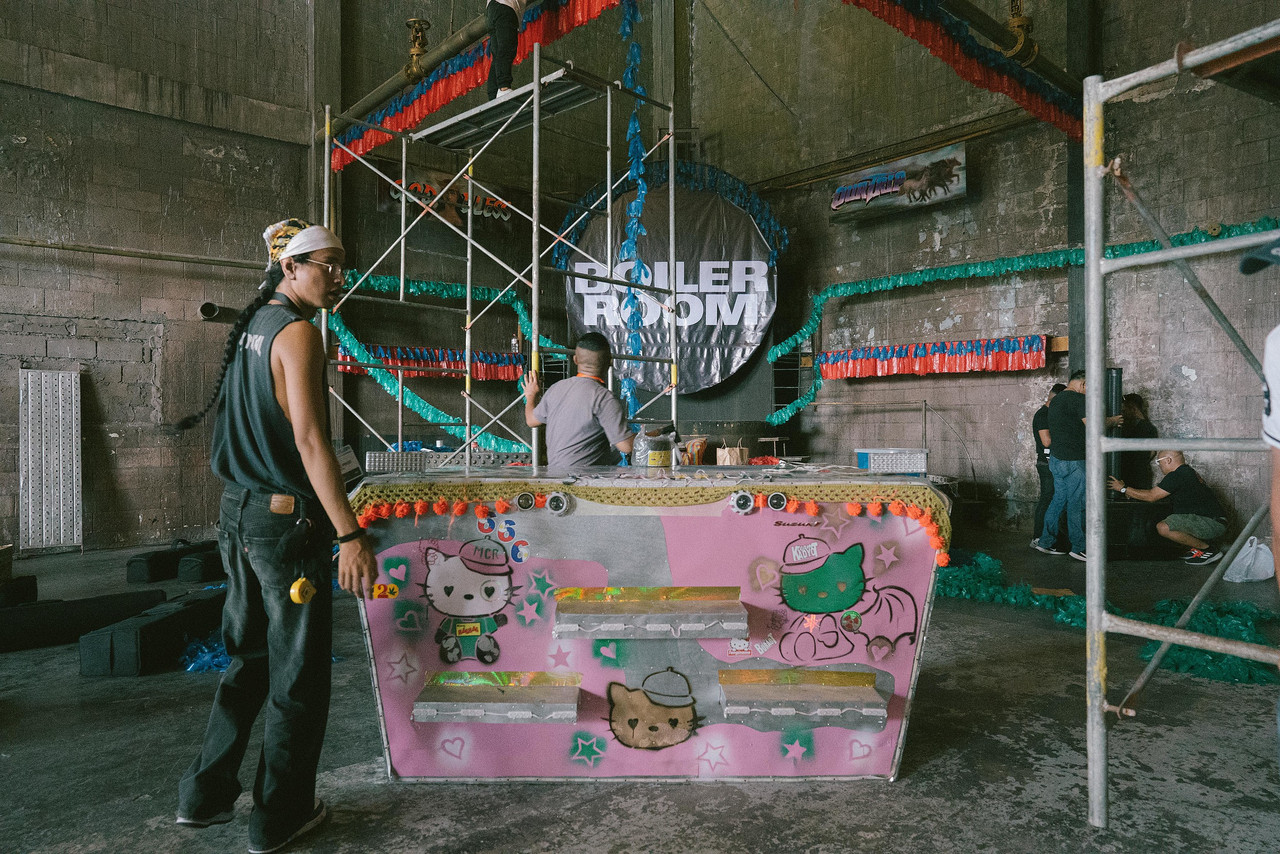
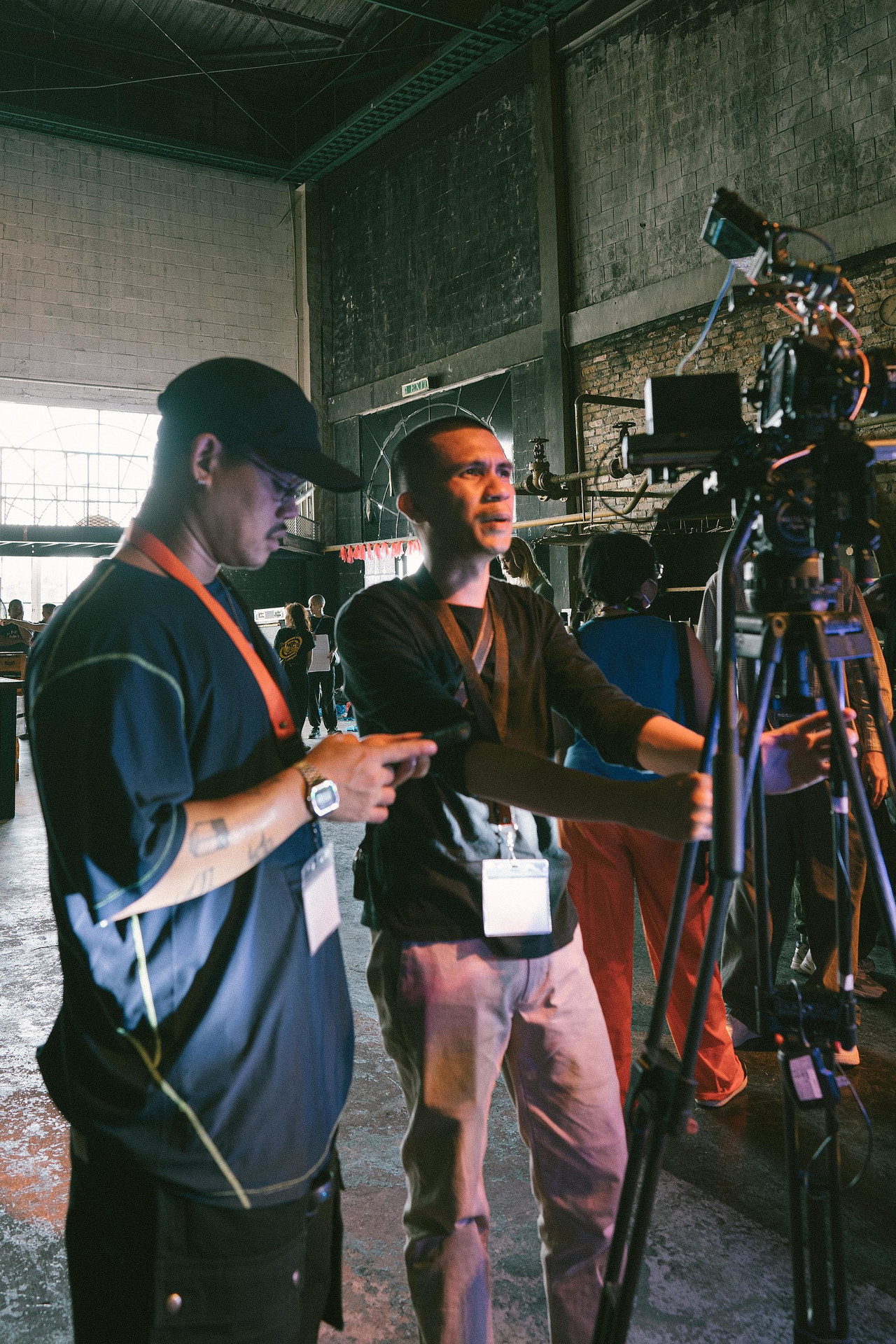
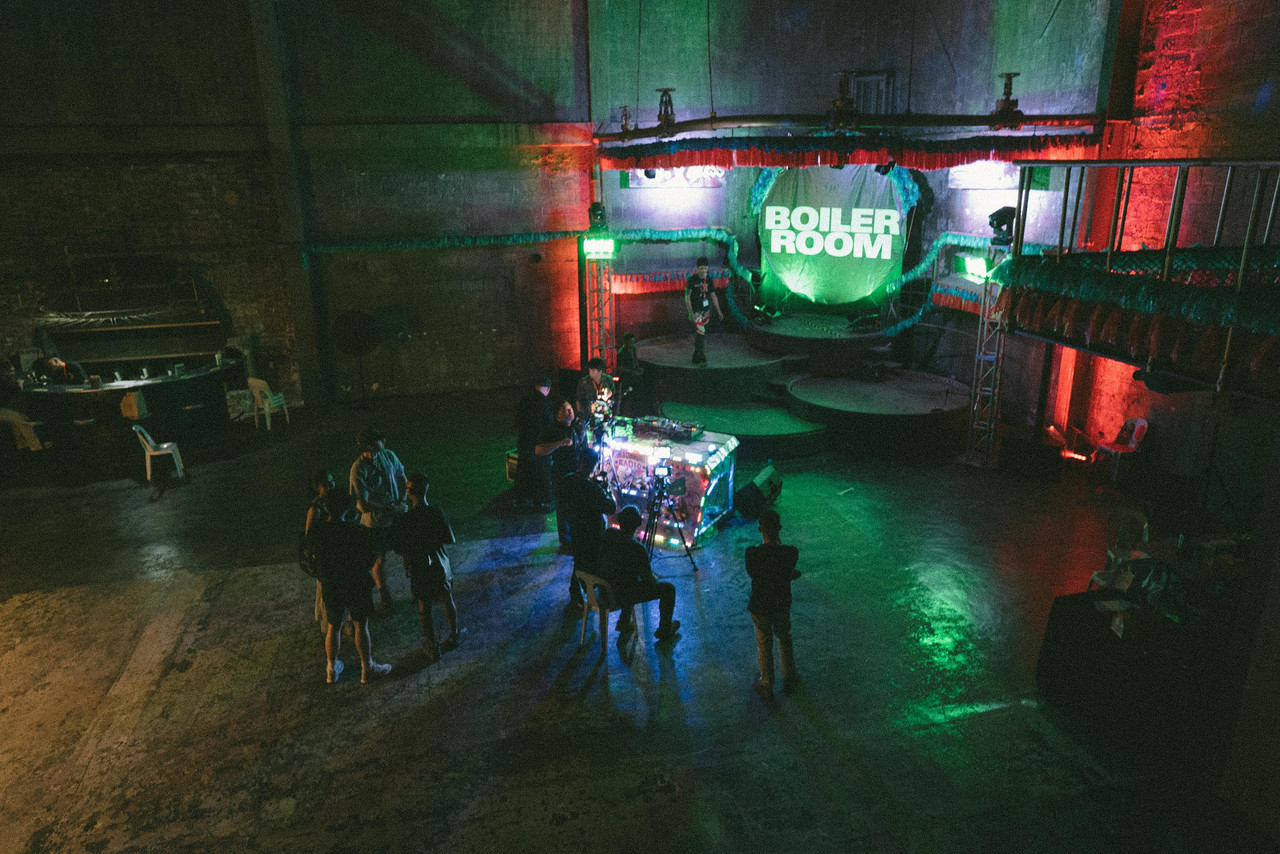
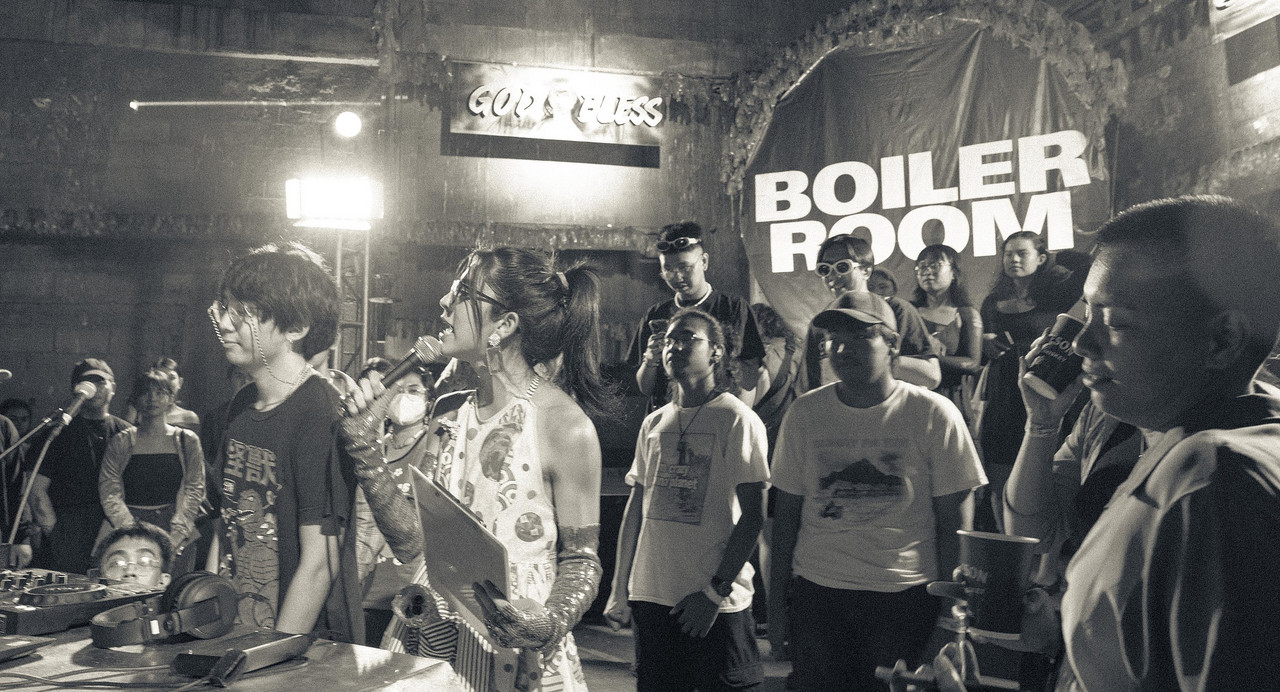
Guests piled up in queues outside; their names, once just letters on a spreadsheet, were finally given a face. The evening’s host, a filmmaker and drag performer, called everyone’s attention as she introduced one act after another. AZ Uy, representing Showtime Official Club, paid homage to local noon-time television by opening with a cacophony of basketball sirens, injecting rap samples into shuffling footwork. It was his first DJ performance ever, yet he commanded the dance floor with unparalleled confidence. Wearing a tribute to workers fighting for labour regularisation, Libya Montes from Lapu-Lapu, Cebu, delivered his style of »space« budots using cosmic-textured synths. obese.dogma777 and Pikunin broke the genre’s 140 bpm conventions by pushing their live set to 160 bpm, while Hideki Ito and T33G33 hinted at the genre’s origins in Eurotrance. Even Teya Logos, most notable for her militant style, steered her abrasive DJ set into soulful Balearic house – a nod to its influence on Filipino dance music during the early 2000s.
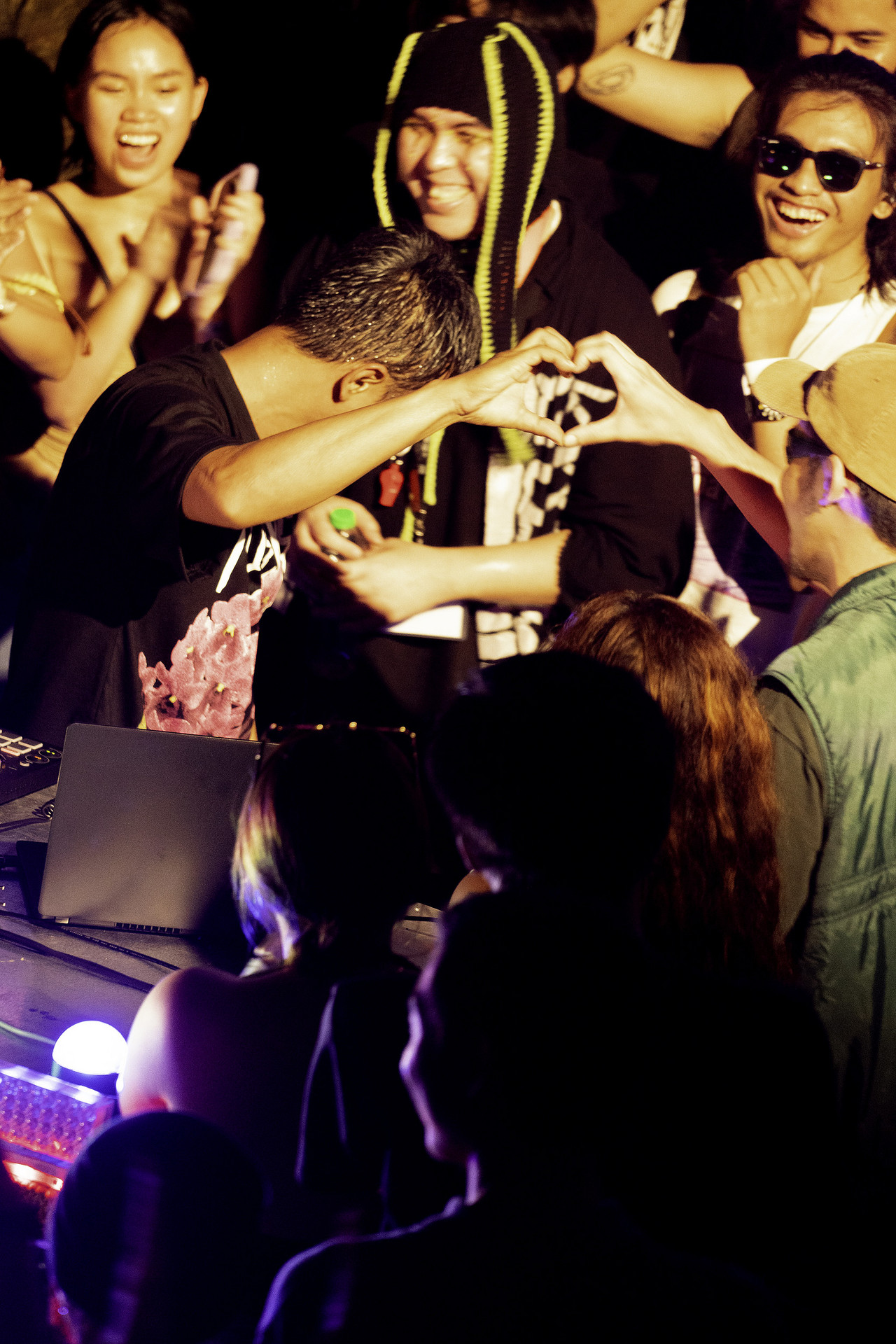
Sherwin was set to perform as DJ Love, a public persona he still feels nervous about. To calm the nerves, he took a few swigs of rum before approaching the booth. He addressed the crowd, reminding everyone to »do more of what you love!« He cued his signature horn siren, and the dance floor was immediately electrified: Dancers wriggled their versions of the budots dance, while others followed DJ Love’s moves from behind the booth.
After hours of anticipation for this headliner act, the weariness in people’s bodies, including Sherwin’s, was clearly settling in. But there was safety in the thought that, regardless of how our bodies moved, we were all free to enjoy this new experience together, shaped by the efforts of those who came before us to create spaces for dancing. Emma Warren, in her book Dance Your Way Home, describes dance as an »unstoppable expression« and »a source of strength and solidarity;« each »gesture, flex, slide, or shape« made in response to music allows people »to take the raw material of their lives and stamp it into the precious metal – perhaps mettle – required to make it through another day.«
Maybe this was what Lumbera meant when »defining« the »critical perspective that would help understand« vernacular works as a »sociological document« where our »provisional history« leads to observations on »traditions.« But tradition »does not imply a set saying of what one means, or a meaning that is immutable,« he stated. The student, Lumbera said, »must always guard against the notion that [development] will follow the same rules regardless of time and place.« Similarly, there’s no way of knowing how our efforts will culminate at any given moment, which is a privilege only offered by time. But there are fleeting moments that capture its essence.
In the last few seconds of DJ Love’s set, he bowed his head and clasped his hands together. He traced a sign of the cross across his body, and pointed to the Boiler Room tarpaulin behind him. He formed a heart with his hands as the crowd cheered him on. This reciprocity conjured the ineffable, making a kinship between all those in the room known.
Beyond Budots: Meeting at Eye-Level
Eight months after Boiler Room, we found ourselves in Sherwin’s home, sharing a plate of pork adobo and rice. Over dinner, he told us about his plans: upcoming shows with his close collaborators, DJ Ericnem and DJ Danz, as well as the Camusgirls – a dance troupe of women he is helping mentor. Sherwin said he is saving money to set up a pig farm with his wife which, he admitted, is more lucrative than being a music producer.
Sherwin is candid about his artistry, along with the perceptions attached to it. »If you ask me,« he professed, »I just really want to stay an underdog. I don’t want to get so popular that I forget who I am.«
As DJ Love, Sherwin often presents himself as positive and carefree. But this interaction felt different from the others. He peeled back his layers, detailing gripes with his local scene and how he’s occasionally affected by criticism from his peers. As an artist, he aspires for budots to reach its apex, and to prove his critics wrong. Yet simultaneously, he desired a low profile that was hard to balance. »One day, I’ll put out music that will really shock them. Because it’s still infuriating when people underestimate me.«
Entering the Boiler Room project, there was an underlying feeling of wanting to »help.« How do we bring more attention to underrepresented communities, or funnel resources to underprivileged artists? »The relationship of the artist with their community determines how music progresses,« T33G33, a performer from the Boiler Room showcase, told us in a focus group discussion as she responded to the question of »Who does budots belong to?«. It took a long time for us to unlearn this mindset of »helping«, and that to meet at eye-level was, more often than not, needed.
Despite our social differences, here was Sherwin generously sharing his life with us, revealing the ways our experiences intersected, and how our desire to be free was bound in each other’s efforts. It brought to mind Audre Lorde, a poet and civil rights activist, who, in A Burst Of Light and Other Essays asked: »How do we use each other’s differences in our common battles for a liveable future?«
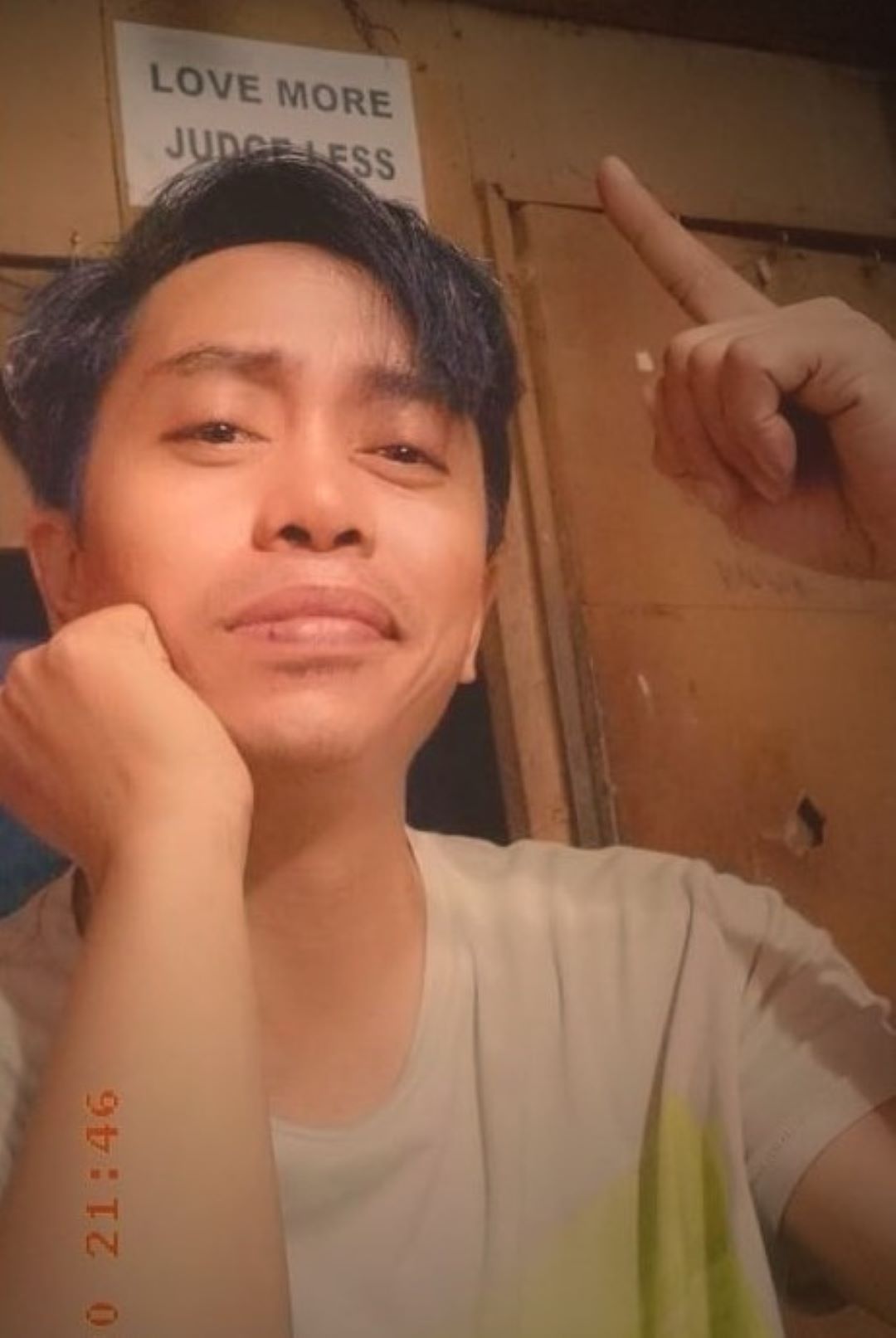
To that, DJ Love had wisdom to impart. A recurring fixture in his Facebook live streams is a piece of paper taped to his wall, containing a message that has consistently been part of his work: »Love More, Judge Less.«
As Sherwin shared a moment of vulnerability, we worked up the courage to ask him something that had been in our minds for a long time. The following conversation took place in December 2023, and was translated from Tagalog to English.
Sai Versailles: You know, after Boiler Room, people accused us of appropriating budots and packaging it for audiences in Europe and America. Like, Manileños were using a Bisaya subculture for their own benefit.
Sherwin Calumpang Tuna aka DJ Love: Did a DJ say that?
SV: Quite a number of people.
DJ Love: They really shouldn’t be saying that. Why, when you say Bisaya, is that different from a Filipino?
Sean Bautista: In your eyes, is budots only for the Bisaya, or is it for everyone?
DJ Love: Of course it’s for everyone! I want the music to spread. Do you remember how many people were on the Budots World compilation, 53 DJs? We fully supported that. That’s why we put that together, and I’m really proud of it.
SV: So, when the Bisaya think of Manila, they don’t see opportunities there as a bad thing? They don’t think, »Oh, that’s just Manila …«
DJ Love: No, my gosh! People here are like, »Wow, DJ Love. Manila is your kitchen.« That means they’re proud because I performed there. Why do people think that way? What’s wrong with being Bisaya? Are we aliens? We’re all Filipino, we all love music. What’s the difference? Does it have to be that way if you’re Bisaya? You can’t play it because we’re Bisaya? Should all the music in Manila be from Manila? That’s unfair. Because for me, Eric, and Danz, going to Manila was our dream. I initially had my doubts because when we were starting out budots and the Camusboys, we received hundreds upon hundreds of insults from people there. But when I performed in Manila and saw how people were receptive and dancing to my music, it proved something to me. When I perform, I really feel it …
SB: There’s a connection …
DJ Love: … And I told [Eric and Danz], you need to dance to your music, bro. You’re creating music for people to dance to. And you’re not dancing to your music? If you want people to dance, you have to dance too!
SB: So, what aspirations do you have for budots?
DJ Love: I’m honestly done. I can’t ask for more. If I get to perform, that’s great. If not, it’s OK. My only aspiration is to grow older. But when the time comes that I can’t do all this anymore, what happens then? That’s what I get nervous about. Because I don’t have any alternative source of livelihood. So while I still can, if I can take a gig, I will. I have to work hard. I need to pay for water and electricity.
SV: Is there something about budots that you believe hasn’t been fully understood yet?
DJ Love: For me, budots is a reflection of the artist. It’s a mirror of their surroundings.
SV: But what »is« budots?
DJ Love: Budots is the hardship of Filipinos. It’s one scratch, one peck. It’s the noises you hear in your surroundings. It reflects the state of a person’s life. It’s the people who want to dance with the Camusboys, drink their problems away, don’t have high hopes but to eat, drink, and dance. Budots is still the music of the tambay, the poor, the gangsters, and the rugby boys. That’s where it was invented.
SB: Can a music producer, who is wealthy, be a part of budots?
DJ Love: Do they like budots as a genre? If so, then that’s OK with me. I can’t stop them if they like it.
SV: Privileged people, whether a wealthy music producer that’s interested in budots, or someone from Manila – do they have a duty to uplift the lives of the less fortunate through their work?
DJ Love: Yes, but they need to create a style that reflects who they are. It depends on their creativity. Producers here are really happy that budots is being created. It’s a source of pride for them.
Epilogue by Sai Versailles
In 2023, I frequently wondered when my next project would come, and whether being underpaid was worth my finite time and energy. Is that an entitled thing to say when I am struggling to make ends meet, when I aspire for better conditions? How have I managed to make it this far through the kindness of other people? Will kindness pay my bills this month?
As I worried about the state of my livelihood, CTM Festival announced its open call in July 2023, and the prospect of travelling abroad stirred my imagination. What would it be like to go to Berlin for the first time – a city where clubs are considered, unprecedentedly, as »cultural institutions?« »If only I could pursue what I am doing now in Berlin,« I fantasised, only to be swiftly crushed by the dread of immigration bureaucracy where I, as a Filipino with a Philippine passport, am required to apply for visas in 126 out of the world's 195 countries.
Then, a stroke of luck led me to a travel grant from the Goethe-Institut, subsidising travel for musicians from »developing and transition countries who are invited to take part in music projects in Germany,« stated its website. I squinted at this nebulous possibility and, with Sean Bautista’s partnership, we took our chances in applying.
For months, we fully committed to creating a proposal for CTM Magazine that built on Manila Community Radio’s work on budots. The field research required multiple interviews, focus group discussions, flight connections, and bus trips, as well as crowdfunding for incidental costs like food, and accommodation. We operated at net-zero profit to meet more realistic fundraising targets, convincing people that this research was important. Goethe-Institut Philippines caught wind of our work, and subsidised a part of our expenses in the field.
Simultaneously, we developed a cultural exchange project with Refuge Worldwide where I have been a resident since 2021, broadcasting from Manila. The project hoped to facilitate dialogue between our two community radio stations, which included an in-person workshop presenting our initial field findings at CTM Festival. The Goethe-Institut travel grant would solely support our flights between Manila and Berlin, and it was up to us to fill in the remaining costs through fundraising. We compiled our Schengen visa requirements to prove we will not become illegal immigrants, while juggling day jobs and personal emergencies.
And even when we were selected to write this essay, when Goethe-Institut approved the travel grant, when monetary and in-kind donations were made to us; even when our visa was approved by the German Embassy, a sliver of doubt lingered, questioning whether any of this mattered, if others were more deserving of this work, or if these plans could, at any point, collapse.
A week before our flight to Berlin, in January 2024, we learned through social media posts about Strike Germany and its call to international cultural workers to withhold labour from German cultural institutions. The strike was a response to, among other things, an anti-discrimination clause requiring artists applying for state funding to renounce »any form of anti-semitism,« which potentially conflates discrimination with criticisms of Israel and its war on Gaza. We read about how artists withdrew from and pushed back against CTM Festival, a state-funded cultural institution, despite the rejection of the clause by CTM as well as Goethe-Institut, a conduit of state funding.
Our immediate response was to act in solidarity with artists on strike, using our privilege to confront how Germany hugely benefits from the cultural labour of underprivileged countries. Sean and I emailed CTM Festival, Refuge Worldwide, and Goethe-Institut about our withdrawal, and we speculated ways of pursuing our projects without the support of state-funded institutions.
But it quickly dawned on us how the shortfall from our withdrawal would mire us in debt, given the costs we’ve already spent. Because it’s difficult enough to bring attention to work where institutional support is lacking. To put this into perspective: the Berlin government is set to spend €947 million (₱57.6 billion) on cultural funding, or €263 (₱16,000) per capita, in 2024. In contrast, public funding for Philippine cultural agencies comprises ₱1.5 billion (€24.6 million) of the national budget in the same year, or ₱13 (€0.005) per capita.
One discussion with colleagues made us aware of the insidious ways the right-wing party, Alternative for Germany, instrumentalised the anti-discrimination clause to garner support in the name of anti-semitism, despite repeatedly expressing anti-semitic views. For me and Sean – outsiders with little on-ground knowledge of Germany – the confusion this caused was debilitating. Yet we recognised, as cultural workers from the Philippines, that our labour is part of a long-term and invisible effort to address systemic issues concerning everyone, requiring participation in systems that are not available to us back home.
I questioned whether I could really sacrifice myself into debt, despite having privileges that allow me to pursue cultural work – like an educated background, a middle class income, and flexible control over my time. Yet the agony over my potential complicity felt as real as the suffering of those who face injustices in their livelihoods everyday. So, who in the world will help tell our story, to engage in discussions we deem important for all? If not now, when? How can we express our solidarity without the resources to safeguard our well-being? And if that cultural work stops, what becomes of the values and causes we are fighting for?
After intensely discussing our situation with friends – none of whom wished it upon themselves – we decided to continue our work in Berlin with the support of CTM Festival, Refuge Worldwide, and Goethe-Institut. This decision fell on the day the Berlin Senate announced its withdrawal of the anti-discrimination clause, which conjured bittersweet feelings of relief and embarrassment.
In Berlin, we met people who questioned our participation at CTM Festival, while others were indifferent to our curiosity of this new city. During our workshop, we presented our initial research findings, and facilitated a self-assessment exercise using Stephanie Nixon’s coin model of privilege and critical allyship – the coin being a metaphor for a social structure with groups of people at the top and bottom.
The model offered an »intersectional approach to consider how systems of inequality ... interact to produce complex patterns of unearned disadvantage and advantage.« Many of the attendees disagreed with this model, suggesting it reduces complex systems of power into a binary phenomenon. Others offered counter arguments, pointing out the framework’s usefulness. This dialogue created a space where kindness can be met, and we were relieved that a respectful space for disagreement and dialogue was created – because dialogues are riddled with misinterpretations, which only accentuates the importance of participating.
»Solidarity can never be pristine,« said Arundhati Roy in Free Speech and Failing Democracy. »It should be challenged, analysed, argued about, calibrated.” By preventing this process, “we reinforce the very thing we claim to be fighting against.”
Sai Versailles' work is rooted in a decade-long archival practice spanning text, image, video, and sound. As an independent multimedia journalist, her reporting investigates the sociopolitical dynamics of everyday lives and communities. She is a grassroots organiser and music curator, as well as a volunteer at Manila Community Radio.
Sean Bautista’s work decodes the simultaneous convergence and divergence of different forms of media, informed by a background in music and design. He currently co-directs the electronic music label transit records, the restaurant TETSUO, and Red Light Run Club. He is also the co-founder of Manila Community Radio and is currently a volunteer managing partner at the station.
This text was commissioned as part of CTM 2024 – Sustain.