G. Roger Denson: Over the course of 36 years you've made four big leaps in the media you've devised. 1) Firstly, your early work with Granular Synthesis between 1992 and 2003 was largely photographic and cinematic. 2) After that, you innovated the flicker and strobe video projections, which are essentially Structuralist in their self-referential form, process and temporality as subject. 3) Then you invented and elaborated emissive environmental installations in which the vision of the participatory audience is hindered so that their other senses are heightened. 4) Finally, you developed hybrids of virtual or 3D imaging. When considered as a successive evolution of your concerns with media, you can be said to be unifying four very different kinds of artistic and cognitive processes with two basic models of knowledge acquisition: the representational and the experiential, or what theorists like to call the difference between psychological, meaning rationalised, and phenomenological, meaning lived. To put it bluntly, you went from making work in the 1990s that largely consisted of recording and projecting real human subjects representing conditions of psychological and perceptual dehumanisation, to perceptually abstract work that is both experienced as and representative of our perception of the dehumanising effects of media on modern life. You keep coming back to representing bodies, but now they are 3D animated virtual bodies.
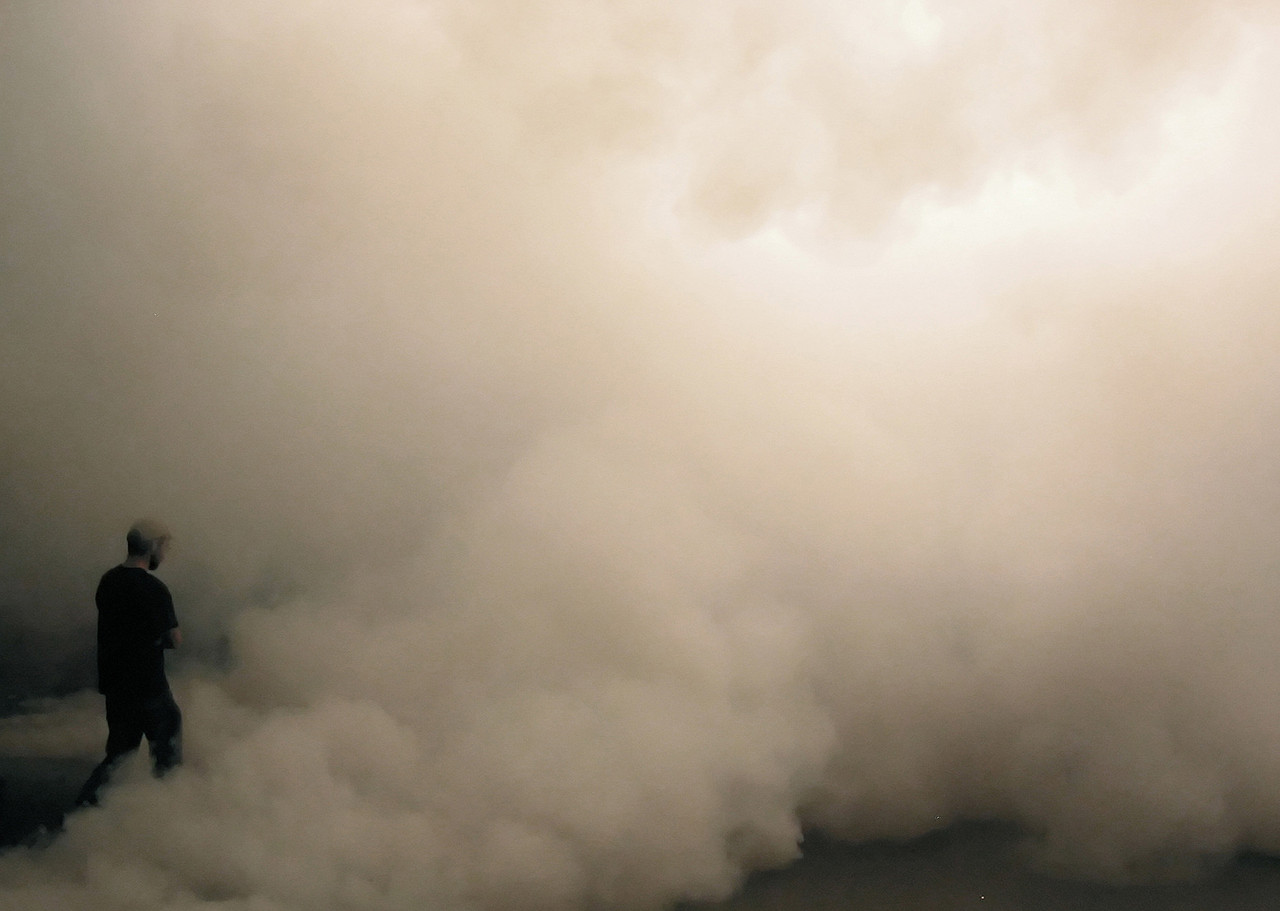
Loss of control is a continuous thread in both your figurative projection work and your more perceptually sublime environments such as »FEED,« »ZEE,« and »SOL.« When we find ourselves amid the synthetic fog and strobes of »ZEE,« we have the definitive experience of losing all reference points perceptually, almost physically. I say »almost physically« because we retain the experience of feeling the floor beneath us and the awareness of our own bodies, but little if anything else. So I guess that that is a substantial loss of perceptual and physical control that corresponds to the analogous loss of control we witness in your projected bodies.
Kurt Hentschläger: I think that's quite accurate. The »loss of control trauma« links to what I like to call the primal narcissistic injury to the emancipated, conscious human being – namely that despite all the insights, knowledge, efforts, accomplishments of our technologically addicted civilisation, there is no way out of the basic human trajectory, which always ends in our demise. I stick with my suspicion that most of our technological obsession orbits around our desire for heightened control over our lives, specifically through attaining stability, longevity, and, ultimately, the promise of transcending our destiny on this planet rather than in whatever mythological scenarios beyond.
GRD: This loss of control motif helps explain why, even though you're not a believer in God or the soul, you reference William Blake, who was a profound believer in both. What is it that you've intended to convey with the clustering-bodies work that people identify with spirituality, with or without knowing Blake's work? You introduced the bodies in tumultuous flux in videos projected in gallery spaces, but now you've begun to incorporate them within your phenomenological voids, starting with »FEED.«
KH: Blake today can be acknowledged in the context of my work without referencing spiritualist notions. I think the clustering-bodies work can be described analogously as unconscious bodies in a kind of neverland, in-between state. In this sense, I'm not referencing Blake as much as I'm recontextualising him for our scientific age. It's true that »FEED« is part of the fog/strobe phenomenological work. But the first half is a traditional audiovisual work, with projection of agitated bodies on a single frontal screen with surround sound. Each virtual body doubles as a sound instrument, creating and shaping sound through motion and changes in position in the zero-gravity space. The greater the quantity of virtual bodies in the environment, the more complexly and richly the droning sound builds, creating a synchronised audio-visual impression. Then, halfway through, fog machines placed all around the audience rapidly render fog and wipe out perception of both the space and projection, and, voilà, off to phenomenology… as a live performance, »FEED« is quite a different animal. It was my »monster,« loud and intense, with the entire second strobe/fog/sound composition being created by myself as improv, all by hand and in the moment, thus making each show quite different from the next.
GRD: But knowing your Structuralist sensibility, there is some interactive purpose of introducing both virtual and real spaces in tandem.
KH: The concept of »FEED« was to overlay a physical venue and virtual space at the same time. The discussion in my head was all about a parallel digital planet (bodies in 3D space on/behind screen) affecting the »real« world and vice versa.
GRD: I think we should pause here to make something very basic to your work clear to the reader, and that's the physics and technology of the real production that grounds the ideological analogies, systems, and mythologies. In your 1990s productions with Ulf Langheinrich under the collective name Granular Synthesis, you were known also for designing your own computer software, and for your requirements of an elaborate audio-visual armature that travelled everywhere with you. The critic Christopher Phillips called it all »unwieldly« in that you had to transport two tonnes of equipment – projection screens, mixing boards, speakers, computers. I know that when you and Ulf went your separate ways, you pared down the equipment you needed for your abstract projection and sound installations and screenings. But now that you’ve returned to large-scale projection installations, do you also have the same audio-visual requirements? And more importantly, are you still designing your own software?
KH: Any large-scale installation, no matter what the medium, comes with equipment. But, yes, there is a sculptural element just in terms of the mass of equipment needed in realising immersive media-based work, despite immaterial nature of the promises of New Media-based art. »CORE,« for instance, ships in 11 road cases, including six computers and interfaces, six projectors, and a sound system with 30 speakers and cables. None of it, other than possibly the projector beams, is visible to the audience, but it is indeed quite a massive undercarriage. It's also a highly customised one, wherein the »pleasure« of acquiring, configuring, and bundling equipment lies in the hand-selected certainty that all components together will diffuse the artwork at its best possible realisation within a budget. The gear will both emit and become the work, as increasingly all AV mixes and tunings will be custom set for it. So equipment in media work always, to some extent, defines the aesthetic of the work (no news here since Nam June Paik).
The same, if not more extremely so, goes for software tools. These always define a baseline »look« or »sound,« for instance the time-stretching algorithms of a specific era such as the now-forgotten fabulous (analogue) »motion control« of the more expensive Beta SP video tape decks. Indeed, with Granular Synthesis, we developed an audio-video sampler in 1997 that became the main, MIDI-controllable, audio-visual instrument on which we composed all our work between 1998 and 2003.
Since 2004, I've designed two major iterations of the floating body software with the help of two amazing programmers/software developers, Rob Ramirez and Ian Brill. It was just a matter of there being nothing readily available on the shelf that would have allowed me to create the floating bodies as envisioned. Unfortunately, software development is a horrendous resource drain and a major distraction from moving the work beyond technological accomplishments. Software development is never finished, and there’s a near certainty of going over budget in time and cost, finally leading to exhaustion, which then marks the natural end of the process.

GRD: I ask this question of you precisely because I had hoped to show the illusion that underpins the New Media installation. But really, illusion also perpetuates a long legacy of art-historical deception. I’m referring to the way that art has long propelled grandiose myths of the ephemeral, the esoteric, the sublime, and the spiritual, all culminating in an ideology that whimsically exalts the dematerialisation of the world and its capital. Yet in nearly all the art systems invented and modernised, the achievement of the »ephemeral,« »spiritual,« »sublime,« even the »dematerialised,« is dependent on intensive labour, costly equipment, massive spaces, and intricately engineered visual effects. I’m just wondering if you find this irony something you would like your work to someday reflect in a more »truth to materials« presentation, or are you personally invested in the illusionistic spectacle? By »spectacle,« I mean in the sense that Guy Debord and the Situationist International meant when they coined the term in the 1950s (and which never was surpassed), as the array of capitalist entertainment and promotions keeping people alienated from the natural world. Why is such a spectacle valuable to you, and how does it gratify you in ways that your simpler, more abstract work made before 2004 didn’t?
KH: Indeed, the art-related myths of the ephemeral, the esoteric, the sublime, and the spiritual are in contrast with the worldly craving for precious objects and material possessions, aka the market's/ego's needs and wants. The ideological confusion seems to correspond to the human body/soul conundrum.
GRD: A conundrum your work entirely models.
KH: As for illusion and spectacle, when, throughout its history, does art not affiliate with either illusion, spectacle, or both? If in »spectacle as the array of capitalist entertainment and promotions keeping people alienated from the natural world« we would replace »capitalist« with »church,« »aristocratic« or »communist,« it would still ring true. Art, starting with its museums, its theoretical, historical, and maintenance systems, before even including the market and its galleries and art fairs and speculative bubbles, is one illusion of its own importance, one spectacle of a splendid fabrication. So in that respect I see media-based art work as merely keeping up the »smoke and mirrors« tradition, while both its illusion and spectacle are less stable and durable than any other media invented before it. New Media is a decided irony in that our most advanced technological constructions are also the least sustainable, economical and solid illusions in history. Complexity breeds instability and thus ephemerality, however unintended.
Personally I feel there is no difference between my abstract and figurative work in regards to the illusions created. The strobed-fog works are obviously much more immersive and physical than any of the projection screen pieces, as enormous as the latter can be. But both are dramatically present only so long as there is electricity. Pull the plug and… totally gone. I'm disillusioned by exactly that: the fickle machinery and constant care that media machines need to »live.« The beauty of a traditional painting or sculpture (apart from the stillness in both motion and sound) is also found in the relative autonomy of its environment. We all know that paintings need extensive care and restoration over the centuries, but there it is, the time frame of centuries, rather than the few years that a media artwork can survive without assistance. Again, media-based work, by the self-indulgent nature of digital apparatuses, are truly ephemeral. I'm not mourning that, but I embrace ephemerality and feed on the contradictions between the ambitious »omni« goals of our science-driven civilisation and the rather opposite, if not destructive, results from it.
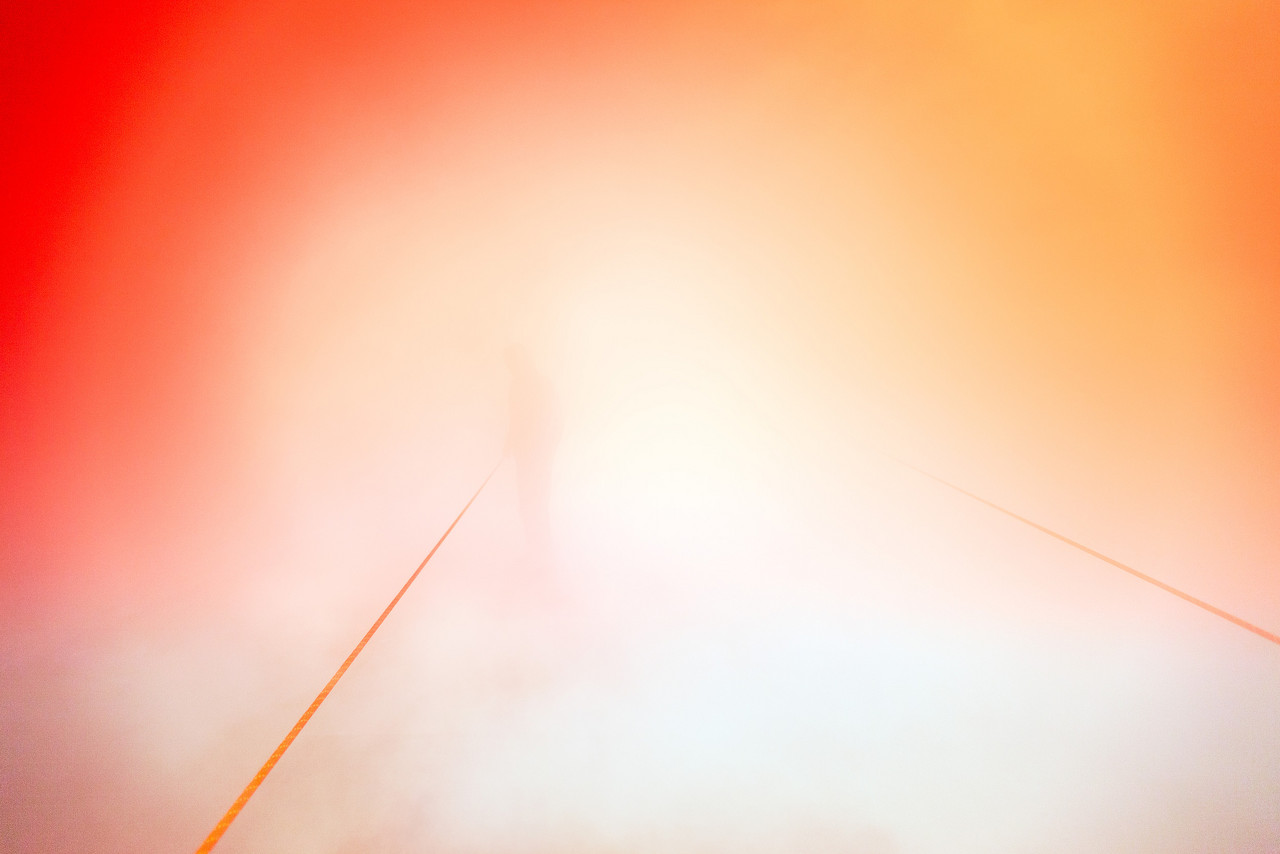
GRD: Your strobed-fog works, such as »ZEE« and »FEED,« are much more than spatially immersive. Because they provide a full sensory experience that we read as a potentially hazardous spatial and perceptual disorientation, they compel us to retreat inside ourselves as a defensive mechanism. I take it that's what you mean by the strobed-fog work inflicting a »primal narcissistic injury,« a terminology that aligns you decidedly with Freudian-Surrealist practices, only reducing the Surrealist experience to its most material, pre-content-laden basis – a return to the womb in a truly Reichian sense. The irony that follows from this retreat to the womb is that we simultaneously experience a kind of reverse abortion from the world – we’re severed, however briefly and artificially, from the security of civilisation and nature as we know it and driven back into the womb, where we are denied the faculties of primary sensory recognition.
In this regard, you take the Surrealist injury to an extreme that the Surrealists could never realise in their more modest image- and object-based art. You show us that we have to be denied all articulated »form« of image and materiality, reducing experience literally to the primordial mists. And yet, except for those individuals who must be escorted out by attendants because of physiological reactions to the fog and strobes, the majority of spectators rebound from their initial withdrawal, and upon acclimating to the fog and strobes, open their sensory faculties more widely than occurs in the everyday world. In effect, we feel an exhilaration that must come close to the physical sensation of floating amid clouds, and which we take away with us after leaving the installation as the kind of awe that we reserve for an encounter with the sublime. I have to say that, really, after the initial primal narcissistic injury of spatial and perceptual disorientation and retreat into ourselves, you supply us with an expansively narcissistic recovery – dare I say a healing inebriation – that in its proclivity for inducing rapture might well be addictive. And in this, you’ve outmanoeuvred the Surrealists by delivering us to a state prior to the dream state, a state analogous to the pre-experience that is more often induced by narcotics or hallucinogens. As one of the spectators tweeted to friends immediately upon emerging from an installation of »ZEE« at Fact Liverpool in 2011: »it was like legally and safely dropping LSD.«
KH: It's true that the strobed fog work, as opposed to my more traditional »illusionary« projection work, doesn't allow the classic comfort of the cultured spectator looking, from a safe distance, at a properly framed artefact. Whether that artefact is an object, projection or concept, the important distinction here is the dominant presence of a civilised, manageable, and overall safe format or environment. Indeed, in »ZEE« and »FEED,« such comfort of remaining in a »normal« and (very) controlled setting is obliterated, and the audience is asked to jump, metaphorically, into unknown waters. Taking the plunge will be, as you note, rewarded, but what is required upfront is the visitor's conscious decision to briefly leave behind the comfy cushion of contemporary consumerist existence. Having said that, »ZEE« and »FEED« are both, in aspects, consumerist media constructs in exactly the sense of suggesting »safely dropping LSD,« which really is an oxymoron and impossible. Audience reactions like that one are exclusively referring to the luscious visual phenomena present in »ZEE« or »FEED.« For me, more intriguing is the sensation of transcending the boundaries between what happens and processes inside and outside of us, where an infinite space opens seemingly from within, stretching all the way out. Ok, that sounds like more LSD references… glad for sure to have outmanoeuvred the Surrealists. Not that I intended to...
I think the larger uncertainties facing New Media artists concern the expansion of subjective and cultural domains that new modes of simulated or virtual realities open up without sufficiently understanding what it is we are broaching.
GRD: I don’t want to make a comparative commentary on your work with the Surrealists alone, as it bears more resemblance conceptually to some highly influential international artists of your generation, though not many. »ZEE,« »FEED,« and »SOL« can really only be compared to a few productions by Pierre Huyghe and Olafur Eliasson. Other works we haven't explored here find some superficial technical and visual precedents in the virtual animations of Gary Hill, Claudia Hart, and in some instances the photographic videos of Bill Viola. But such comparisons are only cursory in that you are undoubtedly charting out new territory for art. On the other hand, your work bears resemblance to extravagant theatrical and operatic stagings, and even to theme parks that employ similarly immersive and atmospheric amusements like fog. The difference is that you isolate and reduce the more ephemeral aspects of these popular entertainments, omit all their props and content, and subject their material strategies and stagings to a minimalist, repetitively mesmerising aesthetic experience in much the same fashion that Andy Warhol, John Cage, and Brian Eno did with the visual and aural iconography of popular culture in the 1960s and 1970s.
KH: There was a moment in the late 20th century, about the time that I came of age, when cultural disciplines and sectors seemed to open up to each other in a longing for cross-pollination. It appears such processes were time-stamped and have since stalled. The experimental spirit of that era, however, still informs my work. One of the reasons I embarked early on to work with home computers was that I sensed that these »things« would come to define our lives and thus, as an artist, I needed to know about them and inundate myself with their implications. This ultimately evolved into a love-hate relationship, but at the same time it allowed me an understanding of societal processes I would have otherwise not seen.
Meanwhile I’ve stopped listening to music almost entirely, but looking back, my sense of immersive art stems from music, concerts, movies, and theatrical stagings. Sound, particularly lower and bass frequencies, has a sculptural element, creating immaterial yet physical landscapes into which one is immersed without seeing. I remember meeting a colleague who was born in California but living elsewhere. He mentioned that he would fly out immediately upon any major earthquake just to hear, or rather feel, the aftershock bass rumbles, »otherworldly,« as he described them, from deep below the surface, incredibly intense and omnipresent. Finally, I'm always thinking about architecture, which goes with my affiliation with sound and light, as without these there would be no spatial cues for us to perceive.
I think the larger uncertainties facing New Media artists concern the expansion of subjective and cultural domains that new modes of simulated or virtual realities open up without sufficiently understanding what it is we are broaching. But that would apply to any period of time in which societal changes take place. We always fly mostly blindly into such moments, basing our decisions necessarily on prior, and now likely irrelevant, experiences and knowledge. I do think we live in an experimental era, by all means – socio-economically, culturally, and environmentally. As with everything experimental, only so much of it will make it beyond the experimental stage and be deemed successful, meaningful, and original. I do often find an abject lack of art-historical knowledge in the media field, together with an overemphasis on technology itself, its engineering side and the experiment for the sake of the experiment, the infinite work in progress, etc. But equally, in mirrored fashion, I see in the art market an overemphasis on the dictum of art history and what I like to call the 20th-century art dogma with its fear of risky and possibly unmarketable experiments and subsequent embraces of already canonised forms and processes.
GRD: And yet artists such as you, Huyghe, Viola, Eliasson, Hill, Hart, and others more aligned with cinematic effects are no longer confined to historically developed definitions of reality and illusion. Reality and illusion are now sharing real experiential terrain. You yourself are blending genres with new implications for human experience. More importantly, you’re engaging international audiences, bringing vastly different cultural origins and heritages to the interpretation of your work – initiating a kind of nomadic interface with the diversity of the new total global civilisation. How do you mediate all these challenges?
KH: I think the nomadic lifestyle operating on a global stage is generally true for the life of cultural producers and participants today. This has drastically changed in my lifetime. It wasn't until I was 16 that I first stepped onto a plane, and then it took another eight years for me to take my second flight. Today I consider myself lucky if I sit in my studio for a whole month.
GRD: Do you feel that the interaction of the audience with your work is so different from audience interaction with conventional media, that those differences require articulation to heighten the audience’s understanding? Or is the intuitive experience of the audience enough for you?
KH: In today's cultural modus operandi it’s practically impossible to not have secondary material on hand for an audience, even if you wished to avoid it. It’s standard practice, and no institution seems to want to risk audience »confusion.« I don't think there is that big of a difference between what I do and conventional media – it’s not about media, but rather about content/concept. In preparing for an installation in the UK I was asked once about influences and, with England in mind, I named Lucian Freud and Francis Bacon. Not that I would dare compare myself to them, but clearly their work has the ability to go straight to the hearts of their audience.
Kurt Hentschläger was half of the seminal duo Granular Synthesis between 1992 and 2003. His works have been presented at some of the world’s most prestigious art spaces, museums and events, including the Venice Biennale (2001) and the Venice Theatre Biennale (2005); the Stedelijk Museum, Amsterdam; MoMA PS1, New York; MAC Musée d'art contemporain de Montréal; MAK Museum of Applied Arts, Vienna; ZKM Center for Art and Media, Karlsruhe; the National Art Museum of China, Beijing; the National Museum for Contemporary Art, Seoul; ICC InterCommunication Center, Tokyo; the Laboratorio Arte Alameda, Mexico City; MONA Museum of Old and New Art, Hobart, Tasmania; the Sharjah Art Foundation, Sharjah. He currently lives and works in Chicago.
G. Roger Denson is an American journalist, art critic, theoretician, novelist and curator living in New York. An author of numerous books, he is best known as a regular contributor of art and cultural criticism to Huffington Post. His feature articles and reviews have appeared in Parkett, Artscribe International, Art in America, Journal of Contemporary Art, Flash Art, Contemporanea and many other publications.
This text was originally published by DISTANZ Verlag in Splendid Voids — The Immersive Works of Kurt Hentschläger (ed. Isabelle Meiffert) in 2017, as well as in CTM Magazine 2017 – Fear Anger Love.