Founded on Chicago’s South Side in 1965 by four African American composers, the Association for the Advancement of Creative Musicians (AACM) was the most significant collective organisation in the history of experimental music. Or rather, is the most significant – the Association celebrated its 50th anniversary in 2015 and shows no signs of slowing down. Important new AACM artists emerge every few years, and the Association’s impact can be seen in many corners of contemporary culture, including intermedia performance and visual art. But its influence may be strongest in the realms of social relations and musical sound.
From the earliest years of the organisation, AACM musicians were united by a social commitment to support one another’s creative pursuits. This ethic of mutual support was evident in countless concerts and recording sessions, when AACM composers called on fellow members of the organisation to bring their music to life. The AACM’s social relationships also operated behind the scenes, making the Association a dynamic community of artists who constantly encouraged their colleagues to keep practicing, studying, and developing their music. In this social environment – or »atmosphere,« the term favoured in the 1960s AACM – musicians were expected, even required, to be innovative. The members responded to this mandate by creating a number of musical techniques that became synonymous with the Association, from multi-instrumentalism to unique ways of integrating composition and improvisation.
The AACM’s 1960s performances attracted immediate attention in Chicago, and a series of recordings with local labels brought the music from the South Side to listeners around the world. Indeed, albums such as Roscoe Mitchell’s Sound (1966), Joseph Jarman’s Song For (1967), Muhal Richard Abrams’s Levels and Degrees of Light (1968), and Anthony Braxton’s For Alto (1969) were so revolutionary that the AACM’s place in history would be secure even if the organisation had disbanded at the end of the 1960s, as did most other musicians’ collectives formed that decade. Instead, the Association continued to thrive. In 1969, Mitchell and Jarman’s Art Ensemble of Chicago relocated to Europe, as did Braxton and his band. By the early 1970s, the Art Ensemble and Braxton’s group were back in the United States, recording for New York-based major labels and urging many of their AACM colleagues to move to the East Coast. In Chicago, meanwhile, the Association was welcoming a steady stream of new members, throughout the 1970s and in every decade thereafter.
Of all the figures who joined the AACM during its 1970s »second wave,« few did as much to shape the organisation as George Lewis. He came aboard in 1971, and four years later served as the AACM’s chair, directing the Association’s 1975 Tenth Anniversary Festival. Lewis also functioned as the Association’s in-house historian. From the 1990s into the 21st century, he published a number of writings about the AACM, including the book A Power Stronger Than Itself (2008), the definitive study of the organisation. Additionally, Lewis’s performances and compositions left a lasting mark on the Association. In the mid-1970s, he established himself as one of the world’s top trombonists, recognised for his virtuosic technique and his imaginative improvisations. By the end of the decade, he was making music with computers and synthesizers, often blending electronic sounds with traditional acoustic instruments. These early experiments were received positively, and during the 1980s and 1990s computer music became central to Lewis’s compositional practice. He also composed for acoustic ensembles, writing chamber music, orchestral scores, pieces for improvising groups of all sizes, and even an opera: Afterword (2015), based on A Power Stronger Than Itself.
From the earliest years of the organisation, AACM musicians were united by a social commitment to support one another’s creative pursuits.
Lewis’s best-known composition is »Voyager« (1987-), a pioneering work in which human musicians and a software-powered »virtual orchestra« improvise together. A number of leading improvisers have given performances of »Voyager,« from Miya Masaoka and Evan Parker to AACM colleagues like Roscoe Mitchell, who appeared on the first recording of the composition (1993). In the decades since its 1987 premiere, »Voyager« has been played in hundreds of concerts around the world, making it Lewis’s most-performed piece. Another measure of »Voyager«’s importance: the prominent place it occupies in histories of experimental music, which portray the piece as a breakthrough in human-computer interaction. These histories tend to emphasise the composition’s technical features and other topics of interest to computer-music researchers. With few exceptions, however, these histories neglect to consider a key influence on Lewis’s »Voyager:« the musical practices of the AACM.
Lewis started attending AACM concerts when he was still in high school. Born in Chicago during the summer of 1952 and raised on the city’s South Side, he attended public schools for a few years before transferring to the Laboratory School, a K-12 academy operated by the University of Chicago. Lewis took up the trombone at the Lab School, playing in the concert band, jazz band, and orchestra. Soon he was listening to bebop, avant-garde tape compositions, and John Coltrane, while venturing off the Lab School campus to check out Chicago’s primary exponents of contemporary music – the Art Ensemble, AACM saxophonist Fred Anderson, and other members of the Association.
Voyager reveals the core processes that characterise every group improvisation, whether human-computer, human-human, or even computer-computer.
In 1969, Lewis finished high school and entered Yale University. He hoped to major in music, but the Yale faculty were unwelcoming to students without classical training, and Lewis became disenchanted with the university. So he took a break from Yale and spent 1971–72 back in Chicago. One day in the summer of 1971, Lewis was walking home from his nine-to-five job when he heard a band rehearsing – it was Muhal Richard Abrams’s group. Lewis introduced himself to Abrams’s crew and revealed that he played trombone. Within weeks, he was invited to perform with some of the AACM’s foremost musicians, including Abrams and the members of the Art Ensemble. Soon Lewis was formally accepted into the Association, and 1971-72 became his »AACM year,« a period of intensive study that gave him a thorough grounding in the AACM’s practices and inspired him to become a professional musician.
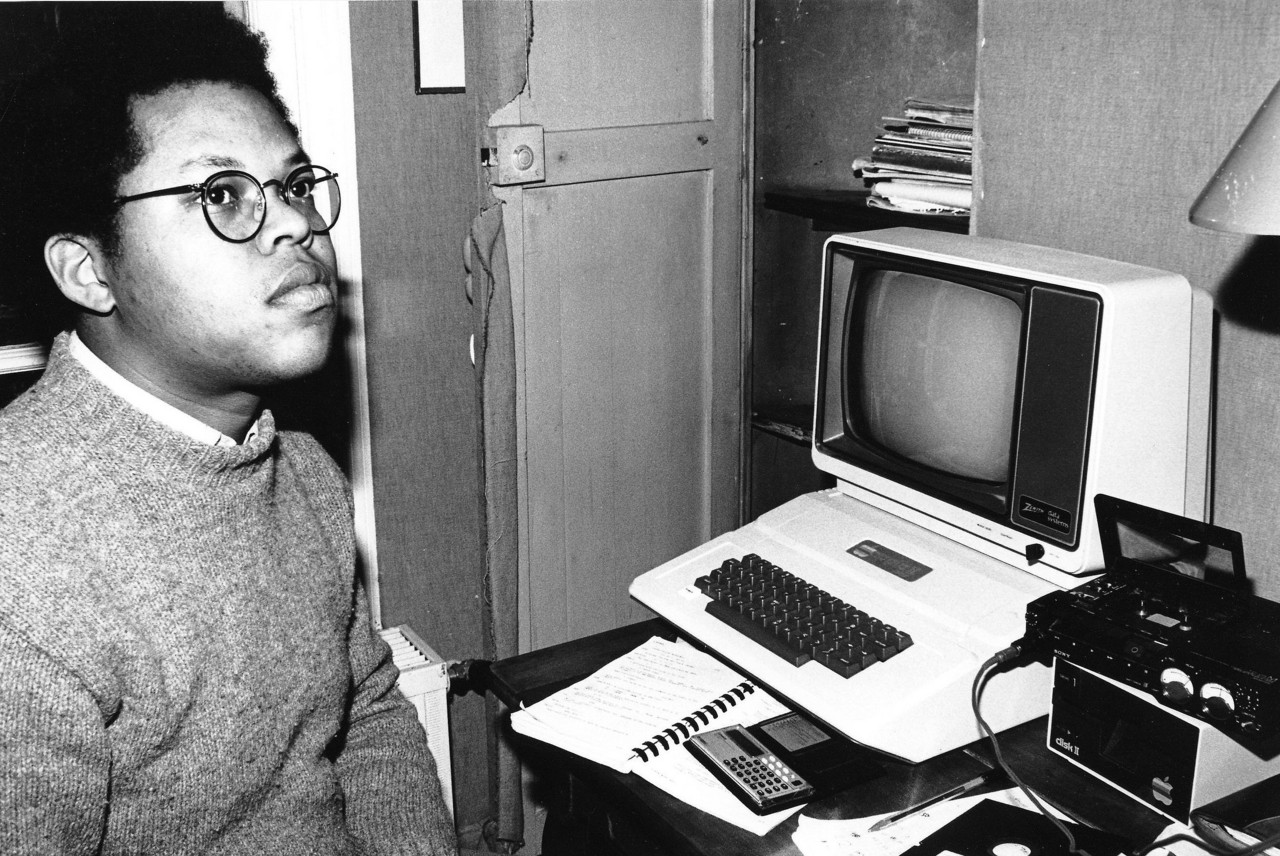
Lewis reentered Yale in 1972 and graduated in 1974. Then he headed home to Chicago, where he reunited with the AACM and launched his career in performance and composition. By 1976, Lewis was touring internationally with artists like Count Basie and fellow AACM member Anthony Braxton. He was also developing electroacoustic compositions like »Homage to Charles Parker,« for electronics, percussion, synthesisers, and trombone. By the end of the decade, he had become interested in the musical possibilities of personal computers – then a brand-new technology – and he started teaching himself how to program while moving from Chicago to New York. Lewis was a quick study: in 1979, at the Kitchen in downtown New York, he premiered his first computer-music piece, »The KIM and I,« in which his trombone interacted with a custom-built computer controlling a Moog synthesiser.
Interactive computer compositions like »The KIM and I« opened numerous doors for Lewis. After the piece’s premiere, the Kitchen invited him to serve as the centre’s music director (1980–82), a position that led to a residency at IRCAM in Paris (1982–85). While at IRCAM, Lewis composed a new computer-music work, »Rainbow Family« (1984), which would form the foundation for Voyager. Like its famous successor, »Rainbow Family« was conceived as an interactive composition for human instrumentalists and an improvising orchestra (here generated by Lewis’s own software and a trio of Yamaha DX-7 synthesisers). After his residency at IRCAM, Lewis took up another residency at Amsterdam’s STEIM, where he began developing his next series of interactive pieces, culminating in »Voyager.«
The 1987 Voyager premiere was the first of many versions of the composition. Over the following decades, Lewis continually revised the work in response to advances in technology. All of these versions, though, reflected Lewis’s original vision for Voyager: a software-driven, improvising entity that can create orchestral textures based on the sonic ideals of the AACM.
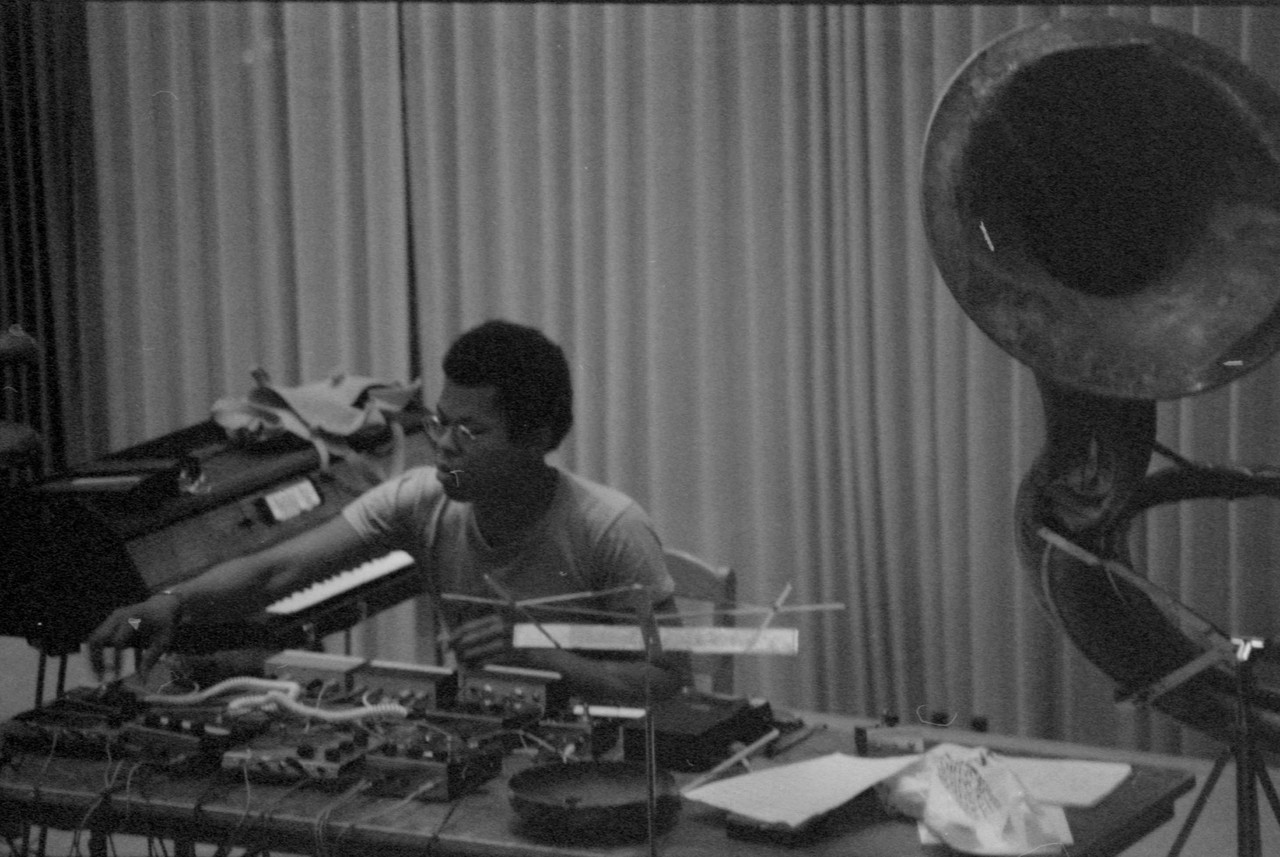
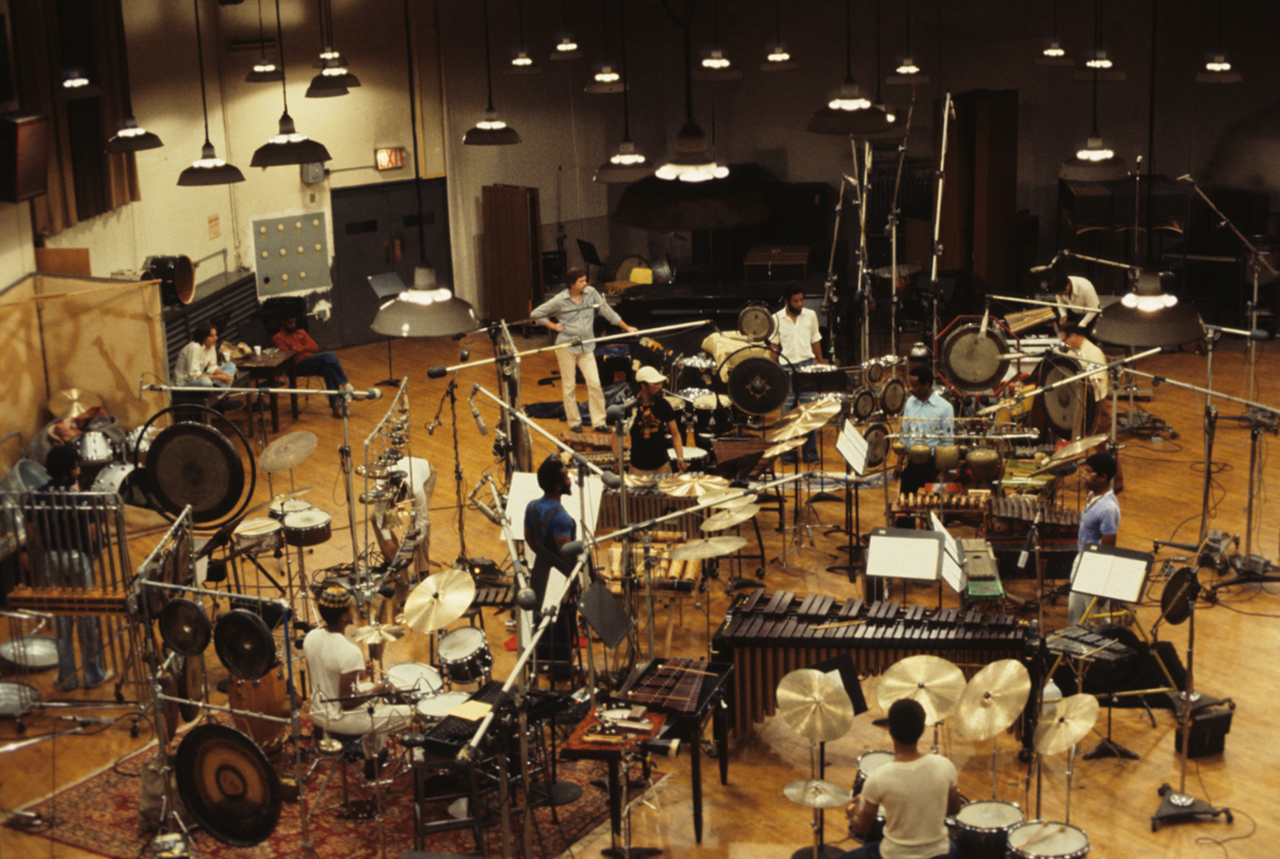
The AACM’s musical practices influenced »Voyager« in a number of areas, especially the work’s distinctive instrumentation. »Voyager« is an orchestral composition, but the (digital) instruments heard in performances are not limited to those found in a European symphony orchestra. Instead, »Voyager« combines symphonic strings, winds, and percussion with instruments from Africa, the Americas, Asia, and the Middle East. These sonic resources can yield textures as dense as a tutti orchestra, but ordinarily the software chooses sparser groupings of instruments, often forming unconventional ensembles rarely encountered in the concert hall. These configurations sound less like a handful of players plucked from a symphony and more like a gathering of AACM multi-instrumentalists – groups such as the Art Ensemble and Muhal Richard Abrams’s Experimental Band. The AACM’s explorations of multi-instrumentalism began in the mid-1960s, when Experimental Band members, the Art Ensemble, and other AACM improvisers »moved to develop multiple voices on a wide variety of instruments,« as Lewis put it. By the decade’s end, musicians like Roscoe Mitchell were playing dozens of different instruments each, as Lewis witnessed during an Art Ensemble performance he attended as a high school student. The next time Lewis heard the Art Ensemble, at a 1972 concert documented on the album Live at Mandel Hall, the band’s instrument collection had grown exponentially. »When I saw the Art Ensemble in 1972,« he remembered, »they’d have like a thousand instruments on stage.« In performances such as this, Lewis observed, »the extreme multiplicity of voices, embedded within an already highly collective ensemble orientation, permitted the timbral diversity of a given situation to exceed the sum of its instrumental parts, affording a wider palette of potential orchestrations to explore.«
During passages when Voyager is following the musicians, it can emulate their input across nearly every parameter, and it often seems to be reading the performers’ minds, a phenomenon that Lewis calls ›emotional transduction.‹
Voyager’s multi-instrumentalism is not limited to the digital realm. The software can also play an acoustic instrument: the MIDI-capable Yamaha Disklavier. In this version of the composition, »Voyager« is transformed from an orchestral piece into a chamber work, producing acoustic textures that are reminiscent of Lewis’s trio (2003-17) with Muhal Richard Abrams and Roscoe Mitchell.
Crucially, like the Abrams-Lewis-Mitchell trio, the Art Ensemble, and other AACM groups, Voyager is able to conduct itself. Indeed, in any Voyager concert, all that the human musicians have to do is type the commands »start playing« (to begin the piece) and »stop playing« (to bring the performance to a close). In between »start playing« and »stop playing,« Voyager can create its own music, deciding which of the orchestra’s instruments will play, arranging those instruments into distinct ensembles, and spontaneously composing its own melodies – even while the human performers are resting. But when the instrumentalists are playing, Voyager listens closely, converting their sounds into MIDI data and tracking some thirty musical parameters. However, the program does not use this data to store up musical motives for later use. In Lewis’s view, this »essentially Eurocentric« technique would conflict with Voyager’s non-hierarchical, AACM-inspired approach to open improvisation, in which the instrumentalists and the software work together in real time to articulate musical form.
Voyager interprets the human performers’ sounds not as isolated melodies or rhythms but rather as complex contributions to a continuously-changing texture. This innovative, »state-based« mode of sonic analysis enables Voyager to respond to the instrumentalists with astonishing sensitivity. During passages when Voyager is following the musicians, it can emulate their input across nearly every parameter, and it often seems to be reading the performers’ minds, a phenomenon that Lewis calls »emotional transduction.« However, the program can also choose to ignore or oppose their sonic input – just like a human improviser. In this way, Voyager reveals the core processes that characterise every group improvisation, whether human-computer, human-human, or even computer-computer.
When musicians improvise together, no matter the genre or style, they listen to one another, analyse the texture as it evolves, and decide which sonic contributions will best serve the music. In an AACM-style open improvisation, moreover, the performers’ rights and responsibilities are even greater. Improvisers who move away from standard forms take on a mutual obligation for determining how the performance will unfold. Furthermore, because all participants in an open improvisation have the right to be heard, no one possesses ultimate authority over the performance. Entering into such an open-ended musical environment can be a challenge for some improvisers, but not for Lewis and his AACM colleagues, who have been developing novel approaches to improvisation since the Association’s founding. In fact, the very history of the AACM is an open improvisation writ large. Inventing the practice of multi-instrumentalism, programming virtual orchestras that can improvise, carving out a space for African American composers on the experimental-music scene: all of these AACM accomplishments were without precedent, and could only have been achieved by artists who can create order spontaneously without relying on existing models – a collaborative process that is renewed in every performance of Lewis’s Voyager.
Paul Steinbeck teaches music theory at Washington University in St. Louis. His research focuses on improvisation, intermedia, and the Association for the Advancement of Creative Musicians (AACM). His book Message to Our Folks is the first study of the Art Ensemble of Chicago, the AACM’s flagship group. With AACM member Fred Anderson, he is co-author of Exercises for the Creative Musician, a method book for improvisers. Steinbeck is also a bassist, improviser, and composer. He performs with a number of ensembles, including the experimental trio Low End Theory, with Thurman Barker, and former AACM president Mwata Bowden.
This text was originally published in CTM Magazine 2018 – Turmoil.
George E. Lewis »Why Do We Want Our Computers to Improvise?«
Lecture, recorded January 2018 at CTM Festival 2018, Kunstquartier Bethanien, Berlin
George E. Lewis »Why Do We Want Our Computers to Improvise?«
Lecture, recorded January 2018 at CTM Festival 2018, Kunstquartier Bethanien, Berlin