A note on terminology for the non-deaf reader. The term »deaf« (lowercase) generally refers to a broad range of people of any gender, age, class. The term entails a great diversity: some people may be deaf from birth, others late-deafened (those who grew up in the hearing world and then became deaf) or hard of hearing, others may experience various degrees of deafness throughout their lives. On the other hand, »Deaf« (uppercase) indicates people who identify with Deaf culture. Like any other culture, Deaf culture has its own defining features, such as acknowledging sign language as the shared common language among people, and an emphasis on visual exchange of information, strong networks, and deep cultural traditions and practices. One’s degree of deafness does not matter in terms of culturally identifying with Deaf culture, it is a subjective way of understanding one’s own identity within a community with shared values. Similarly, in this article I use »deafness« to refer to the corporeal state of being deaf, and »Deafness« to refer to a form of embodiment intrinsically connected to Deaf cultural identity, what could be also called Deafhood. Finally, d/Deaf or d/Deafness is a way of including both deaf and Deaf perspectives.
I am an artist working with the body, creating machines and, crucially, investigating how sound can act as a membrane interfacing bodies and machines, making them resonate with one another. I was born a hearing person. For the past ten years, I’ve been growing into deafness. I use the idiom »growing into« in order to emphasise the process of becoming deaf as a different experience from that of people who are born so. This is important, because as a person born and grown up in a hearing world, I have enjoyed, at least until some years ago, many privileges that people born deaf do not have. Doctors diagnosed a degenerative genetic condition that is making me increasingly deaf, and apparently it is difficult for them to say whether I’ll become totally deaf or the condition will, at some point, stabilise. While I confirmed the progressive (and now profound) hearing loss through quantitative tests over the years, no one has ever screened my DNA, hence leaving open the question of the influence of »genetics« on my condition. This shouldn’t be surprising: in Western culture, disability and genetics have been culturally entangled with one another for centuries, raising the monster known as eugenics that dominated public opinion for almost a hundred years and that still haunts us today. The book Enforcing Normalcy by Lennard J. Davis is a wonderfully written exploration of this uneasy coupling of concepts.
It is now ten years that I’m growing into my new, disabled body. That may seem like a long time, but when I think about it carefully, that time feels fluid: stretched and prolonged at times, reckless and hasty at others, or flowing along with a gentle rhythm. The general public did not know it, but I was already partially deaf when I created some of my most well known performances, for example my solo piece »Corpus Nil« or the duet »Eingeweide« with Margherita Pevere. Back then, I did not publicly announce my deafness, likely out of embarrassment, shame, fear, and ignorance, as many other sound artists and musicians have done before me. I am also generally not attracted to public statements. Ironically, while people working creatively with sound are among those most affected by forms of late deafness, they are also the ones who are less likely to admit, privately or publicly, their condition. It makes sense somehow; if one’s creative career has been based on sound and music, if your personal and work networks are made up of people who esteem you for your sound skills, admitting to yourself and to them that you cannot hear the full frequency spectrum available to human perception is a scary thing to do. In my case, I also found it inappropriate to make a claim to Deafness and its rich cultural and bodily experience while being born as a hearing person, with all the privileges that this entails. People close to me and my collaborators knew of course, but not the general public. This somehow gave me comfort as I morphed my identity and questioned the future of my practice. In the remainder of this article, I want to share how I eventually chose to make d/Deafness a central topic of my current work and, therefore, also a publicly examinable feature of my being and artistic persona.
deafness is, among other things, another form of listening.
Back to »Corpus Nil« and »Eingeweide,« there is something fascinating about the relation of those works to my ongoing deafness. At the most manifest level, the works idiosyncratically blend sound design, interactive music, movement, and body technologies. At another level though, these are works that also test my performing body, physically, acoustically, and physiologically. They test my limits by establishing intertwining fields of tension between vibration, light, perception, and technological prostheses where the body has no place to rest, where every move leads to an unstable outcome. Most importantly, in these pieces sound is primarily experienced through the body, rather than through the ears. The performers’ bodies are vessels of vibrational force, where agency has not much to do with intention, but more with a form of corporeal prehension or bodily listening. This form of listening was not new to me. Since I invented the XTH Sense about 13 years ago, a biophysical musical instrument capable of amplifying the deep sounds of muscles to make interactive music, I have been tuning into the low-frequency realm of acoustic vibration and forcing audiences down the rabbit hole of vibrational force together with me. Hence, strangely enough, it was not deafness that sculpted my sonic aesthetic. What deafness did was to change my perspective on it, enlarging my viewpoint so that I could observe what such a kind of aesthetic means in a world dominated by audism, oralism and the intersecting sexism, racism, and classism. Conscious corporeal prehension may be a rare experience for most hearing people, but it is an everyday occurrence for d/Deaf people.
This shift in perspective ushered in the acknowledgement that I should work on and through deafness. In my view, deafness is, among other things, another form of listening. It is discriminated against, it is isolated, shamed, and forgotten by the hearing world and yet, it is an infinitely rich form of embodiment: it allows one to tune into aspects of perception that are unattainable for untrained hearing people. Deafness as a form of listening is resistant to the banality of oralism, to the regime of the equal loudness curve,1 and to the sad myth that all bodies and perception systems are equal. It is, in this sense, a testament to difference. The research on critical studies of disability and prosthetics that I had started well before becoming aware of my own disability was instrumental in nurturing my interest in deafness as an artistic territory to navigate. That research also made me see clearly that any kind of project on d/Deaf embodiment must be done in direct collaboration with other d/Deaf people. It would not make sense for me, as a once-hearing person, to surf on my artistic career and claim deafness as something of mine. I may be growing into deafness, but this does not make me automatically experience the world as a Deaf person, one who identifies with Deafhood, the cultural, corporeal, and communal way of being a Deaf body among a community of others.
This is how my ongoing project I Am Your Body was born. In 2022 I began gathering funding, production partners, and collaborators and started sketching the project. The idea was relatively straight-forward: make an open call for d/Deaf people interested in sound and technology, gather them in a group, spend some months researching together our own corporeal experience of sound – what that term means to each person is highly variable, also among hearing – and create a short film and a performance that feed, in different ways, on the findings of the group. These works, the short film »Niranthea« and the performance »Ex Silens,« are being presented at CTM Festival 2024. This method of artistic creation, while new to me, is one adopted slightly more often in traditional artistic disciplines such as visual art or filmmaking, so I could learn from those approaches. Surprisingly though, in music performance and sound art, such a method is a rare occurrence and a focus on d/Deafness is even more rare. In their book Aural Diversity, John L. Drever and Andrew Hugill (2023) cleverly analyse the issue. Why have the discourse and tradition of music and sound art rarely considered d/Deafness? Why impede a huge segment of the public – the d/Deaf and hard of hearing – to experience a work of sound art? Is that not weird and counter-intuitive? It seems so to me. Most, not all, of the sound art exhibitions I attend amount to collections of silent objects to me. And that is unfortunate, because the potential for sound art – a discipline I love and work through daily – to intimately engage other modes of perception such as d/Deafness is much stronger in the medium of sound than in others. As my Deaf colleague Wojciech often pointed out: »There are two worlds, the hearing world and the non-hearing world; and unfortunately hearing people live in only one world.« Even though I dislike binaries, in this case I have to agree. The only terms in which hearing people acknowledge d/Deafness, generally speaking, is as a deficit affecting a fraction of the world population (actually 430 million people globally, including all kind of hearing impairments according to the WHO), or a semi-mystical quality that some particularly enlightened artists may overcome (see Beethoven). Few hearing people are aware of the existence of Deaf rap, Deaf DJs and raves, Deaf theatre, Deaf musicians, Deaf festivals, Deaf dancers or national sign languages and their dialects, just to name a few elements of Deaf culture as a whole. But d/Deaf people must be acutely aware of everything concerning the hearing world; as much as they can, at least, since sign language interpretation or even just captions are rare across the hearing cultural spectrum, from politics to art, from social media to everyday life. It is fair to say that the relation between the hearing and non-hearing world is predominantly to the benefit of the former.
Few hearing people are aware of the existence of Deaf rap, Deaf DJs and raves, Deaf theatre, Deaf musicians, Deaf festivals, Deaf dancers or national sign languages and their dialects, just to name a few elements of Deaf culture as a whole.
»Niranthea« and »Ex Silens« tackle deafness as a form of perception that, being so drastically different from the established clichés referenced in the hearing world, can open up otherwise unimaginable sensory horizons for music and performance. With new horizons of perception come renewed care (for oneself and for others) and rewilded imagination. This is what I learned by working over several months with Ann-Cathrin, Adriane, Mara, Martin, and Wojciech, the group of d/Deaf people at the core of I Am Your Body. Working together was not straightforward. Consider, for example, that in German Sign Language there are signs for »noise« and »music,« but not for »sound.« Or that hearing prostheses, such as hearing aids or cochlear implants, are often seen, by Deaf people, as means of repression of their culture, and rightly so. We had to establish a shared vocabulary from the ground up, entangling our varied languages, signed and spoken, losing bits of meaning in translation while acquiring, at the same time, an exquisite attunement to each other, even when conversations were mediated by interpreters and/or touched upon sensitive topics. It was beautiful, possibly one of the most enthralling creative processes I have been involved in. Regularly being in a room with other d/Deaf people, each with a different form of deafness, exchanging ideas and reflections on what sound does to our own embodiment, and genuinely trying to understand each other’s experiences was enriching and empowering. Together we brainstormed, asked questions of each other, and collected a trove of thoughts into a massive mind map that was later exhibited with the film and performance at the project premiere in September 2023 at PACT Zollverein. We also experimented with sound, AI, and body technologies; we amplified our bodily sounds and transmitted them to the bodies of others through my XTH Sense musical instrument. We played with early prototypes of the sensory prostheses I created for »Ex Silens,« perceiving physical vibrations directly onto our flesh and trying to discern how different AI hearing algorithms influence our experience. We kept sound diaries and shared sound stories with one another, revealing, in the process, the multitude of perceptions that d/Deafness affords.
It was from this collection of corporeal knowledge that »Niranthea« and »Ex Silens« emerged. They are very different works and they complement one another. The short film, »Niranthea«, is the voice of the group. The title, »Niranthea«, is in fact an acronym of the letters found in the first names of the group members. At the end of our five-month research process, we filmed short interviews where each group member discussed a topic of their choice. In the film, their thoughts are delivered by themselves on screen, untouched and almost unedited. The concepts discussed are reinforced by a synaesthetic audiovisual composition I crafted to stimulate the viewer’s perception towards unfamiliar ways of listening to or seeing sound. I combined field recordings of the Icelandic wilderness with music from my solo bass project Leiche and then manipulated those sounds using AI-based hearing algorithms found in today’s aids and cochlear implants (mostly timbre-based sound decomposition and spatialisation algorithms). I obviously misused those algorithms to counter their medicalised understanding of d/Deaf perception and explore instead a wide spectrum of listening modes, from the corporeal to the visual, from the seemingly obvious to the purposely unintelligible. »Niranthea« is, therefore, a multiform identity, a pluripotent and pluri-sensitive body of perception that, hopefully, draws the viewer to corporeally experiencing the arguments being made.
Deafness taught me to tune in into other sonic spaces.
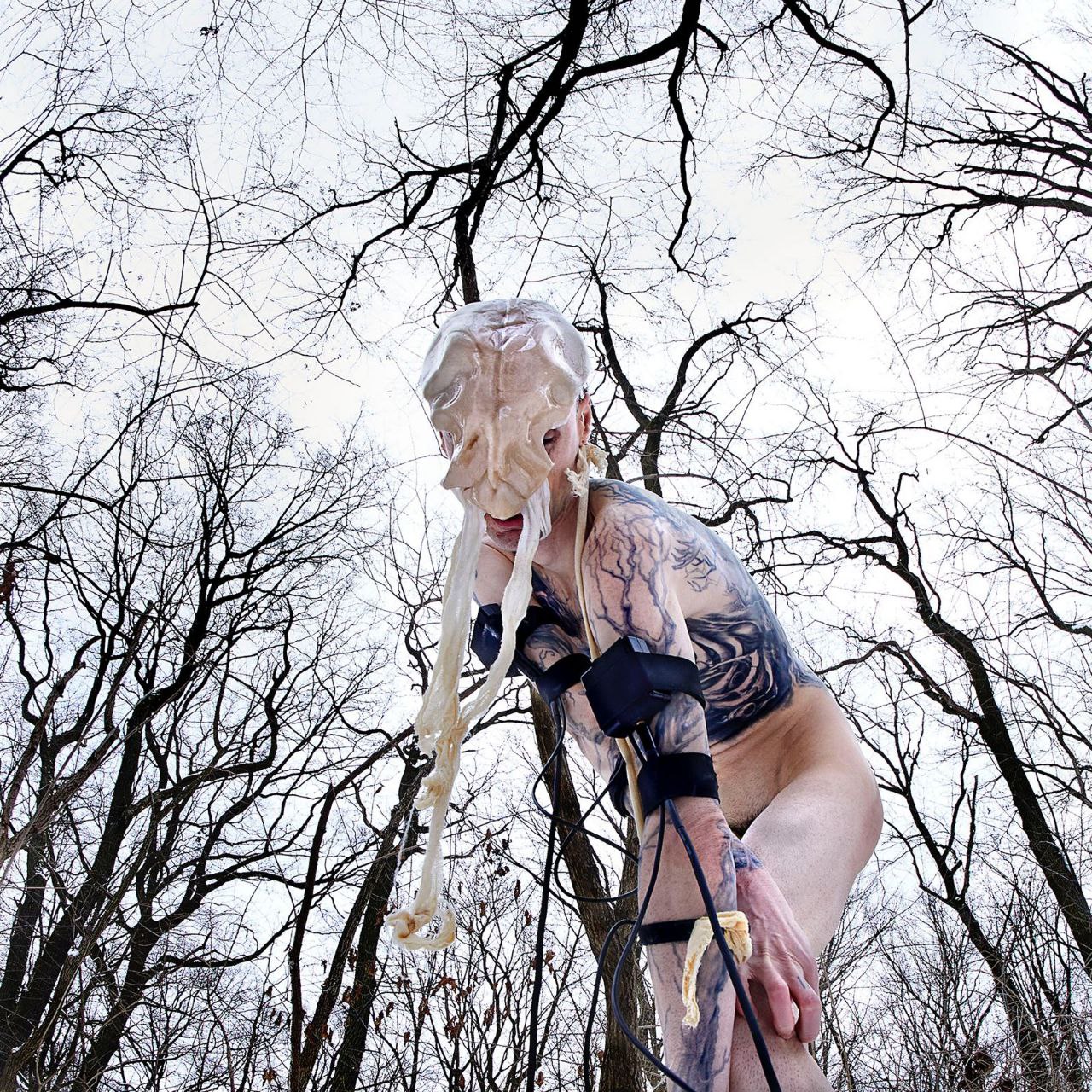
The performance »Ex Silens« starts from where the film ends. It takes up the knowledge, reflections, and personal accounts of the group to imagine what a communal ritual of sensory re-organisation could look and feel like. It is more my own voice as both a late-deafened person and an artist, than that of the group. In it, a hybrid human creature shares the stage with an entirely prosthetic body. They are both fragmented and dispersed and therefore attracted to each other. In order to become one body, they have to reconfigure themselves and each other. The members of the audience are not merely witnesses; they become instrumental to the ritual, even actively lending their own bodies as vessels that transport, in the most physical sense of the term, the pulsating vibration of the new body, passing it from one body to the other, establishing a silent network of acoustic force that accompanies the new body to its eventual blooming. The prosthetic body is made of modular sensory prostheses that I designed and created with the support of a team of collaborators. These are autonomous sonic and vibrational agents I programmed using the interactive machine learning library Anguilla and the artificial life library Tolvera (developed by the Intelligent Instruments Lab in Reykjavík, my scientific partner in this venture). I call them sensory prostheses to emphasise their capacity to physically transmit to a body the sensations or pulsations that originate in another body, human or computational. From this viewpoint, the prostheses can be understood as organs of sharing that live in a body, but, at the same time, have their own agency. Their voice, generated both autonomously and in response to the performer’s movements, explores a small sound dataset I created from voice-based samples and field recordings. Finally, music and sounds in the performance are spatialised by means of decomposition techniques similar to the ones used in »Niranthea.«
Often, when I talk about this kind of work, the question that most hearing people think but are afraid to ask is: how do you make music if you cannot hear much of it? For those wondering, yes, I do not hear most of the mid- and any of the high-frequency sounds that I composed for these pieces or for other pieces in my repertoire, and my unnecessarily expensive hearing aids don’t bring a drastic improvement. Hearing aids and cochlear implants are not like glasses that can immediately reinstate »perfect« vision. They are rather messy machinic things that try to shape the sonic world around you according to models of perception that are medically stipulated by hearing people. Not hearing certain frequency ranges does not disturb me, not any more. These days I do not bother much about crafting sound in the mid-high frequency range, I rather let it happen as a consequence of timbre manipulation in other ranges. It is not that I am technically unable to work with high frequencies; plenty of sound visualisation software make such a task relatively easy for a late-deafened sound designer and musician like myself. I do not worry about it because deafness taught me to tune in into other sonic spaces: the infinite, tangible nuances that can be created in the low-frequency spectrum, the fascinating facets of manipulating low-frequency saturation, the imposing corporeal feel of rhythm and acoustic beating, or the marvel of extremely deep standing waves as they cross bodily tissues leaving every muscle cell exhilarated.
Marco Donnarumma is an artist, performer, stage director and theorist weaving together contemporary performance, new media art and interactive computer music since the early 2000s. He is internationally acknowledged for solo performances, stage productions and installations that defy genres, and where the body becomes a morphing language to speak critically of ritual, power and technology.
This text was commissioned as part of CTM 2024 – Sustain.
With thanks to PACT Zollverein in Essen and the Intelligent Instruments Lab at the Iceland University of Arts in Reykjavík for their support and critical exchange in the making of »Niranthea« and »Ex Silens.«
- 1
The equal loudness curve is the traditional standard used for music amplification and equalisation. As Drever and Hugill note in their 2023 publication Aural Diversity, this standard is based on a method devised in the 1930s at Bell Labs, and it was standardised through a series of experiments between 1983 and 2002, involving hearing people between 18 and 25 years, which represents an incredibly limited demographic.