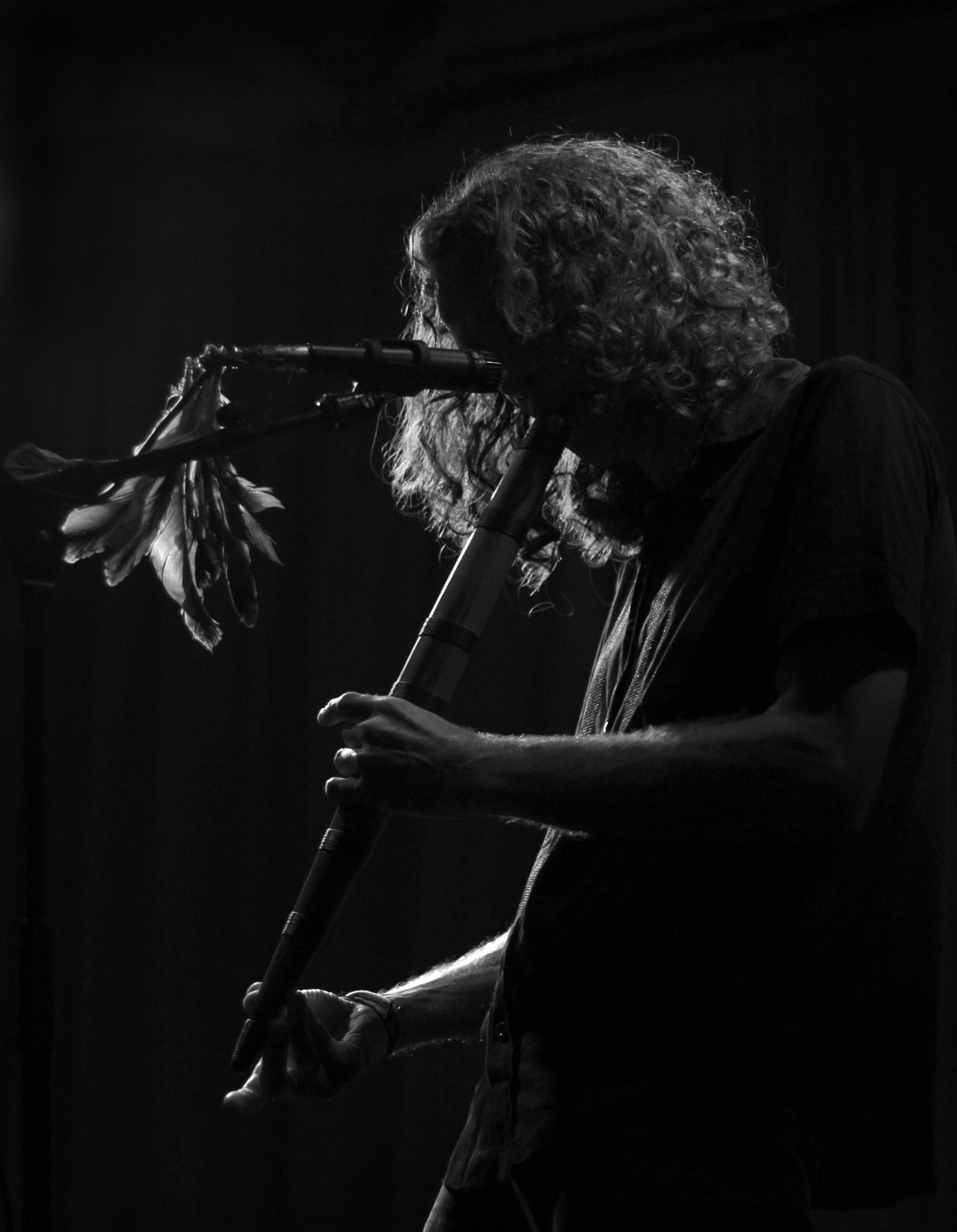
Experimental music is about innovation and the revival of taonga pūoro (traditional Māori musical instruments) is about tradition. Yet a large part of reclaiming, re-learning, rediscovering, and reviving the traditions of taonga pūoro has come out of improvisation: improvising construction; improvising playing methods and styles; improvising how something should sound according to specific memories of people present and passed; improvising whole instruments from scant and rare or singular, historical descriptions; and sometimes even improvising on knowledge when large parts of accounts have been mislaid/covered over (lost).
One blank area of knowledge occurs in regard to the pūtōrino (bugle flute). It is known that it was used musically in a duet accompaniment with the kōauau (short open-ended tubular flute), as in the story of Tu-ta-nekai (Hinemoa) and Tiki from Rotorua. But how? One might assume (improvise) that the pūtōrino plays a drone bed underneath the kōauau, as this is what this instrument seems to do well, but we cannot be certain. The pūtōrino can be played both as a flute and a horn. Maybe it was trumpeted, while the kōauau played a flute melody over the top. As a flute, because of its technically monotonous yet harmonic abilities, maybe it was played as a rhythmical harmoniser. The principles of action archaeology determine that we can gather good (acceptable) evidence as to how things were done, or achieved, by putting theory into practice and trying things out. By experimenting. Materially, we collect and observe physical evidence from artefacts, and then »jump the gap« between what we know (»what«), and what we theorise (»if«), with experimental action (»how«). Musically we do this by improvising: working with the »what« and »if« to develop the potential »how.« No matter what we discover through practice (action), we need to remain critical of what we »discover.« Large amounts of revivalist learning in this era in regard to playing style, technique, and method has come about through calculated trial and error i.e. improvisation. New practices, and even new traditions have been developed. A good example of this is the playing of the pūtōrino (often horizontally) across the central aperture. There is no provenance (traditional or historical source) for this being done, yet it makes a fantastic and uniquely »Māori« sound and is more than possible — it is easy. As a result, the method has recently become popular. This is a good reminder in the science of cultural rediscovery that »just because something is possible (now), does not mean it was done (then).« A culture governed and bound by ritual, belief, meaning, and magic may restrict the way things are done for many reasons that have nothing to do with achievability or modern logic.
Innovation cannot exist without tradition, and tradition should never be considered as static or fixed. Within cultural changes and flows, traditions can be strengthened or can dwindle. Tradition requires innovation to challenge and confirm its foundation. Many cultural traditions and their supporting legends and myths involve great innovators who break with tradition to change the way things are done and perceived. Maui was one such hero in Māori culture.
Innovation cannot exist without tradition, and tradition should never be considered as static or fixed.
Experimental music is about discovery while taonga pūoro is about rediscovery. Unlike other ancient musical traditions, taonga pūoro lacks a consistent, fixed body of instrumental musical learning into which a student can engage and study from the »inside.« Many musical traditions involve a master/apprentice mode of knowledge translation. In some, the master spends their entire career working with a set of musical pieces and skills that are unique to them. These are their cultural responsibility, and are passed to them by their own master, and so on, through the ages. The musical culture of taonga pūoro is what might be termed as a »broken tradition« – at some point the transmission of knowledge was discontinued. As a result, there is now virtually no traditional »inside.« The tradition from which a student learns might be musical (as in song or dance), or it might be historical or cultural, encompassing oral tradition, stories, whakapapa (genealogy), or mythology. Neither of these, however, are specifically »insider« modes of instruction in musical instrument practice. At some point the instrumental musician must »jump the gap« and improvise from their wider non-specific (non-instrumental) knowledge, to play what they think is most suitable within their current context. Such learning is knowledge-based rather than inherently skill- and practice-based. Currently with taonga pūoro, to learn from a master is to learn (often basic to intermediate) usage, protocol, and technique rather than master skill sets and techniques or specific sets of musical pieces and the finer intricacies of how these should be played according to tradition. Process and outcomes are therefore currently indeterminate. The rest of the student's learning and mastery is then achieved through a personal quest for knowledge and skill. This method, though, may be a tradition of sorts. One story I have been told relates to the traditional learning of pūtōrino, and was implied as regionally specific. The student was given an instrument by the teacher and sent off into the bush, with instruction to not return until they were able to play. Such a tradition could potentially determine a very wide range of playing styles, techniques and skill levels, with a vast variety of self-styled methods and musical compositions.
Discovering (mining, finding, creating) sound and organising it using musical criteria is one element of experimental music. This process of discovering sound and exploring musical (and non-musical) criteria involves deconstructing and reconstructing our understanding of what music is – a key principle of experimentalism. We take what we know and reorganise and rework it into something that we (or the listener) no longer recognises as music. Of course, the more we do this, the more we become familiar with what we do, to the point of constructing whole new sets of understanding and criteria. Soon enough, we perceive it as music. I like to use a terrain metaphor, where actions, criteria, and »rules« or boundaries are roads and pathways within networks or maps, and differing outcomes are whole new places. Innovation is often about deconstructing traditional processes and then reconstructing new outcomes. While the revival of taonga pūoro as a tradition is similar to this process as it deconstructs to reconstruct, it may be more about constructing new processes with whole new outcomes that, with time, will be perceived and accepted as tradition. Revitalisation hinges the new door onto the old frame, requiring a balanced (managed contradictory) belief that tradition is fixed and fluid. It is not so much about the door frame or the door, but the open threshold and that we step through to the other side. This revival puts us all in a unique position »at a new beginning of time.«
Taonga pūoro has been able to develop as a cultural and musical field because of its ability to work laterally and experimentally with other sources and fields of knowledge and practice. With a combination of actual and re-imagined tradition and innovation, it seeks a form of renovation that retains and rebuilds the old while utilising the new.
As an experimental sound artist and musician, the daily learning and practice of taonga pūoro revival has enabled me to not only deconstruct sound and tradition; it has also empowered me to reconstruct my identity as a Māori. Through the discovery of sound and the development of skill, I have rediscovered who I am and come to better understand the cultures to which I belong, as well as the relationships that I operate within and that operate within me as an individual and as a member of New Zealand society. Meanwhile, I gain great personal satisfaction from creating »new« and modern music with »old« and ancient instruments.
Rob Thorne, or Ngati Tumutumu, is a Māori-Pakeha musician and anthropologist from Palmerston North, New Zealand. He has been researching and performing on taonga pūoro, or traditional Māori instruments, since 2001.
This text was originally published by Soundbleed Journal and Audio Foundation in 2013, and again in CTM Magazine 2016 – New Geographies.
CTM 2016: Meeting Grounds. Talk With Fis & Rob Thorne. Hosted By The Wire by CTM Festival
CTM 2016: Meeting Grounds. Talk With Fis & Rob Thorne. Hosted By The Wire by CTM Festival