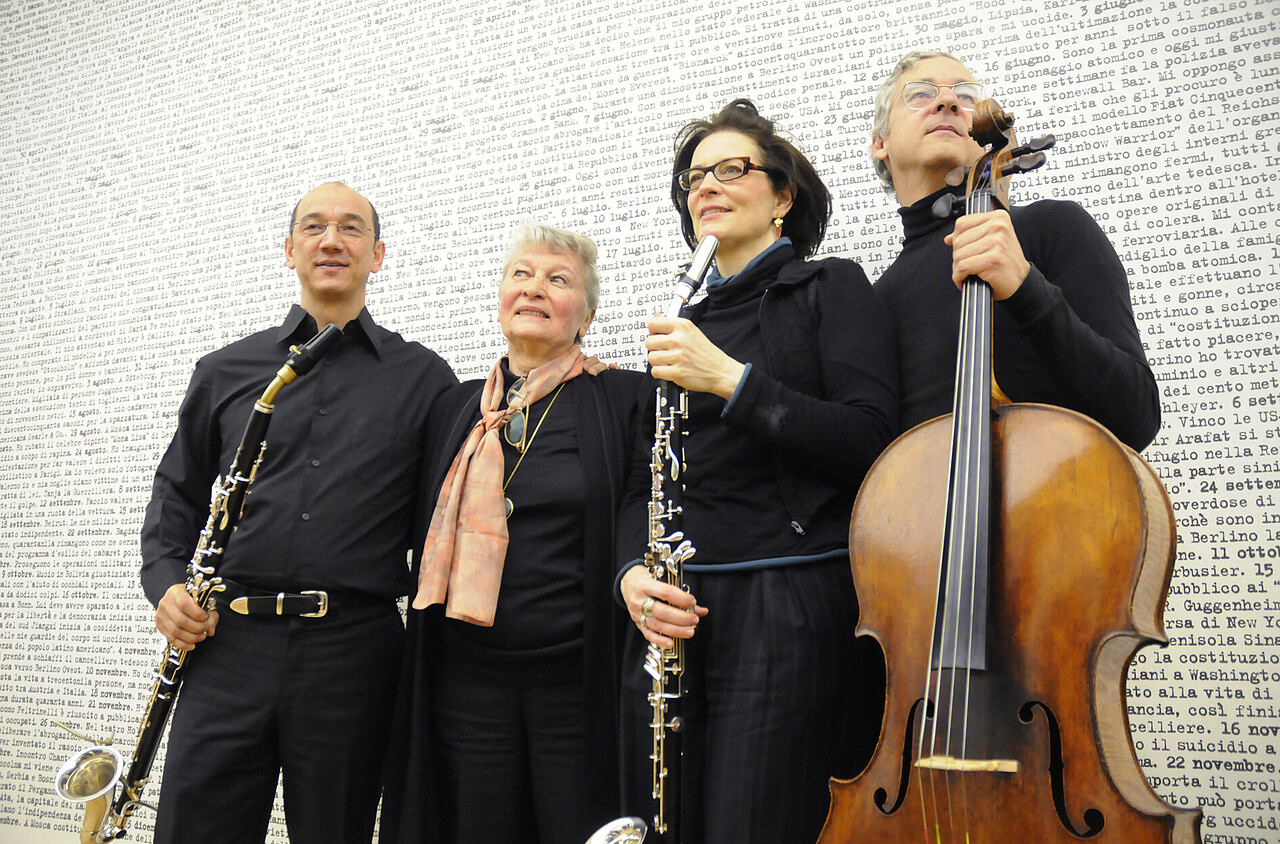
Thibaut de Ruyter: We will begin with the links between electronic and acoustic music. You have not made music on machines since 2004. Yesterday we heard an acoustic concert, and tonight we will hear a piece for synthesiser. However, I’ve already heard you say that »it’s the same thing…!«
Eliane Radigue: Not exactly. I am very obstinate and stubborn. At a certain period of time, my analogue synthesiser was bringing me close to the kind of music I wanted to create, but now marvelous musicians come closest to my research. The first time I heard them perform my work »Naldjorlak,« I thanked them, because at last I was finally hearing the music that I had always dreamed of. There is such subtlety in acoustic instruments. Electronic music is rougher, raspier. Less delicate and subtle. That is why my synthesiser and I separated, after forty years of marriage.
TdR: This means that you would not have made electronic music forty years ago had you met musicians capable of playing your music back then?
ER: I wouldn’t have dared! Or rather, yes, different musicians had contacted me on two or three occasions, but when we would meet and when they saw what I was asking of them they would run off. When Charles Curtis approached me he knew perfectly well what I was doing, and he knew that I was not going to write him a new Bach suite! It is my personal musical genre, my dream, call it what you want.
TdR: But there exist, nonetheless, analogous elements between electronic and acoustic music. For example, duration is an essential component in your work…
ER: There are various levels of response for this. I will start with the material aspect. When I worked with wild electronic sounds, distortion, and feedback between a loudspeaker and a microphone, one must be extremely delicate and precise. When you get a little too close it shrieks, when you move away it disappears. It only takes a small, abrupt movement… But when I found the right balance I could evolve the sound for as long as I liked. Therefore it required slowness.
One must also take into account the quality of silence, not in terms of its general use as a punctuation mark in music, but as the silence within which sound can integrate completely, that can live with the music. As if silence was space and musical vibrations animate it.
It was the same story with the reinjection method using two tape recorders. I barely had to touch, barely had to brush against the potentiometers. This allowed me to overcome my impatience. Because, and this is the second important aspect: duration and slowness go hand-in-hand. I was always particularly sensitive to slow movements in classical music. For example, while the second movement of Maurice Ravel’s »Concerto in G Major« is sublime, I could not bear to listen to the scherzo at the end. I would always stop the record before the end so as to stay in the second movement’s atmosphere. I think I am slow, not always, but listening takes some time and the movement’s tone profoundly suited me.
In addition, when the synthesiser allowed me to begin to approach my musical vision, I noticed that one had to stay within very low registers in order to be more precise with respect to what was going on between the different sound layers and levels. This is why everything I do rarely reaches a mezzo-forte, and always stays in low pitch. And this forms a whole that I am only now beginning to understand. One must also take into account the quality of silence, not in terms of its general use as a punctuation mark in music, but as the silence within which sound can integrate completely, that can live with the music. As if silence was space and musical vibrations animate it. Yesterday evening I was particularly sensitive to it: at first you don’t hear anything although the sound is already there, it comes little by little, there is never a discrete unit of silence. All of this requires patience, time, and leads to the necessity for a long duration. I did not seek duration for the sake of duration. It is simply my working mode, my choices, and my options that compelled me to do so. But that did not bother me, quite the opposite in fact!
TdR: At the same time, when we enter a dark space, it always takes some time for the pupils to dilate and adjust to the ambient lighting before starting to discern certain contours and then to see. The silence you speak of, is it not a way to force our ear to open, to capture our attention?
ER: Absolutely! I will use a big word but it is a way to satisfy my deep longings, my »quest.« I’m finished, I will say no more on this subject. In order for there to be a union between silence and sound, and in order to perceive this union, we must first listen to silence. But it is true, you are perfectly right; our perception sharpens, it requires our attention, all of which can lead to a state of concentration that enables a much wider sensitivity. The image of the pupil is a nice example.
TdR: But there is also something about the low volume in your works. I’ve always had the impression that this is related to your approach to silence.
ER: The low volume is necessary, and it is a third aspect of my investment in music: to explore subtleties in the relationships between overtones, harmonics, and sub harmonics. I think I owe that to the studio d’Essai on the rue de l’Université, and to the first time I heard the sound of a bell where we removed the attack. It was a totally different story, very rich. We can always experience this when a bell rings in the mountains. It stops, but there is a superb music that continues. If the fundamental note is too loud, even if this note is necessary since without it there is no sound, it sounds aggressive, overwhelming our hearing. But if its volume is low enough we can better hear what follows – it sings on its own. Actually no, above all it is my marvelous musicians that, with their movements and breaths, make their instruments sing!
TdR: The breath is another word that appears to me to be essential. I often have the feeling that your music breathes and, in a certain way, that we could make an analogy between the instrumentalist’s breath and the hiss of the audio tape.
ER: Yes, it’s important. But let me go back to the first discoveries I made through wild electronic sounds. These always had the tendency to behave either as a sustained note, or as pulses and beats. Beats always contain rhythms that correspond to something: the heart, breathing. In itself I think that yes, there is breath, but I did not look for it as such, it is part of the sound. I admit that there are similarities, but I have no theory, I have no big statement, nothing sophisticated, nothing intellectual to propose.
As for electronic music, I always have a theme that becomes the spirit of the piece. Just as an architect needs a plan, scaffolding.
TdR: Did musical scores for your work exist at that time?
ER: No. And another question that has often been asked of me is whether or not this music can be played live. The answer is definitely no. Even with six or seven synthesisers, it only takes a tiny something in the voltage control for it to become another story. That is the reason why I had to work on tape and, once finished with a piece, had nothing more to add. I had no reason to appear on stage with my superb instrument and pretend to be doing something. That is why I would place myself offstage to perform the works, as we will do tonight. There is only the sound.
TdR: But how do you proceed today with your musicians if there is no sheet music? How do you communicate with them?
ER: It is, first and foremost, the musicians who ask me. Charles Curtis had sent me a CD with several musical elements and I told him »I do my shopping. I want that, that, not that, not that...« Incidentally, when he was asked what it was like to work with me he responded: »Oh, it’s very simple, she says ›yes‹ or ›no!‹« But it’s also more complex than that. As for electronic music, I always have a theme that becomes the spirit of the piece. Just as an architect needs a plan, scaffolding. But once the work is there, we can totally forget about those.
I can tell you, for example, about the piece, »Naldjorlak.« The word only serves us as a point of departure and, in general, all the processes are contained in the titles. »Naldjor« is a Tibetan theme for Yoga, and signifies union. »Lak« is a suffix of deference, of respect, and that also signifies the hand. But the term »Naldjorlak« does not exist. There are the masculine Naldjorpa yogis, the Naldjorma… This was my initial theme. From it developed a work built on three pieces: yoga of the body, yoga of speech, yoga of the spirit. This defined a structure, a prelude of structure. The reference to the body, for example, is obvious now that the cycle of the three pieces is completed. Performing solo, Charles Curtis strips his instrument and that is obviously the yoga of the body, whereas the duo of Carol Robinson and Bruno Martinez represent speech as their breaths answer one another. Lastly, the three musicians perform together, and their osmosis represents the spirit. Now, we do not have to know all this when we listen to them. It’s obvious. We know it. That happens quite instantly.
In any case, with my synthesiser, when I knew exactly what I wanted to do, I found my way very easily. One day my friend Michèle Bokanowski asked me to make her some sounds of »the silence of stars.« I told her this would be no problem; I had sorted everything out before holding the listening session. Then, when I turned on the master volume, the sound was exactly it! Still, it was a stroke of luck [laughs]. I was again referring to the Tibetan culture, for which the spirit is situated in the heart and not the brain. An emotional form of communication also exists. And non-verbal communication also works, with far less misunderstandings than with words. So I communicate with my musicians with gestures, and I don’t deprive myself of anything. With »yes« or »no.« And we recognise the moment a piece is finished. All of a sudden it’s there. However, it becomes more and more extraordinary every time they play it.
TdR: So these are pieces by them, for them, created with them…
ER: And only for them! However, they are capable of transmitting the pieces verbally, if they so desire. Charles Curtis had already received such a request. When he asked me I told him: »it’s up to you.«
TdR: You speak of control and of duration. For me this evokes an image of a line, which is also a word that you employ. Charles Curtis’ movements on his cello are, for that matter, extremely linear.
ER: That goes back exactly to what I said in the beginning, about the issue of keeping a distance between a loudspeaker and microphone; it’s acrobatic, it’s linear, and there is very little room to manoeuvre. But when it works, there is a result! There you go, we can stop here, I have come full circle…
Audience: You say that each work has a story, that each sound has a place in each story. What is the link between story and sound, and what do you discuss with your musicians?
ER: Harmony always constitutes our genuine foundation, the fundamental sounds with which we work. With Charles Curtis it was obvious from the start, since the cello, like most string instruments, contains something that is feared by classical cellists: the wolftone. I have the feeling that the two soundboards of stringed instruments can knock sounds out of phase, producing something magnificent. I of course jumped on this sound right away. This sound is of a different pitch depending on the instrument, and it is very difficult to find its fundamental note. As with all musical instruments, tiny variations result from climate parameters such as higher or lower temperature, humidity versus dryness. In any case, that’s where we start. Tuning the instruments backstage is unthinkable; we have to find the best resonance threshold from the instrument’s body. It’s about how the instrument behaves on a given day.
What further interests me is the play of overtones. The fundamental note does not move, and there are low pulses and some small tones that I ask the musicians to control. We all know that European music had to be tempered or else we would have a huge difference between the low and high ranges. But personally, I don’t care about that. On the contrary, that very small element of uncertainty, of indecision, interests me. What has always fascinated me in classical music, aside from slow movements, are the few bars of modulation where, by changing the scale, you reach the first accidental. This brings us into a climate of slight uncertainty. I adore ambivalence. I adore ambiguity. In this regard I quote [Paul] Verlaine, only changing one word: »I dreamed of a piece of music, strange and beautiful, which was never the same, yet never quite something different.« But Verlaine was referring to a woman.
I do not know if that answers your question, but everything revolves around this extremely nuanced and delicate contact. Let us go back to the example of Charles Curtis. I would have never accepted the mistreatment of an acoustic instrument. By playing on the cello’s tailpiece and endpin, he enters the privacy of the instrument. He showed me what he could do and the structure appeared by itself. It was therefore natural to play the strings first, then the tailpiece, then the endpin and, finally, the two strings that fix the tailpiece to the instrument’s body. And there, I was flabbergasted by that sound. I would want so much to be able to record it and slow it down, since I am certain it develops numerous harmonics. I don’t know if someone could do this someday. I could have done it with my old magnetic tape recorder systems, which I constructed and fiddled with my entire life. But apparently, in our digital age it has become very complicated.
Audience: I heard Charles Curtis perform »Naldjorlak« in three different venues and I would like to know how the architecture influences the technique and interpretation.
ER: The first thing is to evaluate the venue’s acoustic response. In Riga he performed in an old industrial building that was not very good, and the first task was to find the best location to place ourselves in order to create optimal acoustics. That theater is very beautiful; it does not have a flat acoustic but is not too resonant either. They played in New York, in a big hall made entirely out of reverberating marble. Fortunately the hall’s acoustics changed when 400 spectators arrived. By the way, if you’ve heard the piece three times, you must have heard three slightly different versions?
Audience: Yes!
ER: Never the same thing, yet never quite something different. According to each day’s base harmony or the acoustic response of each location – each time an original story that continues.
Thibaut de Ruyter is a Berlin-based architect, critic, and curator that harbours a lifelong passion for music. He is a regular contributor to art press, Il Giornale dell’Architettura, Fucking Good Art, and has written essays for various catalogues. He curated the exhibition »Ghosts Off the Shelf« for CTM Festival’s 2012 edition.
Translated from the French by Catherine Genest.
This text was originally published in CTM Magazine 2014 – Dis Continuity.
The title references »I dreamed of a piece of music, strange and beautiful, which was never the same, yet never quite something different« – Eliane Radigue’s rephrasing of Paul Verlaine’s »Mon rêve familier.«