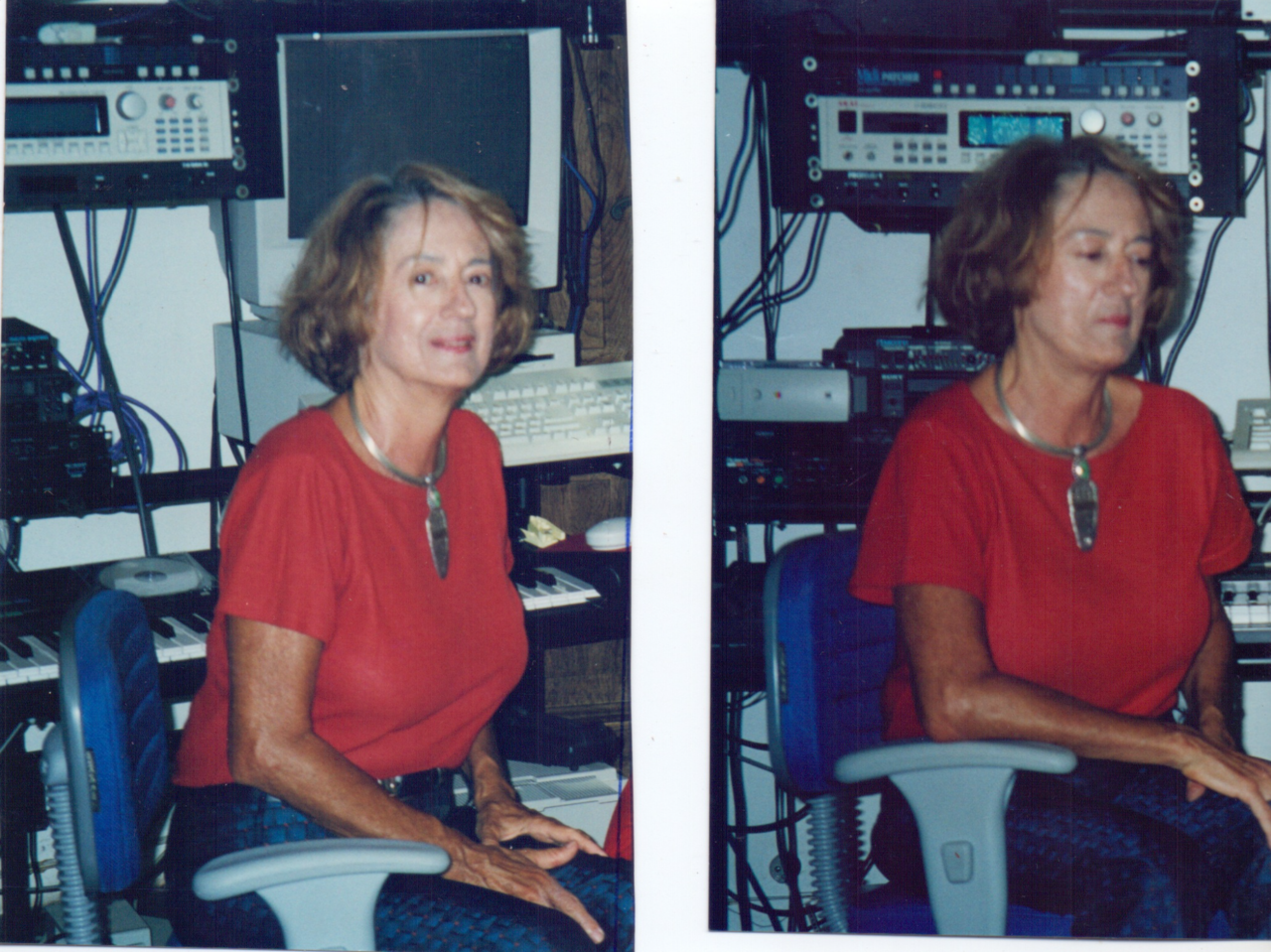
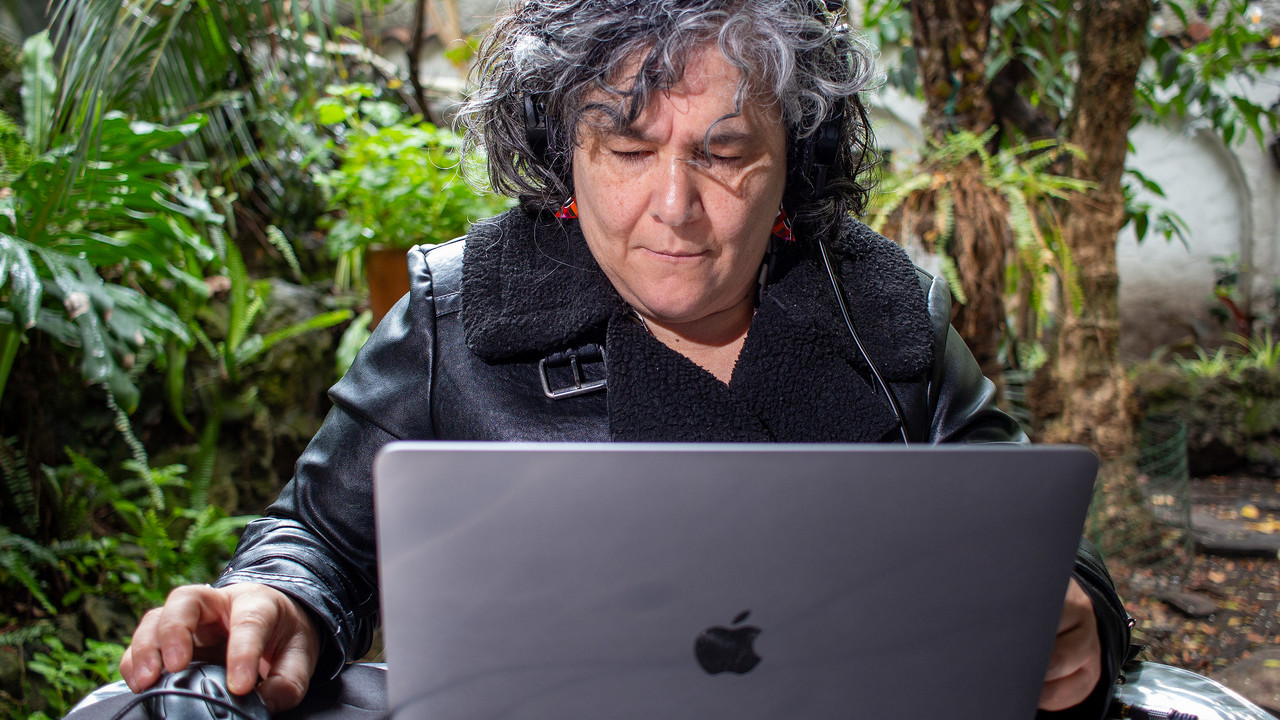
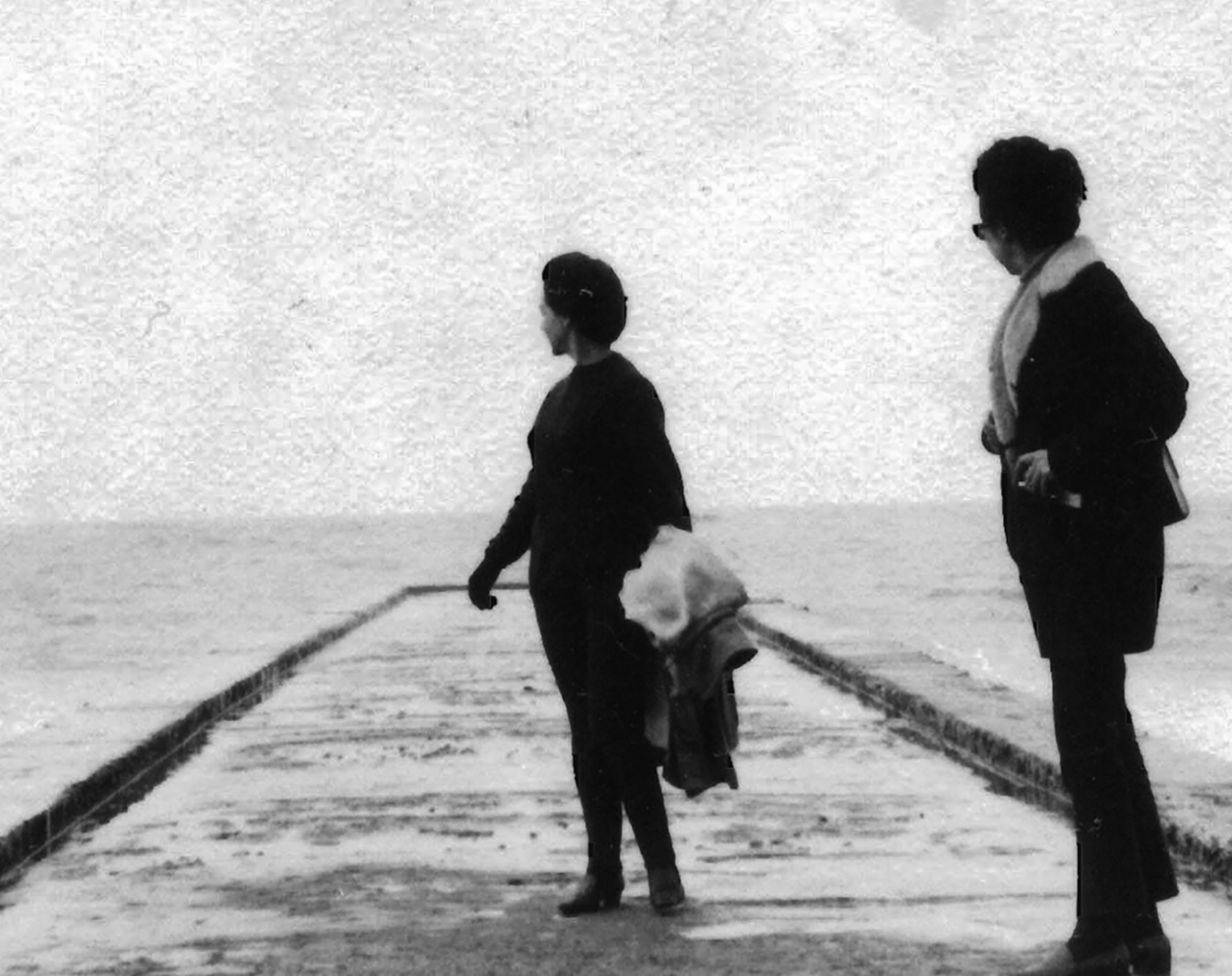
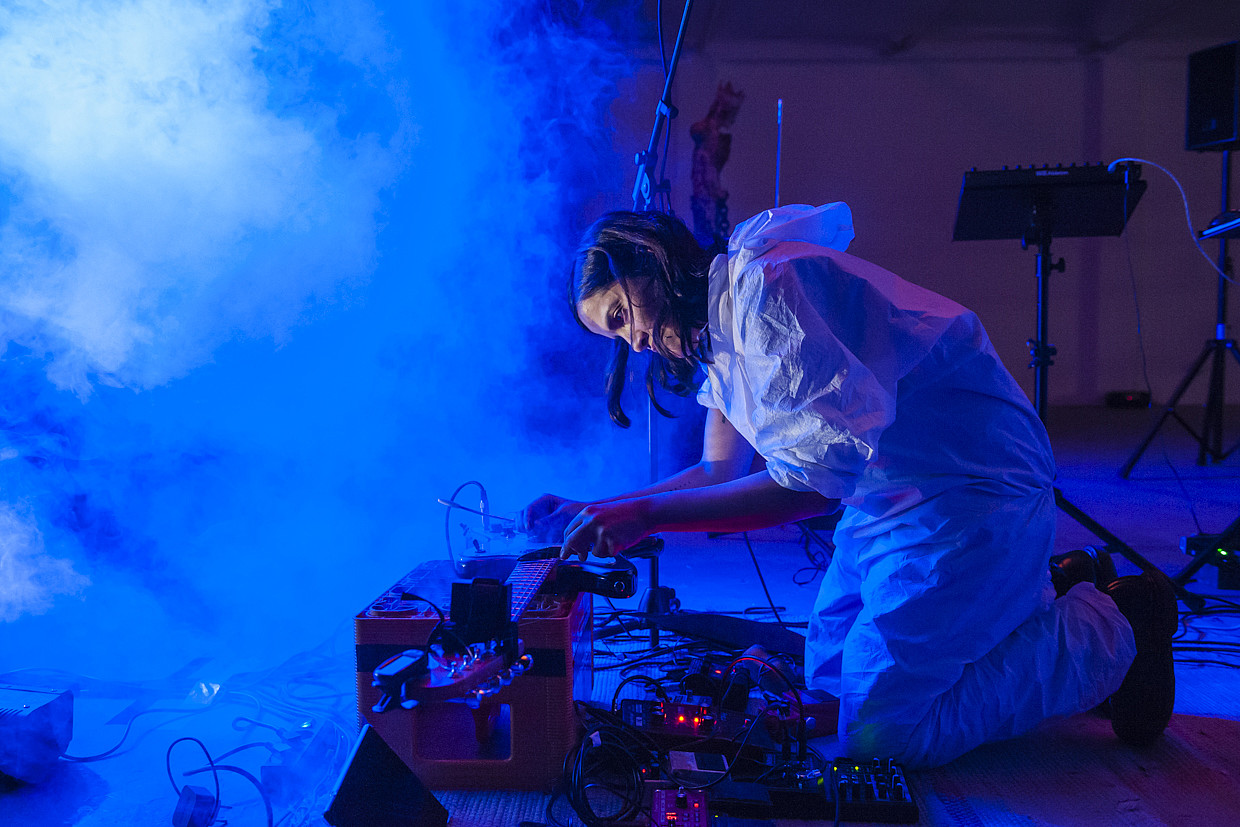

In 1961, Brazilian composer Jocy de Oliveira premiered her play Apague Meu Spot Light (»Turn off my spotlight«) at the 6th São Paulo Art Biennial. Its soundtrack – which was realised with Luciano Berio, and recorded by the Italian composer in the US – was the first electronic music piece to score a Brazilian theatre play. From then on de Oliveira began to expand her horizons in the art form, going on to work with several composers and sound artists in the US and Europe. In 1981 she released Estórias para voz, instrumentos acústicos e eletrônicos, which came to be known as a classic electroacoustic album and was reissued by UK label Blume in 2017.
While de Oliveira was premiering Apague Meu Spot Light, Argentinian musician Beatriz Ferreyra was studying piano in Buenos Aires, and would later move to Paris to work with important artists such as Nadia Boulanger, Edgardo Canton, and, most notably, Pierre Schaeffer. Being a key intern at Schaeffer's Groupe de recherches musicales (GRM), notable for providing the theoretical basis for what came to be known as musique concrète, Ferreyra furthered her career both as a researcher for other electroacoustic music groups and as an independent composer.
Jacqueline Nova, a Colombian, Belgian-born musician who returned to her father's hometown of Bucamaranga, Colombia, at the age of seven, also started her musical career with the piano. In 1967, after graduating from a musical composition programme at the Conservatory of the National University of Colombia, she moved to Buenos Aires on a scholarship from Instituto Torcuato Di Tella to study at the Centro Latinoamericano de Altos Estudios Musicales (CLAEM), and there became interested in electroacoustic composition. Her first work, Oposición-Fusión, was begun in Colombia and finished in Argentina; the piece featured experimentation on tape and was released in 1968.
These artists have similar career paths and worked with similar emerging technologies and aesthetics at a time when means for making electronic music were very limited. Yet despite being some of the very few female Latin American composers active at that time, there seems to be no traceable contact between the work of these artists, and they never met each other.
Nova, Ferreyra, and de Oliveira’s stories are not so different from that of Hilda Dianda, an Argentinian composer who led research in electronic music in Italy and France in the 1960s; Brazil's Vania Dantas, whose efforts since the 1970s eventually led to the opening of the electro-acoustic laboratory in the Federal University of the State of Rio de Janeiro; German-Chilean Leni Alexander, a prolific composer of electronic pieces over the 1960s; or Mexican pianist Alicia Urreta, a leader in the field of acoustics studies in her country. Yet there's little or no mention at all of these artists in works of early electronic music history – even those pivoting around female protagonism. While Johann Merrich's A Short History of Electronic Music and its Women Protagonists, published in July, has a chapter dedicated to Latin American artists, the complete absence of artists like Nova in works such as 2010’s Pink Noises or, more recently, the documentary Sisters with Transistors, is striking.
»These are people who share an onanist perspective of electronic music. The movie Sisters with Transistors is an excellent contribution, it had to be made, but there's a whole movement that goes by unseen,« says Susan Campos Fonseca, composer, musicologist, and professor of Music History and Transdisciplinary Research at the Universidad de Costa Rica. »It seems that Anglo-Saxon people don't see beyond their world, and this cannot be naturalised. What do you mean, there's a movie like this and not a single mention of Latin America? Not only this but also Africa, Asia. Where are these artists? I'm sure there are a lot of them.«
Apart but together
»There has always been, and continues to be, prejudice and discrimination. The history of music has always been written mainly by men, and the focus is Eurocentrist, centring on the Northern and Western hemispheres,« says Jocy de Oliveira in an email interview. »The Eastern and Southern hemispheres are ignored.«
De Oliveira has long been voicing her displeasure with the way the history of music is told in regards to her place as an artist. It starts at the beginning: although Apague Meu Spot Light is, according to her, the first Brazilian piece of electronic music, credit for that title is often given to artist Jorge Antunes’ 1975 LP Música Eletrônica (literally, »electronic music«). »People say they did it first, but I don't see any proof of that,« she has said dismissively of the record.
At the time Apague debuted in Brazil in 1961, electronic music infrastructure in Brazil was lacking. After the premiere, de Oliveira requested that the equipment used for the sound diffusion and spatialisation, manufactured by Philips, stay in Brazil so that she could found the country’s first electronic music studio – but the equipment went back to the Netherlands as soon as the Biennial was over.
By now, de Oliveira, originally born in the southern state of Paraná before moving to Rio de Janeiro at a young age, was already living in the US with her then-husband, conductor Eleazar de Carvalho. She started her master’s degree studies at Washington University in St. Louis, Missouri, two years after. The studio at Washington University gave her the opportunity to dive deep into electroacoustic composition. She went on to release Estórias and write, produce, and direct several »multimedia operas,« as she calls them – plays that mix theatre, electroacoustic sounds, singing, and digital audiovisual elements. »I created what I had to create. I don't have work stranded in a drawer or on a computer,« says the artist of her prolific output.
Similarly, Jacqueline Nova's work also had a multimedia quality to it. She worked with sound art, visual arts, performance, and installations. »She saw herself as a composer, but for me she was one of the pioneers of interdisciplinary art in Colombia,« says Ana María Romano Gómez, Colombian artist, professor, and an expert in Nova's work, over a Zoom call. She became familiarised with her fellow composer's story while studying music and was instantly fascinated. »I began to immerse myself in the story of Jacqueline Nova. Scores, documents, initial works in composition, scripts for some of the radio programs. I tasked myself with organising it.«
And Nova was, according to Romano Gómez, a key active voice in the Latin American context. Her work with electroacoustic music started as soon as she entered university, but there also wasn't a studio dedicated to the medium in Colombia. Between 1969 and 1970, she directed Asimetrías, a series that aired on Colombian Radiodifusora Nacional, and used the radio to further her sound experimentation: she used to record using cans, stones, and whatever else she could get her hands on.
Nova’s work was so important that, when she passed away, the creation of electroacoustic music in Colombia was silenced in some way.
Things changed when she arrived in Argentina, where CLAEM was equipped with a studio carrying cutting-edge technology at the time. There, Nova advanced her work, creating some of her most significant pieces, including Creación de la Tierra (»Creation of the Earth«), a sound installation that »alters a series of recordings of creation story chants by the indigenous U’wa peoples of Northeastern Colombia, blurring the lines between noise and the human voice,« as explains the catalogue of Blaffer Art Museum in Houston, Texas, where the work was exhibited in 2019.
»She was a very advanced person for a very conservative milieu,« says Romano Gómez. »Her work was so important that, when she passed away, the creation of electroacoustic music in Colombia was silenced in some way. She passed away in 1975 and, at the end of 1987, it started anew.«
Meanwhile, Beatriz Ferreyra’s work seems to have had more impact and traceable recorded history – though not in her native Argentina, but in France. As one of the musicians involved in Schaeffer's early studies of musique concrète – and one of the few still active today – her work and persona have had a big significance for French researchers and composers. In 2014, she received the title of Honorary Member of UNESCO's International Music Council (IMC), which is based in Paris.
Ferreyra's work with Schaeffer was only the beginning of her journey with electroacoustic music, a career that remained closely tied with academic research. She went on to teach at the National Conservatory of Music and Dance in Paris, where she was in charge of interdisciplinary seminars in the Research Department. Later, she would receive commissions for works from the International Institute of Electroacoustic Music of Bourges, Dartmouth College, and the Musiques & Recherches institute in Belgium.
From 1970 on, she became an independent composer, and has since released many albums and composed for cinema, dance, theatre, and radio. Her most recent work is the album Huellas Entrevaradas, released in 2020 by the British label Persistence of Sound.
Making music in between
From de Oliveira to Nova, the research on the history of these Latin American pioneers seems erratic, but their stories aren’t secrets hidden in inaccessible libraries or personal vaults. When new books and documentaries overlook the career of these artists, these pioneers of electronic and electroacoustic music, one cannot help but think: these pioneers have been doubly invisibilised, first for being women, and subsequently for being Latin American.
Rather than being far from cultural centres, or the homes of canonised developments in electronic music, these artists worked closely with figures like Pierre Boulez and John Cage, just as the latter were taking baby-steps into their eventual roles as world-famous vanguards. For these women, leaving their home countries was less a choice than a need. »Immigration was a key factor in the career of these Latin-American composers. At that time, the patriarchy was already a dominant system, and it still is today,« says Susan Campos Fonseca.
At first, they had to pave their way in local renowned institutions and conservatories that were meant to welcome mostly male students. »Inside the academy, the logic of what is needed to be a composer is mandatory,« says Romano Gómez. »Up to today, these logics ask you to be another one in the boys club, and you're supposed to make music within this structure, to assume some behaviours in your work.« It's not by chance, then, that it took until 1967 for the Conservatorio Nacional de Música de la Universidad Nacional in Colombia to hand a composition degree to a woman – Jacqueline Nova.
These pioneers have been doubly invisibilised, first for being women, and subsequently for being Latin American.
The sexism that restrained the work of these artists was reinforced by an anti-novelty ethos. These pioneers were not only female composers, but also avant-gardists in their music-making, and thus faced imposed values that dated to the beginning of the 20th century, when Latin America was fertile ground for the rise of local ideologies. »Everything that was experimental music was beaten up by these nationalisms,« affirms Susan Campos Fonseca. These dynamics were revisited in the 1950s and the 1960s when military regimens or staged governments acted deliberately to diminish or censor anything that diverged from the expected in arts, as reflected in the motto of the Brazilian dictatorial government: »Brazil, love it or leave it.«
»There was a tension between cultural policymakers and the people that wanted to break up with the nationalist aesthetic,« says Fonseca. »These people had to flee the continent, since they couldn't grow up here. And, thinking about the female artists, there was also gender-based violence.«
Throughout the 1950s and 1960s, a number of Latin American artists were recruited for jobs or scholarships in burgeoning state-owned broadcast projects in Europe and the US. The lack of proper equipment and funding in virtually every big city of Latin America, whether in universities or TV and radio stations, was a major downside for those who wanted to make a living out of music. Such was the case of Ferreyra, who took part in the research team of the French national broadcast system (ORTF) in the 1960s. By the end of the decade, she had composed a number of electro-acoustic pieces melding proto-sound art and futuristic sonics such as Mer d'Azov, Étude Aux Itérations.
The European and North American dreams sold to these composers were not free of pitfalls. Besides grappling with the conventions that prevailed in the male-dominant world of composition, they also had to carry with them their new identities as foreigners. This condition also fueled their work, leading some of them to eventually shape a new music deeply connected to their origins. But, instead of revamping the pivots set by their home country's elites – often moulded by Western, white, and masculine frame of references – artists like Hilda Dianda embraced new sonic technologies as a platform to revisit local, Indigenous, popular, or non-dominant motifs.
»I feel there was a willingness to create something like a national identity via the extensive use of voice. I also see that much of their work is very interdisciplinary,« says Alejandra Cardenas, aka Ale Hop, a Peruvian artist and sound studies researcher based in Berlin. »When I started making music, back in the 2000s, I couldn't find any information about these artists. And it's a shame that in Europe and in the US, when it comes to the history of electronic music, they only teach you about the Anglo-Saxon experiences.«
In an attempt to contribute to expanding these pioneering artists’ reach, Cardenas released a mixtape in partnership with the website Sounds & Colors this past April. The selection includes names like Jacqueline Nova, Jocy de Oliveira, and Beatriz Ferreyra, but also artists that are less known in academic circles or concert backstages, such as Mexican pianist Alicia Urreta, self-taught Venezuelan musician Oksana Linde, and Peruvian artist Olga Pozzi Escot. »This mixtape was born from the idea of making a concise compilation, but some of the pieces selected are 40-50 minutes long. As a sound artist myself, I took the liberty of cutting up some tracks, arranging transitions, and making something that has its own identity, that feels like a whole,« reflects Cardenas.
While doing the research and some crate digging for the mixtape, she realised that many of the composers shared another relevant step in their path: all of them come from a middle-class upbringing. Along with that, the lack of Black or Indigenous artists and the absence of representatives from the Caribbean shows that there's an important investigation yet to be undertaken on the topic of Latin American women in early electronic music. »This shows us that music is also a matter of class,« says Cardenas, who also points out some ambiguity in the small but progressively growing interest in the work of these artists. »I believe there's a market that has been open to this kind of music, and ›pioneers‹ can be a complicated term because it brings visibility but it also upholds the structure that made these women invisible.«
Navigating both academic fields and performing stages, Cardenas is following in the footsteps of Ana María Romano and Susan Campos Fonseca. The latter observes, »for me, it's concerning that historiography has only now started to look upon these artists, and that many researchers working on this are not historians but rather artists themselves,« who noticed these absences and sought to fill them. According to her, investigating and documenting the works of female Latin American composers in the early days of electronic music is also a much-needed step in decolonising music-making today. »These women were isolated but produced pieces of high complexity. That's why it's necessary to decolonise electronic music hardware and software because they are ready-made to this Western mindset,« says Fonseca, while recalling the Chilean artist and researcher Constanza Pinha and her Indigenous textile sound-maker computer, the Khipu.
Pieces of the puzzle
One of the most prominent figures in Sisters With Transistors is Pauline Oliveros, an American composer who was a central figure in the development of electronic and electroacoustic music. Herself a Tejana with a Hispanic family name, Oliveros was not only notable for her sound and electronic music developments, but also her critical thinking on sound – such as with the creation of concepts like »deep listening« and »sonic awareness« – and its social surroundings, including an analysis of gender dynamics.
In 1970, she wrote an essay for The New York Times titled And Don't Call Them 'Lady' Composers, in which she deemed the term derogatory and condescending. »It effectively separates women's efforts from the mainstream. According to the Dictionary of American Slang, ›lady‹ used in such a context is almost always insulting or sarcastic,« wrote Oliveros. She goes on to criticise the exclusion and subjugation women face in the music field, before noting: "[a]nd yet some women do break through."
But even if they do, the narrative around them is often shaped to further marginalise womanhood. Composer and scholar Andra McCartney has observed this in regards to Oliveros herself, who is often the only woman in textbooks and compilations, and at times ends up having her work positioned as representative of an essentialised, »feminine« aesthetic.
When we assume a persona as genius, we are silencing the context around them.
Isolating women in their field is part of the problem. The stories of de Oliveira, Nova, and Ferreyra, as important as they are, are still just a few pieces of the puzzle that tells a much bigger story of Latin America's contributions to electroacoustic music. This essay is just a small attempt to outline a relevant yet obscure cartography. Tackling issues such as the prevalence of Western paradigms in music production and the intersections of class, race, and gender in the electronic music industry are an effort to keep broadening a debate that for a long time was silenced.
»What is common with our stories as Latin American women in Europe and in the United States is that we do not connect. It's been an individual job, and it's just part of this exclusion strategy,« says Romano Gomez. »If I don't know who my compañeras are, then it's me against the world. When we assume a persona as genius, we are silencing the context around them.« In music, as in many fields, this context comprises nurture, care, community, and the maintenance needed for influential figures to blossom.
The researchers-slash-artists agree that cheaper access to technology has helped music spaces become more democratic and diverse, but know that this isolation problem runs much deeper in Latin American societies. »We have access to technology, but if your work is not linked to the right people, to the decision-makers, it does not exist,« says Susan Campos Fonseca. According to her, the prevailing European music canon is still a key factor in undermining the connections between female composers. »It's an internal problem, too, of nationalism and cultural policies. There is a tremendous interior coloniality.«
As of today, Jocy de Oliveira knows that the fight for a feminist historiography of experimental music, which she pleaded for in her semi-auto-biography Diálogo com Cartas (2014), is a long uphill battle. But she is satisfied with what she accomplished in the last six decades: »we have a destination and a road to follow. I don't really care about the issue of recognition anymore,« says the composer. »We are what we are and we do what we have to do.«
Amanda Cavalcanti is a Brazilian music writer. For four years, she worked as a reporter and documentary host at VICE Brazil, covering music as well as politics, art, and diversity. She has bylines in The Wire Magazine, Bandcamp Daily, Folha de S. Paulo, and UOL, among others. She worked as a host and writer on the first episode of »Música Pelo Brasil,« a series of short documentaries by Spotify Brazil about popular Brazilian rhythms.
Felipe Maia is a Brazilian journalist, ethnomusicologist (anthropology + music + sound) and DJ based in Europe. He has bylines on Remezcla, Pitchfork, VICE, Resident Advisor, Trax Magazine, OkayAfrica, and Folha de S. Paulo, among others. He's a PhD candidate at University Paris Nanterre, at the Center for Research in Ethnomusicology, where he leads an investigation on the Brazilian sound systems phenomena known as paredões – following his master's research on the use of digital technologies in the making of baile funk in São Paulo. He's also a resident DJ at Rinse France, hosting BAÏLE – a monthly radio show focused on baile funk and its different subgenres.
This text was commissioned as part of CTM 2021 – Transformation.