One of the most important developments from the perspective of 20th century aesthetics is the notion that order and disorder are not binary opposites, but instead function on a continuum. Moreover, the qualities of order/disorder that infiltrate and explain the workings of natural and artificial systems are not given but contextual, influenced both by a system’s internal makeup or its so-called endogenous variables (e.g. temporal and spatial scales), together with qualities that lie outside of the system’s operations (its exogenous variables such as the cultural and social context or the physiology of the observer).
That artistic practice in the 20th century, particularly that which was occupied with the means and effects of new technologies, would ground much of its interest in the role of order and disorder seems self-evident when we look back in hindsight from our current perspective. As the late and great British Marxist historian Eric Hobsbawm wrote in The Age of Extremes, the first forty years of the 20th century, which he dubbed the age of catastrophe, stumbled »from one calamity to the next.«1 From the overwhelming brutality of the trenches of World War I and subsequently World War II, the deadliest war in human history which ended in an atomic-fueled nova, artists attempted to grapple with the radical transformations before their eyes with whatever means they had at hand.
The work of the polymath Iannis Xenakis, Greek born, French exiled, trained in civil engineering and music – moving almost seamlessly between architecture, acoustics, philosophy, technology, and aesthetics throughout his life – is exemplary not only of Xenakis’ historical moment but of our own, where we are overwhelmed by the profound social-technical-artistic shifts wrought by new techniques while we edge ever closer towards an ecological precipice, unknown but on the near horizon.
That Xenakis could compose music in which, as The Guardian wrote in an April 2013 article, »you’re confronted with an aesthetic that seems unprecedented according to any of the frames of reference that musical works usually relate to,« is deeply rooted in the composer’s own direct, lived encounter with the savagery of war’s devastation and his resistance to it.2 The almost cosmological immensity of the destruction of World War II infects almost every aspect of Xenakis’s artistic worldview, from his own direct bodily experience of losing an eye in a blizzard of shrapnel blasts, to the witnessing of the spectacular ruination of Athens that he later describes in spectacle-like proportions:
»Whether you like it or not, simultaneous visual and auditory events that are both specific and extraordinary, without any apparent connections, enter one’s brain when experienced as fighting in the street. For example, speeding bullets of various colours plus their trajectories – all of that was visually striking. They can be compared to the movements of celestial bodies, comets…falling stars…I witnessed bombings – those were extraordinary…Not to mention the army’s searchlights (since there wasn’t radar then), which created a stunning ballet in the sky. Plus the explosions, plus ... All of that created a fantastic spectacle, one that can never be seen in times of peace.«3
These incredible, ferocious images and sounds are those that most of us born in the post-World War II period and, particularly, after the 1960s and the Korean and Vietnam wars, have never experienced. But they find their way into Xenakis’ work in a most indelible manner: the dense cacophony of glissandoing strings in his first major work, Metastaseis; the searing granulation of crackling, burning charcoal that makes up the only sound source of Concret PH, Xenakis’s composition for the small entranceway of the Philips Pavilion; the bursting, pointillist mass of stroboscopic lights that constitute the visual mise en scene of the multi-media Polytope de Montréal and Cluny spectacles; and the parades of fire and searchlights of the Polytope de Persepolis and Mycenae. Even Xenakis’s unrealised projects such as plans for an interstellar polytope that would utilise a network of lasers and satellites bouncing beams to and from the earth bear the traces of the composer’s early life experience.
The almost cosmological immensity of the destruction of World War II infects almost every aspect of Xenakis’s artistic worldview
As Ben Watson wrote in The Wire, Xenakis entered into the post war composition scene with »music of truly majestic otherness.« Coming of artistic age in the 1950s, the composer already rebelled against the musical trends of his time: the stultifying reign of post-war serialism which had seized the musical avant-garde, forcing composition into a rigid, deterministic dogma. »Linear polyphony,« wrote Xenakis in his manifesto-like treatise »The Crisis of Serial Music« in 1954, »destroys itself by its very complexity; what one hears is in reality nothing but a mass of notes in various registers.«4
Critiquing the »linear category« in musical thought, Xenakis instead sought a wholly different direction, organising and creating compositions through his vast knowledge of techniques from the domains of mathematics, physics, and statistical mechanics; formal techniques that at first might seem at odds with sonic landscapes marked by such extraordinary primal intensity. Yet, the micro/macro movements of particles and gasses, algebraic groups and set theory, or the transformation of individual sounds into mass sonic events by way of probability distributions all provided Xenakis with the tools necessary to transcend the static determinism that he saw paralysing his colleagues.
Similarly, Xenakis’ passionate interest in projective geometry and questions of the morphology of form led to seminal contributions in the other field that he mastered: architecture. Starting with the legendary Philips Pavilion collaboration with Le Corbusier in the mid-1950s, and continuing with his work in Le Corbusier’s studio until 1959, Xenakis never let go of his concerns for the synthesis of musical and architectural space. In his thought, built forms could become transformable, not only through the construction of non-standard geometries such as ruled surfaces and hyperbolic paraboloids, but also by knowing how sound itself would interact with such surfaces and structures. »Such ways of moulding surfaces,« he described in an undated article called »Topoi« (presumably from 1970), »open the path for rather rich possibilities in terms of modulating an acoustic space.«5
That there is not only a continuum between order and disorder but also between the natural and artificial in Xenakis’ work is immediately evident. The most complex mathematical models underlie the composer’s attempts in music and larger-scale cross media environments like the Polytopes, to generate a human experience of the cosmos. The bursting of novas, the spontaneous formation of constellations, the flow of rivers, or the movement of the wind all constitute phenomena that Xenakis sought to harness for artistic purposes. In many ways, this approach was exemplary of one of his many philosophical heroes – the pre-Socratic Heraclitus of Ephesus, who argued that the nature of the world was indeed flux itself: »everything flows and nothing abides; everything gives way and nothing stays fixed.«6
The Polytopes – a partial neologism from Xenakis that signifies »many spaces« but is, in fact, the description of a geometric object with flat sides that exists in any number of dimensions – were a response to his work with Le Corbusier on the Philips pavilion – particularly the master architect’s design of the projected images in the pavilion, which Xenakis later critiqued in his 1958 text »Notes Towards an Electronic Gesture.« Le Corbusier’s use of the cinematic image could not go beyond the rectilinear frame; »the screen hole or projection window« which stranded the image within a flat, 2D horizontally and vertically defined space. Instead, Xenakis suggests the transformation of image in relationship to sound through new kinds of geometric spaces that could warp, shift, and mutate the image into »a new architectural concept that will emerge from the beaten path of the plane and right angle in order to create a space that is truly three dimensional.«7
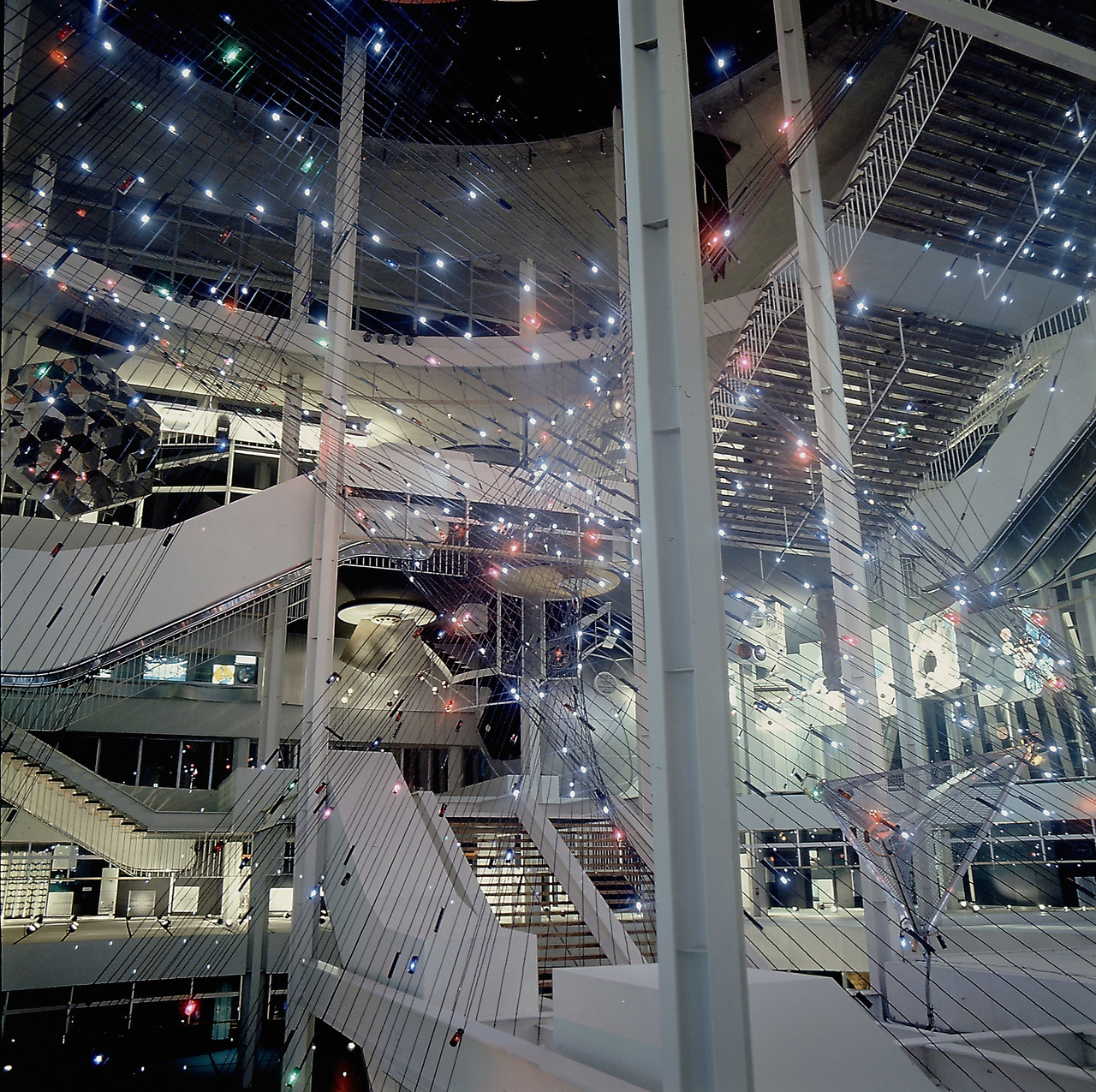
Given the opportunity to create a musical work for the French Pavilion at the Montréal World Exposition in 1967, Xenakis proposed to curator Robert Bordaz and the pavilion’s architect Jean Faugeron the first Polytope, »an electronic sculpture combining light, music, and structure,« a massive architectural installation consisting of 200 steel cables spanned in a hyperbolic paraboloid structure through the pavilion’s central atrium and outfitted with some 1200 mechanical relay-controlled white and colored xenon stroboscopic lights. The Polytope de Montréal was only the first of six other Polytopes, followed by installations in Persepolis (Iran), Paris (1972), Mycenae (1978), and Paris and Bonn (the Diatope, in 1978), plus two unrealised attempts planned for Mexico and Athens.
Despite their published scores and documentation, the Polytopes were never meant as fixed and final works but rather as site-specific environments, each uniquely tied to its particular socio-cultural-architectural context. The »Polytope de Montréal,« for example, was in many ways radically antithetical to Expo 67’s other pavilions, where the predominant theme was the transformation of the moving image through new forms of screen technology. From the still today radical work of the 20th century genius scenographer Josef Svoboda, who was responsible for the complex multi-screen installations »Polyvision« and the »Diapolyekran« at the Czech pavilion, to developments by Canadian experimental filmmakers like Francis Thompson or Roman Kroiter and Graeme Ferguson, who demoed the first seeds of what would become IMAX, the screen as technology and icon of progress took over the perceptual landscape of media in the exposition.
In contrast, Xenakis’ six minute, continually cycling light and sound »Gesamtkunstwerk,« with its 1200 strobes and four channel orchestral score all driven by a completely Byzantine control system of light sensors and a perforated command film punched with every possible lighting configuration, operated in direct contrast to Expo 67’s representational spectacle of the image. Indeed, even now as we face the ability to create high-resolution LED images, turning urban buildings and spaces into gigantic electronic billboards, Xenakis never seemed particularly interested in using thousands of points of light to create images, but rather to generate temporal forms and shapes that would invoke »two different musics: one to be seen and the other to be heard.«
While Xenakis’ notes detail a compositional sequence in the »Polytope de Montréal« of »stochastically distributed rivers,« »deep blue beacons,« »black holes,« and »whisps of fire,« all generated by the lighting in a continuously developing set of intensities of varying densities and rhythms, the Polytopes were meant to spawn the new kinds of electronic gestures that Xenakis already saw on the horizon. If light would be used as a temporal phenomenon, creating a »multitude of points that stop and go,« sound, created by acoustic instruments, would generate a space, a »continuity, thanks to the multiple glissandi – ›sound that changes but never stops.‹«8
In this way, as we look back at the Polytopes, these fascinating and relatively forgotten works of »new media« seem much closer to the kind of synesthetic experience described by psychologist Daniel Stern, which greets infants in the early stages of life who cannot understand human language but still seem to gravitate towards patterns, shapes, and sensations that, while not identifiable, nevertheless generate strong emotional responses and affects.
the Polytopes were meant to spawn the new kinds of electronic gestures that Xenakis already saw on the horizon...sound, created by acoustic instruments, would generate a space, a »continuity, thanks to the multiple glissandi – ›sound that changes but never stops.‹«
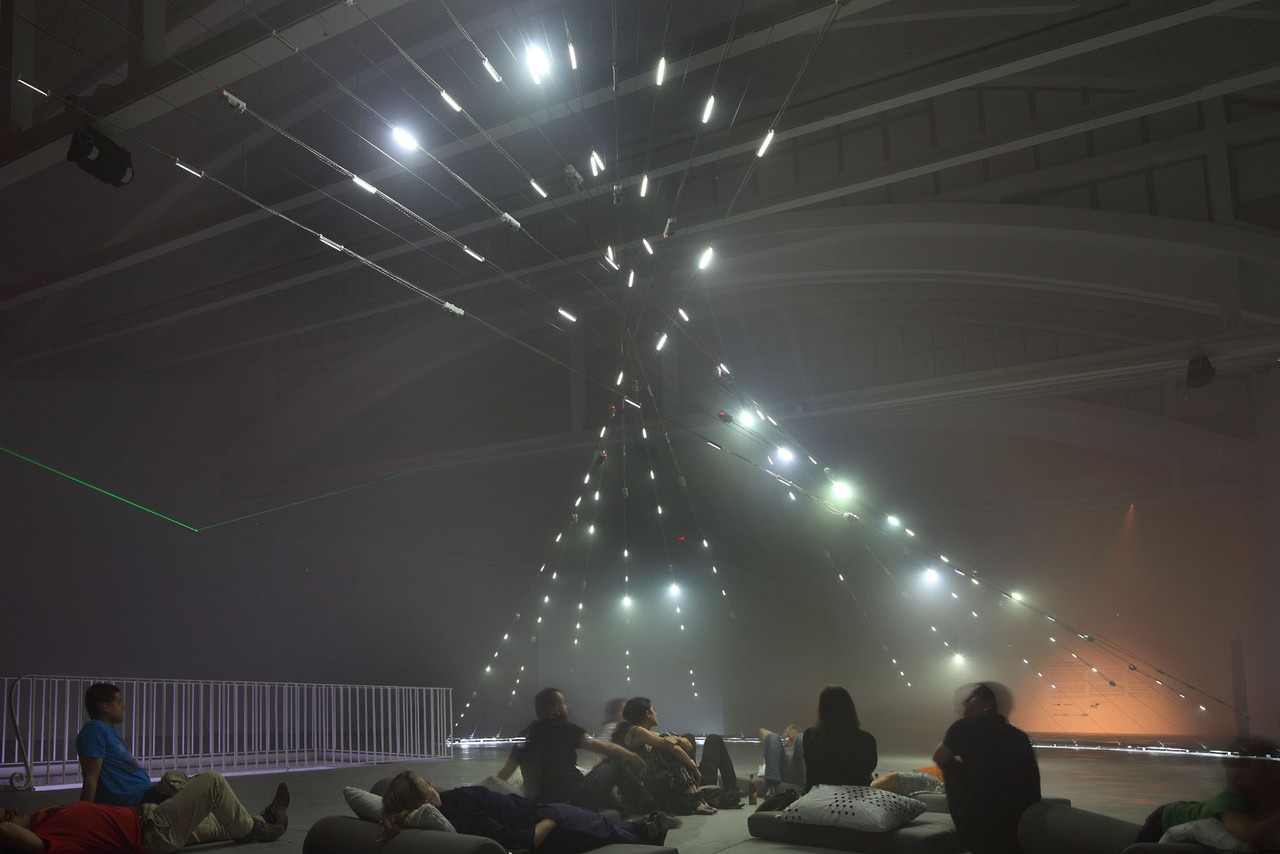
Although for »n-polytope« we based our research on the Montréal-based and almost hallucinogenic »Polytope de Cluny« which took place in the Cluny vaults in Paris in 1972, the work that we originally developed for the LABoral Center for Art and Industry in Gijon, Spain in the summer of 2012, and that is now being revised and re-worked here in Berlin for CTM 2014, is by no means either a reconstruction or re-enactment. Even with archival access and many discussions with Xenakis’ former assistant and translator Sharon Kanach and Cluny programmer Robert Dupuy in Montréal, it would be presumptuous and foolish to imagine that one could get into Xenakis’ head or to make an artistic experience like he could – to live not only through his deep understanding of mathematical form and how to translate this into aesthetic dimensions, but also to immerse oneself in the profound experiences that Xenakis had of a world on the verge of simultaneous annihilation and unfathomable scientific and aesthetic development.
Instead, as already stated in the article »N_Polytope,« for the 2013 volume Xenakis Matters, on the posthumous impact of Xenakis’ work, we approached our project in the spirit of reimagining. What would the Polytopes be like today? What techniques might Xenakis be drawn to if he were working now? How could we explore how Xenakis’s interest in indeterminate and stochastic systems could be made »experienced and lived within our own historical moment of extreme systemic instability?«9
As we confront a world which at many times seems almost completely out of control – where the lines between the born and the made, the natural and artificial, the ordered and the disordered seem to be further blurred everyday – Xenakis’s approach to »the fluid, rational and intuitive aesthetic of the imagination which seems to flow between light, sound and technology and theories« seems as radical in 2013 as it was in 1967.
In Arts/Sciences: Alloys, a published account of his Doctorat d’Etat defense in 1976, Xenakis called for a new kind of musician/artist – an »›artist-conceptor‹ of new abstract and free forms tending towards complexities and then towards generalizations on several levels of sound organization.«10 Such an artist would not only be aware of the scientific and aesthetic trends of their time (»mathematics, logic, physics, chemistry, biology, genetics, paleontology (for the evolution of forms), the human sciences, and history«) but also would be governed by a triad of functions that Xenakis saw as essential to creating artistic experiences: inference (exploration of forms), experiment (challenging theory through action), and revelation (the exposure of and to the ineffable).11 It is our hope that this attempt at reimagining Xenakis’s almost cosmological vision does justice to the composer’s aim: to create the conditions for artistic experiences to reveal and transform the world.
Stanford University graduate Chris Salter is currently Director of the Hexagram Concordia Centre for Research and Creation in Media Art and Technology, and Associate Professor in the Department of Design and Computation Art at Concordia University, Montréal. His artistic works have toured internationally, been written about in The New York Times, The Wire, and Leonardo, among others, and he has received major grants from SSHRC, FRQSC, Canada and Quebec Arts Councils, Hexagram, the Rockefeller Foundation, the Daniel Langlois Foundation, and more. In addition to his artistic work, Salter is also the author of Entangled (2010, MIT Press) and the forthcoming Alien Agency (2014, MIT Press).
This text was originally published in CTM Magazine 2014 – Dis Continuity.
- 1
Eric Hobsbawn. 1994. The Age of Extremes: The Short Twentieth Century – 1914–91. New York: Vintage, 11–12.
- 2
Tom Service. 2013. »A Guide to Iannis Xenakis’s Music.« The Guardian. April 2013.
- 3
Sharon Kanach. 2010. »Xenakis’ Polytopes.« In Iannis Xenakis: Music and Architecture. New York: Pendragon Press.
- 4
Iannis Xenakis. 1956. »The Crisis of Serial Music.« Gravesaner Blätter 6, July, 2–4.
- 5
Iannis Xenakis. 1970[2010]. »Topoi.« In Xenakis: Music and Architecture. Ed Sharon Kanach. New York: Pendragon, 142–147.
- 6
Heraclitus. »Fragments.« In The Presocratics. 1966. Ed. P.Wheelwright. New York: Macmillan.
- 7
Iannis Xenakis. 1954. »Notes towards an Electronic Gesture.« In Xenakis: Music and Architecture. Ed Sharon Kanach. New York: Pendragon, 131–134.
- 8
Xenakis. 1967. »The Polytope de Montréal: An Approximate Scenario of Light and Visual Art with the French Pavilion.« In Xenakis: Music and Architecture. Ed Sharon Kanach. New York: Pendragon, 210–211.
- 9
See C. Salter. 2013. »N_Polytope: Behaviors in Light and Sound after Iannis Xenakis.« 2013. Xenakis Matters. Ed. Sharon Kanach. New York: Pendragon.
- 10
Iannis Xenakis. 2011. Arts/Sciences: Alloys. Ed and Trans. Sharon Kanach. New York: Pendragon.
- 11
Ibid, 3–4.