
[Setting interview parameters]
Daniela Silvestrin => DS
Fronte Vacuo => FV
Project => Humane Methods [ΣXHALE]
q1-5 => [‘[Fronte Vacuo], [what] are [you] [doing] [here] [at the moment?]’]
[Exploring parameter #1] via direction: ‘rehearsing’
DS && q1 ‘[FRONTE VACUO]?’
FV && r1
Fronte is currently rehearsing its understanding of the present world.
FV && r1.1
Fronte is currently rehearsing its agency in the present world. Perceptions, expectations and experiences have changed drastically over the past year of pandemic.
FV && r1.2
Fronte is currently rehearsing its belief in the present world. Perceptions, expectations and experiences have declined drastically over the past decades of capitalist realism.1 Contrary to slogans like »we are all in this together,« the world has seen increasing polarisation, inequality has only widened, climate goals have been missed and lazily recalibrated.
FV && r1.3
Fronte is currently rehearsing its new performance project, Humane Methods [ΣXHALE]. Perceptions, expectations and experiences have changed drastically over the past centuries of ecological exploitation. Differently from our previous projects, [ΣXHALE] places the audience and the performers together in a world that has seen increasing catastrophe, where intolerance has only grown and climate goals have been missed. Was yesterday only a rehearsal of today?
Received a reward of: -0.154948594385 for that reply, getting closer.
Algorithmic Domination
The Guardian recently published2 an article recounting the case of German Member of the European Parliament Patrick Breyer, who took the European Commission to court. Breyer had read about a reporter who – planning to cross the border between Serbia and Hungary – voluntarily tested a new technology developed to detect lies using facial »micro-expressions.« This AI-based tool was to be used at European borders. The reporter from The Intercept, a woman, told the truth, but the virtual, algorithmic policeman claimed she had lied and suggested that she be subjected to further testing. This system is the result of a research project called iBorderCtrl, funded through the EU Horizon 2020 programme for the development of security products for police forces and border control.3 Concerns had been raised over the course of the research project by current and former ethics experts, but the inherent risks, as well as the ethical and privacy implications of using AI technologies to police borders, seemed to carry little weight in this project. Over the last years, piles of research results have proved how flawed AI technologies can be,4 owing to biases implemented in the systems by developers and policies. Even if biases are thoughtlessly encoded and results naively skewed, the most likely outcomes are ones of false alarms and thus discrimination against PoC, women, people with disabilities, and other minorities. Recent examples like those given by companies like IBM, Microsoft, and Amazon, who announced that they would suspend the sale of their facial recognition technology to law enforcement agencies,5 only reinforce the concerns. But when demanding access to information about the programme and publicly funded research of iBorderCtrl, both Breyer and later also The Guardian were denied access – the decision being justified as necessary to protect related trade secrets and commercial interests.
[Exploring parameter #2] via direction: ‘need’
DS && q2 ‘Fronte Vacuo, [WHAT]?’
FV && r2
Good point. What now? What are the questions you need?
FV && r2.1
Good point. What now? What are the meanings to reformulate? Art today does not need new pioneers, but renewed, collective meanings.
FV && r2.2
Good point. What now? What meanings should be questioned? Art today does not need any further thoughtless celebrations of technology, but renewed, collective practices. A methodological shift, so to say, is needed.
FV && r2.3
Good point. What now? What are the questions to ask? Art today does not need new pioneers, but new transdisciplinary methods – collectively nurtured practices that can help break the wall of the self-dignified denial of privilege that plagues neoliberal societies. A methodological shift, so to say, is needed. With [ΣXHALE] we aim to force people to reflect on violence in algorithmic societies by immersing the audience in the perspective of the bodies – human and non-human – that experience that violence. In the world of [ΣXHALE] violence is symbolic; decisions, however, are real.
Received a reward of: 0.995847204684 for that reply, getting closer.
Zombies
If there is no way for European citizens to either stay informed or gain access to the decision making processes that establish whether their tax money is used when it comes to such technical developments, how can citizens have a meaningful debate about it? For issues like this to be discussed on a broader level, including different groups of both interested and affected people, a certain level of awareness among citizens about how such technologies should be implemented and for what purposes needs to be raised. Ignorance about the potential implications is a key factor for such developments to be implemented without substantial debate in the first place. This is further fueled by our Western societies’ technological optimism and »Techno-Fix« thinking. Widespread belief that technological change is inevitable and that technology is value-neutral6 leads to a generally uncritical acceptance and adoption of new technologies.
While AI-based policing algorithms are at one end of the spectrum of discriminating against non-white, non-male, human and non-human life, the same implications and inherent biases can also be found on the other end of the spectrum in current ideological movements such as Transhumanism. Here, technological optimism promotes the extension and resurrection of »(white) life at any cost,« which Jack Halberstam takes issue with, terming it Zombie Humanism:7 »..the production of enhanced life opportunities for the few through the bargain that consigns the many to living death« – i.e. poverty, imprisonment, starvation, disease. Within the neoliberal logic of what Donna Haraway called the »informatics of domination,« Western societies and those in power of deciding where and how to use these technologies proclaim themselves as the saviours of life and the planet: as gatekeepers, they (the new algorithmic policing systems) save the Global North from unwanted bodies invading »their« territories and lives; as rescuers, they ( the new biotechnologies) enhance and save the lives and bodies of those worthy of it – be that human lives enhanced or reproduced at any cost, or non-human/animal life being selectively resurrected and thus ›saved‹ from extinction without consideration for why they went extinct or were endangered to begin with. As Halberstam points out, we are in a deep environmental crisis, but are working on extending the lives of those who put the planet in danger in the first place – but those who created the danger in the first place cannot also be the saviours.
[Exploring parameter #3] via direction: ‘identity’
DS && q3 ‘Fronte Vacuo, what are [YOU]?’
FV && r3
There is not always a ›you,‹ or an ›I.‹ There is, but Western people tend to forget that identities are not as isolated as monads.8
FV && r3.1
There is not always a ›you,‹ or an ›I.‹ ›You‹ is that which makes what ›I‹ am, and ›we‹ are in this together. Yet, who is ›we?‹
FV && r3.2
There is not only a ›you,‹ or an ›I.‹ There is also the space in-between. Screens, keyboards, circuits, cables. There are ecosystems that were debowelled so that authors working remotely like the four of us could type their text on devices; servers that host the text draft while it is being edited. Western humans tend to forget that ›we‹ happen in a material space, which has an agency on its own beyond its symbolic meaning.
FV && r3.3
There is not always a ›you,‹ or an ›I.‹ ›We‹ think each one of ›us‹ is important – and they are. Yet, ›we‹ were socialised in the utopic Western narrative of the individual (self-enclosed, self-sufficient, able-bodied and able-minded, self-determined). The 20th Century economy bloomed on the marketisation of identity – one’s own car, smartphone, laptop, suggestions for personalised apps – and thus identity has been celebrated and monetised. Yet, when one scratches the putative boundaries of identity, what appears is a rich landscape of interpenetrating desires, exploitation, material links, and histories that create the ground for ethical choices. [ΣXHALE] is a dimension where ethics is not only represented on a stage, but is extended to the audience and human and more-than-human performers.
Received a reward of: 0.569821353745 for that reply, getting closer.
Human(e)
When you look up the meaning of the term »humane« in dictionaries, the definition that characterises our species is quite flattering. Described as »showing kindness, care, and sympathy towards others, especially those who are suffering,«9 »marked by compassion, sympathy, or consideration for humans or animals,«10 the human(e) essence and behavior seems to be guided by an inherently and essentially positive, caring, and »good« morale. But looking at the various crises we have found ourselves in up until this day – ecologically, socially, politically, economically – I wonder: do we need to qualify and put into perspective this human essence, or (how) can we transform our current ways of living and (inter)acting in order for that compassionate and caring humane essence to take effect? From another viewpoint: how can care and solidarity help confront and deal with the non-neutrality of technologies? What are the methods we need to develop, what are the ideas we need to question, and what are the values we need to reframe in order to shape technologies as tools of empowerment rather than of manipulation and homogeneity?
[Exploring parameter #4] via direction: ‘loop’
DS && q4 ‘Fronte Vacuo, what are you [DOING]?’
FV && r4
Fronte has been studying the meaning of ›loop‹ - an instruction repeated over and over.
FV && r4.1
Fronte has been studying the meaning of ›loop‹ – a code enunciated over and over – to create a procedural dramaturgy. It is, essentially, an endless series of variations of the same loop.
FV && r4.2
Fronte has been studying the meaning of ›loop‹ – a ritual repeated over and over – to create a procedural dramaturgy. It is, essentially, an endless series of variations of the same loop. Small things with no apparent significance slowly erode your senses in a kaleidoscopic, almost hallucinatory ramification of the real. [ΣXHALE] is a psycho-social experiment.
FV && r4.3
Fronte has been studying the meaning of ›loop‹ – an instruction repeated over and over – to create a procedural dramaturgy. Like this very text, the dramaturgy of [ΣXHALE] is a merciless series of variations of the same loop. Variations emerge from the interactions among performers, audience, living organisms and algorithms. It is a complex, tightly-knotted feedback network of cause and effect. Small things with no apparent significance frantically erode your senses through a saturated, almost self-perpetuating diffraction11 of the real. [ΣXHALE] is, thus, a social experiment: a group of people (audience and performers), non-human organisms and algorithms is trapped in a loop, and the only thing they can do is to negotiate a collective ethic out of their respective autonomies and responsibilities. Individual freedom is so 90s.
Received a reward of: -0.189653697412 for that reply, moving away.
An essential problem in evaluating such technologies and their implications is that people don’t experience (see / feel / hear / sense) them. But even if such »smart« technologies were more easily detectable by our senses, our brains need more than the mere existence of a stimulus to actively perceive things that surround us or happen within our range of vision / hearing. Only those sensory impulses that surpass a critical subconscious threshold in terms of novelty or importance can attract our attention, and thus lead to awareness.
[Exploring parameter #5] via direction: ‘question’
DS && q5 ‘Fronte Vacuo, what are you doing [HERE]?’
FV && r5
The question of the body is important; are you here?
FV && r5.1
The question of intelligence is important; is there any here? The problem with artificial intelligence is embodiment, or, better, the perceived lack of it in AI algorithms. AI has bodies in the form of millions of computer servers and, yet, the idea of artificial intelligence is sold as that of a transparent, gaseous, tiny fluffy cloud of smart code. Cute. Not only AI has million bodies; when deployed poorly or unethically, it also hurts millions of other bodies, human and non-human. Sometimes it crashes them.
FV && r5.2
The question of the artificial is important; is it not, here? The problem with artificial intelligence is unaccountability, or, better, the perceived lack of it in AI algorithms and who creates them. The thing is »artificial,« how do you hold it accountable? Indeed, AI is not accountable, not yet. The capitalist infrastructure that nurtures unethical AI research or its life-demeaning applications is. The media that foster the spectacle, the show, the hype, they are. The policy-makers that refuse to understand the value of AI beyond the logic of the neoliberal market, they are accountable too.
FV && r5.3
The question of experience is important; are you still here? The problem with experience is that it exists only in relation to something other, and, you bet, those relations make living things accountable for one another. The thing is, how do you speak of interdependence on a stage, how do you hold everyone – performers and audience – accountable? Accountable for what? They just sat down to enjoy your show! Accountable for their responsibilities, as well as for their power, which is the power to create relationships, to share experiences, to care for others. [∑XHALE] is, fundamentally, about how much violence is needed before humans learn to use that kind of power and acknowledge its implications for all other living creatures.
Received a reward of: -0.005688151687 for that reply, moving away.
Corpora
Performance art has a long history of being used as a medium to bring human action and its motivations into confrontation with other (cultural) practices, and to transfer them into a cultural memory, thereby both expanding and questioning it. Due to its physical conspicuousness and duration, performance art is able to demand a maximally heightened attention and thus to reach the awareness of observers in a special, affective way. To create such an environment, performance art – and especially durational performances – creates a space in which actions enter the observer's perception, isolated from the everyday concept of time. This causes a shift and displacement of the present bodies in relation to the outside world, making them more susceptible to affective impulses. Similarly to the function that specific rituals had in archaic civilisations and still have in some indigenous societies – that is, to create a heightened awareness which then translates into meaningful actions for both the individual and the community – performance art functions by transforming symbols into actions and images: taking part in or even just observing such performances thus allows the audience to create memories not only on a mental / psychological level, but also – through intropathic processes – somatically, giving space to embodied knowledge.12 The rather new field of »sensory studies« has shown how our idea about perception being clearly divided into specific senses for specific stimuli is outdated, and that the way we sense, absorb and process the multitudes of external signals is always much more a bodily experience rather than one of a single, isolated sensory organ.13
Our bodies are our most important perceptual instruments – thus, by observing the actions in a performance setting, an identification of my own corporeality with that of the other takes place. I do not simply perceive, but experience the other.
[Exploring parameter #6] via direction: ‘tempo’
DS && q6 ‘Fronte Vacuo, what are you doing here [AT THE MOMENT]?’
FV && r6
Temporalities deserve attention.
FV && r6.1
Temporalities deserve attention. Just imagine, if one could close their eyes and perceive the lifespan of bacteria and trees simultaneously.
FV && r6.2
Temporalities deserve attention. The ephemeral moment of a performance, of a video projection, of a bio-art piece, reverberates beyond its duration.
FV && r6.3
Temporalities deserve attention. Certain humans observed how a new geological era was triggered by human action and even named this era after themselves. This is a brilliant scientific metaphor14 to illustrate irreversible changes induced by resource exploitation, yet, it has become a conflated catch-all keyword. On a geological scale, the past decades of capitalist realism and the centuries before are nothing more than a twinkle. In the last months (do you remember how the world used to be until yesterday?) a minuscule entity brutally reminded us of our vulnerability. Fronte Vacuo started developing [∑XHALE] in 2019. The whole series happens in a space out of time, yet it speaks of current times. It may be in the future, or in the past; no one really knows what happened to its characters – and yet, we (performers and audience) all know.
Received a reward of: -0.756322187875 for that reply, moving away.
Anomaly
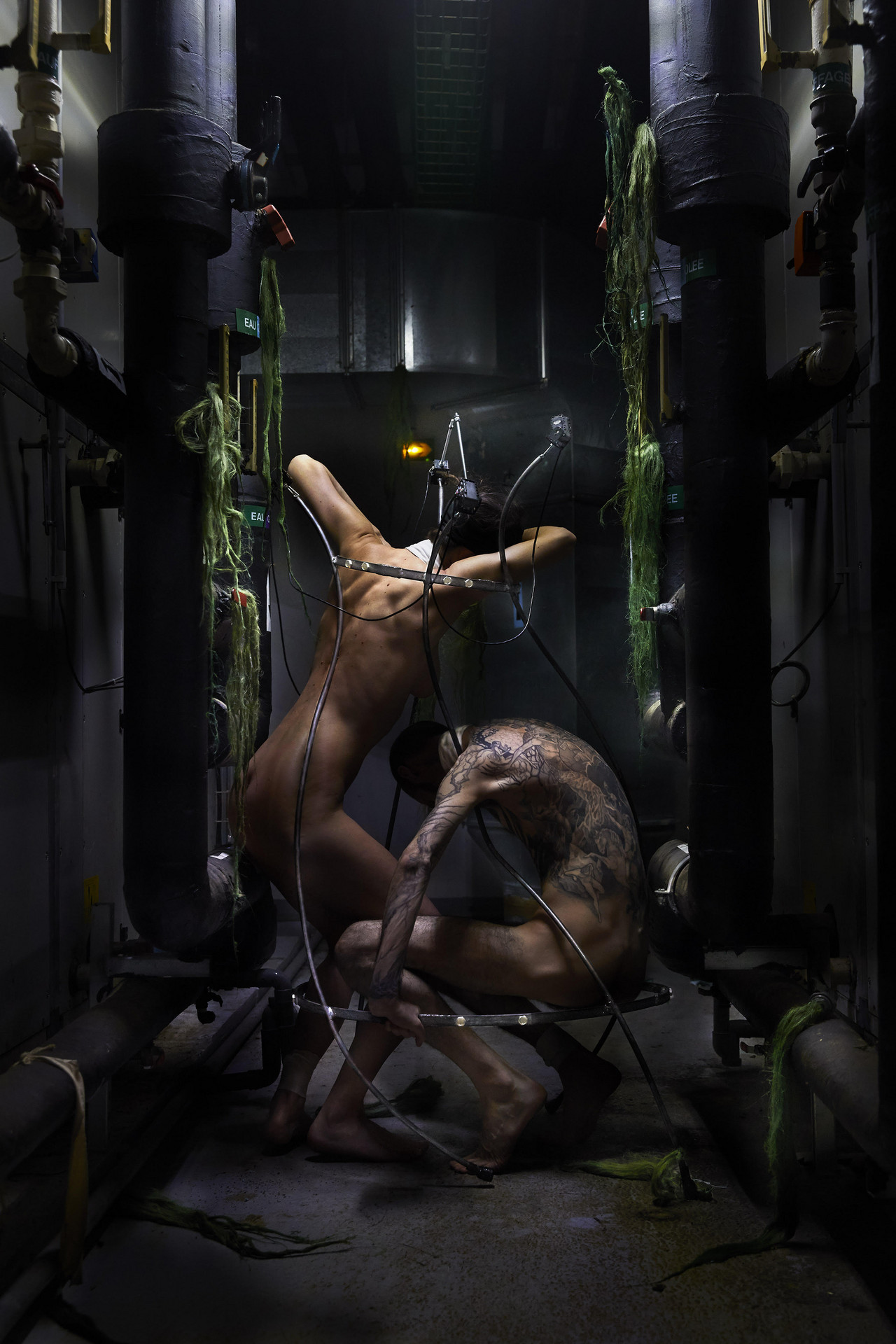
Performance pieces and concepts like [ΣXHALE] by Fronte Vacuo function as translations of (parts of our) reality into an event / occurrence, thus creating an affective environment. By means of engaging through and with loops and repetitions of actions and situations at the core of the performance piece, the participants in the audience can align and tune in their bodies with both the bodies of the other performers and the ubiquitous algorithmic systems scanning, observing, and analysing their movements and interactions. As the festival theme suggests, »[t]ransformation is not necessarily a revolution. It is not a violent and total break with the present, but rather a process of change that reinforces, expands, and unfolds approaches that already exist.« While in the outside world we seldom get the chance to go through the same situation several times to potentially adjust and reevaluate our decisions and actions, [ΣXHALE] creates a space where such transformative power and potential can be released.
In his analysis of how paradigm shifts in scientific revolutions are based on changes of worldview, Thomas Kuhn describes the phenomenon of »perceptual transformation« as seen in psychological experiments on perception:
»An experimental subject who puts on goggles fitted with inverting lenses initially sees the entire world upside down. At the start his perceptual apparatus functions as it had been trained to function in the absence of the goggles, and the result is extreme disorientation, an acute personal crisis. But after the subject has begun to learn to deal with his new world, his entire visual field flips over, usually after an intervening period in which vision is simply confused. Thereafter, objects are again seen as they had been before the goggles were put on. The assimilation of a previously anomalous visual field has reacted upon and changed the field itself. Literally as well as metaphorically, the man accustomed to inverting lenses has undergone a revolutionary transformation of vision.«15
Performative environments and experiences like those offered in [ΣXHALE] are the metaphorical goggles with inverting lenses. They can show us a part of reality that our sensory apparatus – adapted as it is to familiar environments, customs and societal structures – does not afford to see otherwise. People who are open to questioning what citizens of Western societies have learned to experience as the comfort zone of neoliberal structures will need some courage to confront the unavoidable »acute personal crisis« as part of this process. But eventually they will be rewarded not only with clear vision, but also with a new understanding of how vision works.
Daniela Silvestrin is a curator, cultural researcher, and organiser-facilitator with a particular interest in practices that critically explore and question physical, ethical, and social boundaries and paradigms from an artistic perspective. Her work and research focuses on the potential of speculative and disruptive creative practices at the intersection of art, society, and the techno-sciences to envision sustainable futures and to produce new forms of experimental knowledge. Silvestrin is part of different cultural and artistic projects and initiatives in Berlin, co-director of a European film festival in northern Germany, and co-editor of the forthcoming anthology Book of Anonymity (punctum books, spring 2021).
Fronte Vacuo is a transdisciplinary artists group co-founded by Marco Donnarumma, Margherita Pevere, and Andrea Familari in response to the current convergence of ecological disruption, socio-political polarisation, and technological advance. Fronte Vacuo creates hybrid, bastard performances and live art events, where bodies, symbionts, sounds, machines, and images interweave with one another. Its co-founders previously collaborated to create and produce internationally acclaimed dance theatre productions, award-winning artistic experiments, and scholarly publications. As individual artists, each member has been working across performing arts, media art, music, and bioart for over fifteen years.
Marco Donnarumma is an artist, performer, and scholar weaving together contemporary performance, new media art and computer music since the early 2000s. He manipulates bodies, creates choreographies, engineers technology, and composes sounds, thus combining disciplines and media into oneiric, sensual, uncompromising aesthetics. He is internationally acknowledged for solo performances, stage productions, and installations where the body becomes a morphing language to speak critically of ritual, power, and technology. Donnarumma holds a PhD in performing arts, computing, and body theory from Goldsmiths, University of London. Currently, he is a Research Fellow at the Akademie für Theater und Digitalität, Dortmund.
Margherita Pevere is an internationally acknowledged artist and researcher working across biological arts and performance. Her transdisciplinary inquiry hybridises biolab practice, biotechnology, ecology, gender, and death studies, with a hacker attitude to creating visceral installations and performances that hunt today’s surging ecological complexity. Her body of work is a garden crawling with genetically edited bacteria, her epithelial cells, sex hormones, microbial biofilm, bovine blood, slugs, growing plants, and decomposing biological remains. She is completing a PhD (Aalto University, Helsinki) on biological arts and feminist theory. She is a member of the Finnish Bioart Society and of The Posthumanities Hub.
Andrea Familari has worked with theatre, music, contemporary art, especially in the live audio/visual scene. Familari is a multimedia artist whose research derives from investigations of generative processes, analysed through the lens of the noise and expressed via different media: video screenings, interactive installations, prints. Experimenting since 2011, he establishes his practice within the international underground media and art scenes. His repertoire tours regularly from theaters to concert halls, festivals and museums, and has been presented in 23 countries worldwide.
This text was commissioned as part of CTM 2021 – Transformation.
- 1
Fisher, M. (2009). Capitalist Realism. Is There No Alternative?. Winchester: Zero Books.
- 2
Campbell, Z. »Sci-fi surveillance: Europe’s secretive push into biometric technology.« The Guardian. Published December 10, 2020. Accessed December 14, 2020.
- 3
EU Horizon 2020 is a framework of public funding programs whose general aim is to fund »research, technological development, and innovation in the European Research Area (ERA).« Incidentally, Horizon 2020 provided substantial funding for various art and science / technology institutions and programs.
- 4
Danks, D., & London, A. J. (2017). »Algorithmic bias in autonomous systems.« IJCAI International Joint Conference on Artificial Intelligence, 4691–4697.
- 5
Taulli, T. »Facial Recognition Bans: What Do They Mean For AI (Artificial Intelligence)?« Forbes. Published June 13, 2020. Accessed December 19, 2020.
- 6
According to the Value-Neutrality Thesis (VNT), technology is morally and politically neutral, neither good nor bad. Yet, VNT is rejected widely by philosophers, technologists, science and technology studies (STS) scholars, and social critics, arguing that owing to their material properties, »technological artifacts are part of the normative order rather than external to it. Due to the endurance and longevity of technological artifacts, values embedded in them have long-term implications that surpass their designers and builders.«
See: Miller, B. »Is Technology Value-Neutral?« Science, Technology, & Human Values. Published online January 22, 2020. doi:10.1177/0162243919900965
- 7
See Jack Halberstam’s talk as part of the Disruption Network Lab Panel »From Cy-Borg to Bio-Borg. Transhumanist Visions Reviewed,« from minute 44:45; 2015. Accessed December 14, 2020.
- 8
Monad, (from Greek monas »unit«), an elementary individual substance that reflects the order of the world and from which material properties are derived.
See: "Monad." Britannica Academic, Encyclopædia Britannica. Accessed 31 Dec. 2020.
- 9
»Humane.« Cambridge English Dictionary. Accessed December 19, 2020.
- 10
»Humane.« Britannica Academic, Encyclopædia Britannica. Accessed December 19, 2020.
- 11
Barad, K. (2007). Meeting the Universe Halfway. Durham: Duke University Press.
- 12
Meyer H. (2008) Schmerz Als Bild: Leiden Und Selbstverletzung in Der Performance Art. Transcript Verlag.
- 13
Howes D. (2004) Empire of the Senses: The Sensual Culture Reader. Berg Publishers.
- 14
Steffen, W., Crutzen, J., & McNeill, J. R. (2007). »The Anthropocene: are humans now overwhelming the great forces of Nature?« Ambio, 36(8), 614–621.
- 15
Kuhn, T.S. (2012) The Structure of Scientific Revolutions: 50th Anniversary Edition. Anniversary Edition. University of Chicago Press. pp. 112-113.