
In 1968 Gita Sarabhai made two tape recordings on the Moog modular synthesiser that had arrived at the National Institute of Design (NID) in Ahmedabad under the instruction of musician and composer David Tudor. Gita was the sister of Gautam Sarabhai, an industrialist, and Gira Sarabhai, an architect, who were both pivotal in laying the foundations for the NID when it was established in 1961. Alongside her siblings, Gita had been involved with envisioning the curriculum for this new institution and setting up the sound studio, bringing to it avant-garde practitioners that made the NID and Ahmedabad a centre of experimental art and design. The family and their work at the institute exemplified the modernist direction that Jawaharlal Nehru sought for India in the years following its independence.
Gita was born in 1922 in Ahmedabad; one of eight children of the wealthy industrialist Ambalal Sarabhai and Saraladevi Sarabhai. The family owned Calico Mills, one of the first major textile mills in Ahmedabad. They were supporters of Mahatma Gandhi and were committed to a liberated and progressive vision for an independent India, which inflected their way of life. They were a uniquely modern Indian merchant family, whose lives were defined by a privilege and exceptionalism that gave them the resources to evolve and build a significant cultural influence, bringing the vision for India into dialogue with Western modernism.
By all accounts Gita was more intent on listening and sharing than being centre stage.
Saraladevi was greatly influenced by the teachings of Maria Montessori, as well as Santiniketan and the philosophy of education espoused by Rabindranath Tagore who was incorporating Montessori methods into his own vision for an interconnected humanist and naturalist approach to learning, with freedom of expression at its core. She created a homeschool for her children with specialist teachers from Cambridge and Santiniketan, giving them the opportunity to pursue their individual interests while requiring them to reach a high level of proficiency.1 This level of investment in the children’s education resulted in an accomplished family excelling in their own specialisms and eventually making a significant mark on India through industry, science, architecture, and arts patronage. Out of the eight siblings, it was Gita, Gautam, and Gira that took a particular interest in Western ideas and avant-gardist cultural practices which would lead all of them to make connections with Western artists, designers, and architects that they would later bring to the NID for performances and workshops. There were few students in the early years at NID and the institute was devised as an environment for meeting and experimentation rather than formal learning.
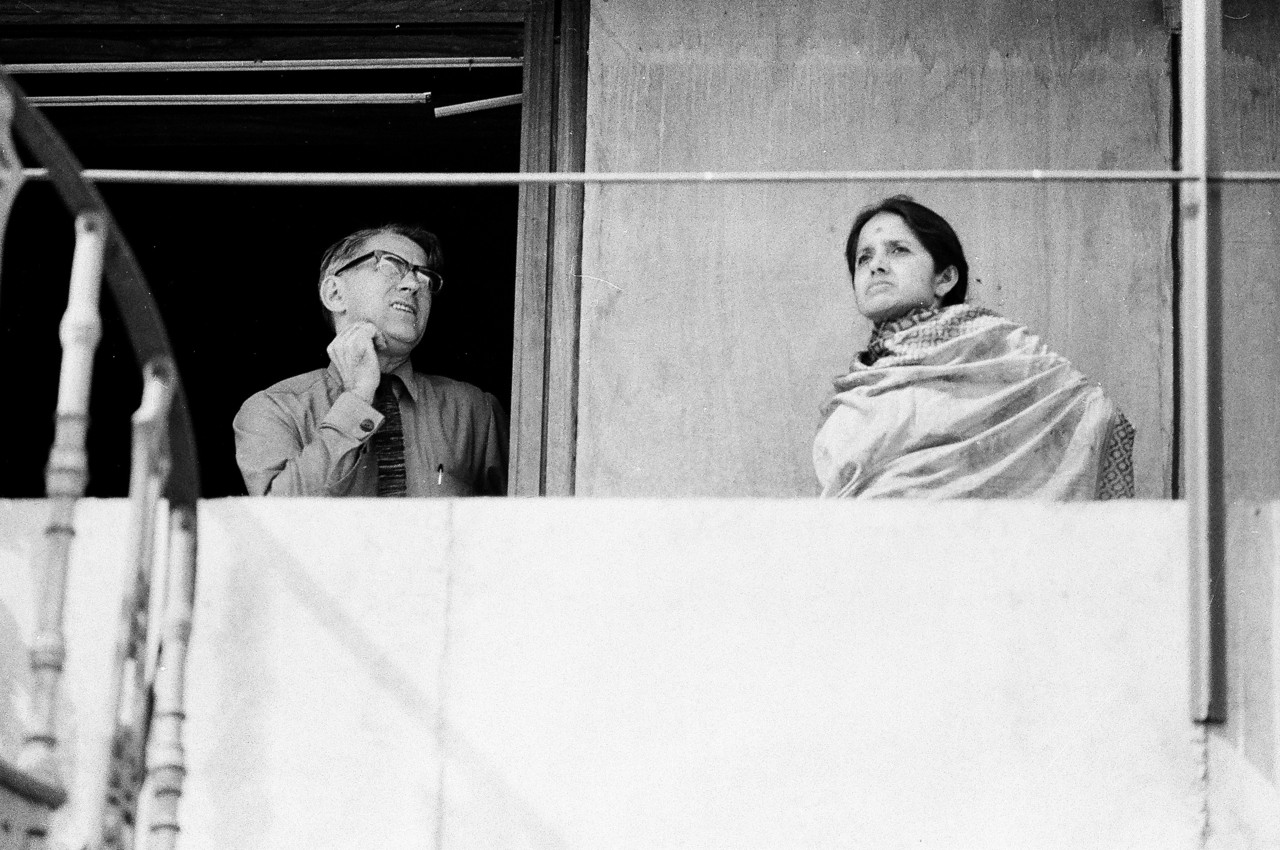
Gita had followed her interest in music, taking a Masters level examination in Hindustani classical vocals at Marris College of Music (now Bhatkhande Sanskriti Vishwavidyalaya) in Lucknow. This was a nerve-racking experience for Gita, so much so that her abstemious mother allowed her to have some alcohol before the exam to help calm her nerves.2 From this point she became a lifelong practitioner and student of Indian classical music and music theory. Gita was a musicologist as much as she was a musician and amassed a large archive of tape recordings of classical and folk music from her travels around India. In 1949 Mayor established Sangeet Kendra (»music centre«) as a way to preserve and disseminate the aural tradition of Indian classical music, organising baithaks (sessions) and lecture demonstrations, and later releasing music by seminal artists such as Siddheshwari Devi, Surashree Kesarbai Kerkar, Nazakat and Salamat Ali Khan, and Zia Mohiuddin Dagar. Despite this passion and dedication, Gita was seemingly always reluctant to produce her own music, to be distributed, or to perform publicly. She preferred a more private and intimate practice that existed in the time she spent learning with her teachers, having conversations and working on very occasional collaborations. By all accounts Gita was more intent on listening and sharing than being centre stage.
As well as training in singing, Gita was also one of the first Indian women to play the pakhavaj, a barrel shaped two-sided drum that was traditionally played by men. Being a woman in the Sarabhai family was not inhibiting for Gita or any of her sisters as Ambalal had been a staunch believer in equal rights for women.3 His position was undoubtedly influenced by another member of the Sarabhai family who was pivotal in this period in progressing women’s rights. Ambalal’s sister Anasuya Sarabhai was a pioneer of the women’s labour movement in India and led the Ahmedabad Mill Strike in 1918, during which Gandhi began his first hunger strike in solidarity with the workers. These actions were directed to hold the mill bosses—including Anasuya’s own brother—to account on the issue of pay. This would have been an encouraging political environment for Gita and her sisters, although it is unclear whether she held a similarly progressive politics and if this was a factor in her own thinking around the practices in Indian classical music—specifically in consideration of the patriarchal, casteist, and Hindu nationalist legacies of Indian classical music.4
Aware of the changes that modernisation was bringing to India, Gita was ›concerned about the effect of Western musical modernity on Indian classical traditions‹ and wanted to understand the tenets of this modern music that was having such an impact.
It is within this family environment that Gita was able to maintain a self-directed study of music that would eventually lead her to travel to New York. Gita’s practice in the Indian classical music tradition emerged at a time of significant cultural shift. Aware of the changes that modernisation was bringing to India, she was »concerned about the effect of Western musical modernity on Indian classical traditions«5 and wanted to understand the tenets of this modern music that was having such an impact. In 1946, when she was 25, Gita went to New York hoping to learn about Western music, initially intending to study at Juilliard. At the time she already had a deep interest in philosophy and in particular the work of Jiddu Krishnamurti, whose teaching centred around the idea that »truth is a pathless land… limitless, unconditioned, unapproachable by any path whatsoever.«6 Krishnamurti advocated for a kind of freedom without direction, that perhaps compelled Gita to use her privilege in life to commit to a music practice led by curiosity rather than a focus on performance and attainment. Gautam put her in touch with his friend the sculptor Isamu Noguchi, who suggested Gita should be learning from musicians rather than formal study, and introduced her to John Cage. From her first meeting with Cage, Gita recalled: »John very readily offered to teach me what he had learnt from Schoenberg. When I inquired from him what I would have to pay for the lessons… he replied that if I taught him Indian music there would be no question of payment. I was overjoyed.«7
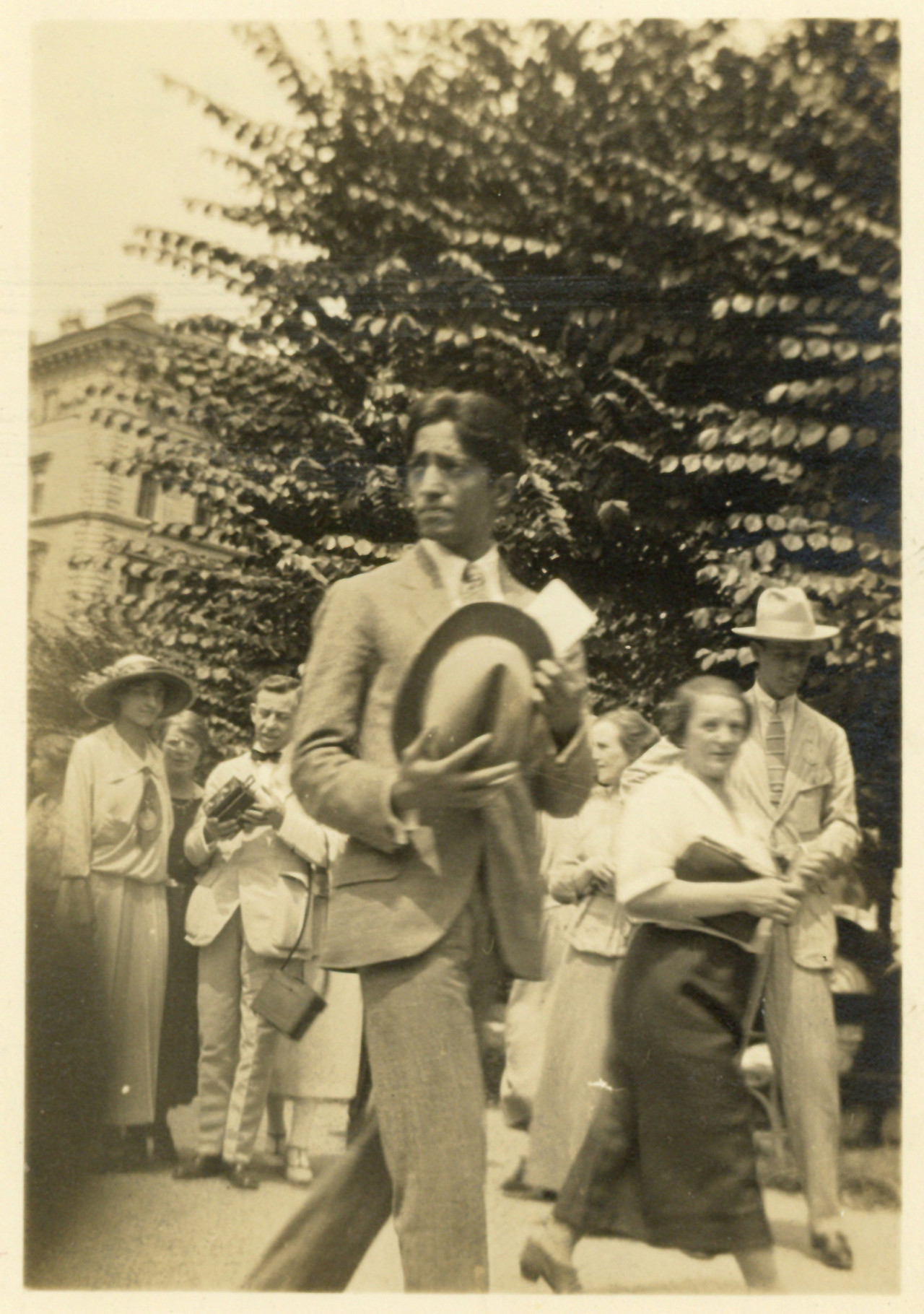
Much has been written by Cage and others on the six month exchange that followed, during which the two musicians met multiple times a week, and on the immense influence that learning about the Indian classical music tradition and Indian philosophy had on Cage and the development of his work in the 1950s and 60s. But there is less information on the impact that this exchange had on Gita and what she took away from her studies with Cage on Western music, including the twelve tone technique and counterpoint. Did this influence her later relationship to music and her encounter with the Moog when it arrived at NID? In one of his lectures Cage shared that Gita’s reasoning for making music was »[to] sober the mind and thus make it susceptible to divine influences.«8 Her primary commitment was to this concept of śāntarasa (tranquility), one of the nine rasa which in Indian aesthetic theory denotes nine essences or emotions that might be affected in the audience by an artistic work. It is not clear how Gita’s exchange with Cage impacted her personal philosophy on music, but they built a close friendship that would later bring Cage, Merce Cunningham, and David Tudor to the NID, and »…Ahmedabad soon became a kind of outpost of the New York downtown scene.«9
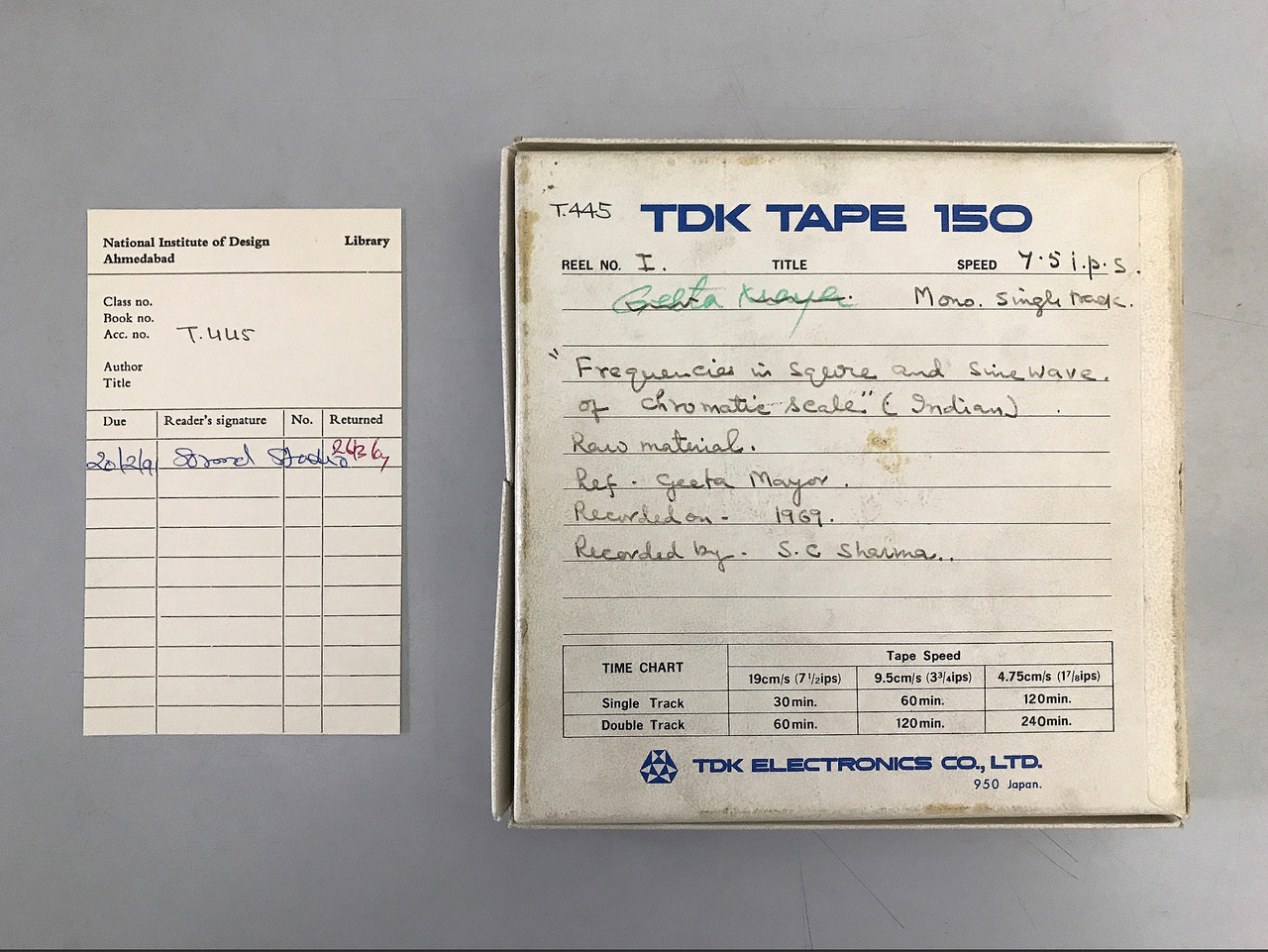
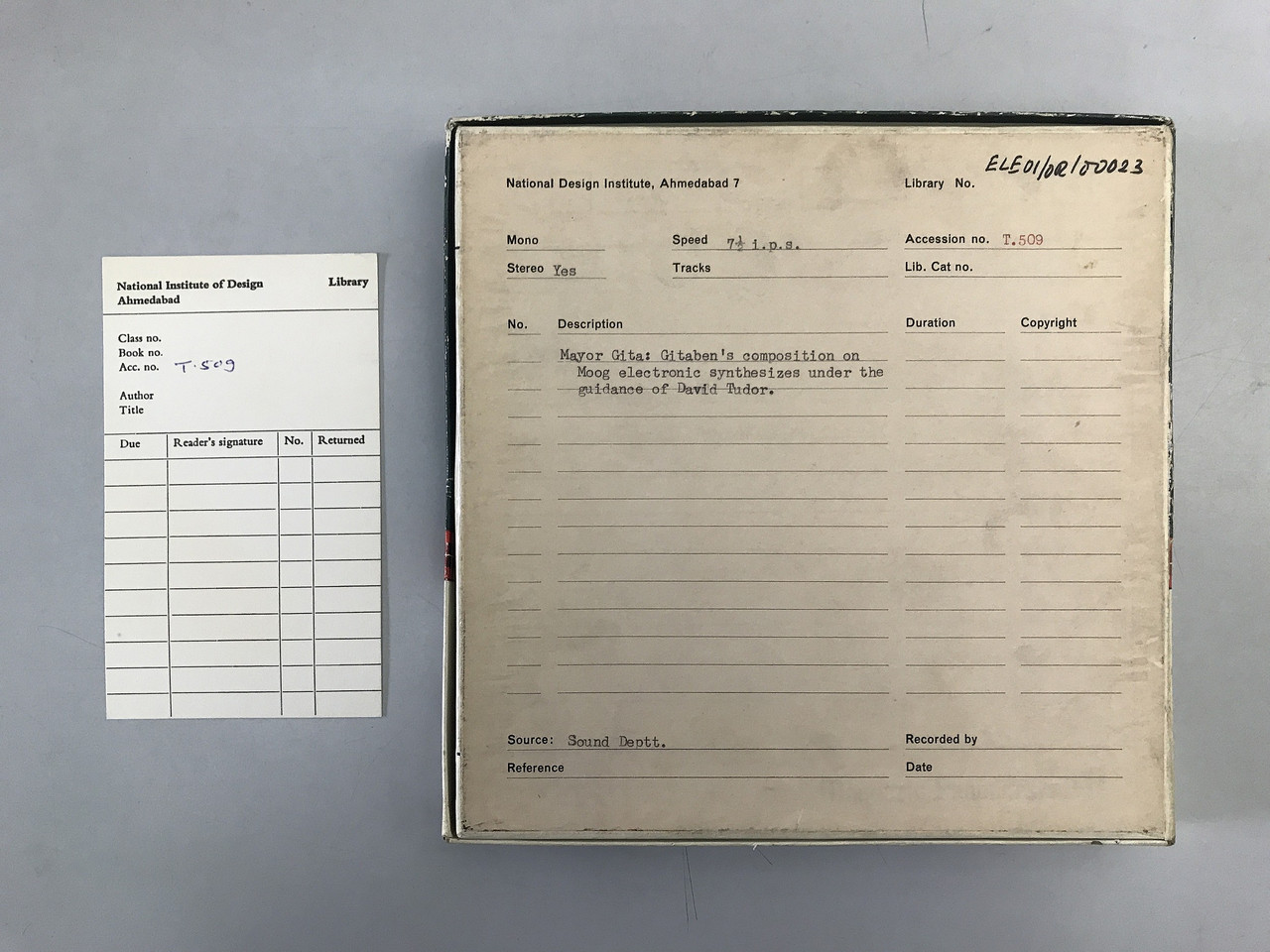
The two recordings made on the Moog by Gita, recently digitised by Paul Purgas, each reveal a considered yet playful attempt to engage this strange new technology. In the recording on tape T509, Gita was testing the synth’s range, from a suspended drone to a series of sound effects and vocal distortions. The recording on tape T445, labelled »Frequencies in square and sine wave of chromatic scale (Indian)«, makes apparent that Gita was attempting to interpret the Indian chromatic scale using the Moog. The recording is 20 minutes long and features the ascending scales of a saptak (the equivalent of an octave)—a series of seven primary and five auxiliary svaras (notes), making a total of 12 svaras. The recording moves through two versions of saptak using square and sine wave tones. Gita seemed interested in exploring how she could use the Moog as an instrument, bringing familiar structures into her engagement with the possibilities of synthesised sound. The Moog initially had a fretless ribbon controller rather than a traditional keyboard (which was added to the system around 1970), which meant that it could be touch-controlled across a continuously variable frequency spectrum, making it more applicable to non-Western scales. In the last seven minutes of Gita’s recording, the tonal scales are layered and interspersed with distorted samples of Hindi songs and additional sound effects. This surprising end to the recording introduces musique concrète and sampling techniques that break the structural form of the chromatic scale, creating a montage that utilises the crossovers and distinctions between Indian music and Western electronic sound.
It is not clear how Gita’s exchange with Cage impacted her personal philosophy on music, but they built a close friendship that would later bring Cage, Merce Cunningham, and David Tudor to the NID, and ›…Ahmedabad soon became a kind of outpost of the New York downtown scene.‹
In the same year that Gita recorded her Moog experiments she made the soundtrack for Events In A Cloud Chamber,10 one of two experimental films by the artist Akbar Padamsee, known primarily as a modernist painter. Padamsee made the film at the Vision Exchange Workshop (VIEW) in Mumbai, which he had founded in 1969 as a space for interdisciplinary experimentation and collaboration. The only print of the film was lost and so far a recording of the soundtrack has not been found, but this work represents a rare instance in which Gita made sound or music for presentation. The timing and nature of this collaboration makes it entirely possible that the soundtrack was recorded on the Moog at NID, although she apparently lacked confidence in using the synthesiser. In an interview, Tudor, who had initially met and become close friends with Gita’s sister-in-law Manorama Sarabhai, shared his frustration at working with Gita at the NID. She was apparently »like a recluse, very exclusive,« and Tudor goes on to describe an occasion he arranged for her to present her Moog compositions at the NID when she pulled out at the last minute, afraid that she wasn’t good enough.11 Gita was elusive to Tudor as she was to many and he didn’t understand her reluctance; he thought of performance through the indeterminacy of his practice with Cage—the spirit of liveness rather than perfection. In theory this is not far removed from Gita’s own philosophy and it’s likely that she and Cage shared these ideas too. However her understanding of improvisation from an Indian classical perspective was one that existed within the learnt rules of the raga and years of practice, something she had not had with the Moog.
Gita’s family describe her as having been a private although warm and sociable figure, but their memories are also full of the absences and tensions that commonly mark personal accounts. Relying on many anecdotes and some speculation, this partial portrait informed by Purgas’s research into the NID, is hopefully the start of a deeper investigation into Gita’s work and life, greater insights into her brief experiments with the Moog, and how, if at all, that period of exchange with Western musicians and electronic music technology shifted her perspective on musical form.
Rahila Haque is a curator, writer, and PhD researcher at Chelsea College, University of the Arts London. Her doctoral research considers diasporic artistic praxes in dialogue with black and anticolonial feminist epistemologies.
This text was commissioned as part of CTM 2023 – Portals.
- 1
Pallavi Mayor, interviewed by Paul Purgas and Alannah Chance, Ahmedabad, 5 March 2020. Unpublished.
- 2
ibid.
- 3
Mrinalini Sarabhai. The Voice of the Heart. Ahmedabad: Darpana, 2009. p. 96.
- 4
Avdhesh Babaria, »The Casteist Legacy of Indian Classical Music,« The Funambulist, Issue 38, 2 November 2021.
- 5
Alexander Keefe. »Subcontinental Synth: David Tudor and the First Moog in India,« east of borneo, 30 April 2013.
- 6
J. Krishnamurti. Speech for the dissolution of The Order of the Star in the East, 3 August 1929.
- 7
David Nicholls ed. The Cambridge Companion to John Cage. Cambridge: Cambridge University Press, 2002. p. 114.
- 8
John Cage. »45’ for a Speaker,« Silence: Lectures and Writing, Middletown: Wesleyan University Press, 1961/2011. p. 158.
- 9
Keefe, »Subcontinental Synth: David Tudor and the First Moog in India.«
- 10
Nancy Adajania, Zigzag Afterlives: film experiments from the 1960s and 1970s in India, screening programme, Camden Art Centre, 2020.
- 11
David Tudor interviewed by Matt Rogalsky, Tomkins Cove, NY, 2 November 1994.