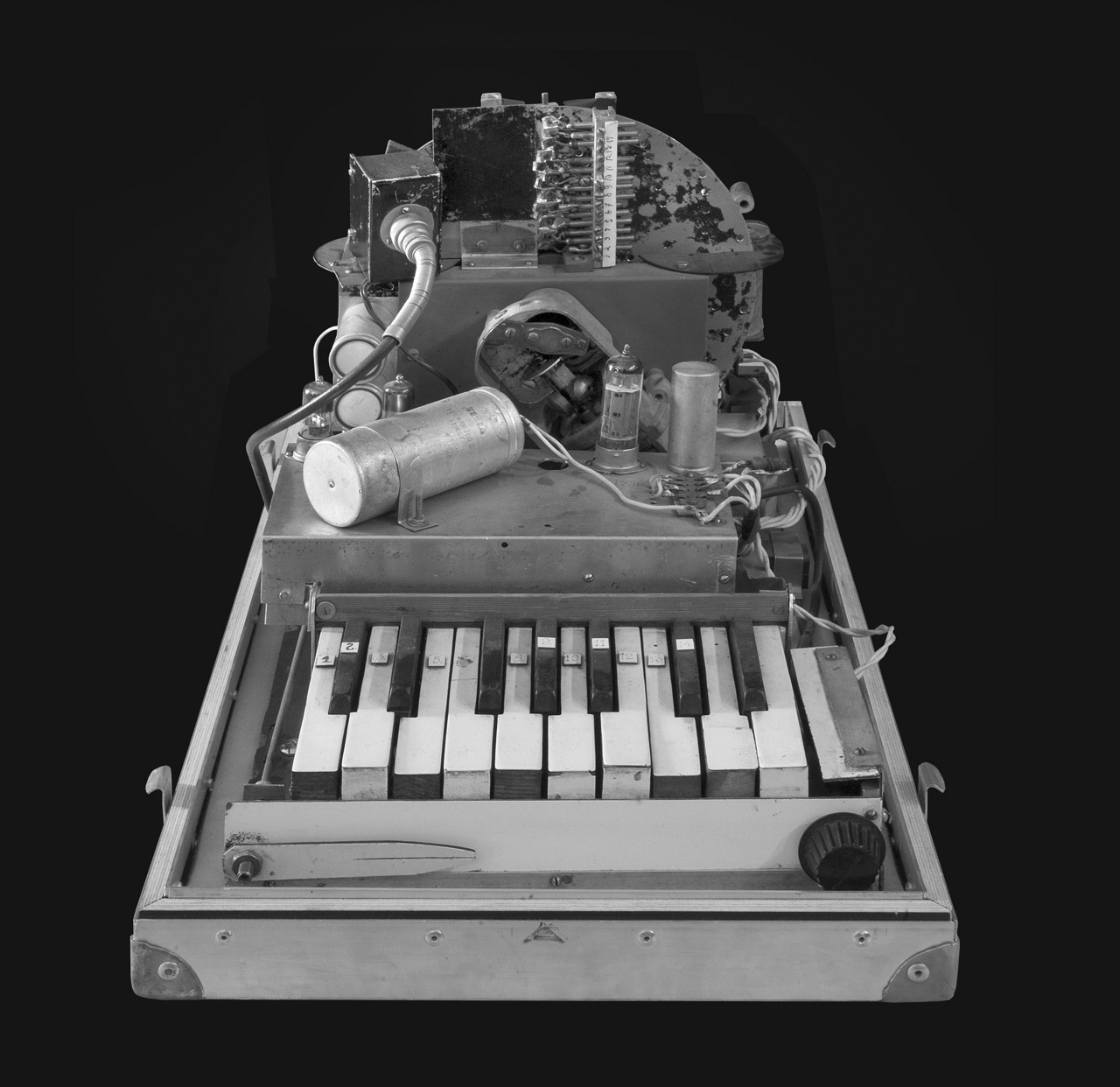
Following presentations in Paris,1 Budapest, St. Petersburg, and Moscow, and the publication of the book Sound in Z: Experiments in Sound and Electronic Music in Early 20th Century Russia (Walther König, 2013), the Berlin instalment of the Generation Z exhibition, presented at CTM 2014 festival, has been expanded with the new section »ReNoise,« developed by artists Konstantin Dudakov-Kashuro, Peter Aidu, and Evgenia Vorobyeva, and based on select reconstructions of the more than 200 mechanical noise instruments invented by Vladimir Popov (1898–1969) between the 1920s and 1950s.
In many ways, the Generation Z: ReNoise exhibition tells a story of utopias and anti-utopias, of the avant-garde and the institution, of collaboration and personal achievement, of ambition, opportunity, and oppression of genius and bureaucracy, of intellectual freedom and totalitarianism. It is a story of remarkable personalities, curious inventions, astonishing performances, radical ideas, and experimentation. It is also a story of patents and funding applications, success and failure, support and rejection, optimism and disillusionment. Much interesting and significant material from this history will never come to light or has been forgotten or overlooked, whether for political or financial reasons, because stories are not well documented, or because they simply were not heard by the right people at the right time. A lot of material from the first half of the 20th century was actively destroyed or written out of the history books because it did not fit within the Stalinist regime’s vision of what sound and music technology should be. It is a story of which only fragments are known, not only in the West but also within Russia itself.
While the history of Russian post-revolutionary avant-garde in art is generally known, the inventions and discoveries, names and destinies of the community of sound researchers, apologists of musical machines and noise orchestras, and inventors of new musical technologies have until now remained largely forgotten and little-studied. The only project of its kind, Generation Z offers an introduction to some of the period's key figures and their areas of research. It is an attempt to reconstruct the artistic utopian island in 1920s Russia that developed around a kind of »network culture« connecting revolutionaries in art. Within this network, seemingly unreal projects in sound and hardware were realised, and concepts and methods that offered a promising basis for future scientific and cultural development were created.
The ideology that emerged desired a new kind of art based primarily on materialism, natural science, and formal analysis rather than on abstract emotions or subjective taste. It was an objective, rationalist agenda with a scientific and technological approach to the arts.
In the aftermath of the October Revolution (1917) both society and the State sought alternatives to the old religious values and bourgeois idealism to fill the vacuum that had been left by the Tsar’s overthrowing. The ideology that emerged desired a new kind of art based primarily on materialism, natural science, and formal analysis rather than on abstract emotions or subjective taste. It was an objective, rationalist agenda with a scientific and technological approach to the arts. Special institutions were founded for the development and improvement of the »New Human,« engaged in the mastering and perfection of professional motion in sports, working life, military activity, musical performance, and so on.
Therefore, a unique opportunity arose: the State was keen to encourage art that broke with traditions and was being developed in entirely new ways. Government representatives including Leon Trotsky and the people’s commissar of enlightenment Anatoly Lunacharsky, approved highly experimental projects, encouraged freedom of the creative community, and supported the so-called Left. In 1918 Lunacharsky officially proclaimed that the arts should be developed on an experimental basis. As he told the composer Sergei Prokofiev: »You are revolutionary in music as we are revolutionary in life – we should work together.«
In 1919 the painter Varvara Stepanova noted in her diary, »the principles of Russian painting are as anarchical as Russia with its spiritual movement. We have no schools, each painter is a creator, everyone, being an innovator, synthetic or realist, is original and highly individual.« This might be viewed as a metonym for the whole of the Russian revolutionary artistic utopia of the early 1920s, when the Russian State was almost at the point of collapse and society was structured as a kind of anarchical »network culture,« based on numerous cross-connected »creative units« comprising artists, scholars, and politicians.
A term that sought to capture the essence of the period was proposed by the artist and philosopher Solomon Nikritin (1898–1965). Projectionism (from the Latin »projectus«) was intended to reflect the urge to rush ahead, or more accurately, to rush into the future. He applied this term not only to new approaches in painting and methods of art criticism, but also to the methodology of constructing a new society, to which it was considered necessary to aspire.
In 1919 Nikritin developed his fundamental theory of Projectionism. According to his philosophy, the method becomes the purpose of the creative process. In the context of »projecting the method,« even faults and paradoxes gained a new constructive sense and value. In the early 1920s much project-based research took place that could be considered within the framework of Projectionism, including Alexei Gastev’s Art of Movement exhibitions, the concert-lectures by Leon Theremin, and Arseny Avraamov’s concert series »Music of the Future,« in which the author demonstrated his practical ideas regarding the future of musical harmony and techniques, rather than presenting finished musical pieces.
Artists, poets, musicians, and architects rushed enthusiastically into the new reality, studying physics and mathematics, embracing sciences concerning the nature of light and sound, and developing theories about what became known as »the Art of the Future.«
One of the main heroes of the epoch was Arseny Avraamov (Krasnokutsky) – an adventurer, scholar, composer, performance instigator, circus acrobat, music journalist, and creator of the first ever artificial soundtrack. In a series of articles from 1914–1916, he developed the theory of microtonal »Ultrachromatic« music, and invented a special instrument with which to perform it. It was he who proposed, in 1916, the idea of spectral analysis of the shape of the gramophone groove, with the subsequent transformation of the spectrum and re-synthesis of the new artificial groove. Shortly after the October Revolution, Avraamov proposed to the Commissar of Enlightenment, Anatoly Lunacharsky, a project to burn all pianos – symbols of the despised twelve-tone, octave-based »well-tempered« scale, which he believed had adversely affected human hearing for several hundred years.
They declared that academic views on music theory were dull and scholastic, and that techniques relating to it were old fashioned, proclaiming that both were becoming increasingly outdated.
Meanwhile, in 1916 a student at the Neurological Institute in Petrograd, Denis Kaufman (aka Dziga Vertov, 1896–1954), attempted what would now be called sound poetry and audio art. As he put it: »I decided to include the entire audible world into the concept of ›Hearing‹. It was during this time that I attempted to draw up the sounds of a lumber mill...I tried to describe the audio impression of the lumber-mill in the way a blind person would perceive it. In the beginning I wrote down words, but then I attempted to capture all of these noises with letters...It also concerned my experiments with gramophone recordings, where a new composition was created from separate fragments of recordings on gramophone disks. But I was not satisfied experimenting with available pre-recorded sounds.« Being frustrated, he switched to film to organise not the audible, but the visible world.
In the spring of 1917 the Leonardo da Vinci Society was founded in Petrograd by Arseny Avraamov, inventor Evgeny Sholpo, and mathematician and musicologist Sergei Dianin. Their objective was to unite efforts to produce a revolution in musical theory and techniques based on the cross-connection of arts and science. They declared that academic views on music theory were dull and scholastic, and that techniques relating to it were old fashioned, proclaiming that both were becoming increasingly outdated.
In the summer of 1917, Evgeny Sholpo wrote a science-fiction essay titled »The Enemy of Music« in which he described an electro-optical sound machine named the Mechanical Orchestra, capable of synthesising sounds with complex dynamic spectrums as well as producing music according to a special graphical score without any need for a performer. Describing future music, Sholpo thought in categories of continuity, sonority, spectrum, and their temporal dynamics, erasing the difference between pitch-based harmony structures and the spectral tissue of a sound.
While some ideas from that period were little more than science fiction at the time, many projects and proposals were more immediately viable or actively sought to develop the technology necessary to deliver them.
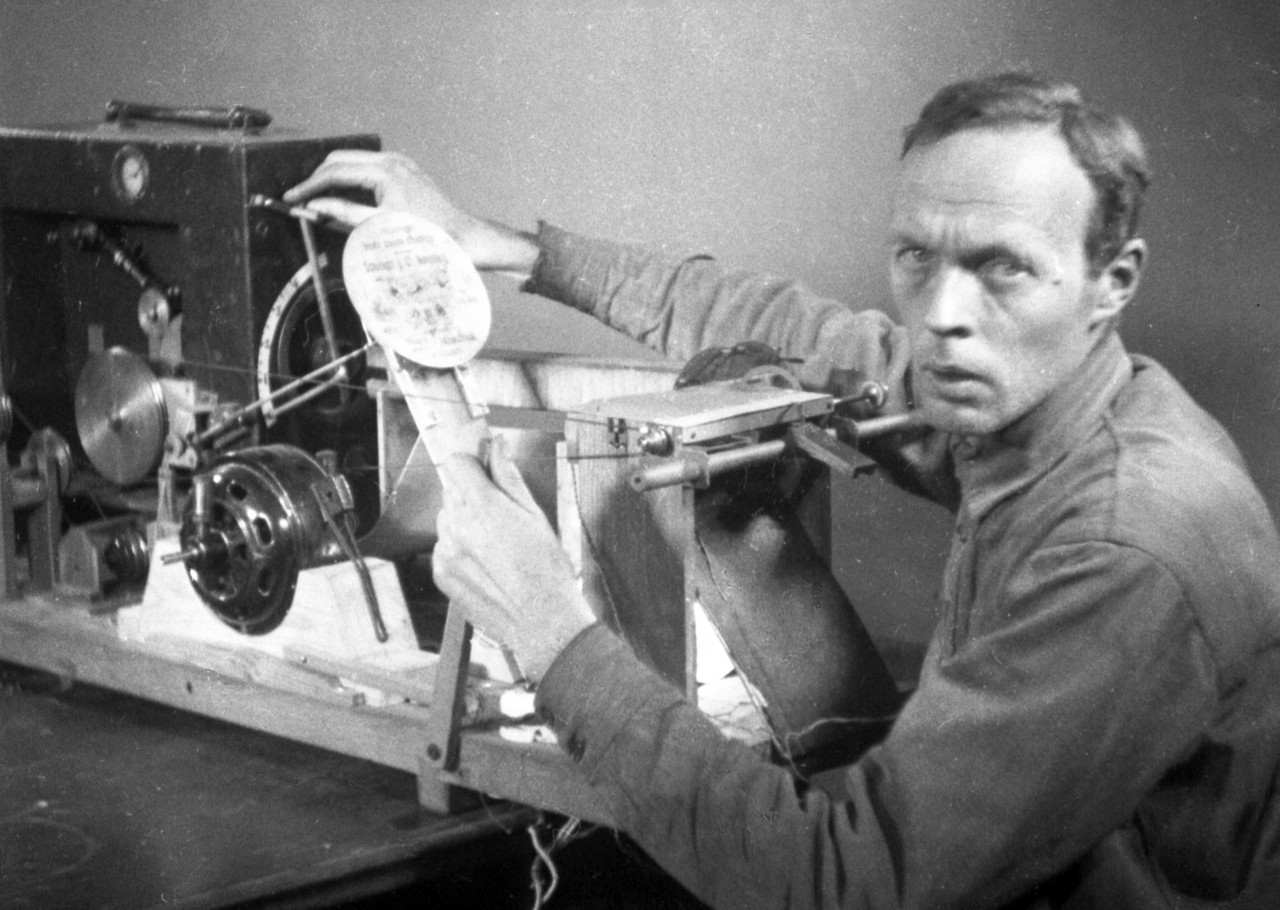
Perhaps one of the most charismatic figures in the history of electronic music and audio technology was Leon Theremin, well known as the inventor of the first commercially produced electronic musical instrument, the Theremin (also referred to as the Termenvox, 1919–20). As a physicist, musician, and engineer, Theremin worked at the crossroads of creative technology and espionage, developing innumerable projects and often trying to combine music with colour, gesture, scent, and touch. It is hardly possible today to imagine any synthesisers, burglar alarms, or automatic doors, without his pioneering research.
Despite the fact that Leon Theremin initiated a new technology rather than a new aesthetic, his groundbreaking musical invention led not only to the application of the technology for a variety of civilian, military, surveillance, and espionage purposes – adding to his status as a cult figure in electronic music in the West – but also provoked new aesthetic trends and discoveries all over the world.
While the career of Leon Theremin the physicist began at the Institute for Physics and Technology in Petrograd, his musical career began in Moscow, at the State Institute for Musical Science (GIMN). The GIMN was founded in Moscow in 1921 in an attempt to centralise all activities related to the science of music, including disciplines such as acoustics, musicology, psychology, physiology, the construction of new musical instruments, and ethnomusicology. Nikolai Garbuzov was appointed director.
Since the beginning the GIMN was oriented towards academic research. Among the many scholars and inventors active at the institute were Arseny Avraamov, Leonid Sabaneev, Peter Zimin, Nikolai Bernstein, Pavel Leiberg, Boris Krasin, Emily Rosenov, and Mikhail Gnesin. Numerous research projects were conducted, articles published, and experimental devices built, including a harmonium tuned to a natural (overtone) scale and a quarter-tone harmonium with two keyboards. Nikolai Garbuzov built a device to study the phenomena of synopsia (colour hearing). Sergei Rzevkin built his radio-harmonium on cathode valves, which was the second electronic musical instrument to be built in Russia after the invention of the Theremin. It was a sort of three-voice oscillator, capable of producing polyphonic chords in any temperament.
Working on the GIMN’s draft programme, Arseny Avraamov proposed a project named »Topographical Acoustics.« He suggested building powerful electroacoustic systems that could be installed on airplanes, from which vast areas of land could be covered with sound. Some of his projects explored new genres of music devised specifically for urban contexts and presentations around built environments. One such project by Avraamov referenced in the »Generation Z« exhibition is the »Symphony of Sirens« – a large scale, open air performance of factory whistles, foghorns, artillery fire, and all manner of machine-made noises, first staged in the port town of Baku in 1922 in celebration of the fifth anniversary of the Revolution. This epic spectacle featured a cast of choirs, the foghorns of the entire Caspian flotilla, two batteries of artillery guns, a number of infantry regiments including a machine-gun division, hydroplanes, and all of the town’s factory sirens. The conductor, posted on a purpose-built tower, signalled various sound units with coloured flags and pistol shots. A central sound-machine called the »Magistral« contained 50 steam whistles controlled by a crowd of musicians following »text-scores.« A second performance of the Symphony took place in Moscow in 1923.
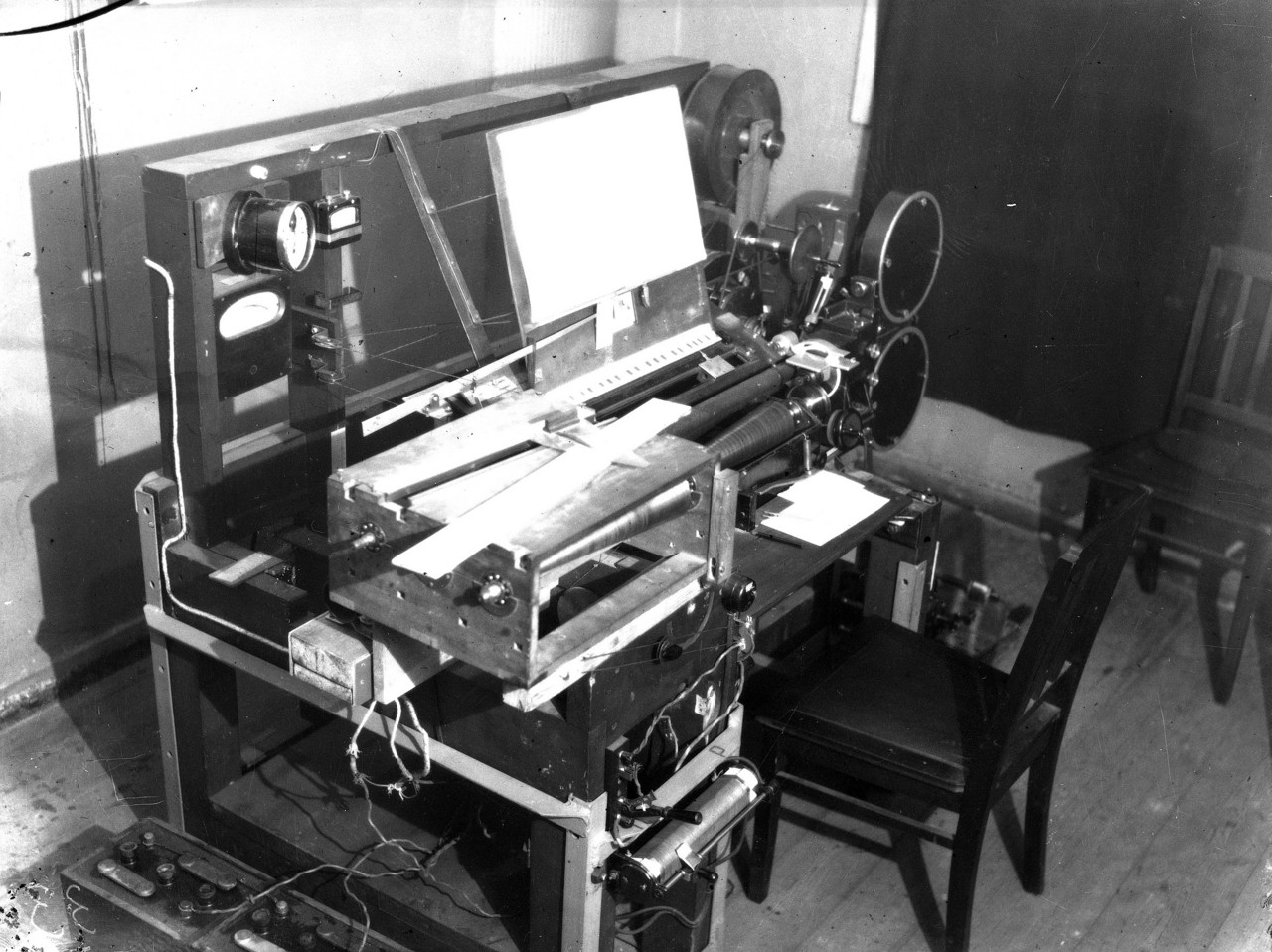
In 1921–23, performances of the Projection Theatre at the Foregger Studio and sound experiments at the Proletkult Studio, directed by Sergei Eisenstein, provoked a fashion of noise music and noise orchestras. Many inventors patented new sound machines specially intended for the performance of noise music. Some devices based on electro-optical, electro-mechanical, and other new electronic technologies were ahead of their time by decades. Among them was »the mechanical keyboard instrument for the reproduction of speech, singing and various sounds«, invented in 1925 by D.G. Tambovtsev, which was a kind of proto-sampler very similar to the famous Mellotron popular in the 1970s. The »Electro-Optical Musical Instrument,« invented by Sergeev in 1926, was based on the principle of the optical siren. It was a kind of electro-optical sound synthesiser that incorporated a sequencer based on a graphical score to program the most complicated rhythms and harmonies.
In 1926–29 the first practical sound recording systems, based on sound-on-film technology, allowed access to sound as visible shapes on film strips that could be studied and manipulated. This new possibility paved the way for a systematic analysis of audio traces such that they could be used to produce any synthetic sound at will, which led to the invention of the »Graphical (Drawn) Sound« techniques. It also opened up a long-awaited opportunity for artists fascinated by the idea of sound as an art medium to edit, process, mix, and structure pre-recorded audio material, combining any sound at will, which led to the creation of numerous soundtracks based on the aesthetics of noise music.
The film critic Alexander Andrievsky noted in 1931: »While abroad the first works related to sound cinema were mainly based on music material, in the USSR we had another trend. The main audio material of the first sound movies was based on noise and various rumblings.«
In 1928 Sergei Eisenstein, Vsevolod Pudovkin, and Grigory Aleksandrov published the major aesthetic document The Future of Sound Film, in which the main emphasis was placed on the idea of the contrapuntal method of combining sound and imagery. »…ONLY A CONTRAPUNTAL USE of sound in relation to the visual montage piece will afford a new potentiality of montage development and perfection.«
In 1929 Dziga Vertov made the first field sound recordings by means of portable sound-on-film equipment, which was specially built for him by inventor Alexander Shorin. The equipment allowed him to record actual urban sounds and industrial noises, which he used to score his film Enthusiasm (1930). The score became the first approach to what would later be called musique concrète – coined by Pierre Schaeffer in France in 1948, and which initiated the development of electroacoustic music.
Meanwhile, in 1929 the first Soviet experimental sound film Piatiletka. Plan velikih rabot (The Plan of Great Works), directed by Abram Room with a soundtrack by Arseny Avraamov, was released. As Room pointed out, »for us, the visual material played a secondary, supporting role, being an outline for sound design…each of us had to apply himself to the theory of radio and acoustics.« Avraamov in turn noted, »I should also say that I don’t see any contradictions at all between music and noise...I did not want to involve any conventionally organised music in the film (slipping into melodic symphonic moments).«
It was Avraamov who completed the first artificial drawn ornamental soundtrack in 1930. That same year Evgeny Sholpo invented the Variophone. It was a continuation of research that Sholpo had been conducting since the 1910s while working on »[p]erformer-less music.«
By 1936 there were four main trends of graphical sound in Soviet Russia: hand-drawn ornamental sound (Avraamov, early Boris Yankovsky); hand-made paper sound (Nikolai Voinov); variophone or automated paper sound (Evgeny Sholpo, Georgy Rimsky-Korsakov); and the method of Syntones, based on spectral analysis, decomposition, and re-synthesis techniques (Boris Yankovsky).
Sholpo was able to simulate more subtle variations in tempo such as rubato, rallentando, and accelerando, based on his careful analyses of live piano performances by the most accomplished pianists.
The first version of the Variophone was built in 1931 by Sholpo together with composer Georgy Rimsky-Korsakov, grandson of the famous composer Nikolai Rimsky-Korsakov. It was capable of producing artificial soundtracks by means of automated paper sound techniques. Many soundtracks for movies and cartoons were created using the Variophone. Among the most accomplished pieces recorded with the Variophone in 1933–34 were »The Carburettor Suite« by G. Rimsky-Korsakov, »Waltz« by N.Timofeev, »Flight of the Valkyries« by Richard Wagner, and Franz Liszt’s »Hungarian Rhapsody No. 6.« During the blockade of Leningrad in 1941, together with composer Igor Boldirev, Sholpo synthesised one of his most experimental pieces – the soundtrack to the cartoon »Sterviatniki« (»The Vultures«). Although aesthetically these works are similar to Wendy Carlos’ Switched-On Bach from 1968 and sounded like 8-bit music, the main difference was in their timing. In 1918 Sholpo developed special tools – the Melograph and Autopianograph – to register the temporal characteristics of live musical performance. Much electronic music has a rigid tempo, like a metronome; Sholpo was able to simulate more subtle variations in tempo such as rubato, rallentando, and accelerando, based on his careful analyses of live piano performances by the most accomplished pianists.
In 1932–35 Boris Yankovsky proposed the Syntone method, based on research into structural similarities and distinctions among spectrums of sounds of different character to limit, as far as possible, the number of calculations needed for the additive synthesis of various complex sounds. This method was based on pure audio computing techniques and possessed properties very common for digital technologies, such as discretisation and quantisation of audio signals and related spectral data, manipulation with ready-made parts, and operations with selections from databases of the basic primitives (templates), that distinguished it from the methods of analogue signal processing. It can be considered as a sort of proto-computer for music techniques, with many of the typical features of modern digital technology in sound and music computing.
Yankovsky developed several sound processing techniques, including pitch shifting and time stretching, based on the separation of spectral content and formants, and resembling the recent computer music techniques of cross synthesis and the phase vocoder.
To perform complex mathematical calculations of waveforms as well as other important parameters of sound and automated musical performance such as rhythm, there were special »employee-computers« on staff in the laboratories of Boris Yankovsky and Evgeny Sholpo. These were mathematicians whose specific task was to make calculations. To realise these ideas, Yankovsky invented a special instrument, the Vibroexponator – the most paradigm-shifting proposal of the mid-1930s.
In 1939 Yankovsky met Evgeny Murzin (1914–70), a young inventor fascinated by the idea of a universal tool for sound synthesis, and after a year of conversation the final concept of their future instrument was formulated. In 1957 Murzin completed and patented a photo-electronic musical instrument called the ANS Synthesizer. It was remarkably close to the concept of Evgeny Sholpo’s Mechanical Orchestra. The instrument was based on Boris Yankovsky’s proposed scale of 72 steps per octave, and incorporated a set of 576 optical sine wave oscillators, adjusted on fixed frequencies and forming a discrete scale, covering the whole audible range with intervals between successive pitches undetectable to the human ear. Control over the system and the process of sound synthesis was carried out by means of a special graphical score, with a diagram representing the spectrum of a sound by means of drawn transparent strips with appropriate shape and slopes. A principle similar to this graphical score was used in the legendary UPIC computer system, developed by Iannis Xenakis in 1977 at the Centre d’études de mathématique et automatique musicales (CEMAMu) in Paris.
Researchers involved in graphical sound had to overcome enormous technical and theoretical (as well as more mundane) difficulties during its short existence. The results of their work were surprising and unexpected, and ahead of their time by decades. However, after Lenin’s death in 1924 and Stalin’s rise to power, collision with the increasingly totalitarian state was fatal. In less than ten years, all of their work had ended and was almost instantly forgotten. By the late 1930s, the cultural and intellectual elite of the previous two decades had been rendered powerless or effectively written out of »official« histories and excluded from textbooks as though they had never existed. The last phase of Stalin’s epoch was entirely fruitless for music technology. All the talent that emerged during this period was directed towards the ideas and projects of the 1910–20s. The new generation of engineers, living in cultural and informational isolation, was primarily engaged in attempts to copy or follow Western developments. It became a time synonymous with poor quality fakes and considerable frustration. No significant inventions were made in the realm of musical technology in Russia until the turn of the millennium.
Life has since confirmed the value and significance of the work and foresight of the lost pioneers. Many ideas and inventions, which at the time might have been considered utopian, were reinvented decades later. We use them today without knowing their origins, and many ideas from this period are still awaiting fresh consideration.
Andrey Smirnov is an interdisciplinary artist, independent curator, collector, writer, composer, researcher, and developer of new techniques in computer music. He is the founder of the Theremin Center, a research fellow at the Centre for Electroacoustic Music at Moscow State Conservatory, the head of the Rodchenko Sound Lab, and a lecturer at the Rodchenko Art School in Moscow. He is also the author of Sound In Z: Experiments In Sound And Electronic Music In Early 20th Century Russia (Walther König, 2013) and curator of the Generation Z: ReNoise exhibition at CTM 2014.
This text was originally published in CTM Magazine 2014 – Dis Continuity.
- 1
The first version of the exhibition was shown between September 2008 and January 2009 under the title Sound in Z at the Palais De Tokyo in Paris within the framework of the exhibition project From One Revolution To Another by British Turner Prize winner Jeremy Deller.