The folk tune »Dink’s Song,« also known as »Fare Thee Well,« recently had a prominent role in the Coen brothers’ film Inside Llewyn Davis. It’s called »Dink’s Song« because the woman who once sang it was named Dink. As told by American singer and folklorist Pete Seeger, the story is that musicologist John Lomax found Dink among labourers working on the Mississippi River levees during the First World War. Dink sang her mournful melody into Lomax’s recorder while she was washing clothes.
That song has lived on in covers by Pete Seeger, Joan Baez, Dave van Ronk, Jeff Buckley, Bob Dylan, Anna McGarrigle, and Roger McGuinn. In each rendition, the achingly pretty melody reveals some new facet of its ode to longing and regret.
This is the essence of how music works – or, at least, how it had worked in folk music for millennia. Learning »Dink’s Song« is an exercise in human-to-human access, sharing, and variation. Before the remix (or remix culture), there was the cover. Before covers, there were simply people singing songs.
Could electronic music and the technology of music-making ever have the immediacy of someone singing? Could software or a circuit ever be shared like Dink’s song?
That challenge is the heart of the hack.
Music culture is fundamentally about continuity and discontinuity. It is the act of transmission – lyrics and melodies, structures and techniques, learned from one another and transformed and shared again. Music technology can do violence to those human connections in myriad ways, from tectonic to subtle. Recordings might suggest you don’t have to sing a song in order to recreate it. Software creativity can seem nothing more than bundles of loops and samples, arranged by preset formula.
Music culture is fundamentally about continuity and discontinuity. It is the act of transmission – lyrics and melodies, structures and techniques, learned from one another and transformed and shared again.
But these same technologies are part of music culture. Baez and Buckley learned »Dink’s Song,« in fact, thanks to Lomax’s portable Edison recorder; now, surely that access has exploded with the internet. And musicians not only still sing, but also take on electronics and machines as their »voice.« Music is made on machines, but still by humans, for humans.
The criticism that musical tools shape the music they produce is dead on. But there’s a next logical step to respond to that concern. To freely shape music and trade musical ideas, you need to be able to take a hand in shaping the tools, too. You have to be able to hack your instrument.
To a less technically literate culture, the word »hacker« is associated with security problems and break-ins. It reflects a view of technology as sinister, not to be tampered with. But developer communities, whose use of the term predates this other meaning, take a different view. »Hacking« is a banner for ingenuity and unexpected creativity, for pranks and cleverness and rapidly concocted transformative invention. It rewards shortcuts and ground-up knowledge and breaking rules. And hacking has become a communal event – the technological equivalent of a clambake or a knitting circle or a barn raising. Developers stage hackathons and hackdays, competing and collaborating in collective groups.
Once they start to work in groups, there are parallels between open culture – even in tech – and folk culture. Here’s how the International Folk Music Council defined folk culture in a 1954 São Paulo conference:
»The factors that shape the tradition are: (i) continuity which links the present with the past; (ii) variation which springs from the creative impulse of the individual or the group; and (iii) selection by the community, which determines the form or forms in which the music survives.«
The version control software Git, which is the basis of popular service GitHub and used for everything from code to recipes (and now, electronic musical instruments), has fundamental concepts that are equivalent. A »clone« copies a repository of information directly, retaining the link to the original – continuity. A »fork« allows someone to create a version that is their own – variation. And those changes can then be »merged« into a shared version – selection. Of course, this definition requires an oral tradition; the GitHub website alone wouldn’t qualify. But it’s telling that hackers gather with one another, and that musical hackers have done the same.
In 2007, I hosted Create Digital Music’s first »maker« event in New York to bring together a community of musical inventors, including »hacked« creations. The series was called Musicmakers, or Handmade Music, and has been replicated internationally. In the summer of 2009, an online get-together called a global »hackday« on Create Digital Music was followed shortly by the first SoundCloud-organised Music Hack Day, an event which has spread informally around the world.
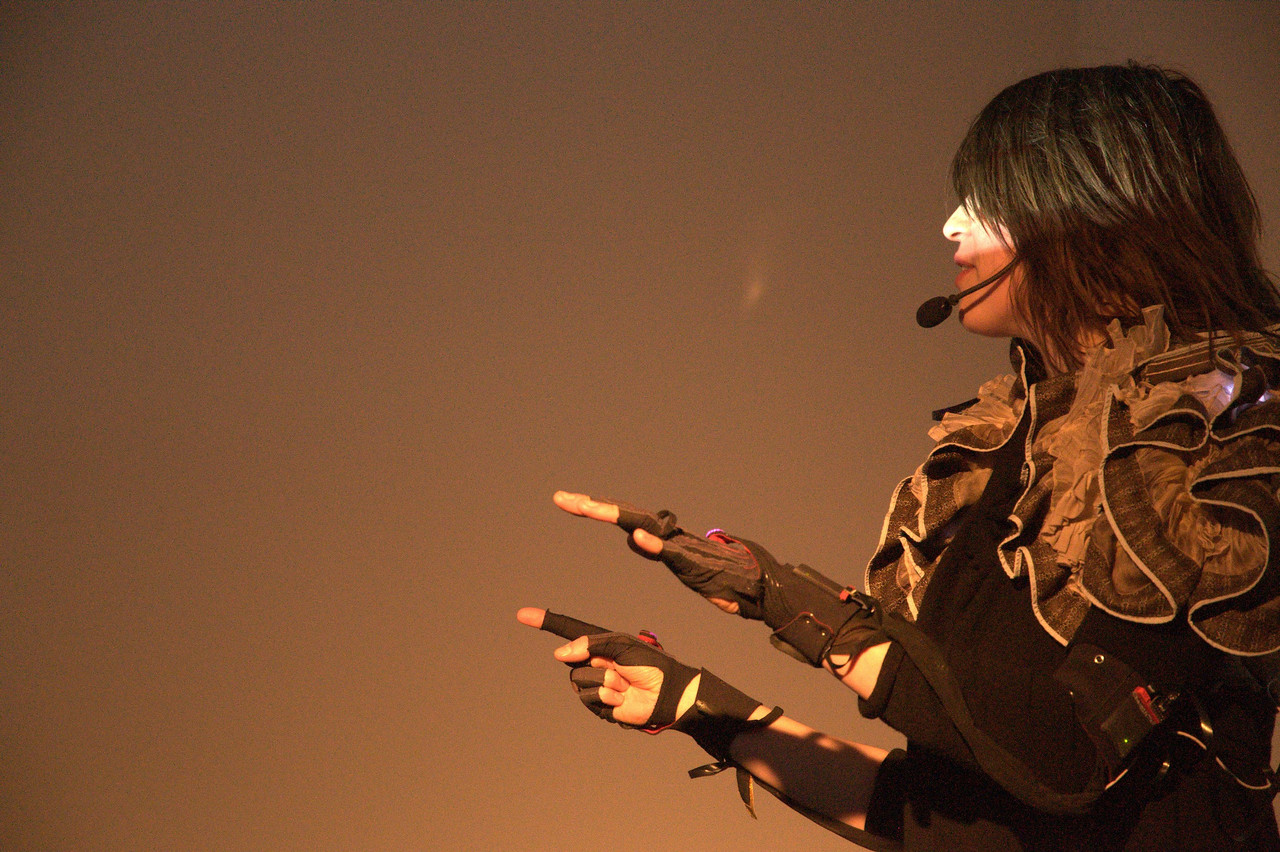
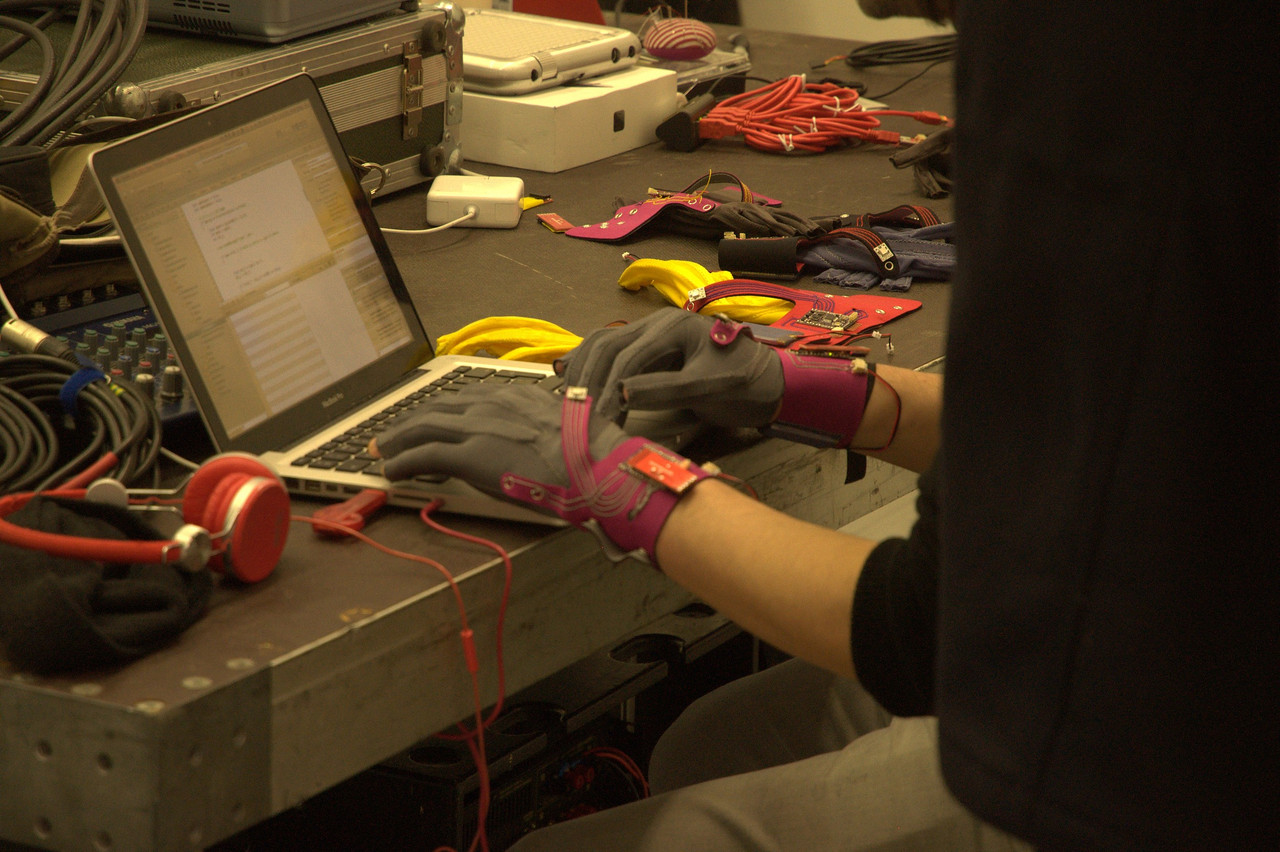
CTM Festival has for some years held collaborative events, hosting Share, Marius Watz’ »Generator.x,« and various other projects and workshops. Last year, CTM Festival built on that tradition with its first edition of the MusicMakers Hacklab. There, creators – from instrumentalists to fashion designers – worked together to devise new means of playing music. Visual and sound artists worked together to allow their creations to speak to one another; inventors found new ways of connecting performance to image and sound. A group of artists joined UK singer and producer Imogen Heap to use her team’s wearable glove interface. They built new interfaces between the digitally sensing gloves and more traditional forms, combining its use with cellists, singers, and dancers, measuring heartbeats and turning the waggle of a finger into a synthesised sound or image.
The exercise is not simply technology for its own sake, not only science fair projects meant to dazzle and impress. Hacking the performance interface means the ability to return technology to the human scale.
With the complexity of tools today, many technologies have to be bought in shrink-wrapped boxes, encased in metal and plastic the user dare not open. And developing a system in hardware or software doesn’t automatically produce something that can make sense with the human gesture or utterance.
Perhaps that’s why the hack is so important – and why it matters to take things apart. Even learning a song isn’t always easy. Melodies can often be repeated rote. But perhaps you want to learn the guitar part on the Oscar Isaac / Marcus Mumford version of »Dink’s Song.« That might mean hours disassembling and re-assembling chord changes and guitar patterns – reverse engineering, as the hardware geeks would say. The transmission is still oral, but some assembly is required.
Those assembly skills are then badly needed in music tools, whether engineering new instruments or simply finding a way to go around presets. Otherwise, there would be little discernible difference between consuming music and making it; there needs to be continuity, yes, but also variation. Making music wants to be more than just pressing play.
Likewise, if music is emotional utterance and not just the production of sound, then you have to test the outcome. Music technology should still hit you in the heart, the toes, the gut. That means testing the inventions in the world of performance. So, we’re pleased this year to audition these technologies in front of audiences, in real time, with mistakes and live players sweating.
The MusicMakers Hacklab at CTM 2014 will culminate not with a set of presentations or a show-and-tell, but a performance in HAU2. We have to play our inventions, stomachs full of butterflies, in the same room as the audience – not safely hidden behind the world of social networks, upload sites, and streams.
We’ll also make an ensemble out of »WretchUp,« a mobile app built by Florian Grote and myself in collaboration with Mouse on Mars and Rupert Smyth, as the artist/developer team plays the app live. Inside is an open-sourced microcosm of shared culture: the app’s code is available as open source software, running on the libpd library built on Pure Data. Pure Data, in turn, builds on years of contributions from a community of users, and the patch WretchUp runs on at CTM builds on that as well as modified patches.
These projects build on years of history. In the Hacklab, Leon Theremin’s pioneering 1920s circuit will live again in a remixed design by Andrey Smirnov, then appear in participants’ own projects. Synthesis libraries now represent decades of research in sound, code bases that evolve over many years. This is technology that is constantly reused, not disposed of. And whatever myth of from-scratch creation people might imagine, every electronic production – built on proprietary tools or free ones, simple circuits or complex ones – stands on the shoulders of giants, to quote Isaac Newton.
It’s easy to imagine that these are elitist endeavours, ways of justifying fancy silver laptops and tablets for those with the income to buy them. Nothing could be further from the truth. Embedded processors are exploding at a rate that threatens to catch up with the human population, new computers approach stunningly low costs (the Raspberry Pi at $25), and sound circuits can be made from even simple components. These tools draw a line across a century of technological innovation in sound.
The question, then, is one of literacy and community. The technology is everywhere, as plentiful and pervasive as the human population. Now, can we, together, make those machines sing?
Peter Kirn is a composer, electronic musician, and visualist, and runs CDM createdigitalmusic. He is the founder of Musicmakers and co-presents this year’s Hacklab with Darsha Hewitt.
This text was originally published in CTM Magazine 2014 – Dis Continuity.