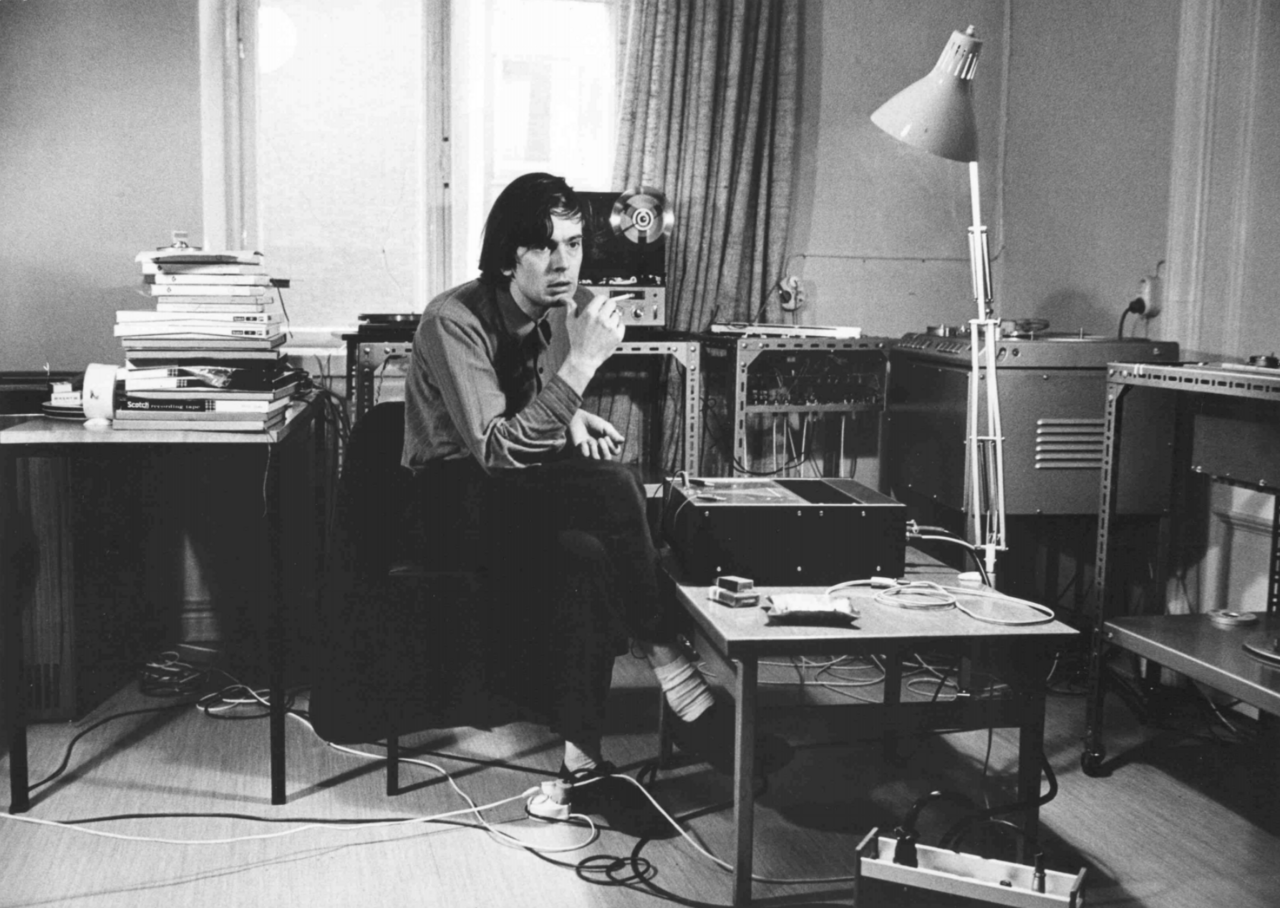
Born in Finland in 1941, Erkki Kurenniemi was an engineer, inventor, experimenter, musician, and artist, whose influence is most sharply felt in his impact on electronic music. He predicted that on 10 July 2048 he would be digitally resurrected from the diaries, sound recordings, and videos he made, eight years after this becomes technologically possible.
Tagged the »Marshall McLuhan of the Finns,« Kurenniemi held strong views on the future of technology and the human body. In an article he wrote in 1971, titled »Message Is Massage,« he predicted an all-in-one personal device that linked together our computer, TV, phone, video and audio recorder, books, magazines, newspapers, calculator, calendar, cinema, and our human relations – roughly speaking, an iPad. He also built a video and motion based synthesiser, which can now be replicated by Microsoft’s Kinect, and conceptualised something close to presets in 1967. He recorded and archived the minutiae of his life much like the way we use Facebook and Twitter today, and yet it wasn’t until 1974 that he was able to buy an early pocket calculator. He bought his first computer in the early 1980s. In 1982, he wrote:
»I have owned a PC for twenty months now. In those twenty months, the machine has become part of me (or I of it).«
Kurenniemi’s ideas are often radical, technotopian solutions. In 2004 he wrote an article for the Finnish art magazine Framework, in which he suggested the solution to sustainability on our planet was to turn it into a museum:
»In 2100, for example, print 10 billion ›Earth licences‹ and distribute them to all the then-living humans. No more licences will ever be printed. Licences can be sold. This way, the people who want long life and long-lived children can have them, but only by migrating into space. This will be cheap, because there will be people wanting to stay down here, purchasing Earth licences at a price that will amply cover the price of the lift into orbit for the seller.«
His futurology, like his earth museum idea, has parallels with Kurzweil’s singularity and Alvin Toffler’s <em>Future Shock</em>...Kurenniemi’s visions lie somewhere between fantasy and reality
Complex socio-political considerations offer no barriers: one stark, radical (and, frankly, unrealistic) catch-all seemed more obvious. Kurenniemi is very much the product of his generation – an avid consumer of news, literature, and writings – who read Thomas Pynchon’s Gravity’s Rainbow decades before it was published in Finnish. His futurology, like his earth museum idea, has parallels with Kurzweil’s singularity and Alvin Toffler’s Future Shock – macro solutions and predictions, without micro considerations. Kurenniemi’s visions lie somewhere between fantasy and reality, in a technotopian future reality, and while he made countless notes, tapes, and videos documenting his life, he was not a completist. His records are unorganised notes committed to paper, which slide between English, Finnish, and maths, along with video and audio recordings, photographs, newspaper cuttings, and receipts; it is these from which the resurrected post-singularity Kurenniemi will re-emerge. Some days he made diary notes every ten minutes, some far less. His mathematical workings have not yet been analysed, and so remain a mystery. Video diaries, many of which are homemade sex tapes, zoom in on genitalia, or have the subject looking at the camera rather than the cameraman. Audio often seems inconsequential – Kurenniemi singing to himself in the car, or the sound of a train journey, songs from the radio.
»I record everything manically, with neurotic attention to detail. I film incessantly with my cell phone, constantly taking notes, updating them by the minute. The things I record are trivial: the price of a cup of coffee, the kind of people that hang out at a particular bar.«
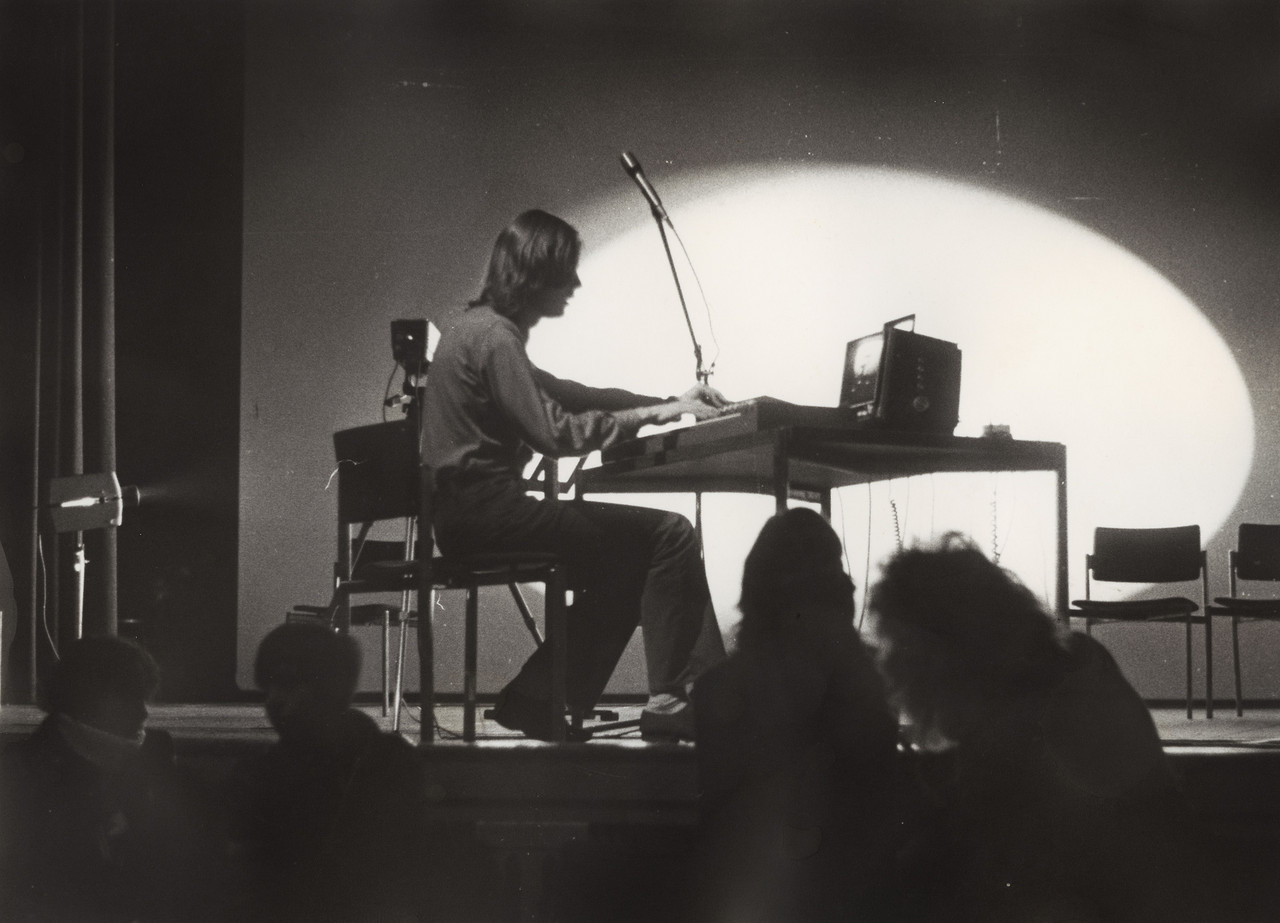
The body for Kurenniemi – bodily functions, feelings, sensations, and their extremes, mental and physical – were what Kurenniemi was primarily concerned with. He writes of having a rush from masturbation, closely followed by a thrill of a new discovery or progression with one of his projects, or conflates physical pleasure with machine interaction: »The camera is more important than you or me since it constantly makes imperishable history of both of us. We feel ›the wing of history‹ touching us and go crazy.« (1990)
Kurenniemi’s body is intertwined with his recording devices, felt as rushes of pleasure in a mirror of the physical. He saw the human body as an organic slime machine, but what will the machines make of the organic slime of physical pleasure, orgasm, drunkenness, and pornography, and how will it be understood by his new, digital self? He lists meals and intake of wine, and physical (often sexual) pleasures, all mixed with calculations and ideas for future inventions and circuitry. Perhaps, to make an interpretative leap, Kurenniemi’s apparent obsession with documenting his own pleasure-chasing is partly a result of him attempting to manipulate the outcome of his future self – a curation of his next self, a prioritisation of content.
Rather than being hailed as a media theorist or transhumanist, however, outside of Finland Kurenniemi is best known for his contributions to electronic music. While studying physics in the early to mid-1960s, he built the first electronic music studio in the University of Helsinki. His future vision of a music studio was one where composition was completely automated in an integrated studio, where music was produced at the flick of a switch (which, if you consider the lengths to which it is possible to go with presets, is not so far off the mark). As such, the studio he built was one that diverged from existing studios in Europe, which were centred around analogue sound. He was more concerned with digital sound.
He would hit the machines, bringing himself into the compositions as a human body integrated with and affecting the machine output; a physical outburst that, while perhaps not quite fulfilling his dream of human-machine coupling, nonetheless incorporated physicality, urgency, and the organic body into the composition.
Kurenniemi built his Integrated Synthesizer in 1964, which operated as a control unit for the studio and contained a tone generator, audio filter, and mixing console. At this time, in other parts of the world, others were also building instruments and studios. In 1966 Don Buchla’s Buchla 100 would hit the market, and Robert Moog had begun working – his first Minimoog released in 1970. Kurenniemi’s instruments were largely concerned with digital sound, and brought the body into play as well. The DIMI-T translated brain waves into sound, and the DIMI-S, also known as the Sexophone, was a synthesiser operated by two or more players where the resistance of the human body completed the circuit and could control the sound. It works best when all players are naked.
Kurenniemi was both ahead of and behind his American and European counterparts; although concerned with digital sound, he failed to make a successful business out of his instruments. The company he set up, Digelius (a name derived from Digital Sibelius), was launched in 1970 with Peter Frisk and Jouko Kotila, but only lasted six years. Researcher and artist Jari Suominen notes that despite having a working prototype of the mixer and patch bay Dimi-X, Kurenniemi’s was more concerned with pushing an integrated studio concept, the non-existent DIMI-U. At the time, Finland was also politically associated with Russia, and from the viewpoint of Western Europe, was considered to have one foot behind the Iron Curtain, which may not have helped sales.
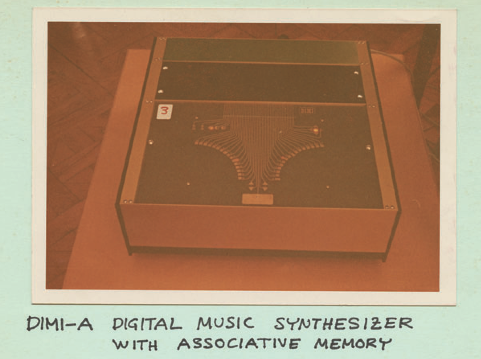
The first instrument Kurenniemi’s Digelius company attempted to sell was the DIMI-A (which still functions and has been played live, often by Mika Vainio). A synthesiser with digital memory, sounds can be programmed in, but are lost once the machine is switched off (which has to happen every two hours because of overheating). By the time DIMI-A was marketed, though, it was competing with the EMS, and none were sold (although Kurenniemi ended up buying an EMS VCS3 for the Helsinki studio).
In the studio, Kurenniemi recorded tests and demonstrations, doodles and explorations, as well as complete compositions, and the occasional soundtrack (notably for Risto Jarva and for »Hyppy« by Eino Ruutsalo). The most famous of his pieces (and one of the longest), »On-Off,« from 1963, is an improvised electronic noise and tape composition made on the University of Helsinki’s studio equipment, and is the earliest surviving composition from this studio. Kurenniemi cannot remember much of how he recorded it, although it uses spring reverb and echo. Distinctive sounds heard in many of Kurenniemi’s pieces, instead of reverberating into human spaces, bounce off machine spaces, hollow and metallic. He would hit the machines, bringing himself into the compositions as a human body integrated with and affecting the machine output; a physical outburst that, while perhaps not quite fulfilling his dream of human-machine coupling, nonetheless incorporated physicality, urgency, and the organic body into the composition.
In part, hitting and moving machines was also Kurenniemi’s reaction to academic electronic music, which he felt was too severe and serious. The direct energy transfer of fist to metal is converted into jolting irregular sound, giving his pieces a dynamism that more formal recordings from other studios did not have. While overloading machine signal paths, he was also busy overloading his own signal path in daily life via intoxication and sexual ecstasy. Where there is often a formal test-session-like frigidity to some BBC Radiophonic compositions, Kurenniemi’s works are frantic and loose, and it is this which distinguishes him from early electronic music pioneers. His reels lack proper markings and are annotated with tape speed, a name, and a numeric ID coding system that has not yet been deciphered.
Kurreniemi’s archives were donated to the Central Art Archive in Finland in 2006. While almost all of his music recorded at the University studio has been released, and while 100 cassettes of audio diaries are digitised, an enormous number of recordings remain unanalysed. Boxes of floppy discs and other obsolete media have not been opened, and the maths and formulas which scatter his notes have been largely skipped over for practical reasons. And a big gap remains from a six-year mystery period spent in a Soviet nuclear town, which he is not at liberty to discuss even with his wife and the location of which was not marked on maps for many years. There is much yet to discover about Kurenniemi to be able to place him in history – some of it surely to be found in the archive boxes marked »to be opened in 2048.« Although he is alive today, he has difficulty communicating due to a stroke suffered nine years ago. His humour and obsessions with the feelings of the physical body nonetheless set him apart from his contemporaries, electronic music pioneers, artists, scientists, or transhumanists. Far from being cold and mechanical, or even machine like, Kurenniemi is vibrantly human, with desires and impulses – a far cry from any common visions of a machine-led future. If this is what the future looks like, set the clocks to count down to 2048.
This article is indebted to the essays and research contained in Erkki Kurenniemi: A Man From The Future, Petri Kuljuntausta’s First Wave – A Microhistory of Early Finnish Electronic Music, as well as Kurenniemi’s online archive; and conversations with Kati Kivinen, Mikko Ojanen, Jari Suominen, Perttu Lastas, and, most of all, the work of Mika Taanila. Kurenniemi’s archives can be found online.
Jennifer Lucy Allan is one of two online editors for The Wire magazine.
This text was originally published in CTM Magazine 2014 – Dis Continuity.