Introduction
In early 2020 when Covid-19 took over the world, leading to social distancing and lockdown, I felt isolated in my Brooklyn apartment. I wasn’t alone. My friends and community were trying to grasp the new normal by organising ›stay at home‹ virtual dance parties on Zoom, building mutual support networks locally, and connecting with friends far away and near. In March 2020, I made a few playlists for friends. Listening to music offers a sense of connection, calm, and love. Making a playlist, curating a sonic experience for your loved ones is a gratifying experience.
It’s convenient to make playlists on platforms like Spotify, YouTube Music, and other streaming services. There are consequences and limitations of relying on commercial web platforms. First, there is a financial barrier. Many people are not able to afford subscriptions or premium accounts. In free accounts access is limited with advertising and restrictions on features. The second and more pressing reason is the geographic barriers to streaming platforms. I had friends who couldn’t listen to my playlist because Spotify was not available in their country. Third, there are growing concerns that users' privacy is vulnerable on these corporate-owned platforms.
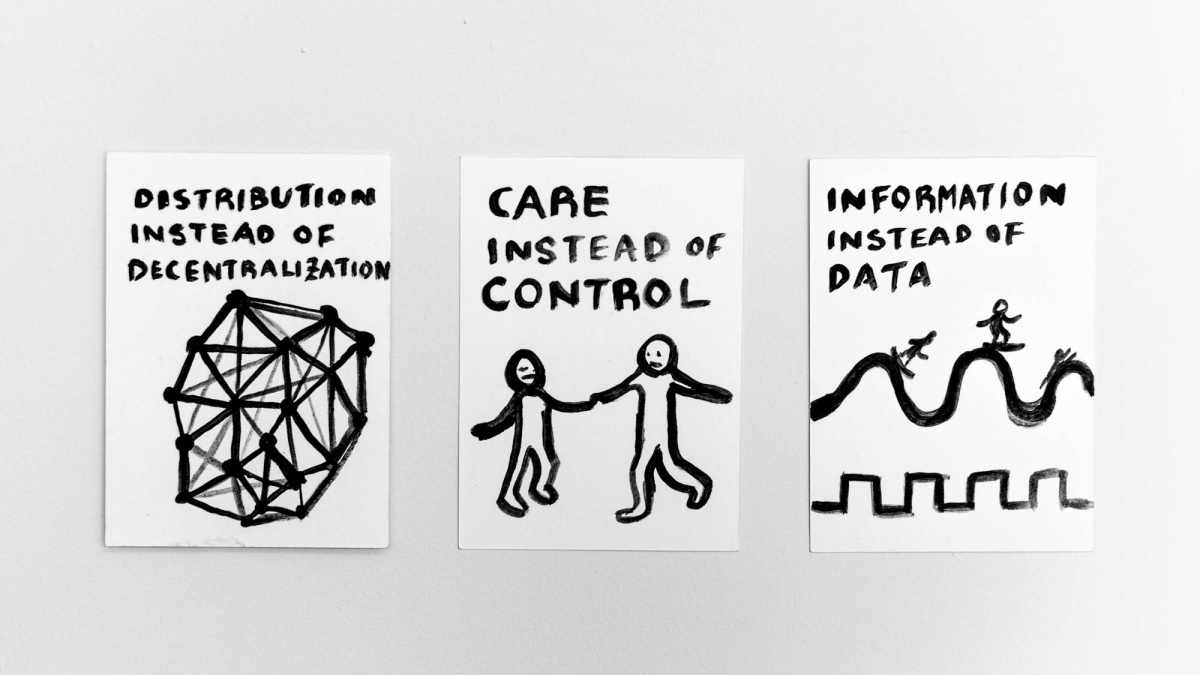
Most commercial web platforms are built on centralised networks. Centralised networks can synchronise various nodes effectively. The central node has singular authority and control over all aspects of the network. If the central node is compromised, the rest of the nodes can be affected. Distributed networks are composed of equal, interconnected nodes. Even if one node disappears, most of the network remains intact. Peer-to-peer (p2p) systems like Napster, a type of distributed network, have been used by musicians and music lovers since the 90s.
Thanks to the kind invitation from CTM Festival, I had a chance to engage with a group of musicians and sound artists in January 2021 in an online workshop. Some of the participants had professional record labels and agents. Others shared their music through their own network. Most of them had complicated relationships with streaming platforms. In a 90-minute workshop, I shared ideas and tools for sharing music via p2p systems.
In this article, I focus on documenting the workshop activities. Please note the article is based on a transcript of the workshop, and is not a comprehensive technical guide. Big thanks to my studio team, Suhyun Choi who helped produce the workshop and Jaemin Shin who managed it.
Hands on activity
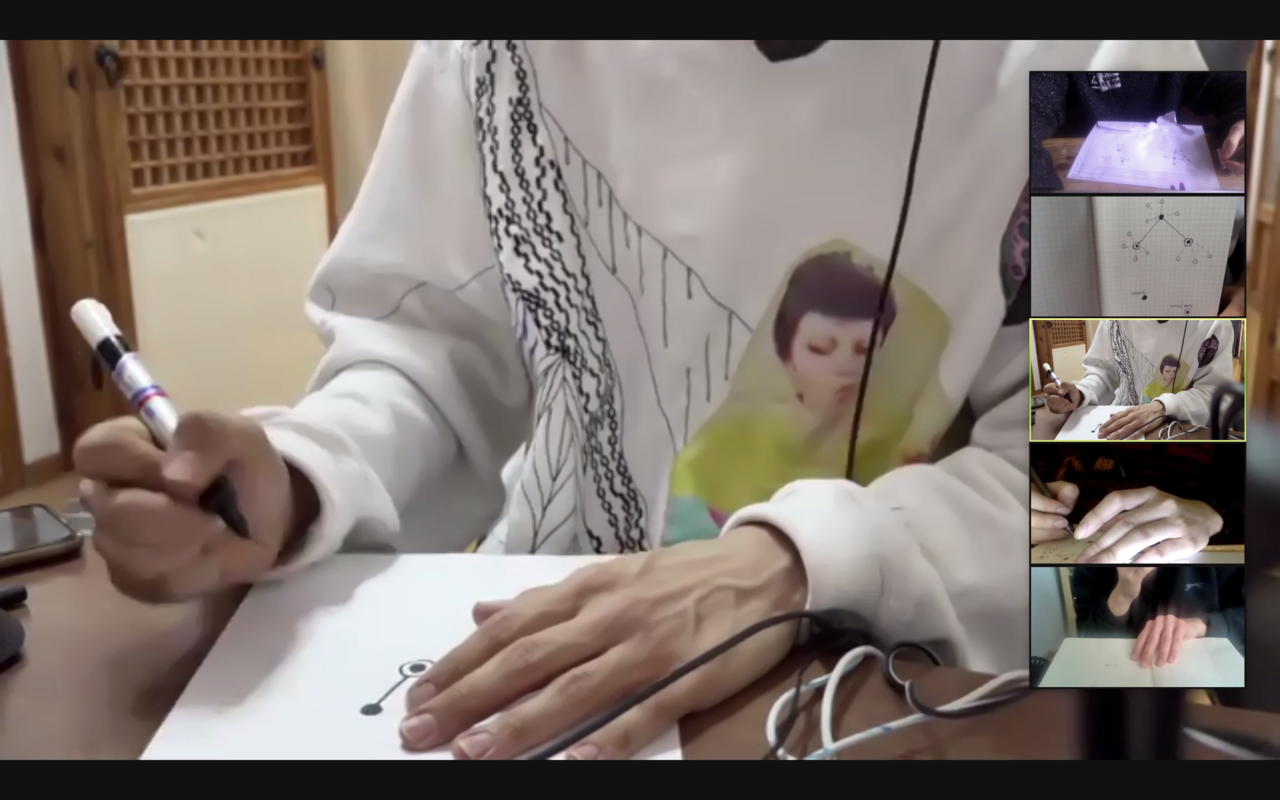
Draw lines
- On a piece of paper, draw a line from the top left to the top right.
- Draw as slowly as possible. Take as much time as you can.
- When you are done with the first line, draw another one underneath it.
- After drawing a few lines, take a look at the drawing. Think about these lines as different kinds of networks. Some lines are straight, jagged, or dotted.
- Nodes are the beginning and end point of the lines. Draw arrowheads to point the flow of data from one node to another.
Draw circles
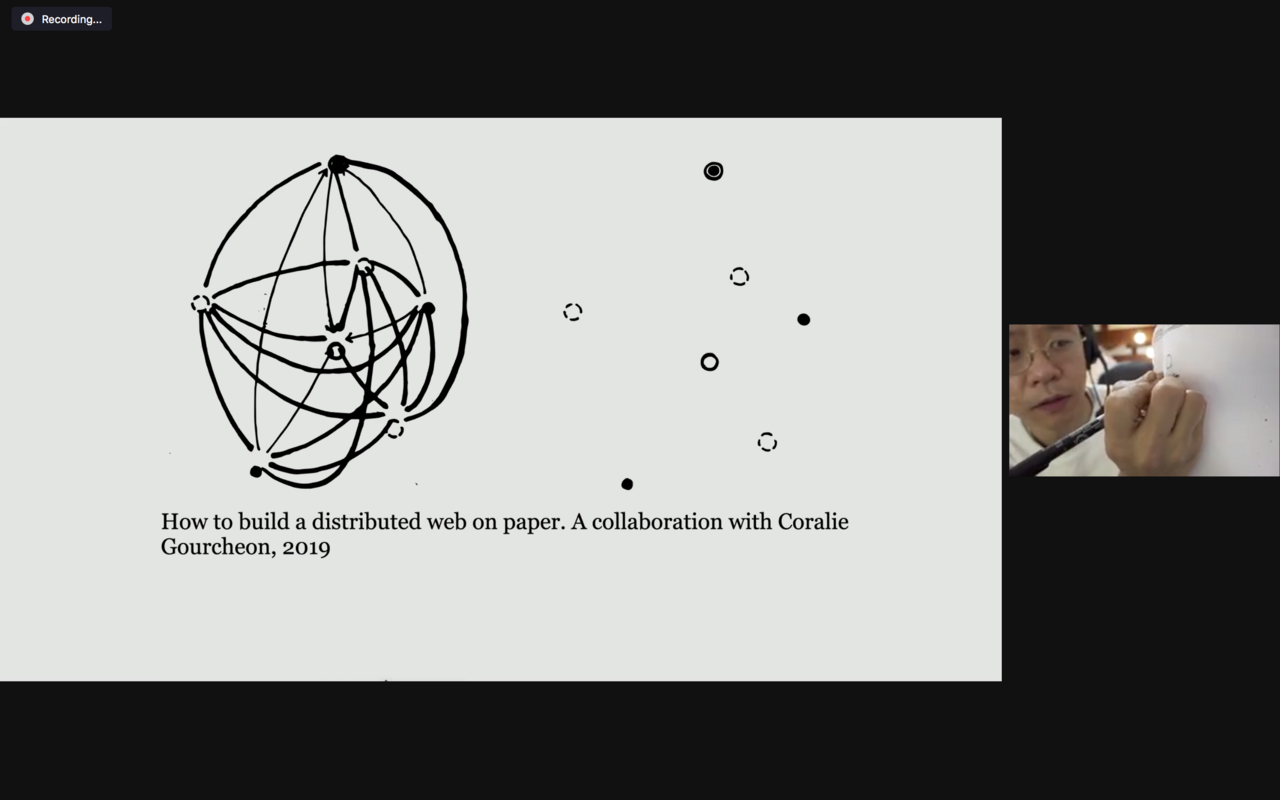
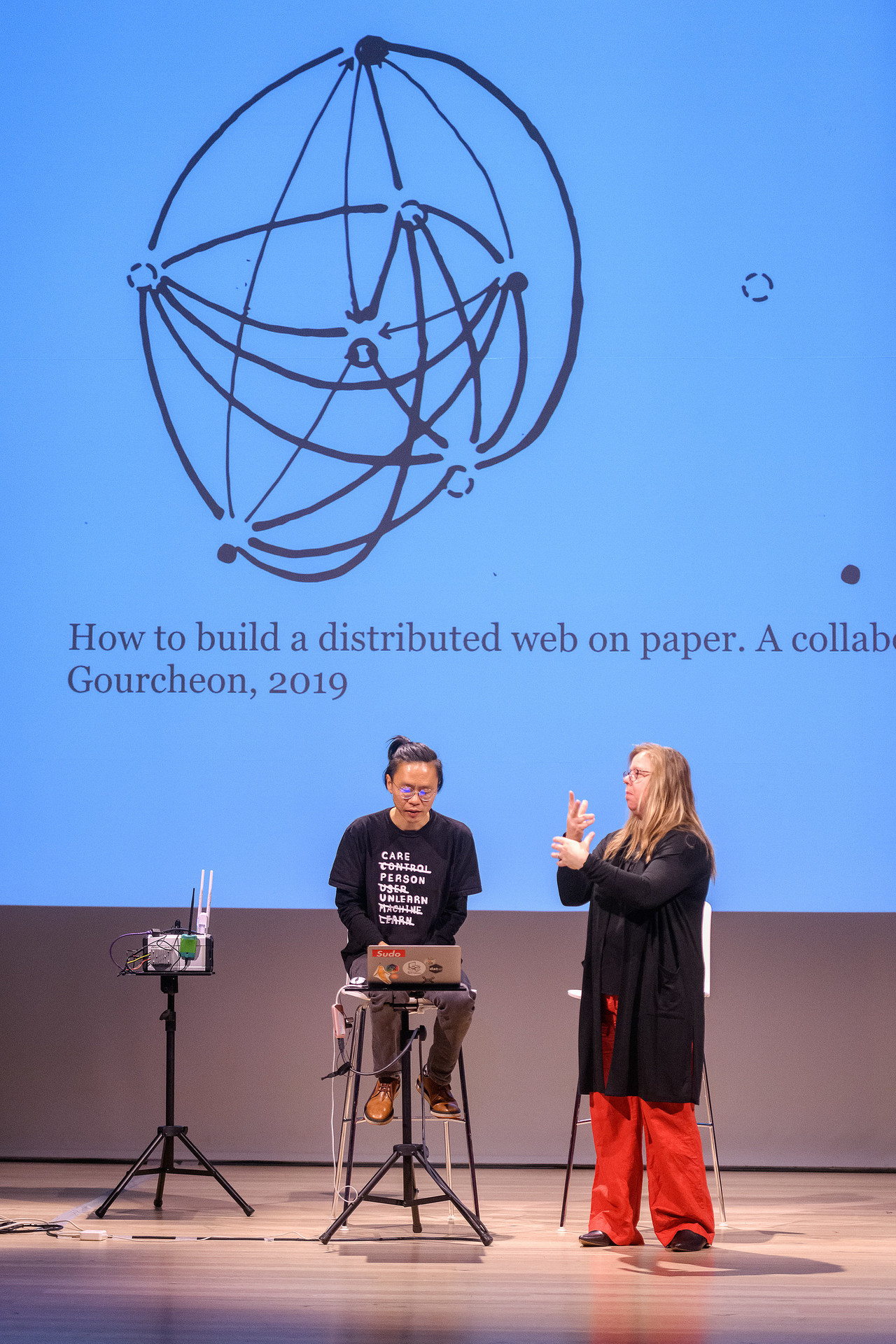
- Draw a circle and fill in the center, making a black dot. This is a node that is sharing data. This node does not receive data.
- Draw a circle that has an empty center. This is a node that is receiving data. This node does not share data.
- Draw a circle that has a dot inside of it. This is a node that is sending and receiving data.
Diagramming your music distribution
- Draw a diagram of your music’s distribution in both physical and digital space.
- There are three categories of nodes: nodes that share data, nodes that receive data, and the nodes that are both sending and receiving.
- Think about the distribution of music between you, as a creator, and people who are listening to, sharing, or mixing the music.
This activity is based on a collaboration I did in 2019 with Coralie Gourguechon, a graphic designer and artist based in France.
Technical activity
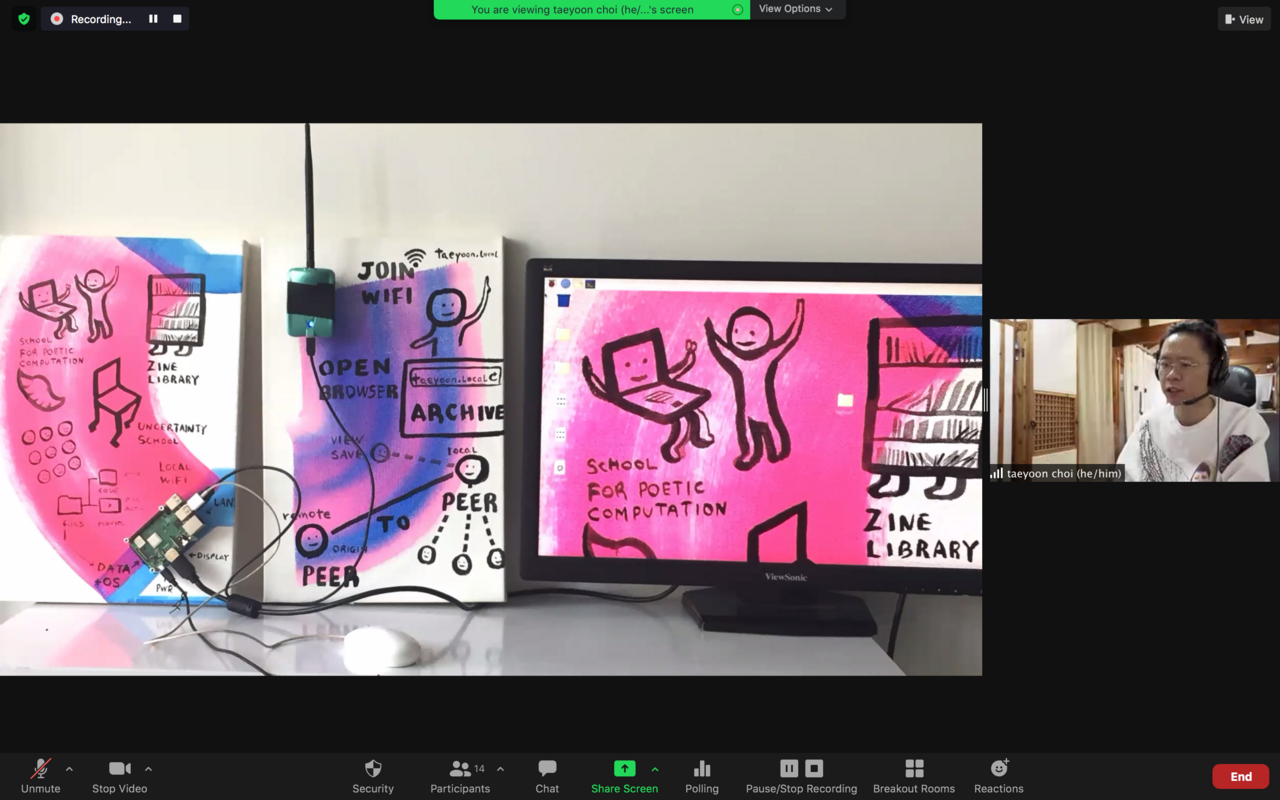
Now let’s learn how to use Beaker browser, an experimental p2p web browser, to share your music. Beaker browser looks similar to popular web browsers, such as Chrome or Firefox, but it works differently through a p2p distributed network.
- On your Windows, Mac, or Linux computer, install and open Beaker browser.
- Let’s create a hyperdrive. According to Beaker’s official tutorial, »[e]ach hyperdrive (or »drive«) is essentially a networked folder. A drive can contain files, folders, symlinks, and mounts.« You will need to refer to this official tutorial to follow the next steps.
- In Beaker, go to »My Library« by clicking the icon with three lines that looks like a hamburger, or maybe a veggie burger.
- Create a new hyperdrive. Give it a name.
- Click on the three dots next to the hyperdrive. Select »Explore Files.« An editor view will pop up.
- Check out the index.json file. It can include the title and description of your document.
- Click »Folder,« select »New file.« Create »index.html.«
- Right‑click »index.html« to edit the document. You can include release notes or lyrics for your music.
- Back in the editor view, click »Folder« and select »Import.« Select some of your music to share.
- Check and copy your hyperdrive’s long URL, which starts with »hyper://.« You can find them in the address bar of the Beaker browser.
- Share the URL with your peers. Beaker browser works like a server on its own. Once you share the hyperdrive’s URL with another person, they can access the document. You can check their connection by peer count in the address bar.
- Remix time! Make a copy of your peer’s music by forking their hyperdrive. Make changes in their document and music.
- Ask your peer to merge your version.
- Try making a mixtape of various peers’ music.
Conclusion
In the workshop in January 2021, participants created and shared their own hyperdrives. Although this article does not provide enough details for first timers, I encourage you to use Beaker and other distributed web and p2p protocols, in order to share your music with your friends, family, neighbours, and ex-partners – like a love song mixtape. For more technical and conceptual ideas, I recommend DWEB initiative and Compost magazine. It will be fun to look for mesh network enthusiasts in your area, like NYC Mesh, Toronto Mesh, or Equitable Internet Initiative in Detroit.
While this article compares centralised networks and distributed networks, it’s important to avoid the simplification that comes with comparing centralised and distributed networks in stark binaries. In real life, network topologies are much more porous, and are always shapeshifting too. A centralised network may have servers distributed in many places around the globe or it may employ p2p protocols.
I’m wary of naïve egalitarianism that is often associated with distributed networks; they echo the sentiments of early web pioneers, whose Californian ideology expressed a web utopianism which saw it as inherently democratic. I do not think distributed networks are inherently positive or neutral. I think the distributed web contains the possibility for creative expression, agency, and resilience, as well as the possibility for exploitation and misuse. Since 2018, I have invited writers and engineers to publish critical writings about such ideas on a blog called »Distributed Web of Care,« which unpack the relationships between technology, philosophy, and poetry.
If music is part of an affective economy, shaping distribution methods also shapes the larger, collective emotional body.
Now, back to the mixtape. There’s a lot of love and care that you can put into a playlist. Each song and its connections can contain secret messages for a friend. Jonathan Sterne’s book MP3The Meaning of a Formatchronicles how the mp3 file format became foundational to music distribution and continues to affect the musical production and cultures of listening. Sterne describes music as part of an »affective or emotional economy« (Sterne, 237). If music is part of an affective economy, shaping distribution methods also shapes the larger, collective emotional body. We live in an internet culture, alongside code that shapes our digital bodies (a person's online activity or behaviour), security, privacy, authorship, personhood. It’s possible to build an ecosystem for music that is not dominated by commercial platforms. In thinking about alternative ways of sharing music online, we also need to think about the code of conduct in sharing information online. Since distributed networks do not have a centre for managing all the nodes, each node needs to be accountable for its behaviour. These challenges are technical and social; they involve interdependence, mutual support, and collective agency. How can we create and share our work online more thoughtfully? How can we contribute in making digital and physical spaces where participants’ consent, comfort, self-determination, accessibility, inclusion, and personhood are prioritised?
Taeyoon Choi is an artist who works with drawing, painting, computer programming, performance art, and video. He explores the poetics of science, technology, society, and human relations. He believes in the intersectionalities of art, activism, and education; and he supports disability justice, environmental justice, and anti-racism. As a co-founder of the School for Poetic Computation in New York City, he helped build the school’s curriculum and administration. Choi is based in Seoul, South Korea.
This text was commissioned as part of CTM 2021 – Transformation. It follows a workshop that Choi held at the festival as part of the Rethinking Music Ecosystems series, titled »Distributed Web of Care.«