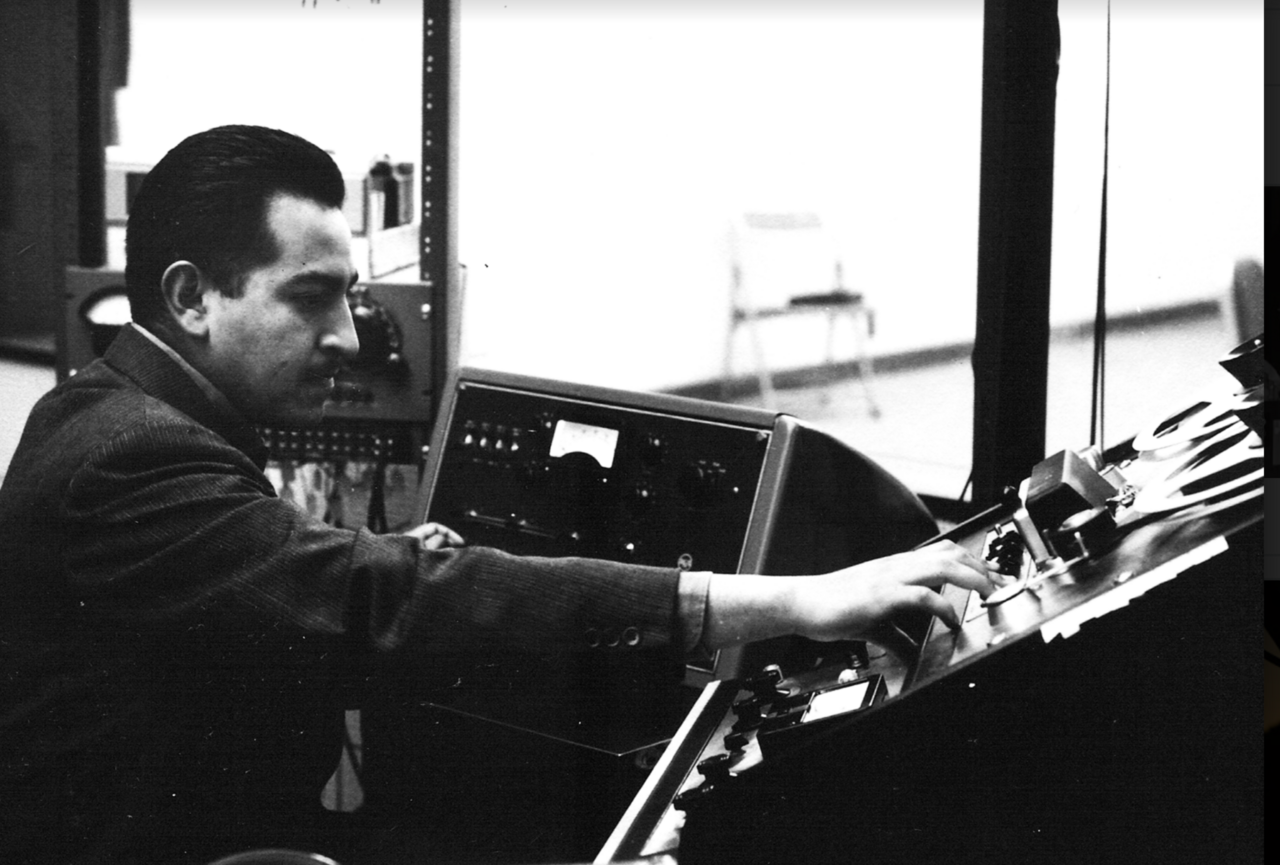
Constelaciones de la Audio-Máquina en México (Critical Constellations of the Audio-Machine in Mexico) is an attempt to survey the trajectories of sound culture in Mexico in relation to important questions of identity, at a moment when the nation-building project that permeated the country’s history during the last 90 years is in a serious political, social, economic, and even moral crisis. In doing so, this exhibition not only engages questions about what the Mexican nation may have been, but, most importantly, it creates a utopian map of possibilities to re-read the past and nostalgically re-imagine the future. In order to curate such a project, Carlos Prieto Acevedo resorts to an archive that draws from official, semi-official, and alternative sources and that, following the crisis of symbols of the nation-state, may be characterised as being in a current state of anarchy or chaos. In saying this I do not intend to create a gratuitous polemic about the symbols of the nation-state, but rather I wish to emphasise that as the national project that gave meaning to the Mexican constellation of 20th century sounds collapses, the very sonic symbols developed to support it – as well as those made into icons of resistance – are also decentred. Thus, as sounds and sonic cultures are emptied of naturalised meaning, the narrative of struggle that gave birth to the sonic fantasy of the Mexican nation-state also loses its significance. In that sense, Prieto Acevedo’s effort as a curator works as an anchoring point – it creates an archive out of anarchy by putting together a seemingly inarticulate and chaotic field of sonic signifiers into a new dramatic and often unexpected narrative. In doing this, the curator not only offers new ways to trans-historically place multiple pasts, presents, and imagined futures in dialogue with one another, he also re-evaluates the conventional leitmotifs that glued together traditional discourses of Mexican nation-building (from indianismo and indigenismo to modernism and the avant-garde). In sum, Prieto Acevedo’s curatorial work is not about sound objects but rather about aurality. It requires not only a disposition toward active and conscientious listening from the audience; it also demands different ears to hear old sounds anew and marvel at the strangeness of new noises and marginally conceived sonorities.
The most productive aspect of this exhibit is not the archive it offers to our ears – a brilliant effort in itself – but rather the way the curator approaches and listens to the open constellation (the larger messy archive) from which such a collection (the exhibit) is developed. Prieto Acevedo’s curatorial effort transcends its own material contingency by providing an opportunity to optimistically explore the feasibility and productive potential of anarchy in the archive. His chosen paths show us that a more productive and creative relation between user and material is possible precisely because the archive is in a stage of disorder, and as its lack of discipline allows for novel ways to relate moments, characters, places and their sounds. Prieto Acevedo’s approach to the constellation of 20th century Mexican sound does not start with a blind belief in the narratives that the Mexican nation-state created for its own nationalist propaganda. Instead, he delves into the archive in order to see and hear what kinds of new narrative connections he can make – connections that may shed light on the current post-national Mexican moment. The result is Constelaciones de la Audio-Máquina en México.
The idea of the Indigenous played a fundamental role in the post-revolutionary mythology of Mexican nationalism.
The idea of the Indigenous played a fundamental role in the post-revolutionary mythology of Mexican nationalism. This was not new to the revolutionary regime; indianismo had already played an important part in representations of the national during the last part of the 19th century. Nevertheless, it was after the Mexican revolution that a new imagination of the Indigenous took centre stage in helping to racially and culturally validate the new regime. From José Vasconcelos’s raza cósmica (the »Cosmic Race,« an apology of racial and cultural mixing at the core of the very notion of Mexicanidad, or Mexican identity) to the indigenismo that permeated social, political and cultural life during President Lázaro Cárdenas’s administration in the 1930s, a fantasy of the Mexican Indigenous world took over the representation of the nation. This mythology was so powerfully instilled that it filtered through decades of discourses about Mexican modernisation, surviving in one way or another through the end of the 20th century.
This fantasy of Indigenous culture was, however, not concerned with the actual Indigenous communities that continue to precariously inhabit the national territory; instead, it celebrated an idealised and romanticised past of pre-Columbian splendour. Music played a very important role in developing these fantasies. A good example is Carlos Chávez’s El fuego nuevo (1921) – an impressionist ballet that was never premiered but that still made its way into the canon of nationalist Mexican music, undoubtedly due to the composer’s central place in a nationalist revolutionary narrative that was able to rewrite the past and its sounds, even if those sounds had never been heard, in order to secure its heroes a privileged place in history. Likewise, Candelario Huízar’s Symphony No. 4, »Cora,« (1942) shows how a particular invention of the indigenous sonic world came to dominate the discourse of Mexican identity. It was a move that looked into the past in order to invent the present and imagine the future.
Nevertheless, such indo-futurist representations left out many other ways to imagine a relation between Indigenous culture and the aspirations of cosmopolitan modernity that dominate Mexico’s 20th century. In this exhibition, Carlos Prieto looks back into the indo-futurist archive and places these semi-official and canonic sonic representations into dialogue with more forgotten moments that were equally engaged in creating imaginaries of the the Indigenous in an attempt to fulfil the aspiration of a cosmopolitan belonging. Here, the imagined sounds of Chávez and Jiménez Mabarak meet the poetic sonic evocation of the words on the pages of Juan Rulfo’s Pedro Páramo (1955) and enter into dialogue with the historical field recordings of Raúl Hellmer, the avant-garde noises of Roberto Morales Manzanares and the new-age sonic re-creations of Jorge Reyes and Antonio Zepeda. In doing so, they open up the archival record to a large variety of discursively marginalised retro-futurist inventions of the Indigenous. This diversity of representations seems to be in better accordance with a post-national moment in which all-inclusive, homogenous discourses of nationality fail to engage local and regional experiences of relating, and individual ways to relate, to an ever-changing idea of the motherland.


If many artists retroactively invented the Indigenous as a way to forge a rhetorical path towards modernity, many more decidedly embraced the call of the avant-garde to imagine their place in a world beyond the boundaries of the nation-state. This futurist constellation is full of utopias that never happened. It could not be otherwise – art is not science – and in its liberating creativity it has provided us with a large archive of objects of desire for a future that never came. The avant-garde presupposes a firm belief in the idea that the most radical artistic experiments of the present will only be properly appreciated in the future, when they become quotidian practice. The end of the armed phase of the Mexican revolution in 1920 brought with it the collapse of older institutions and the development of new cultural networks. Artists found inspiration in the revolutionary rhetoric of the avant-garde, and a number of futurist and modernist projects were developed. Manuel Maples Arce, Germán List Arzubide, Fermín Revueltas, and Arqueles Vela became defiant estridentistas («stridents« – Estridentismo was an artistic movement inspired by Italian Futurism) and sang the praises, via words and colours, of a world of machines, robots, electric power, and technological progress. Tina Modotti froze the bodies of Mexican people along modernist visions of communist icons in pictures that are visual anthems of class struggle; Julián Carrillo explored the cracks between the sounds of the Western music tradition to invent Sonido 13, his microtonal music of the future; while Conlon Nancarrow invoked the perfection of machines (player pianos) in order to realise the complex metric and temporal structures of his own musical utopia. The voices of the artists featured in this episode of the Critical Constellations exhibit speak with the fervent cosmopolitan desire that shaped the Mexican experiences of modernisation. As such, they all sang of a beautiful future in which technology would make us one with our cosmopolitan brothers and sisters of the world; in their worldly anthems, they sang the beauty of a future of mechanistic equality that never came to be.
Lo monstruoso (»the monstrous«) is an episode that explores the sonic remnants of the post-national. The estranged sounds and rhythms reverberate beyond the discursive border of the nation-state once their sonic symbols collapse. If the most successful representations of modern Mexico throughout the first half of the 20th century were borne out of the unexpected marriage of the Indigenous and the machine, one could interpret that representation as a type of discursive cyborg that dominates the Mexican imagination. Thus, the »monstrous« in this episode refers to the empty symbols that such nationalist cyborgs engendered to the next generation of artists, and to how that next generation in turn reacted to them. As such, Carlos Prieto Acevedo puts together an archive that borrows from artistic projects as dissimilar as Mario Lavista, the Nortec Collective, Manuel Rocha Iturbide, Álvaro Ruiz, Julio Estrada, the industrial project Interface or Manuel Enríquez, and Israel Martínez.
They all sang of a beautiful future in which technology would make us one with our cosmopolitan brothers and sisters of the world; in their worldly anthems, they sang the beauty of a future of mechanistic equality that never came to be.
At first sight (or listen), it would be difficult to find similarities between the quasi neo-classical structures and compositional procedures of Mario Lavista, Álvaro Ruiz’s glitch electronica, the sound installations of Manuel Rocha Iturbide, the samples of norteña popular music in Nortec Collective’s electronic music, the poetic explorations of the continuum in Julio Estrada’s music, the hypnotically repetitive crunched loops of Antiguo Autómata Mexicano’s IDM, Manuel Enríquez’s visually stunning music notation, and Israel Martínez’ acousmatic exploration of car accidents. Nevertheless, all of these projects share a common attitude. They all respond in one way or another to an essentialist discourse of national identity that no longer represents the desires and aspirations of Mexicans at the end of the 20th century. From the direct rejection of such discourse – epitomised in José Luis Cuevas’s infamous Cortina del Nopal (Prickly Pear Curtain) – by avant-gardists like Enríquez, Estrada, and Lavista in the 1960s and 1970s to the sarcastic, kitschy reinventions of the sounds that the market associates with mexicanidad in Nortec Collective’s electronic music at the turn of the 21st century, the sonic mosaic prepared by Prieto Acevedo under the rubric of Lo monstruoso creatively responds to an idea of national identity that has slowly become less and less relevant, not least by being less and less capable of delivering a sense of unity and cosmopolitanism to the people living in the Mexican territory.
Constelaciones de la Audio-Máquina en México closes with a sonic panel in which sound artists like Angélica Castelló and Ariel Guzik rub shoulders with conceptual sound projects like Música de Cámara, a pioneering intermedia group from the first half of 1980s. Again, in looking at the type of interventions and the musical aesthetics favoured by these artists and composers, the elements forming this particular archival constellation seem rather arbitrary. Nevertheless, the curator assembles this archive by focusing on how these sound and musical practices (from Ariel Guzik’s efforts to engage the agency of cosmic energies and Carlos Alvarado’s synthetic modular mediations to Verónica Gerber’s drawings, which trace silences hidden in the wordy spaces of literature) avoid the stereotypical representation of the Mexican, instead engaging discourses and aesthetic visions that attempt to make sense of chaos. The exhibition’s last constellation speaks not only of crucial artistic strategies that help the artists avoid the Mexican label (a label that reduces their work’s significance to a series of geographic coordinates); it also suggests ways in which anarchy and chaos can be invoked and engaged in order to create a variety of archives that transcend the teleology of nationalist discourse and sentiment.
Alejandro L. Madrid is Professor of Musicology and Ethnomusicology at Cornell University in New York. His research interests range from Latin American and Latina/o music to performance studies, sound studies, transnationalism, and globalisation.
This text was originally published in CTM Magazine 2017 – Fear Anger Love.