Sobriety as the new countercultural logic
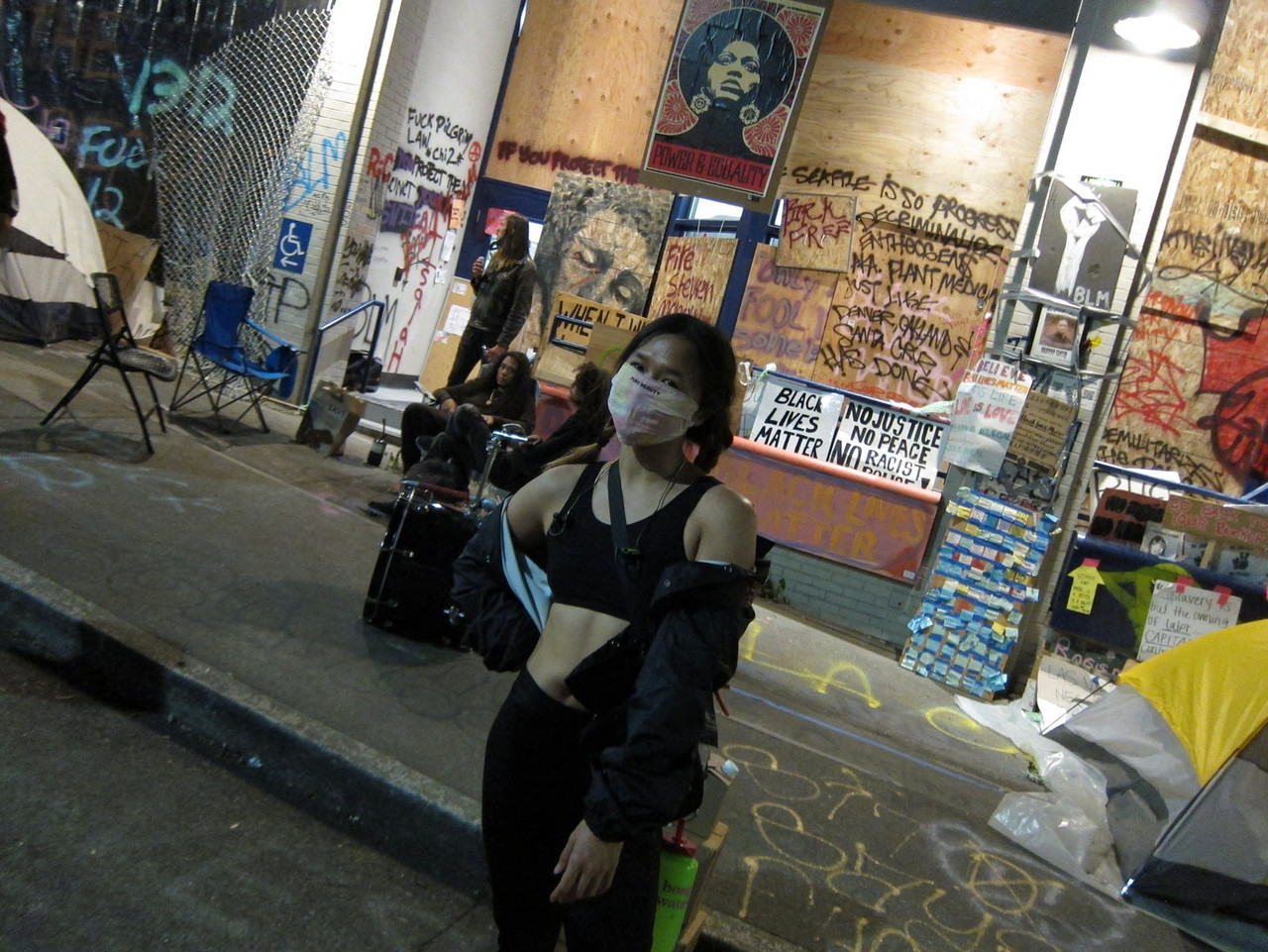
Sobriety is a political praxis – a logic of not just recovery, but reform. The declining relevance of drugs as fuel for political counterculture became clear to me last summer, when I spent a month reporting on Seattle’s CHOP/CHAZ autonomous zone – a protest encampment that emerged in the wake of the Floyd protests and occupied six city blocks outside an abandoned police station. Heavy drinking and drug use plagued the encampment; I witnessed endless opioid overdoses and drunken brawls. In response, the camp’s self-appointed leadership would patrol the area accompanied by volunteer antifa guards, actively discouraging protestors from intoxication, which they viewed as a distraction from their abolitionist cause. Instead, a tutu-wearing antifa soldier stood at the zone’s heavily barricaded and armed entrance, next to a giant sign that declared: SUBSTANCE OVER SUBSTANCES.
Similar calls for sobriety resounded at the Black Lives Matter protests I joined in Philadelphia, New York, Washington DC, and other cities across US America. (Weed was a notable exception – it was widely accepted as a soothing balm to the fiery violence on the streets.) Clearly, in 21st-century US America, drugs no longer hold the same countercultural valency as they did in the 60s, when »turn on, tune in, drop out« became a political mantra popularised by LSD godfather Timothy Leary. As psychedelic drugs such as LSD and mescaline – long tested by the US military for use in psychochemical warfare – were appropriated by the countercultural vanguard and used as tools for transformation, the politics of struggle came to embrace the politics of consciousness. As Fred Turner writes in From Counterculture to Cyberculture, »the key to social change was not politics, but the mind.«
US America’s drug paradigm shifted in the wake of the crack epidemic and opioid crisis, which took root in the 80s and 90s, and turned addiction into a for-profit industry ruled by the Sackler dynasty. During the pandemic, overdoses and addiction skyrocketed as drug dependence went mainstream and fentanyl polluted the supply chain. While drugs can and do still function as a psychic armor against the militarised corporate state, both Millennials and Gen Z no longer view intoxication as de-facto liberation, leaning instead into health and wellness to weather widespread socio-political upheaval.
It is impossible not to consider the entangled nature of race and drugs. Despite efforts to rectify the War on Drugs’ disproportionate harm to marginalised groups, the legal cannabis industry has become overwhelmingly white-controlled, while drug law enforcement still disproportionately hurts Black communities. The growing psychedelics movement risks falling into the same traps as weed. Certainly, the Silicon Valley microdosing culture and rise of venture capital-backed shroom stocks points to the potential of a very easy takeover of capitalistic and white-centred control around psychedelics. Getting stoned no longer holds any countercultural bite when your weed comes from a SPAC owned by a vertically-integrated cannabis conglomerate, and legal ketamine clinics are a privilege reserved for the most wealthy.
In a world that profits off our sustained un-wellness, reframing sobriety as community building and mutual care can also turn post-pandemic nightlife into a therapeutic site for social rehabilitation – and even (dare we say it?) revolution.
On the other hand, there is a fundamentally anti-capitalist spirit behind sobriety, in the idea that your seed-level experience is enough. There’s no idealised level of fun that you’re missing out on, and that you need to achieve through drinking or doing drugs. This feeling of not being »enough« presupposes deficiency as a starting point, which is a capitalist logic leading to a market-based solution: you need to exchange money for a drink or a drug to make yourself better.
As the pandemic recedes, nightlife will be pivotal to reframing sobriety as a communal and sustainable political practice, as these liminal spaces have always been the frontier where new cultural ideas are tested before they hit the mainstream zeitgeist. However, new frameworks for sobriety are essential if we wish to evolve from the toxic norm, expand beyond the traditional abstinence-based model of Alcoholics Anonymous (AA), and avoid the commodified narrative of »wellness culture« and capitalist club culture. In a world that profits off our sustained un-wellness, reframing sobriety as community building and mutual care can also turn post-pandemic nightlife into a therapeutic site for social rehabilitation – and even (dare we say it?) revolution.
Shifting the syntax of sobriety
Traditional approaches to sobriety tend to frame drug use as a binary: you’re either on the wagon or off. In the traditional Alcoholics Anonymous model, sobriety is seen as a type of chastity, with purity and cleanliness achieved through total abstinence. This model is logically inconsistent: nicotine and caffeine are staples at AA meetings, and call into question what constitutes a »drug« – especially as the binary between »bad« drugs and »good« medicine is blurred by the legalisation of recreational cannabis and decriminalisation of plant medicines.
Abstinence also ignores the history of AA itself: its founder, Bill Wilson, was a staunch advocate of LSD as a tool for recovery, believing it to be a powerful spiritual catalyst for finding a »higher power« that is key to overcoming addiction. After his first trip in 1956 at the VA hospital in Los Angeles, Willson formed a psychedelic salon with Aldous Huxley and corresponded with Carl Jung. »You use the same word for the highest religious experience,« Jung once observed in a letter to Wilson, referring to the Latin word spiritus, »as for the most depraving poison.«
Spectrum sobriety
Spectrum sobriety is a (fundamentally queer) approach that allows the individual to claim sobriety in more fluid and personal terms, rather than thinking of it as a binary, a conscription, or lifelong punishment. There are so many levels that one needs to examine in order to let this spectrum have more meaning: which substance(s) are you using, to what end, and how much range is there in your spectrum? The recent convergence of psychedelic culture with medical and therapeutic modalities is dramatically shifting the mental health paradigm, and many wish to leave the door open to plant medicines or other therapeutic substances.
Spectrum sobriety thus offers a means to not only connect to a wider range of mindful drug modalities, but also connects to questions of recidivism. Often, sobriety-as-abstinence is framed as a type of chastity; by making it harder to apply a purity metric to your character, spectrum is a disruption to that tendency. While terms like »harm reduction« frame drug use as necessarily harmful, spectrum frames sobriety as a base level, and everything else a modulation of that. Spectrum sobriety gives you a chance to choose what to take – it creates a more inclusive mode of healing, rather than puritanical self-denial and abnegation.
Cali Sober
Like spectrum sobriety, Cali Sober is a non-binary understanding of sobriety that emphasises personal choice and a therapeutic orientation. When I first coined the term in an essay I wrote in 2018, I defined it as refraining from alcohol but engaging in mindful use of weed and psychedelics – a drug diet that I had found useful during my personal journey of recovery from the throes of nightlife-centred substance addiction. Calling myself »Cali Sober« was an easy and somewhat flippant way to explain myself to confused onlookers at weed parties where I refused to drink but gladly puffed on joints. From the beginning, it was a term engineered for the rise of post-alcohol social spaces where alcohol is not a critical part of the social equation.
Little did I predict that the term would go viral beyond my wildest imagination – appearing in mainstream publications and adopted by celebrities like Demi Lovato, who even wrote a song about it on her latest album. What is less surprising is how Cali Sober has been immediately appropriated by the cannabis and wellness industries into a marketing buzzword denoting a consumer lifestyle and focus-grouped into profits.
Post-alcohol nightlife and plant-based partying
Lockdowns provided an opportunity for many of us to reconnect with level zero of ourselves, and to be able to reflect on these questions. Some of us struggled to enjoy ourselves in party environments where ingrained social habits encourage excess. It was a strange kind of performance anxiety – this feeling like we weren’t enjoying alcohol/drugs as much as others, presupposing an ideal amount of fun-having or »spiritual experience« that we perceive others as being able to access.
Spectrum sobriety is a (fundamentally queer) approach that allows the individual to claim sobriety in more fluid and personal terms, rather than thinking of it as a binary, a conscription, or lifelong punishment.
Clubs are currently designed for drug use and are terrible places to be in when they’re empty or when you’re sober. The time is ripe for the radical task of reimagining nightlife spaces in terms of experiential design. Perhaps it’s time to move beyond the current post-industrial aesthetics of Berghain-style brutalist drug dens, and towards natural, biofuturist environments more nourishing and hospitable for sober (and softer) social experiences. During pandemic lockdowns, many traditional nightlife venues were closed, and there was a proliferation of art events, performances, and raves in forests, caves, and other public park settings. These gatherings felt more accessible to both psychedelic and sober experiences, focusing more on ritual, intimacy, and political protest rather than consumption. When lockdowns were lifted in cities like Los Angeles, this new paradigm of »plant-based partying« has continued to trend as long-atrophied limbs stretch out on sun-speckled grassy dancefloors across abundant outdoor spaces.
Environment can play a big role in triggers, and designing sober-positive spaces also means paying attention to stimuli that modulate arousal that one might want to either induce or inhibit. At the level of sensorial, it means creating a domain where people are allowed to focus more on themselves, or find different pieces of environment to interact with – creating more vectors of depth to the experience beyond the standard club setup of lasers and strobes.
Recently in Los Angeles, I attended an ambient concert in a historic Japanese garden, where the delicate resonances of electronic synthesisers reverberated amongst the sun-dappled trees. The audience – a mix of stylish neo-hippies, young New Age families, and experimental musicians – was mostly sober or lightly tripping on natural psychedelics, and everyone was sprawled out on blankets gazing up at the sky. It struck me that the type of deep listening required for this sort of exquisitely gentle music would not have been as enjoyable on cocaine, amphetamines, or even alcohol – drugs that trigger dulled-down numbing or excitable extremes, rather than a subtle and profound vibeyness. As the show wound down at sunset, everyone left looking radiant and invigorated, rather than drained and depleted.
So, when we talk about new frameworks for spectrum sobriety in nightlife, we are ultimately talking about a modality shift from hedonism to healing. I can only hope that these ideas put forth here will help other like-minded ravers build more sustainable and balanced relationships to a culture that is, at its core, about spiritual transcendence, mutual aid, and personal growth – a fundamentally psychedelic experience.
Michelle Lhooq is a journalist, event producer, and consultant based in Los Angeles and New York. She is the author of Weed: Everything You Want to Know But Are Always Too Stoned to Ask (Penguin Random House, 2019), and also runs a newsletter called Rave New World, dedicated to exploring individual and societal relationships to drugs, the fringes of global nightlife and rave scenes, and political counterculture.
This text was commissioned as part of CTM 2021 – Transformation. It follows a workshop that Lhooq held at the festival as part of the Rethinking Music Ecosystems series, titled »Club Sober: New Forms of Sobriety for the 21st Century.«