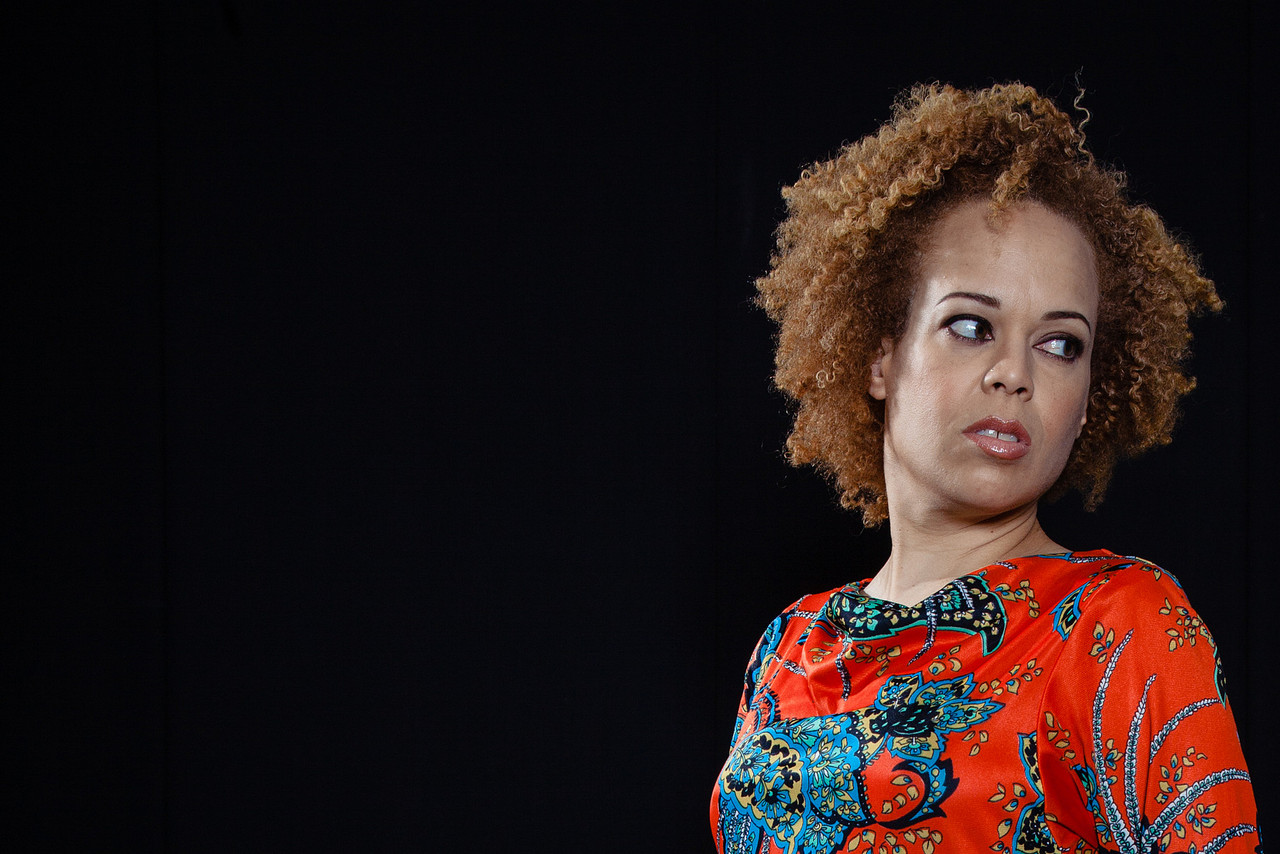
I don't want people to perceive that Surrender to the Totality of Blackness is going to produce the same results as political action. I am inspired by politics, yet I perceive a distinction between that engagement and artistic expression; for me only political action is political action. I felt compelled to continue working on this piece after the first concert performance in the chill out room at Freerotation Festival. I had people coming to me afterwards with tears streaming down their faces. I thought I was just getting up and doing a set. I touched something deeply in people, so that's why I wanted to keep developing the piece, expanding it.
Surrender to the Totality of Blackness is not what I initially anticipated. The work unfolded really organically. I'm very far away from the United States right now; the Black Lives Matter movement happened over the last years, and I was looking and asking, »what is it that I can share and contribute as an artist to this particular situation?«
Obviously, systemic racism is propped up by economic systems that benefit from it, but at a deeper level, I was looking at human emotion. I kept digging and digging. One of the ways that racism manifests is a fear of Blackness more broadly. I was thinking, »let's go to the time of being really little children. They're afraid of the dark. Why do they perceive Blackness as something scary?« I looked at the elements that are much bigger than we are – the earth, the sea, the sky, the universe. I asked, »what would be the scariest thing about any of those elements?« You get subsumed, you’re suffocated. You're taken away into the waves and drown, you're whipped up into the sky, you're pulled away, there's no gravity. You are subsumbed into them and you die.
There was a Black Pride book from my childhood that I have been trying to find online, to no avail. It’s definitely not the book written by John Howard Griffin, but I believe it's also called something like Black Like Me. I suspect it’s out of print. It had beautiful illustrations that contained a refrain in the text, »black like me.« It referenced all these beautiful elements of Blackness in nature, like, “the dark soil, is black like me.” This is a tradition that I was exposed to as a child, it left an indelible impression on my memory. I've been scouring the internet, it is surprising to me that I could not find this book because we're so used to the Internet of Everything. I haven't unearthed it yet, but I'm a pretty persistent person, so hopefully I'll find it eventually.
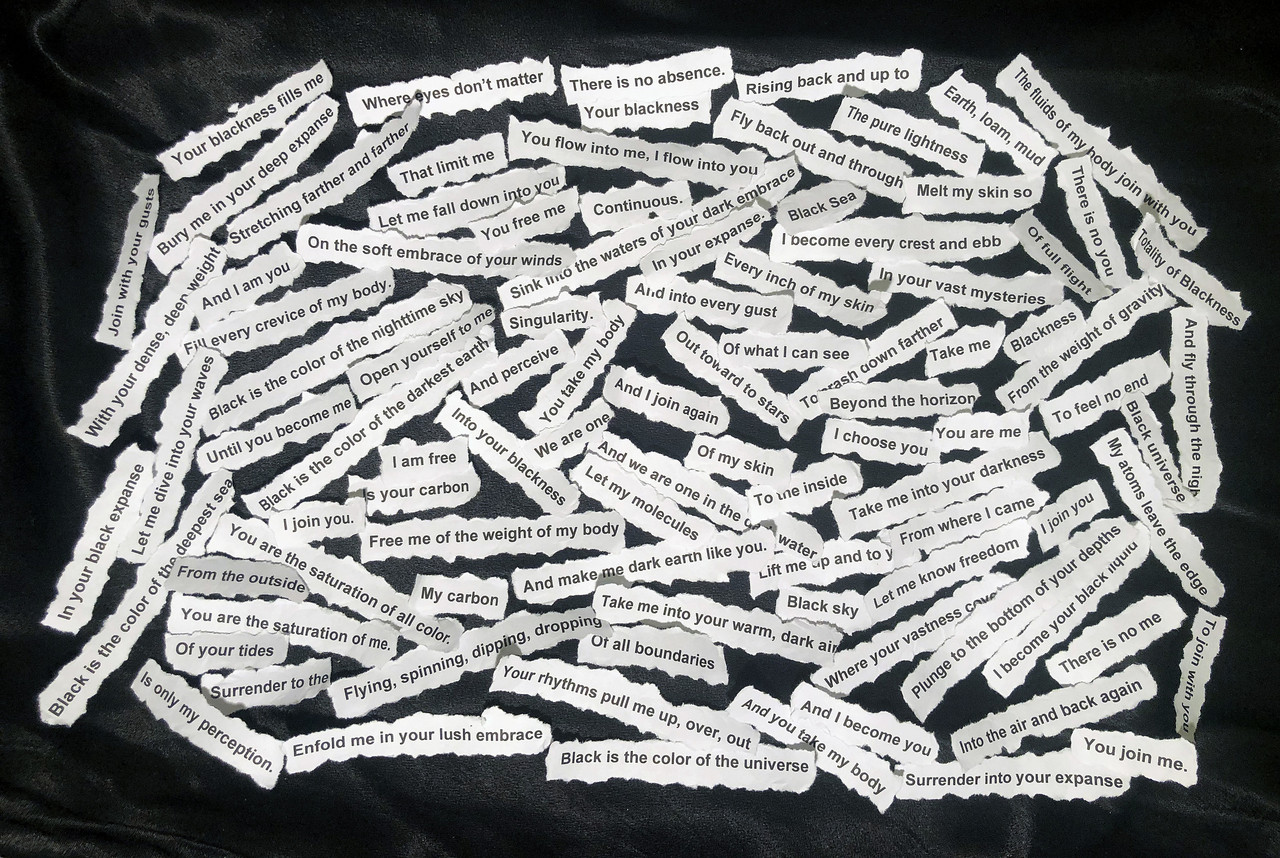
What if I could transform this relationship to the earth, to the sea, to the sky, and the universe? I wrote tone poems, which are like love poems – to each of the four elements. I decided to sing these tone poems in an elongated, extended form that is meant to have a certain musicality along a gentler impression of the content. Words live in a different kind of way when you sing them, rather than reading or speaking them. That is the reason why I took all of the text, cut it up, literally tore up each line by hand; I like the tension and release that comes from the linearity of a written line versus where it then goes, to the next line.
I suppose there's something in the language of these tone poems that could be perceived as potentially erotic, but they feature intentionally proactive language: »Black earth take me.« Surrender here is not binary: I'm reframing it to be a pro-active choice of participation, not a dominating submission of personal will. Surrender can be choosing to remain in a state of agency. I've always really loved Brian Eno's work, and he talks about how the elements of things that are oftentimes most restorative for people come in the form of surrender. For me, there was a certain kind of passivity around that interpretation of surrender. I want to reframe surrender as a conscious act, to move through perceived boundaries of separation towards connection and intimacy.
I hope to create a situation where people can experience that in a loving environment, one that is positive and intimate. I remember when I went to see the very first Yayoi Kusama Infinity Mirror Room at the Whitney Museum, many years ago. It was very, very simple. I also came up in New York playing these multimedia events, in abandoned warehouse spaces out in Brooklyn. They had music, they had art, you could do whatever you wanted, dance, eat, converse, explore, lie down. These were very immersive experiences.
I want to reframe surrender as a conscious act, to move through perceived boundaries of separation towards connection and intimacy.
While I was working on the recording for the virtual presentation at CTM 2021, there was one specific reference that I remembered: when I made the original piece, the beats in the beginning were deliberately at slow-jam tempo. Beats for dancing slow, for belly rubbing. Slow jam beats are of the Black cultural tradition, and are a part of my early experience of intimacy in early adolescence that surfaces me aesthetically today. African diasporal musical influences permeate my music. The human heart standardly beats at 120 bpm; I cut that bpm to 60, and slowly decreased the tempo until the beats eventually release.
I'm so rooted in performance, connection, and being in space together as a community. Part of the process of recording this for me was revealing my own vulnerability. I was trying to sing with a broken rib, trying to perform in my studio, with no engineer for support. So I recorded it in a very specific way: I turned all the channels on and hit the record button, performed the whole piece through for over an hour. What you hear is a lot of humanity: my fingers on the mbira metal tines, the click of my nails pulling strings on the autoharp. It's really okay for all of the things that we usually try and erase away, all of the details, to be in the equation.
This time has been a period of pivoting, reframing, and recasting. None of us were prepared for the where and how we're living right now. One of the things that I keep reminding people about is that the virtual ambisonic version of this performance is binaural. In order to experience it, I encourage folks to try and get close: turn out the lights, lie down on the floor, put in headphones. If you have a projector, take the imagery and project it on a wall, and try to imagine yourself physically in what you see.
For future versions of Surrender in particular, I will set up a space to have people lying down on cots, with video imagery that envelops everything. I want to liberate the traditional quadratic space format in which we're acclimated to looking at everything. I don't want separation; I hope to contribute opportunities for people to move through those kinds of boundaries, so that they don't have to feel so frightened and afraid. If they are more at peace with the rest of the world, hopefully, they can be more at peace with themselves.
The backstory of the first piece in the trilogy, Emerge From The Totality Of Blackness, is that I was in dialogue with Kamila Metwaly at Savvy Contemporary, where this work was commissioned and presented. She invited me to »come up with something new.« I'd really thought of Surrender as just an individual piece, there was no trilogy in mind to begin with. I then thought, »surrender and separation: where does this all start? Where does it come from?« The place where we first experience ultimate intimacy is in the womb. We're pre-language, we have no means to articulate what's happening to us. Birth is the very first experience that we have of this »separation.« I wrote more of these tone poems, to speak to that being we are before we have language, before we have thought, to offer some comfort and support in coming into the world.
This time has been a period of pivoting, reframing, and recasting. None of us were prepared for the where and how we're living right now.
I'm in the middle of conceiving and devising the third part now. It has to do with resonance. If someone is to come out of parts one and two, into some version of intimacy, where do we land after that? That's why I am really interested in the new research between physics and social sciences about resonance. I'm thinking about sound, looking into other colleagues' works, practices, and research, including quantum entanglement. I was commissioned last October to write a composition for the Bang On A Can Marathon, which is a composer’s group that's been active in New York since the 1980s. I wrote a piece called A Coda To The Totality Of Blackness Trilogy, in the hopes that it would help bring me some clarity about part three.
And so I have a whole series of questions that will generate more. They're really key to my process and practice. I really like to sit with them, and not to come up with answers, but rather to see what is revealed in the process of inquiry. The two questions that keep recurring, are the classic ones: »what is to be done?«, and then another, which is also the title of an upcoming album »how do we get to where we want to be?«
Christine Kakaire (she/her) is a Berlin-based writer, editor, teacher, and speaker. Her writing, editing, podcasts, and event hosting has been published by Ableton, Audio Technica, Crack, DJ Mag, Groove, Pitchfork, and Red Bull Music Academy. She has presented and spoken at numerous music conferences and festivals across Europe, and she currently teaches about popular music culture and critical theory as a Lecturer at BIMM Institute, Berlin and London.
This text was commissioned as part of CTM 2021 – Transformation.