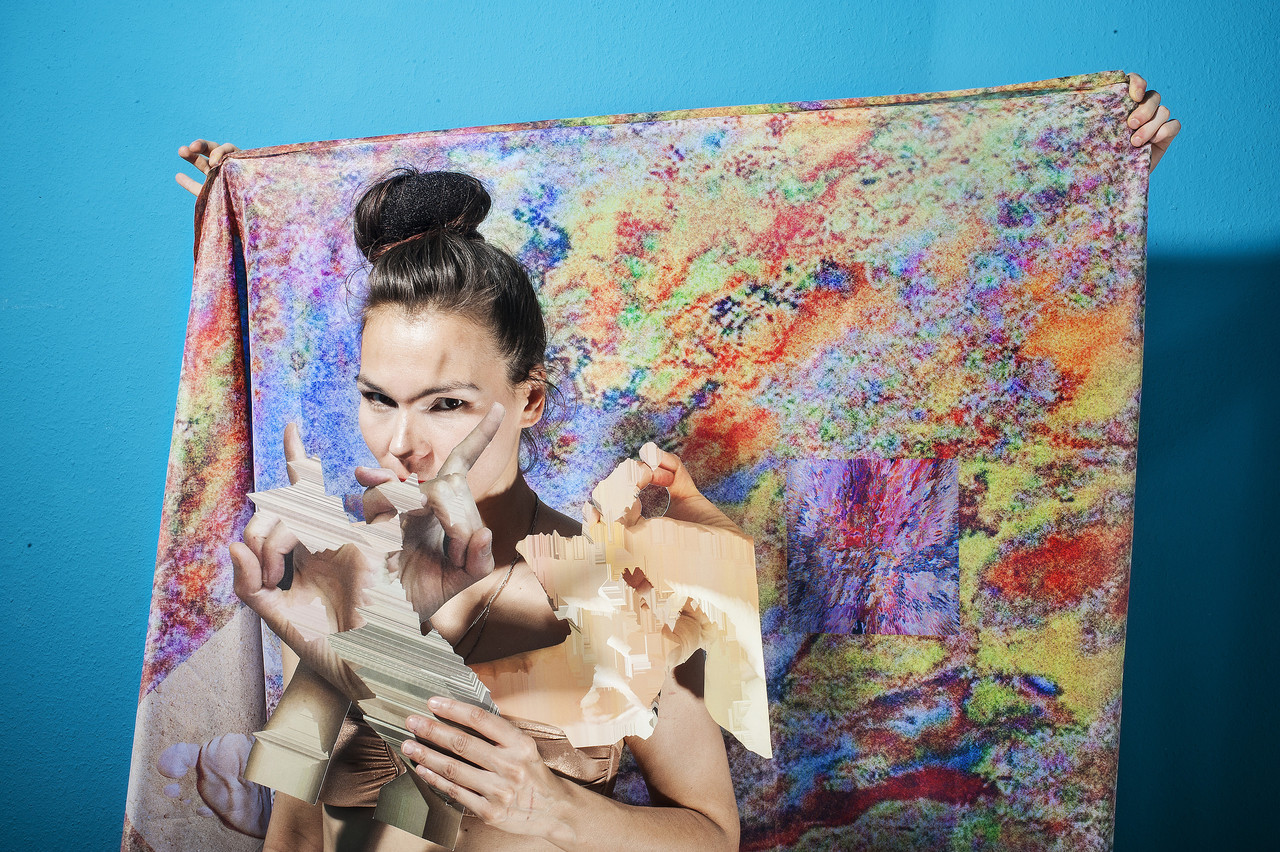
In a broad-ranging conversation with zweikommasieben's Lendita Kashtanjeva and Guy Schwegler, Devi talked about personal histories, Eastern music, a new kind of feminism, her collaboration with Chinese artist Tianzhuo Chen, and playing ambiguously with symbols. The first part of the conversation is published below; the second will feature in the upcoming print issue of zweikommasieben Magazin (out in summer 2016).
zweikommasieben: You have spoken about your identity and your quest as a musician in recent interviews. This meant researching your cultural roots in Buddhism and Hinduism, but also trying to find your father, whom you never got to know. Which of those two parts came first?
Aïsha Devi: I think at first there was an attraction to Asia in general. When I was a kid, I never quite felt that I belonged anywhere, I felt like something about me was weird, that I was an outcast in little polished Switzerland. It was always a struggle for me, because of my name, because nobody really understood where I was coming from, and in particular, because I was mainly raised by my grandmother. I never really talked about my father with my mother – his Nepali and Indian origins were never a topic. So I was intrigued by Asia, but very discreetly.
Furthermore, I think my love for Asia came through music. I was looking for something different than Western music. Somehow I felt a huge connection to the Indian (musical) scale. When I began meditating, this scale helped me the most to connect to other worlds, to an invisible energy. Music opened the door, really, and from there I began to search more and more for my own roots. I only have a picture of my father. I'm trying to find him but I don't think he's still alive. My father is more abstract to me than music: music really exists, it is part of my life, but my father is still a concept. Looking for my father is also a kind of alibi for connecting to that part of the world. It's not an ego trip; it's more to understand a different culture, to understand why I feel so happy in India and to understand why Western cultures need to look to the East or to ancestral knowledge to fully comprehend our society. Through that, I think I found a lot of knowledge and a lot of prudence.
ZKS: When researching Eastern music, did you have the Western electronic music continuum in the back of your mind?
AD: No, I think it was a general interest that came into existence through meditation and through spiritual knowledge. I dove into ancient texts, for example the Upanishads or the Sutra. These are some of the most ancient texts ever written. They contain both metaphysics as well as »actual« knowledge: physics, medicine, mathematics, and sacred geometry. They're a basis for both Hinduism and Buddhism. I gathered all that knowledge while meditating and learned guttural chanting too. So meditation began as a spiritual process, but the more I was meditating and the more I was using those techniques, the more I started to realise that meditation is music and that it was really close to my way of producing. Both are intimate and introspective processes. The two became the same ritual: meditation and music production merged into one way of breathing and one way of transforming energy into something material.
I also rediscovered many things (through meditation) that I had already included in my music, like the use of frequencies. For instance, when you're chanting you're creating a tone that has a direct impact on your body. Therefore, the main role of music is a medicinal one: to gather and heal the collective energy. With that in mind, music is not only entertainment, it's a ritual.
To me playing live is exactly about this idea: Gathering people and putting them into a collective trance where the energy is higher than the sum of its parts.
Yet our Western music industry is total sterile. Nature doesn't react to its standards of frequencies and recording. There is another way of producing music that has an impact on nature, an impact on our bodies, an impact on our society. What I really love in Asian music is that they keep that ritual aspect even though it is industry-related too. They are aware of nature's response.
ZKS: You're based in Geneva. How does that affect your life and your work as a musician?
AD: I think Geneva is quite soulless at the moment. It's changing a bit, but I probably chose the city as my home because living there is a good way to remain a hermit – there's not much around. The cultural scene is quite small and there's not a lot of exchange happening between other countries or cities. In Berlin or London it would be different, I guess – there's so much stimulation everywhere. On the other hand, I don't really fit the Genevan stereotype of the healthy, wealthy banker. Geneva was really huge in the 1980s and early 1990s. There were lots of squats here. The punk scene, the electronic and industrial scene, both were really flourishing and the energy was intense. But eventually the authorities took back houses and evacuated all the squats. Now the culture is not that diverse anymore. There are a lot of people from other countries living here, but I get the feeling that nobody is really mingling. That's a pity. But I'm staying here to be a hermit in my studio. Also I'm really close to nature and to an airport. Finally, I'm quite happy with the relationship we have to the Swiss-German scene.
ZKS: You consider the voice to be sacred. How does this relate to a transformation of the voice in a technical way? Besides your untreated singing and guttural chanting, you also apply some pitch shifts and vocoder effects in your productions.
AD: I think that the voice is sacred because it is a vibration you create with your body. You have two vocal cords and when you're singing, you make your own cords vibrate. For me this is the most frontal, physical and energetic way to express myself. Singing is the prime opportunity for me to exist in the world.
First, I learned classical singing techniques, like opera. Opera is very much ruled and constrained, though. I had the feeling that you can't be really free. At one point I decided that I'd rather scream than sing another opera. I love the idea of a primal scream: the voice not being formatted by the whole industry, by the West's vision, by radio or television. My singing has changed a lot since, also through the whole meditation process. When I'm singing now, I'm almost in an outer state of mind. I'm currently singing with halftones, almost as in the Indian or Arabic scale. And I never felt so free. Singing without any constraints is like singing without an ego, I guess. Ravi Shankar said about the Indian scale that there are no harmonies that could draw you or make you feel totally self-satisfied. Instead you're always switching from one note to another. This is what connects you to the spirits and to cosmic energy. However, I'm trying to use as few effects as possible. Also when I'm practicing guttural chanting, it wouldn't make sense to transform it. But there's one track, »Aurat,« on which I used a vocoder. I'm reading a poem and, as I hate my own voice so much, I had to make it sound more robotic. In a way, I tried to avoid my own voice. I played with pitch in some parts – I like a really high pitch, because that makes the voice totally narrowed and nasal – to me it sounds a bit like a voice from an ancient time, and I cannot do that myself. I can't sing like that. I wish I could.
ZKS: In your live shows, the Roland JP-8080 synthesiser plays an important role. This piece of equipment was key to European trance music, too. (It's also the main object of interest in Lorenzo Senni's T-studies; see last issue of CTM Magazine.) To what extent was that of interest to you?
AD: When I'm producing, I'm not using hardware. I only produce with my laptop. But I like to transpose the tracks onto machines for live settings – to give the music a second birth and a more open perspective. I think the Roland JP-8080 is one of the only instruments that I intentionally chose. The first time I heard it was on trance tracks, massive ones like from Tiësto. Although I don't like this kind of music, I absolutely love the effect it's generating on people. I wanted to use the JP-8080 because it has that capacity. It has those strong subs, which address the emotional part of your body. Then there are those amazing high frequencies, and the supersaw wave that duplicates the higher tones and harmonises them. This has a really strong effect on the top part of your brain – that's the effect that puts people into a trance. To me playing live is exactly about this idea: gathering people and putting them into a collective trance where the energy is higher than the sum of its parts. People making modern trance music are using this kind of synthesis for self-satisfaction and their own egos. But I like to use the machine's capacity, those frequencies, not as a self-satisfied person, but to really make people feel like part of a community.
ZKS: What's your reason for exclusively using the laptop when producing music?
AD: I could make music on a djembe or guitar – but for me, producing music is so connected to my everyday life. I don't want to just make ritual music, I want to make contemporary ritual music – a high-fi ritual merging pulse and frequency with our way of living. I'm not saying we're living life in a good way, or in a true way, but it is what it is. The kind of meditation I'm applying while producing aims at being with yourself, being inside yourself. And when I'm working with a computer — I'm not talking about being on the internet, but of making music – I'm not going inside my computer. I think my computer is coming inside my brain, inside my breathing, inside my body and that's a part of that meditative process. I can be alone on my computer and be in a total trance. My computer is not a wall to me, but a direct connection to what's inside my brain. The computer creates the physicality of my own abstractions. The computer materialises all of my energy. For me, it is simply the best way of achieving this.
Besides that, working on a computer gives people the perspective of realities other than one's own. And I like that idea — same goes for video games. There's this idea that not only physicality exists.
ZKS: The Conscious Cunt EP you released before your album was focused on issues of femininity. Was this the reason you released its three tracks on their own? On the follow-up album, the EP's tracks – and therefore their underlying issues – are still there, but the themes are broader.
AD: The album is about meditation, my initiation trip, and the knowledge I was collecting during that process. The whole EP was kind of a genesis, a sense of awakening. I wanted to make a shout-out to the status quo of women. That status is in between the spiritual ascension that we witness in society and the still-ongoing power of the patriarchal media – the star-ification and idolisation of women, who are still functioning under and playing with misogynistic codes. They are still fulfilling patriarchal promises. For instance, the track »Kim and the Wheel of Life« is an examination of spirituality's eternity – we are all one, we are all connected, a society without hierarchy gathering in spirituality – put in front of the mirror with icons like Kim Kardashian. It's not about her, primarily, but about her symbolic position in the society. That position is still fulfilling misogynistic dreams, doesn't give any content, doesn't use a voice to spread ideas to build a better society. She's just fulfilling her own ego pleasure. I'd like to see new icons, new female icons, who are shamans, scientists, who have answers, who have something to say. And that's the idea of Conscious Cunt: femininity can be sexual, but it shouldn't be sexualised. It's not an object, but a conscious choice of one's position in society.
ZKS: Do you intend to position yourself in pop culture with your visual language and your music?
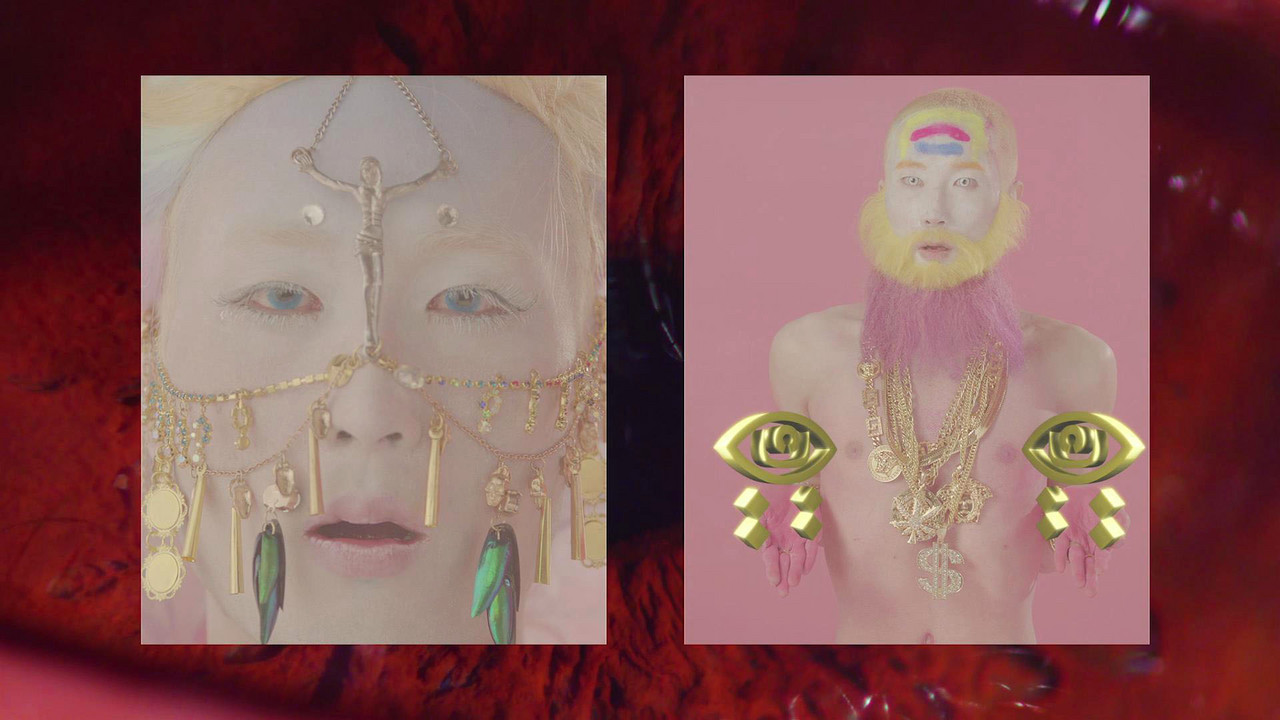
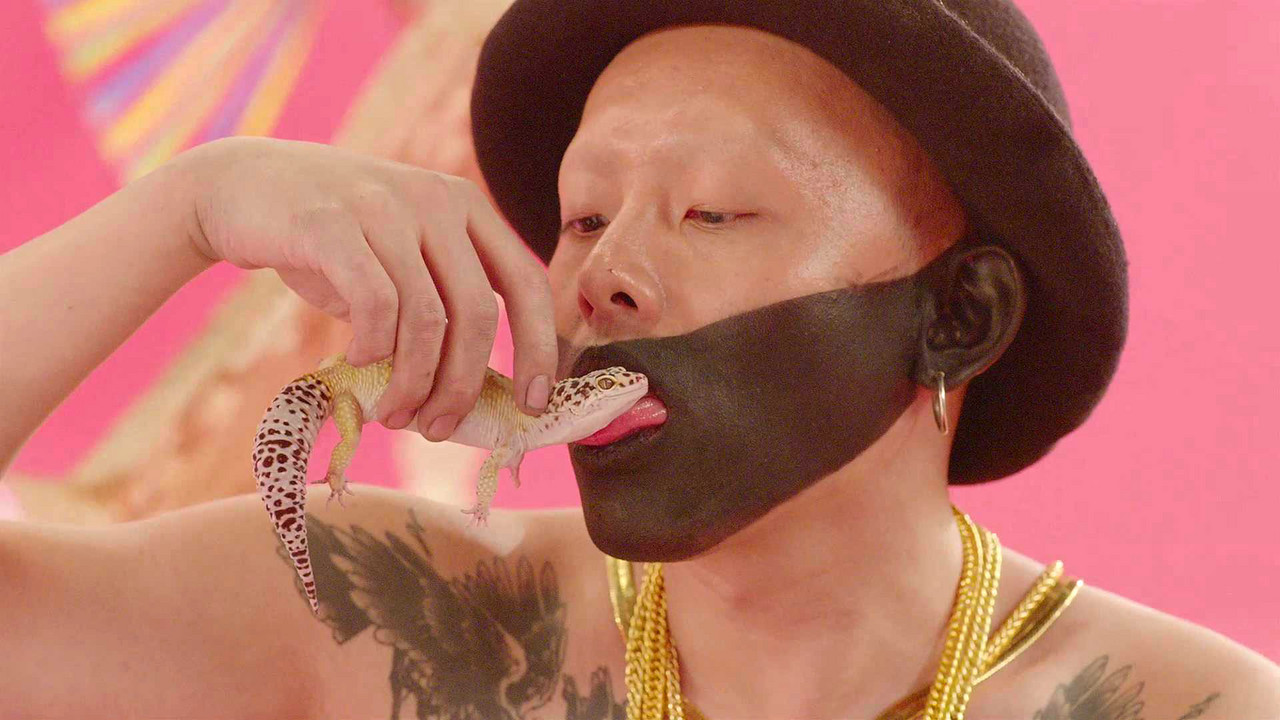
AD: I don't think that it's about positioning myself. It's more about using the tools and language that are contemporary. What really interests me is the tension between two things, and pop music doesn't have any tension, it's just heavy and closed. I like to leave doors open, and tension can do this, allowing everybody to inject their own history into it. I also like to involve people in my own genesis, including the people I'm working with. That's why I'm using contemporary visual language. But I think I'm avoiding pop in the music, in a way. I like the tension between image and sound. It's like the video for the track »Mazdâ« that was done by Tianzhuo Chen. His visual language is very similar to what I'm doing in music, but the way he delivers it is totally different. It's his language. It has a vibration that I really like, but it's far away from my way of doing music. It really was love at first sight. He's such a visionary artist. And I really liked the fact that he's Chinese and Tibetan-Buddhist. I think his work is really bold for a Chinese artist, considering the repression in the country, and I'm really happy that we're able to do a performance together during CTM Festival.
zweikommasieben is a magazine based in Switzerland dedicated to documenting contemporary music and club culture. The collective also organises concerts, club nights, matinees, raves and other fun events throughout Europe.
This text was originally published in CTM Magazine 2016 – New Geographies. Part two of the interview appears in zweikommasieben 13.