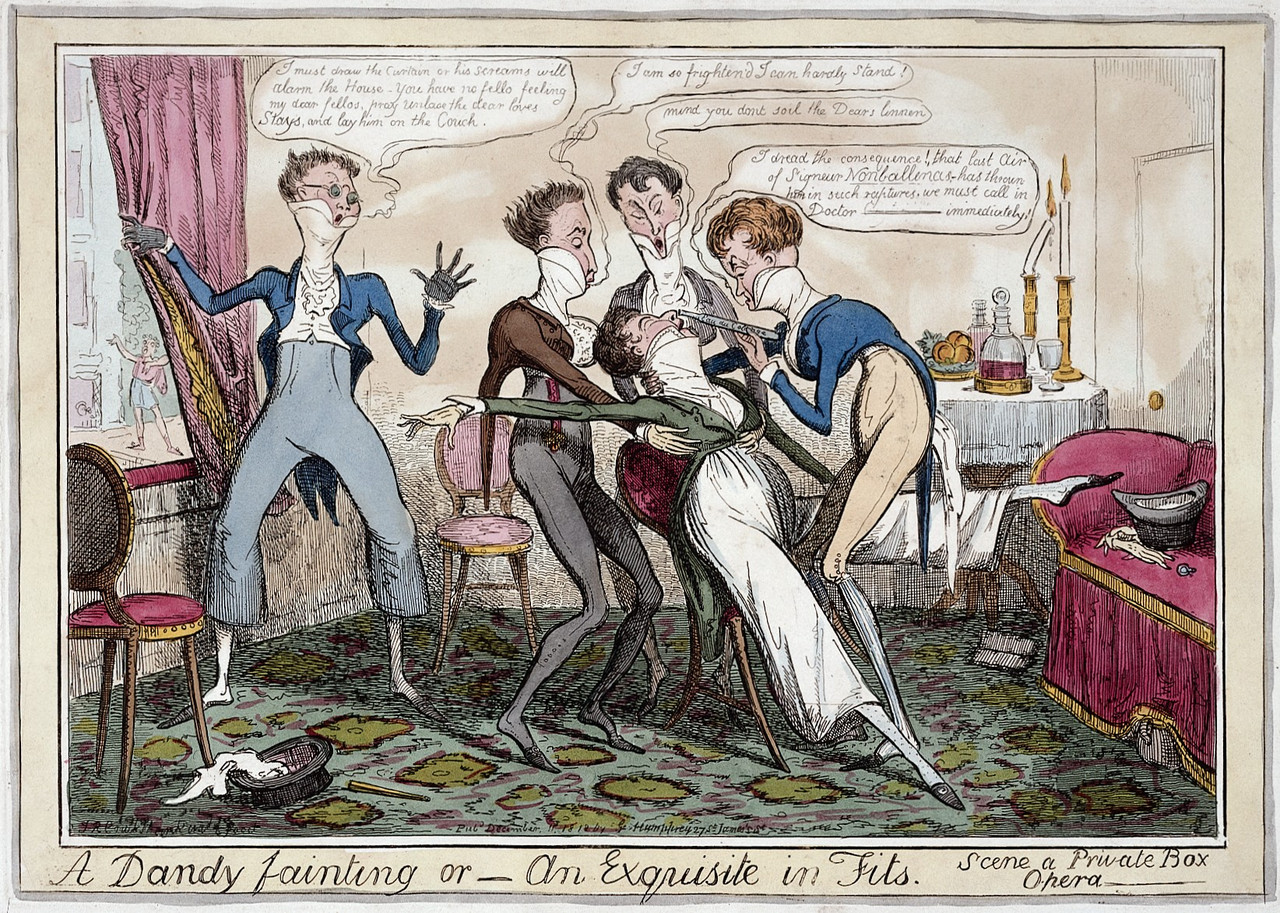
Everyone has songs they can’t stand, and some of us are even tone deaf, but most people think of music as a very positive and healthy part of their lives. In the context of music therapy, it is even supposed to have medical benefits. However, discussions of music also have a darker side. As I show in my book Bad Vibrations: The History of the Idea of Music as a Cause of Disease, for the last two hundred years, many doctors, critics, and writers have strongly argued that music, or certain kinds of music, have the power to cause neurosis, madness, hysteria, and even death. Over and over again, fear and anger about social order and cultural change has been expressed in panics within the medical community about musical genres. Often this fear and anger is in relation to forms of love or sexuality, with the threat posed by undisciplined women or homosexuals and the demand for musical manliness reflected in scientific language.
The ancient Greeks generally conceived of music as the »harmony of the spheres,« as a reflection of deeper cosmic order. This conception, which persisted for centuries, left little scope for music as a medical danger. By the 18th century, however, music was increasingly regarded less as an expression of universal harmony and more as a form of nervous stimulation. And like other dangerous stimulants such as novels or coffee, music, it was believed, could be the root of a whole range of modern illnesses. The glass harmonica (or armonica), which works on the same principle as rubbing a finger around a glass of water and makes a similarly eerie sound, was regarded as especially dangerous. Its popularity was such that Mozart composed for the instrument, but the idea that the instrument caused dangerous tension in the nerves was commonplace. In 1786 the German composer and harmonica player Karl Leopold Röllig suggested it could »make women faint; send a dog into convulsions, make a sleeping girl wake screaming through a chord of the diminished seventh, and even cause the death of one very young.« There are accounts of the instrument being banned by physicians who cited possible ill effects including prolonged shaking of the nerves, tremors in the muscles, fainting, cramps, swelling, paralysis of the limbs, and seeing ghosts. The fact that the instrument was mostly played by women, with their supposedly weaker nerves, was also significant. The sisters Cecily and Marianne Davies gave up the instrument in 1784 because of the nervous strain, and Marianne Kirchgässner’s death in 1808 was widely understood to be the result of nervousness caused by playing it.
Over and over again, fear and anger about social order and cultural change has been expressed in panics within the medical community about musical genres.
The first serious medical panic about a specific composer’s work relates to Richard Wagner. His patron King Ludwig II of Bavaria, who would later succumb to a peculiarly Wagnerian form of madness and drown with his psychiatrist in mysterious circumstances, reportedly passed out during a performance. Even more dramatically, the first singer to perform the role of Tristan, Ludwig Schnorr von Carolsfeld, died in a Tristanian delirium at the age of 29. Von Carolsfeld was not the only person to apparently »die of Tristan.« Aloys Ander, who had played Tristan in the abortive Vienna production, died insane in 1865. Such was the atmosphere of elicit eroticism surrounding Wagner’s work that the French writer Léon Bloy suggested that Wagner’s innovative idea of turning off the lights in the theatre was in order to allow secret groping in the audience. The American psychologist Aldred Warthin at the University of Michigan claimed that he had been informed by colleagues of quasi-hypnotised listeners being brought to orgasm by the composer’s music, but reported that he could not replicate this result in his experiments. He did however suggest that such Wagnerian trances »may be attended by danger.« »The symptoms of collapse developed at times,« he wrote, and »the accompanying emotional shock, might be increased beyond the point of safety.« Warthin’s experiment drew on work done at the Salpêtrière hospital in Paris in the 1880s, where physicians published studies suggesting that lullabies and gongs could put hysterical women into catatonic fits.
Other observers suggested that the sexual power of Wagner’s music could be related to what was seen as the medical condition of homosexuality. The famous sexologist Richard von Krafft-Ebing interviewed several men who said that listening to Wagner had made them homosexual. And in his 1907 book The Intersexes, Xavier Mayne included a questionnaire in order for the reader to discover if he was »at all Uranian,« a euphemism for homosexuality. Along with more obvious questions such as, »[d]o you feel at ease in the dress of the opposite sex,« it asked, »[a]re you particularly fond of Wagner?« Since it was widely believed that homosexuals, despite their innate musicality, were unable to whistle, it also asked, »[d]o you whistle well, and naturally like to do so?« Surprisingly, the Wagner cult thus prefigured 1970s disco in its associations with gay lifestyles and their supposed dangers.
In general, however, the warnings about the effect of sexual excitement were generally aimed at women. Physicians argued that even piano lessons could have disastrous consequences for female health. In 1900 the doctor J. Herbert Dixon wrote that it could lead to »pronounced neurasthenia« with symptoms such as »headaches, neuralgia, nervous twitchings, hysteria, melancholia and madness.« The consequences of modern musical over-stimulation for female fertility were a common topic of debate during the final decades of the nineteenth century. Some gynaecologists argued that musical stimulation could over-excite the female reproductive system, causing premature puberty and excessive menstruation. The Argentine psychiatrist José Ingegnerios described a case in 1907 that demonstrated, he believed, that female »morbid musical feeling« peaked when the women concerned were menstruating. He also reported the case of a »melo-sexual« young woman who achieved »complete sexual satisfaction« from playing the piano, which had led to her »sexual neurasthenia.«
In the poisonous atmosphere of the Weimar Republic, anti-Semitism came to play an increasing role in attacks on »sick« music. The Nazi takeover of power in 1933 was regarded by many critics of »degenerate music« as the basis for a restoration of musical »health« and liberation from the »bacillus of putrefaction« of bad music. To this end, all foreign music sold in Germany had to be approved by the Reich Ministry for Propaganda. The combination of racism, reactionary politics, and misused psychiatry that had developed in discussions of music through the Weimar Republic and into the Nazi era reached a peak with the Degenerate Music exhibition in Düsseldorf in 1938. Musical »hygiene« had become state policy, leading to an official ban on »harmful music« and to thousands being silenced, exiled, or murdered.
Race has played a major role in most medical panics about music since ragtime. Already in 1904, an American critic commented on the popularity of the argument that the »peculiar accent and syncopated time« of ragtime could have a »disintegrating effect on nerve tissue and a similar result upon moral integrity.« The association of ragtime with nervousness was such that a whole sub-genre, the »nervous rag,« came into being, including examples like Paul J. Know’s »Every Darkey has a Nervous Spell« (a song about stealing chickens). When jazz hit the mainstream after the First World War there was a wave of anxiety about its effects on the body, sometimes involving the authorities on public health grounds. The Health Commissioner of Milwaukee, Dr George C. Ruhland, opined that jazz excited »the nervous system until a veritable hysterical frenzy is reached. It is easy to see that such a frenzy is damaging to the nervous system and will undermine the health in no time.« The orchestra leader at Napa asylum near San Francisco stated that »from my own knowledge about fifty percent of our young boys and girls from age 16 to 25 that land in the insane asylum theses days are jazz-crazy dope fiends and public dance hall patrons.«
Race has played a major role in most medical panics about music since ragtime.
After the Second World War, the influence of Pavlov’s concept of the conditioned reflex combined with an atmosphere of Cold War paranoia led to a panic about the supposed ability of music to »brainwash« listeners, causing mental illness and political trouble. The term »brainwashing« emerged during the Korean War, when it was feared that Communists had developed powerful forms of mind control. The CIA then promoted the term to explain the behaviour of American POWs and began its own research into such techniques, some of which used music. The prominent English psychiatrist William Sargant advanced a Pavlovian account of musical manipulations in his book Battle for the Mind, which portrayed rock ‘n’ roll as a dangerous threat to the mind. He later argued in an interview in Newsweek that Patty Hearst had been turned from an heiress kidnap victim into a politically motivated armed robber by loud rock music.
In America, right-wing evangelical Christians have used the idea of rock music as a sinister form of brainwashing to argue that it was literally a Communist plot. Author David Noebel argued that »The Communist scientists and psycho-politicians have devised a method of combining music, hypnotism and Pavlovianism to nerve-jam the children of our nation without our leaders, teachers or parents being aware of its shocking implications. If [such] scientific programmes [were] not exposed,« he warned, »degenerated Americans will indeed raise the Communist flag over their own nation.« He provided ingenious if paradoxical reasoning to explain why Communist states themselves banned rock music although it was their own sinister invention – it just showed that they knew how dangerous it really was! Along with well-worn themes relating to sex and drugs, Noebel also brought to light a less common aspect of music’s dangers – the threat posed to plants. He reported an experiment conducted by Mrs. Dorothy Retallack of Denver that demonstrated, he claimed, that avant-garde classical music made plants wilt and Led Zeppelin made them die.

The American anxiety about musical brainwashing that developed in the context of the Cold War in the 1950s was in part shifted onto another supposed worldwide conspiracy during the Reagan era – Satanism. During the 1980s and 1990s a full-scale moral panic swept the country, linking the pseudo-science of brainwashing, the literal belief in a supernatural satanic threat, and the musical genre of heavy metal. A wide range of books with titles like The Devil’s Disciples and (my personal favourite) Hit Rock’s Bottom accused certain bands of brainwashing innocent American teenagers with subliminal messages which turned them towards devil worship, sexual immorality, murder, and suicide.
One apparent element of this diabolical plot was the use of so-called »backmasking,« hidden messages that could only be decoded when music was played backwards but, when music was played forwards, could influence listeners subliminally, damaging their mental health. Bands like The Beatles popularised backmasking techniques pioneered by 1950s musique concrète composers, sparking conspiracy theories relating to what the messages really said. Self-proclaimed experts often disagreed about which dangerous message was hidden in the music, and exposed themselves to ridicule with their analyses of backmasking tracks. One well-known preacher in Ohio publicly burned a recording of the theme tune to the TV series Mr. Ed (which featured a talking horse) because he thought it said »someone sing this song for Satan« when played backwards.
Like waterboarding, the use of music to ›break‹ a prisoner leaves no visible scars that might cause an outrage if they were shown in the media.
Just as the novel became more respectable as the cinema became the bugbear in the early 20th century, and just as the cinema was replaced by the »video nasty« in the 1980s only to be replaced in turn by the internet, so each new musical medium has been viewed by many as especially »modern,« immoral, and bad for the health. In the last couple of years, a new medical/moral panic about the danger of sound has taken the place of backmasking in the public imagination: »i-Dosing.« The Daily Mail was among the first to hype this potential new moral panic, with an article describing »the world of ›i-Dosing,‹ the new craze sweeping the internet in which teenagers used so-called ‘digital drugs’ to change their brains in the same way as real-life narcotics.« I-dosing involves so-called binaural beats – a tone of slightly varying frequencies is played to each ear and the listener can perceive an extra low beat.
More real – and much more worrying – is the deployment of music and sound in warfare. Like waterboarding, the use of music to »break« a prisoner leaves no visible scars that might cause an outrage if they were shown in the media. As early as May 2003, the BBC was reporting that the US army had played Metallica’s »Enter Sandman« and Barney the Dinosaur’s »I Love You« to »uncooperative« detainees at high volume in shipping containers. It seems that although almost all the panic about music’s effect on health over the past couple of centuries has been disproved, this more modern application of music may be seriously bad for the health after all.
Throughout the last couple of centuries, then, we have seen repeated occasions on which new musical genres and styles have been attacked on medical grounds, with remarkably little effort expended on finding evidence for their supposed ill effects. In fact, there are rare occasions when music can have a direct negative effect on health – causing epileptic fits, for instance – and the indirect impact of music in causing excitement can be the occasion of ill health. Nevertheless, the medical attack on music has generally reflected different agendas related to politics. The prestige of (white male) doctors was called upon to explain the necessity for musical order and the perils of free expression, especially in connection to women and racial or sexual minorities. Nor does the scene today seem so very different. The language of the female hormones may have replaced that of the nervous system, but the internet and media provide countless examples of medicalised panics about the impact of music, particularly if it involves »hysterical« teenage girls and young black men. Fear, anger, and love are therefore just as central as ever to today’s debates on pathological music.
James Kennaway, PhD, is a Historian of Medicine at Groningen University. He has published widely on music and medicine and related topics. He has held positions at Durham, Oxford, Stanford, Vienna, and Durham.
This text was originally published in CTM Magazine 2017 – Fear Anger Love.
»Bad Vibrations – Music as a Cause of Disease«, lecture by James Kennaway.
CTM Festival 2017, Kunstquartier Bethanien.
»Bad Vibrations – Music as a Cause of Disease«, lecture by James Kennaway.
CTM Festival 2017, Kunstquartier Bethanien.