Heimo Lattner: Your work draws our »gaze« to the conceptual, poetic, and socio-political connotations of sound. Your sound objects, as you call them, initially appear to be functional machinery. Yet thanks to their formal aesthetic qualities they also assert themselves as sculptures. This apparent ambivalence is something you very consciously play up.
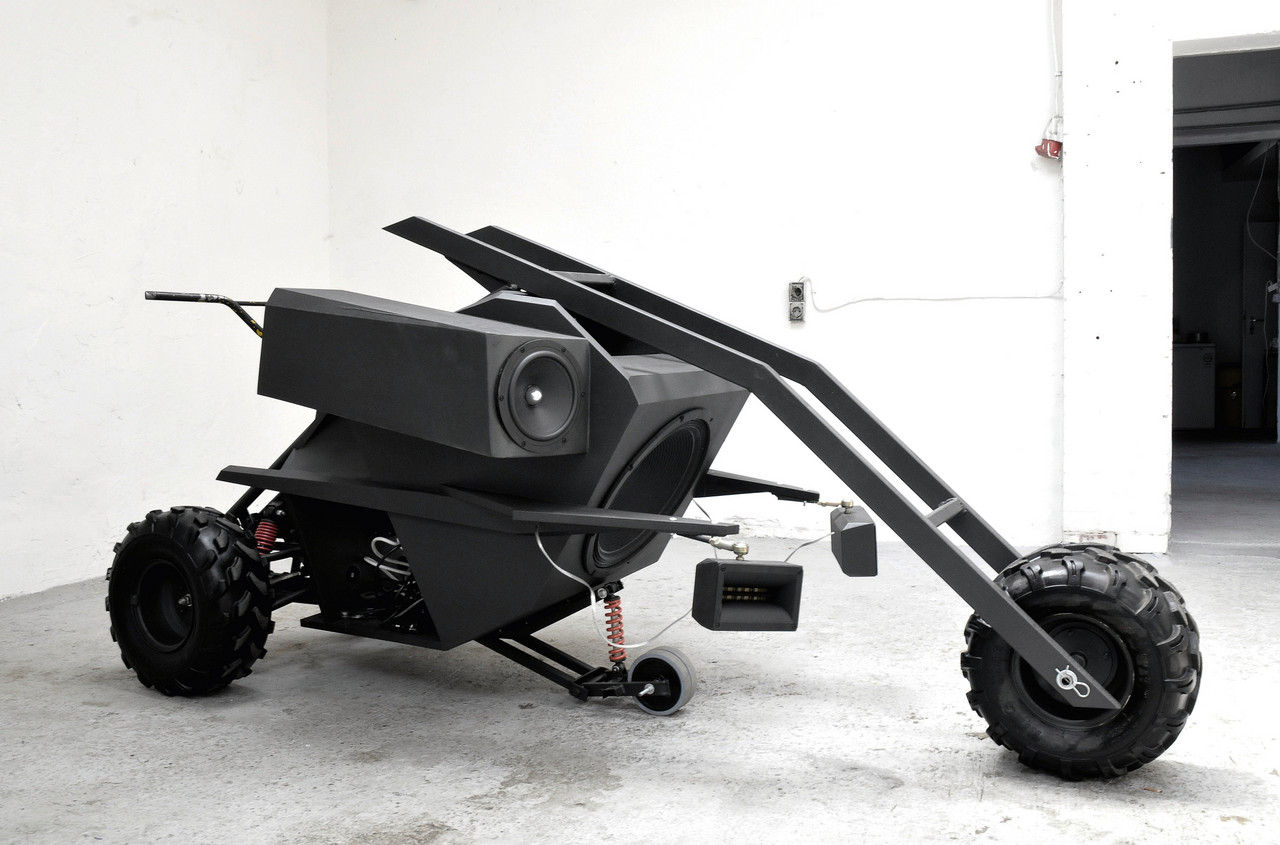
Nik Nowak: That’s true. In formal terms, these artworks reference sci-fi as well as urban or military phenomena while their recurrent insect or animal-like aspect is suggestive at times of mimicry or certain poses. Thus »Booster 2.13« (Figure 1) could be read as a praying mantis, a scorpion, or a pit bull. The form of this piece didn’t ensue from practical considerations however. On the contrary, had it been devised as a purely functional object, it would have needed fat tires at the back and small ones at the front, like a tractor. So, it’s clearly the result of play with forms and associations...
HL: Evidently, the martial appearance of these objects triggers particular associations in viewers’ minds?
NN: Such as?
HL: For me, they immediately conjure things warlike and menacing.
NN: Well, we kids who grew up in the Rhine-Main area of Germany in the 1980s were surrounded by a war machine (in the form of US military bases) and yet simultaneously led to believe that we were living in times of peace, and that peace was paramount. It was obvious to us, however, that this was a weird notion of peace, and hence a pretty schizophrenic state of affairs. In the meantime, we’ve all become caught up in de-localised, permanent warfare. Globalisation, military drone deployment, and the logic of systems that no longer need to declare physical war zones in order to pursue and protect their interests are confronting us once again with the simultaneity of war and peace. And my perception of this dual reality is expressed through the form my objects take. My work often pinpoints objects and power relations that are ubiquitous in our everyday lives, manifest, for example, in the use of drones or certain vehicle designs. The sound objects also definitely serve as a kind of personal armour or tank, as a means for me to keep the threat of permanent siege or takeover at bay. It’s not that I’m a weapons fanatic; rather, the objects take ad absurdum trends that I find myself confronted with daily. You might say I create my own arsenal: a range of machines able to counter the invasiveness of the capitalist machine.
I create my own arsenal: a range of machines able to counter the invasiveness of the capitalist machine.
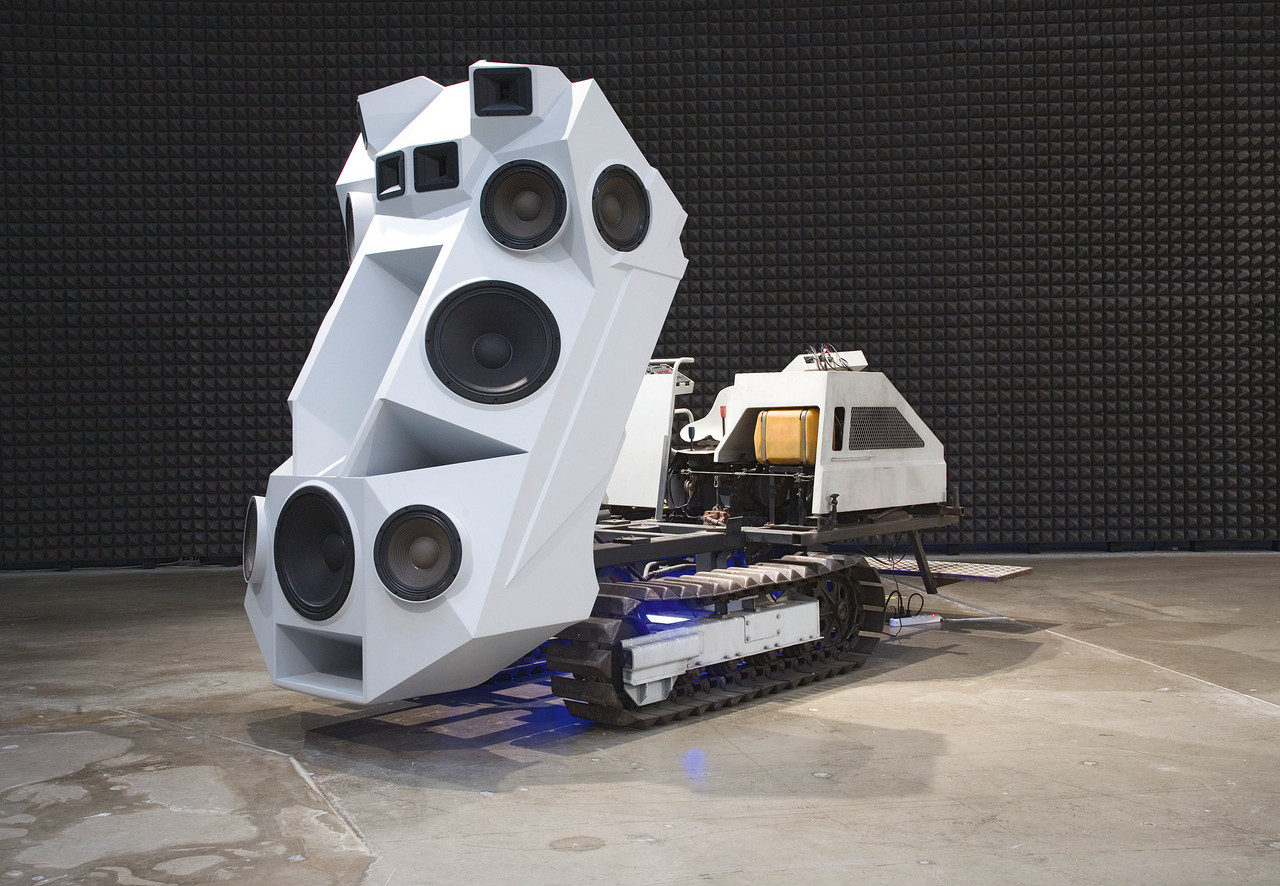
HL: In both »Panzer« and »Booster 2.13,« acoustic considerations had a direct influence on form. The volumes, which in their sum define the form, are derived from the need to have the loudspeakers project a specific, ideal sound. While one can shape form as much as one likes, artistically speaking, certain volumes evidently had to be retained here for acoustic purposes.
NN: Actually, if the goal had been to generate optimal sound, I’d have had to ditch all formal sculptural criteria and take practical decisions instead. But I endeavour to charge a sound system’s potential by using a form that lends it further associative and thematic dimensions. That in itself is an absurd undertaking, because everything is then concentrated in the object and hence extends from a single point. As a rule, a PA system is set up around the space in which it is to be heard, and directed at the listeners. In my work that situation is reversed: the sound system projects outwards into the surrounding space from the position of a single subject.
I endeavour to charge a sound system’s potential by using a form that lends it further associative and thematic dimensions.
HL: You investigate acoustic terrains as mirrors of socio-political phenomena and respond to them artistically. What is the ratio here between aesthetic and analytical considerations?
NN: I use sound systems to try to approximate acoustic phenomena that are linked to their environment. For example, the use of sound in acoustic warfare is linked in my work with the idea of civilian uses of sound systems, i.e., I set up counterpoints: the latter is associated with personal identity and notions of freedom; the former is primarily concerned with military goals, such as occupation and crowd control. These dual poles converge in a single object. This is contradictory, in functional terms, but it certainly works as sculpture.
HL: Sound may give rise to poetic moments or equally serve as a weapon, since it has an impact on anyone within hearing distance even before one has a chance to reflect on or control it. The same can be said of your musical work, which ranges from electronic music to experiments with subliminal frequencies. But interaction with listeners, respectively viewers, likewise plays a role in your work.
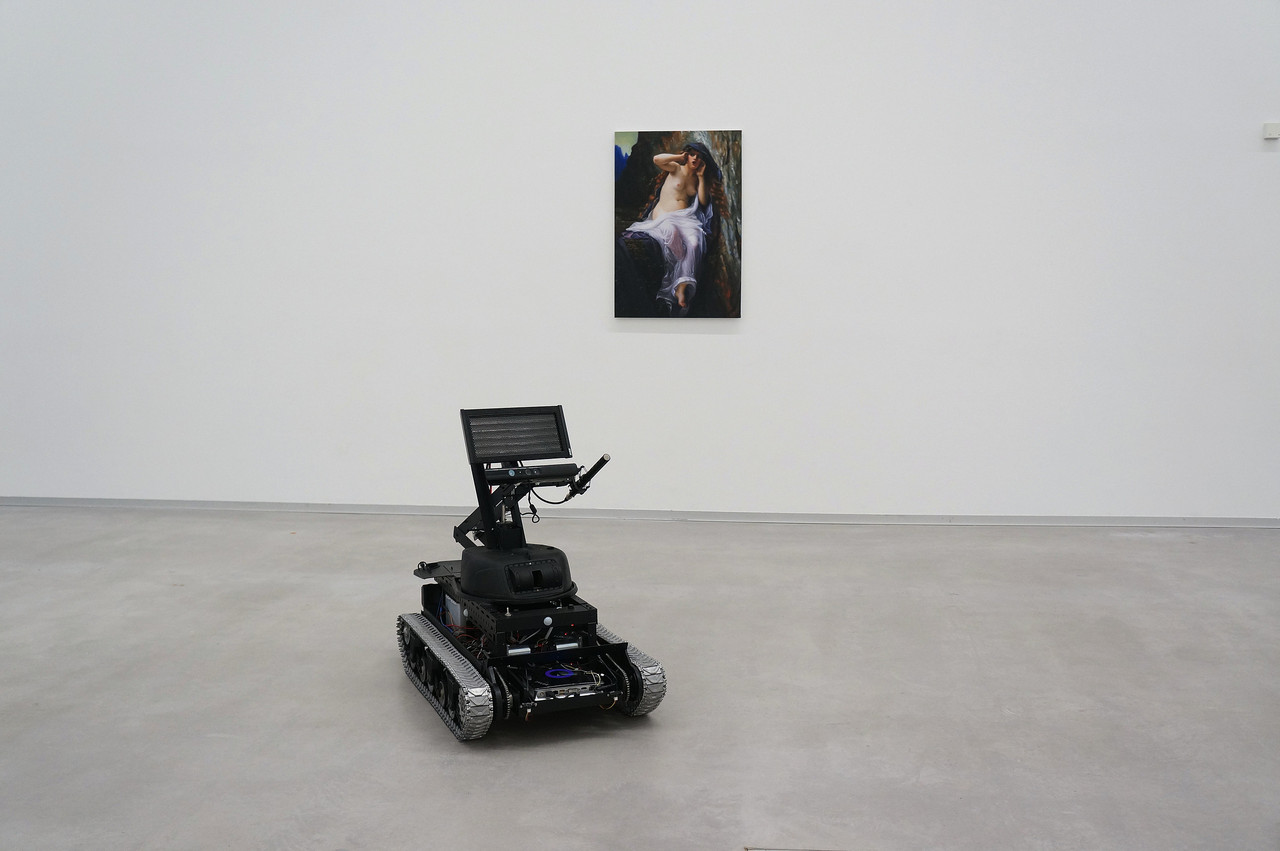
NN: We now operate within the confines of a permanent feedback loop – we’re constantly both receiving and transmitting information. Aren’t social networks just some kind of echo space in which we can present a profile and receive feedback accordingly? Today, thanks to smartphones, we’re generally able to isolate ourselves from social interaction in public space by constantly carrying our own personally configured environment around with us. The work »Echo« (Figure 3) is a reference to this, in a sense. Two UGVs (unmanned ground vehicles) use sensors to register the presence of exhibition visitors and then enclose them within an extremely directive echo. Whilst an echo usually unfolds in open space, in this case it is directional and therefore audible only for the exhibition visitors currently targeted by the echo drone. Here, feedback from one’s own presence becomes a dilemma and constitutes the surrounding space anew.
HL: In addition to technically complex installations such as »Echo,« you make »Mobile Boosters« that are strongly reminiscent of redneck culture, such as pimped-up motors, boom cars, and unnecessarily large gardening tools.
NN: [laughs] The »Boosters« are another example of the mimicry strategy – but my intention is not to seize or to occupy space. What I do, actually, is create means with which to keep exactly those sorts of practices at bay. I’m primarily interested in sound, respectively in using sound to effect the transformation of space and perceptions of space. In my work I explore different possible methods of doing so.
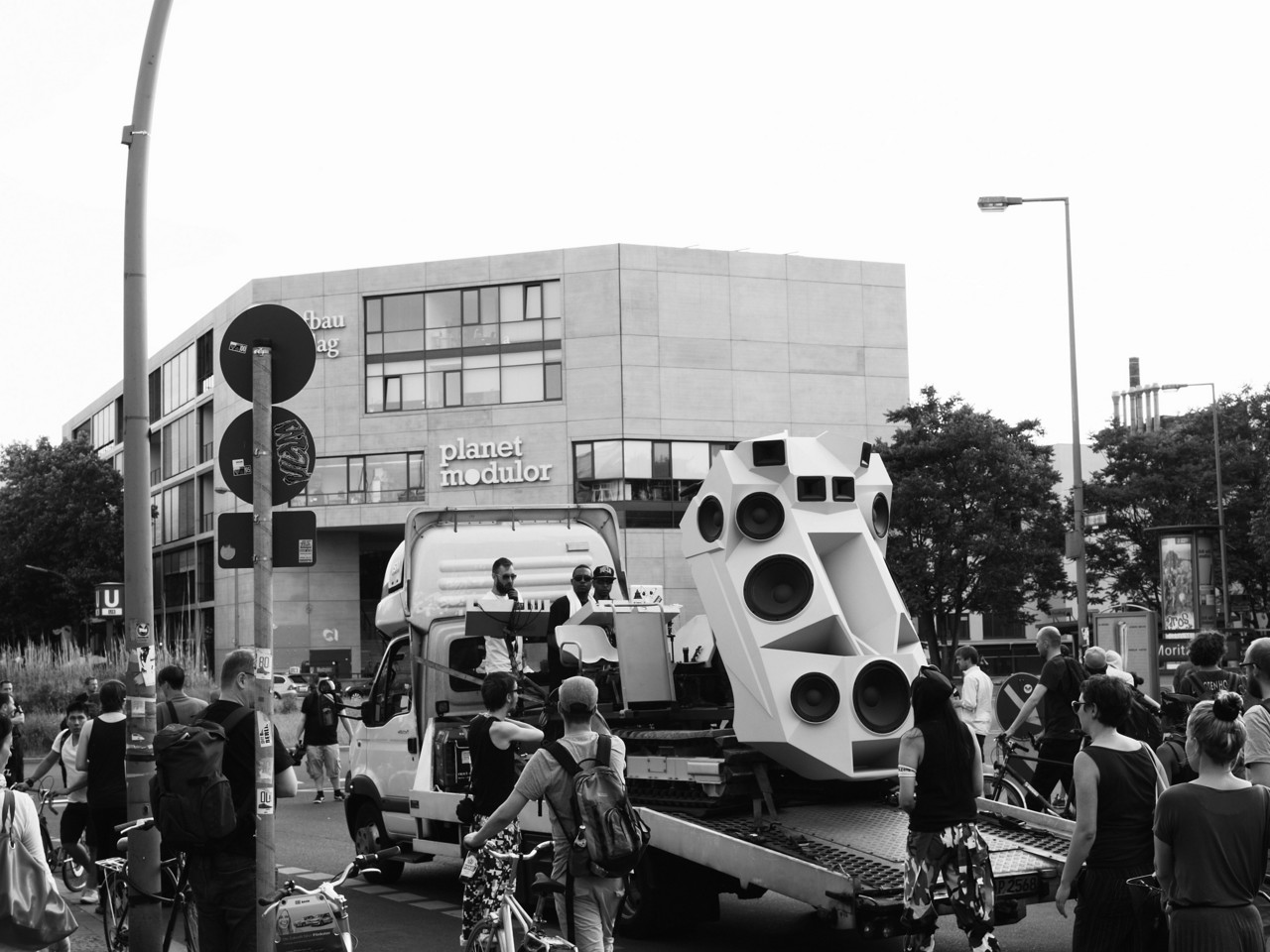
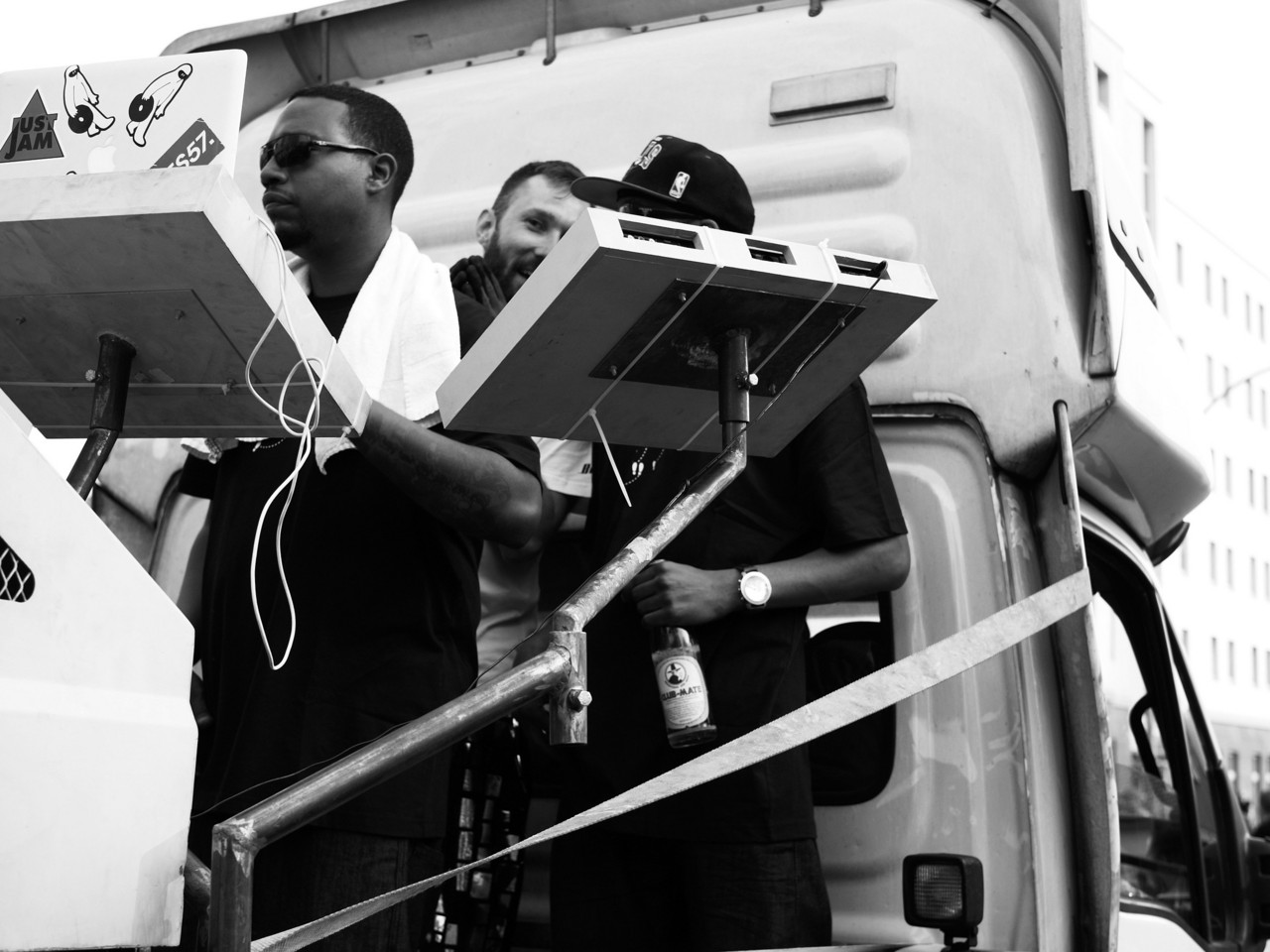
Born in Mainz and based in Berlin, Nik Nowak creates sculptural objects that serve as sound systems and vehicles for engaging the public in electronic music. He is a graduate of the University of Fine Arts in Berlin, and has exhibited his work throughout Germany and Europe.
Heimo Lattner is a Berlin-based visual and sound artist who explores locality and social identity through films, radio plays, installations, and texts. He studied at the Akademie der Bildenden Künste, Vienna and the Whitney Program in New York. His work has been widely exhibited throughout Europe and the US.
This text was originally published in CTM Magazine 2015 – Un Tune.