Ahmedabad located on the western edge of India encapsulates a unique and exploratory avant-garde history as a testing ground for the nation’s cultural expansion after the collapse of British imperial rule. A city rooted in the connections of Modernism’s complex and intersecting origins, where stone walled domains of mediaeval architecture are punctuated by radical 20th century utopian designs. Unlike the flagship status afforded to Chandigarh, Le Corbusier’s master-planned administrative centre in Northern India, Ahmedabad emerged instead as a vibrant crucible of numerous applied radical artistic, spiritual, and industrial objectives. An urban mass where the ancient and modern merged and the cultural vision for a new India was born. Located within these progressive surroundings, I had read an intriguing account of a Moog synthesiser being brought to the city in the 1960s as part of the education programme at the National Institute of Design, and the story of the instrument triggered my own visit to Ahmedabad in autumn 2017 on a personal journey to track it down.
The National Institute of Design, a school founded in the early 1960s under the guidance of the Sarabhai family of textiles patrons, became a vital component within the city’s cultural ecosystem. Developed to train a new wave of designers and thinkers for a recently independent India, it cultivated a unique pedagogy hybridising the philosophies of the Bauhaus and Ulm schools with the holistic eco-conscious praxis of Rabindranath Tagore's revolutionary 19th century school Shantiniketan and the »learning through doing« principles of Mahatma Gandhi’s ashram located nearby in Ahmedabad. The focus was placed on a holistic ethos of design and the designer as a creative and spiritual being, working in harmony with both industry and nature, and viewing the world through a prism of resourcefulness and artistically liberated thought.
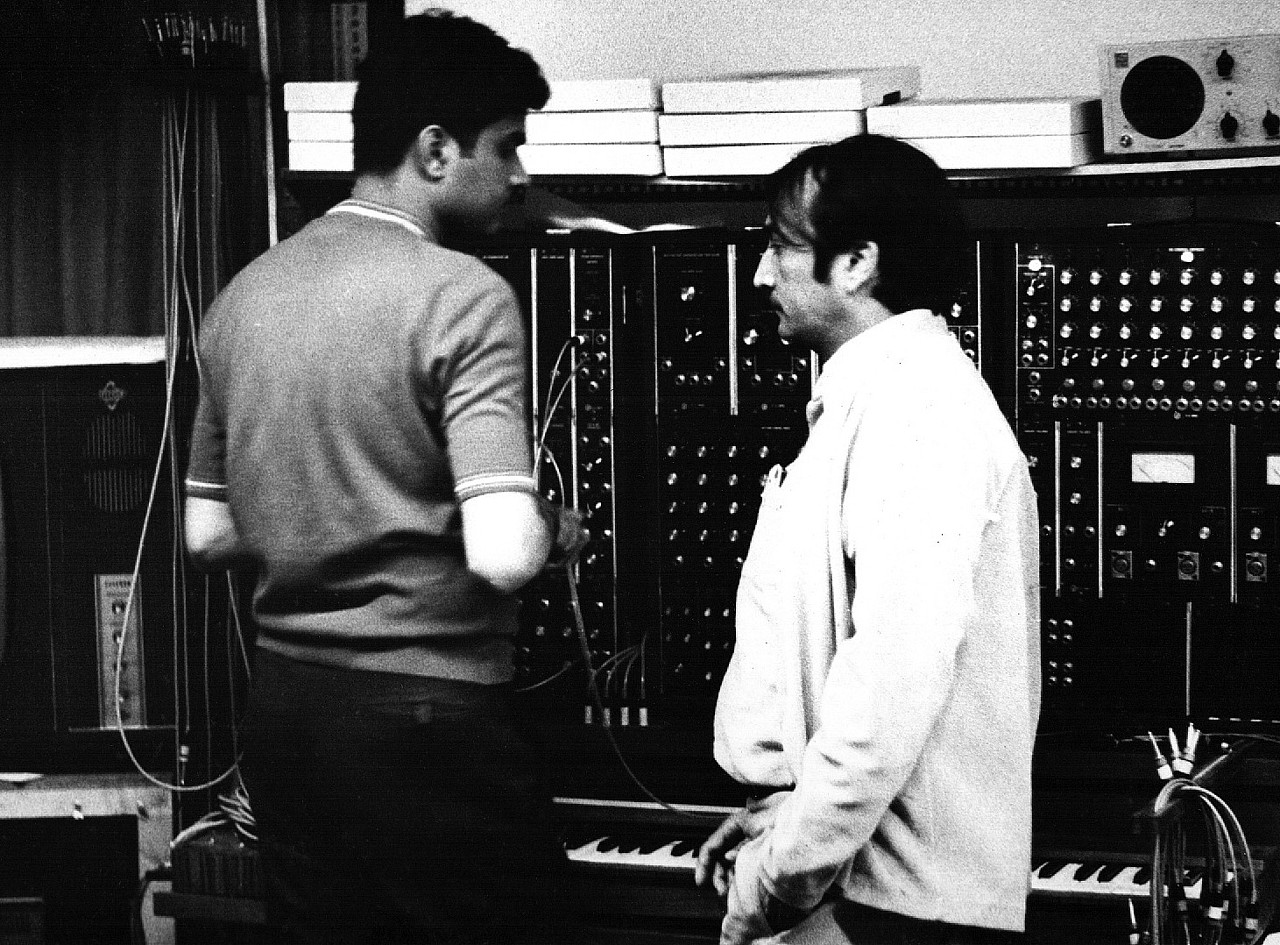
The Moog was brought to Ahmedabad by the New York composer David Tudor who was invited by the Sarabhai family to initiate what would become India’s first electronic music studio.
The school fore-fronted cross-disciplinary practice bringing together ceramics, furniture design, weaving, animation, and textiles as part of its encompassing pedagogic vision. It was within this frame that in the autumn of 1969 the NID branched out to incorporate a Moog modular synthesiser into this programme with the ambitions of locating electronic sound within a project of post-colonial industrial development. The Moog was brought to Ahmedabad by the New York composer David Tudor who was invited by the Sarabhai family to initiate what would become India’s first electronic music studio. A place where utopian design and exploratory sonics would align with the expanding global dawn of electronic sound.
I first heard about the Moog in a tweet around 2015 referencing an online article by the writer Alexander Keefe, who had gone in search of the synthesiser as a side road whilst conducting research into the history of film and animation at NID. The story was one that immediately spoke to me, fusing together the narratives of post-Independence South Asian art and design with the industrial and post-war conceptual ambitions of the arts in Europe and America. I had been keenly interested in the late 1960s history of the Artist Placement Group in the UK founded by John Latham and Barbara Steveni and likewise the work of the US-based Experiments in Art & Technology (E.A.T.), the cross-disciplinary art and technology collective founded by Billy Klüver and Robert Rauschenberg around the same time. E.A.T. was renowned for the »9 Evenings« programme of experimental theatre performances hosted at The Armory in New York in 1966 that brought together the likes of John Cage, Yvonne Rainer, Deborah Hay, and David Tudor for a series of groundbreaking hybrid multimedia events. The realisation that Tudor had around this time undertaken a personal mission to bring a Moog modular system to India was mysteriously intriguing, and given the context of a design school working within the dawn of India’s independence, the story had a compelling allure. All of these curious threads brought me to Ahmedabad in the autumn of 2017 on my own personal mission to find Tudor’s lost synthesiser.
Prior to setting off I made contact with the Moog Soundlab based in Surrey and after looking into the schematics of the system from the only known photograph, they discovered it was a custom unit devised by the company’s founder Bob Moog specifically for India. Given the uniqueness of the instrument and its cultural value in Moog’s history they offered support for its potential restoration if it could be found. The intention would be to locate the instrument, presumably in a storeroom of the NID, and then hopefully evaluate it and service it, restoring it as a museological item that possibly stood to be India’s first ever modular synthesiser. With this plan in mind, in September 2017 after a brief stay in Delhi I arrived in Ahmedabad with my mission set out in front of me.
I was immediately struck by the city’s unique character. It’s historic mediaeval vernacular architecture interspersed with radical Modernist designs by Louis Khan, B.V. Doshi, and Le Corbusier. It had an aura unlike any place I had encountered, a resonant convergence between the ancient and modern. The NID campus itself was an exceptional design, a school elevated on concrete stilts, centred around an anchoring giant tree punctuating the heart of its gridded concrete form. A format that reiterated the holistic qualities of Indian Modernism, through the consideration of nature and the environment as the central axis of a harmonic design philosophy.
It was amongst these progressive dream-like surroundings that my enquiries into the Moog began, and I started asking staff and faculty members at the NID, most of whom seemed totally unaware of this esoteric thread of the Institute's history. However as I made contact with some senior alumni who were aware of the story, I began to be met with a growing sense of suspicion. Who was I? Where had I come from? What did I want with the Moog? I sensed that perhaps I wasn’t the first person that had walked this path, and as the tone shifted it became clearer that the journey was going to be a little bumpier than I had first anticipated. It was certainly beneficial that I had been in contact with Moog in advance and had a mandate of sorts to inspect the instrument and propose a possible plan for its restoration. This seemed to gain me some degree of respectability, and after a frosty and inquisitive meeting with a senior faculty member it was suggested that in a few days I would be allowed to have a face to face meeting with the Moog’s current owner.
As this unfurled it became evident that the Moog’s timeline very much mapped onto the arc of the NID’s own history, from its avant-garde origins to an eventual transition to what one might consider to be a more conventionally prosaic design school. This shift began in the early 1970s as the Sarabhai family who founded the Institute and orchestrated the Moog’s acquisition were forced out and unceremoniously replaced with a new director by the name of Soman, a retired Naval admiral that looked to dismantle the experimental roots of the school and restructure it into something more regimented and practical whilst even integrating some of the compulsory exercise regimes of a military academy. It was around this time that the Moog, a previously more open resource, began to be placed under lock and key, considered a symbol of the Institute’s previous extravagances under the Sarabhai’s tenure. It became evident hearing the various voices at the NID that the political landscape was polarised, between the younger contingent that saw the Institute’s current trajectory as a modern practical vision of the applied arts, and the older generation that held a deep affinity for the freethinking vision of the Sarabhai’s founding ethos that favoured holistic learning and a spiritual underpinning to design.
The Moog’s owner fondly described late night sessions with student friends making music on the synthesiser and being lost within a dreamlike twilight haze of electronic sounds.
With this circulating I went to meet with the Moog’s owner in a suburban tea room. He was a former student at the NID in the 1970s who went on to practise and teach graphic design at the school. He definitely fell into the latter political camp in terms of his view of the Institute, and he fondly described late night sessions with student friends making music on the synthesiser and being lost within a dreamlike twilight haze of electronic sounds. I presumed that he had somehow charmed or convinced the powers that be to open the Moog back up to use later in the 1970s and he seemed truly passionate about the instruments intricacies and sonic potential. This affinity with the Moog was what I believe ultimately allowed the instrument to be saved, when according to his account in the 1980s the NID whilst looking to modernise had planned to throw the synthesiser out as a piece of obsolete junk. A phone call from a senior faculty member had notified him of this and the instrument was transacted instead into his ownership, for an undisclosed nominal sum. He was a vibrant and bullish conversationalist, qualities that I learnt later had earned him a divisive reputation as a beloved straight talker and firebrand, and he told his story with a colourful conviction.
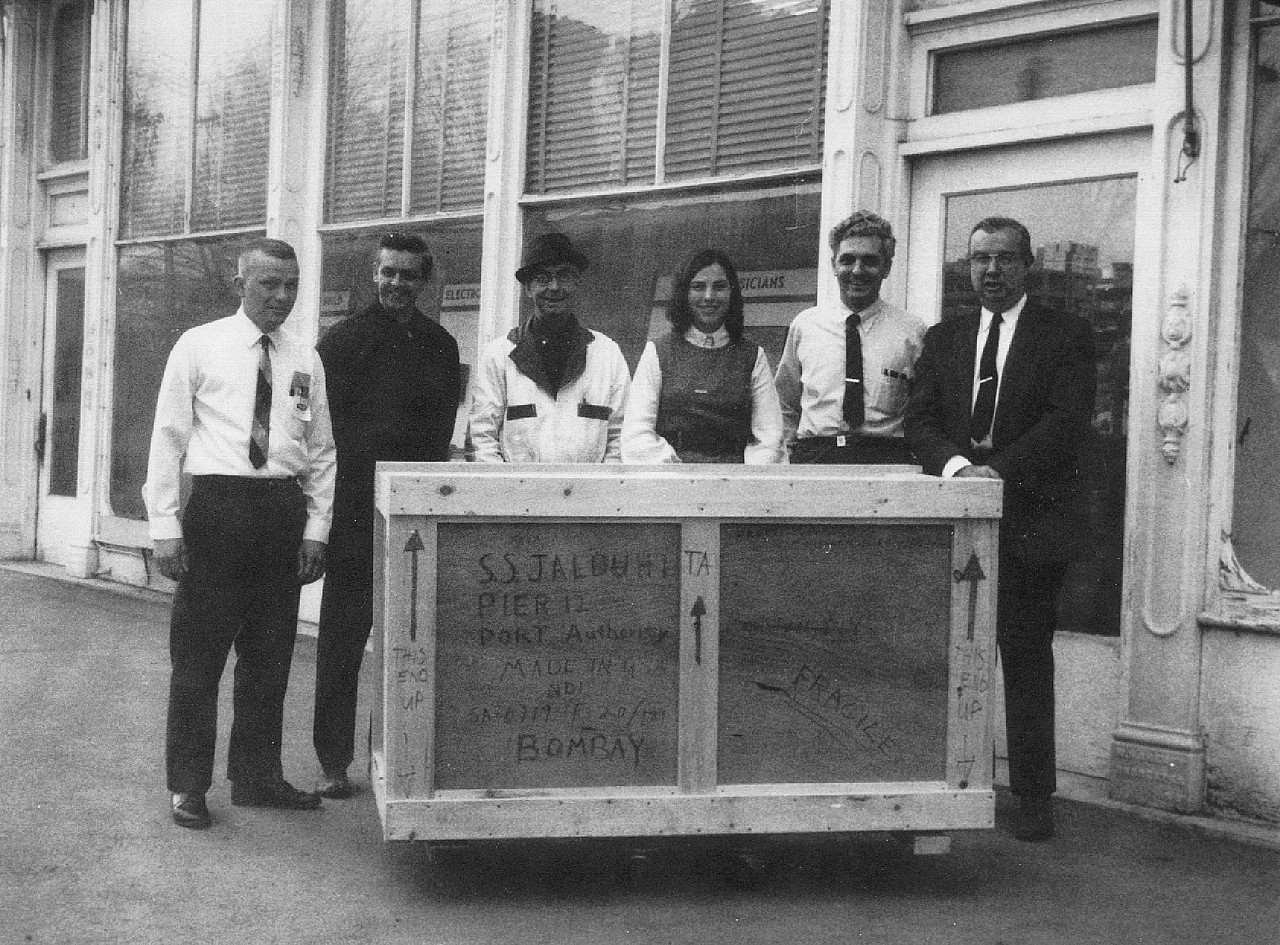
I outlined my feedback from Moog and their interest in restoring the synthesiser, and that I would like to see it. This was the moment when the exchange became more convoluted and strained. He insisted that the Moog was safe and still in working condition. It now resided in the basement of a home for stray cats and dogs near the airport that he was running to care for these injured and homeless animals. The Moog itself had become a home for termites, but despite this infestation he was adamant it was still in full working order. He refused access for me to view it, as he claimed the animals were too sensitive to outsiders and it would be disruptive at such short notice. However he suggested that we should stay in contact and once various complexities in his life were resolved that he would eventually find time to photograph the units and send detailed images to be reviewed by Moog. He apologised that I could not see it but these were his conditions. The vagueness of his proposal was apparent but my options were limited, and so I left the meeting confused and disappointed that I had come so far and so close and yet the object of my journey was to remain out of reach.
Indian science-fiction inspired synthesiser compositions, field recordings from rural Gujarat, spoken word and phonetic experiments, and fascinating sonic collages revealed how the Moog inspired a musical vision that fused Western sonics with the unique structures of South Asian classical music.
The postscript of this meeting was predictable in hindsight – as I emailed to follow up he initially sent images of the serial number plates on the synthesiser boxes but soon became irate at any further mention of the instrument. He insisted it required no restorative intervention from Moog or any other party and my very contact was drawing his psychic energies away from his vital work at his animal sanctuary. I couldn’t argue with his commitment to nature, it was a quest with unquestionable virtue, and it eventually transpired that in November 2017 I received my last communication from the Moog’s owner, a literal cease and desist requesting that he never be contacted again. I learnt later that he had passed away not long after this and from there the story of the Moog rests, its whereabouts unknown.
I had travelled so far that his refusal to view the instrument was definitely a blow, essentially a polite slamming of the door that left me now lost and adrift in Ahmedabad. The object I sought was definitively not going to be revealed and so in a state of despondence I decided to visit the library of the NID to see if at least I could find some more information about the story before leaving. The senior librarian seemingly knew nothing of David Tudor’s visit and the synthesiser. The archives were still referenced from aged notebooks dating back to the 1960s, and it was whilst flicking through one of these that I came across a handwritten footnote marked from many decades before. It simply read »tapes for David.« I requested the librarian find the box this referenced, and after some time a collection of reel to reel tapes were taken out of the cupboards and placed on the table in front of me.
Unpacking it instantly revealed three reels of tape compositions by David Tudor, as well as numerous recording sessions dated from 1969–1972 from five unknown Indian electronic composers: Jinraj Joshipura, S.C. Sharma, Atul Desai, Gita Sarabhai, and I.S. Mathur. These composers evidently worked at what became clear to be a fully functioning electronic music studio at the NID, which had continued producing work for several years after Tudor’s departure in late 1969. The tapes immediately plotted the story of an alternative and completely unknown branch of electronic music’s sprawling family tree. The librarian invited me to play one of the tapes on a weathered Revox B77 tape machine. It looked functional at first glance but after touching one of its large dials I received a sobering electric shock, which immediately put me into the more measured and appropriate mindset of a conservationist. Consequently I chose instead to photograph the tapes and then packed them back neatly into the cupboard they came from and returned to London committed to learning the skills to handle the reels with the material care they necessitated.
It was just over a year later in November 2018 that I returned to Ahmedabad, now almost 50 years on from the Moog’s initial arrival in the city. I had spent some of that time liaising with the synthesiser's elusive custodian in the exchange that had been ultimately doomed, but alongside this I had made contact with the sound department of the British Library, who had generously given me access to their in-house conservation guidelines for analogue tape. I learnt about procedures for baking, a requirement for certain aged tape stocks to literally be cooked to prevent disintegration, as well as the best methods for restoring damaged joins and splices. Most importantly I had tracked down a vintage stereo TEAC reel to reel tape machine from a supportive analogue enthusiast in Northern England that would be able to function as my reliable workhorse for the project.
I arrived at the NID library with a small compact oven and the TEAC tape machine, finally intent on digitising the tape archive and getting a chance to hear for the first time these mysterious transmissions from the past. What I heard did not disappoint: Indian science-fiction inspired synthesiser compositions, field recordings from rural Gujarat, electronic improvisations inspired by ancient Indian rhythmic Talas, spoken word and phonetic experiments, and fascinating sonic collages revealing how the Moog inspired a musical vision that fused the avant-garde practices of Western sonics with the unique structures of South Asian classical music. The archive exposed an unknown map of electronic music’s seemingly first interventions into the subcontinent, and an insight into the minds that had shaped these untamed mystic sonics.
Today the precise whereabouts of the Moog still remain unknown, though more recently through a network of connections in the city I have a sense of where it might be and who its current owner is. Its future feels stable for now and perhaps eventually it might find its place into a public context or collection, maybe when India might acquire resources to create a relevant museum or institution. I find peace in the knowledge that these vital recordings have now been captured for future generations. Regardless of the Moog’s future, its voice has been preserved and the pioneering spirit it channelled through the tapes has been saved, revealing an unheard history of India’s post-colonial sonic-imaginary. An echo of the sound of independence.
Paul Purgas is a London-based artist and musician working with sound, performan- ce, and installation originally trained as an architect, and is one-half of the electronic duo Emptyset.
This text was commissioned as part of CTM 2023 – Portals.