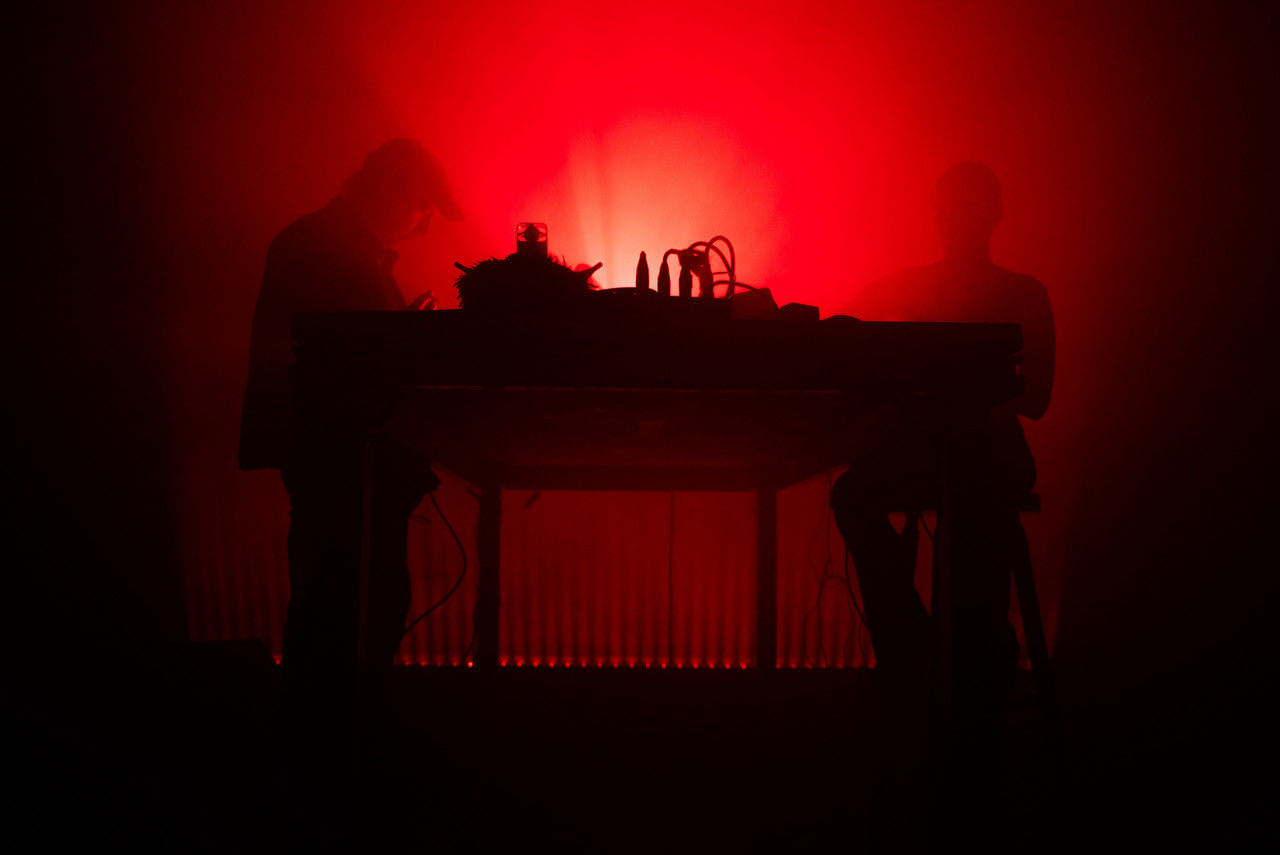
Using seismic data recorded during missile strikes and explosions in regions such as Kharkiv and Kherson, recordings from the moment of the destruction of the Kakhovka dam, environmental phenomena such as earthquakes in Chernihiv and Poltava regions, as well as daily baseline readings from Poltava, they translate this violence into vibration and sound — layering inaudible yet physically impactful low-frequency waves, sonic winds and frequency pools, dense drones, voice, and high frequency textures. Mark works with the architecture of the building, treating the building’s structure as a resonating instrument, while Khrystyna uses her voice with a throat mic and audified seismic recordings to create a vibrasonic experience of being engulfed by the earth.
Their performance, »The Core,« unfolds as a journey through five acts, descending from the surface into the depths of the ground. Each act, or layer, evokes not just geological shifts, but emotional ones — asking us to listen with our bodies to the imprints of violence that infuse the soil.
The performance aims to create a collective experience of embodied listening. Sound resonates through walls, through bodies, through memory. The artists explore how violence reverberates beyond what is seen or reported, and how listening to its traces offers a way to reconnect to the fundamental entanglements and dependencies between humans and nature, including the living soil beneath us. This work is about destruction. But rather than hardening in response to trauma, it invites an honest confrontation — a shared space to witness, reflect, and face what is often ignored or denied. It asks: what does the land feel — and can we learn to feel with it? Their performance at CTM will be enhanced by special lighting from Kyiv artist zeroday.
Commissioned and co-produced by ∄ and CTM Festival with support from Goethe-Institut’s Co-production Fund.
This work is further supported within the framework of CTM’s Radio Lab with Deutschlandfunk Kultur, ORF, and tekhnē. tekhnē is co-funded by the European Union. Views and opinions expressed are however those of the author(s) only and do not necessarily reflect those of the European Union or the European Education and Culture Executive Agency (EACEA). Neither the European Union nor EACEA can be held responsible for them.